10/10 Anniversary: Bitcoin and Ethereum Liquidity Recoupment, Altcoin Bloodletting Continues Deeply
10/10 Anniversary: Bitcoin and Ethereum Liquidity Recoupment, Altcoin Bloodletting Continues Deeply


- The order book depth for Bitcoin and Ethereum has increased significantly compared to the crash day as well as early 2025 and early 2026, with dollar-denominated depth growth reflecting deeper capital deployment by market makers, not merely cheaper token prices.
- In contrast, altcoin liquidity has moved in the opposite direction: dollar depth has steadily declined since early 2025, a downward trend masked by falling token prices.
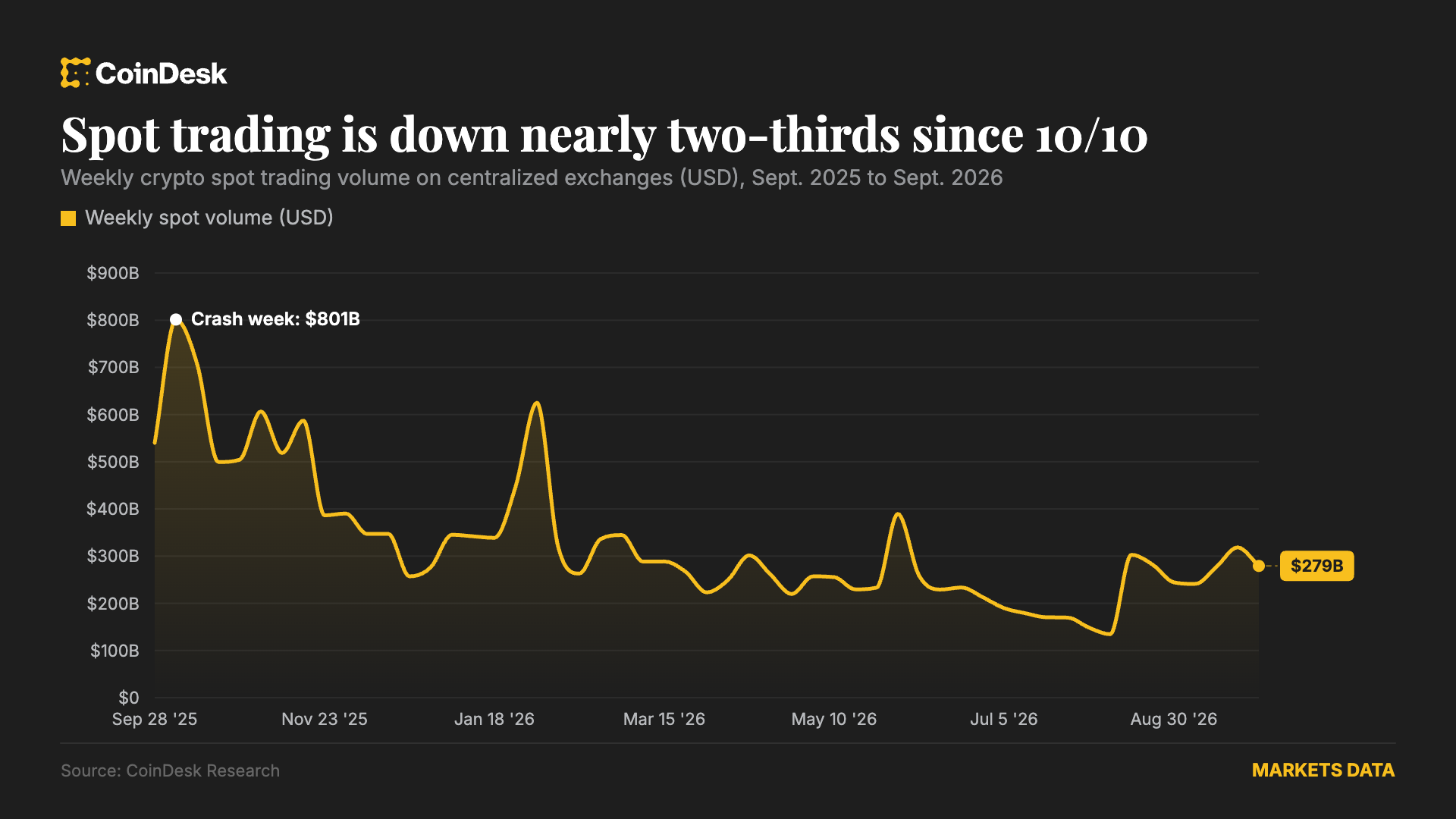
- Weekly spot trading volume has dropped nearly two-thirds from the crash week, despite having roughly doubled from its August low.
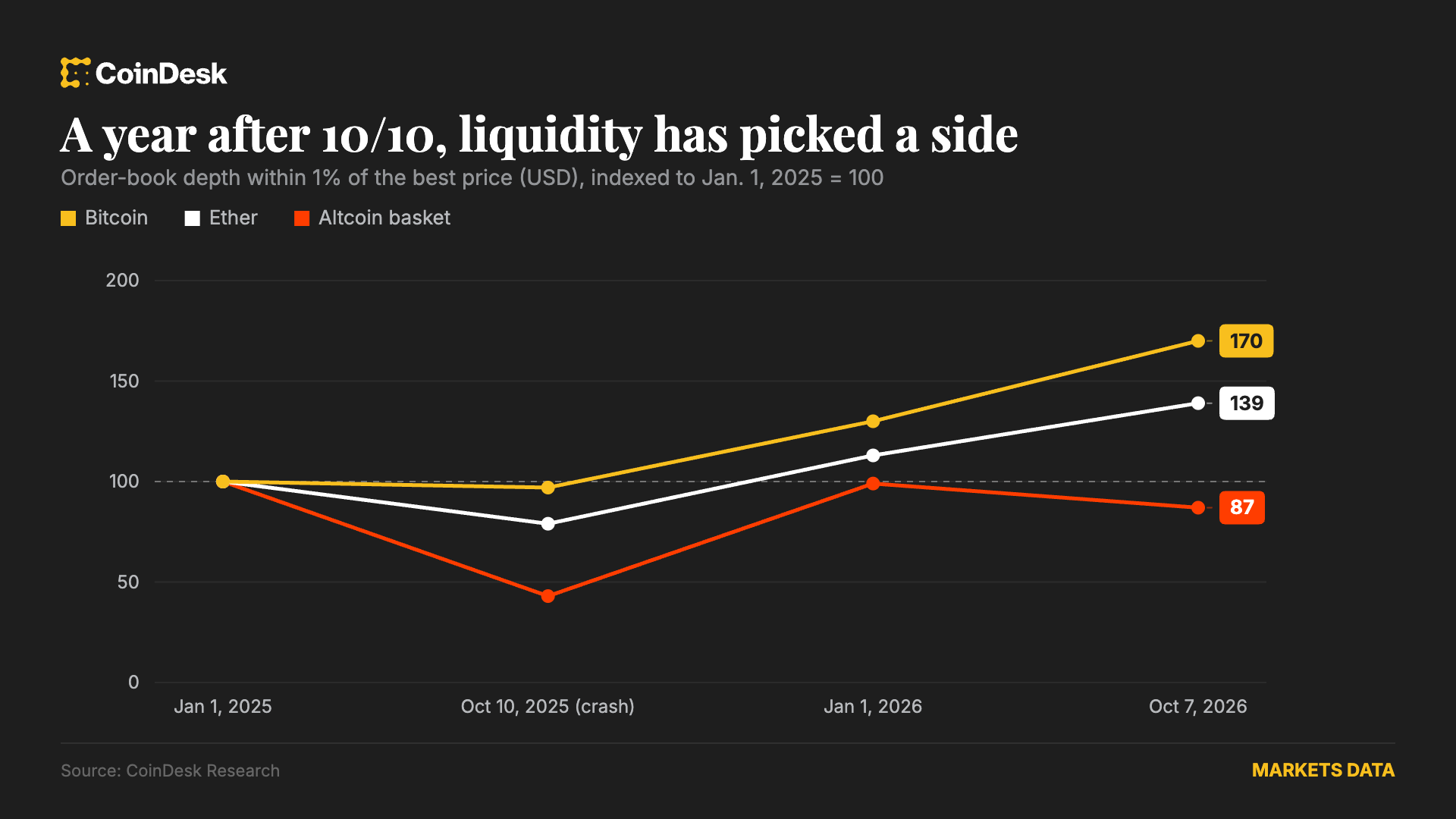
One year after the largest forced liquidation event in crypto history, market "pipeline" dynamics reveal a fragmented narrative. Order book liquidity for Bitcoin and Ethereum now exceeds levels seen on the crash day or at the start of this year; smaller-cap tokens and spot trading have failed to keep pace.
After reaching an all-time high above $126,000, Bitcoin retreated to around $122,600 by early October 10, 2025. Hours later, it breached $105,000—a significant portion of the decline occurred during a thin-trading window on Friday evening in U.S. time, when President Donald Trump announced a 100% tariff on imported Chinese goods. Over $19 billion in leveraged positions were liquidated in a single day.
To assess the recovery, CoinDesk Research compared market depth across four key points on major centralized exchanges: January 1, 2025, October 10, 2025, January 1, 2026, and this week. Depth refers to the value of buy and sell orders near the current price. A deeper order book allows larger trades to be absorbed without materially moving the price.
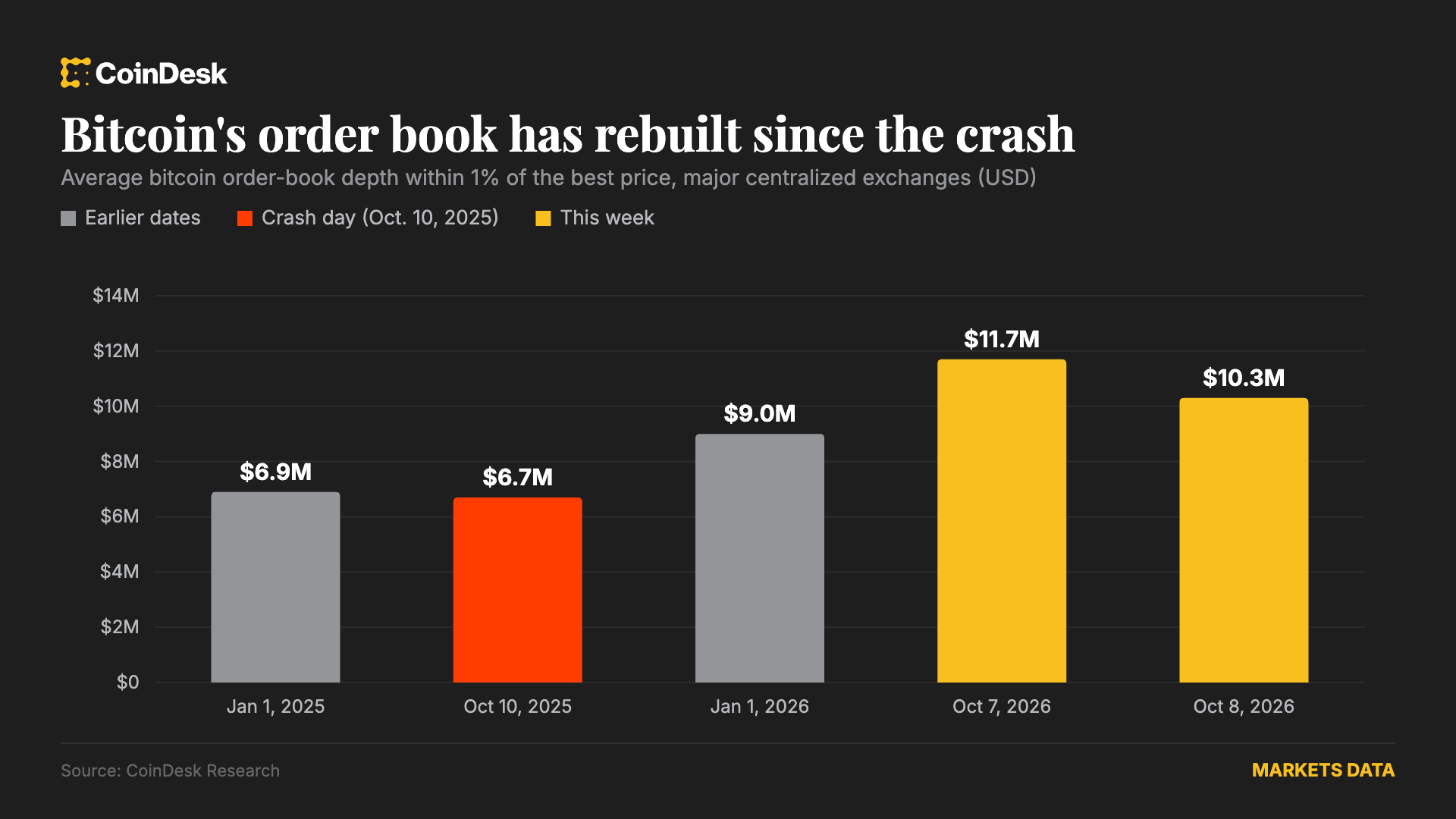
The Bitcoin order book is now deeper than at any of the earlier reference points. On October 7, there was approximately $11.7 million in orders within 1% of the price—up about 75% compared to the crash day a year prior, and higher than the ~$9 million seen at the start of this year and ~$6.9 million in early 2025.
This is not a price effect. Bitcoin’s current price is roughly two-thirds of its pre-crash level, so the increased dollar-denominated depth reflects greater capital commitment by market makers, not simply cheaper token availability.
Improvement is concentrated closest to the price—the most active quoting zone for market makers. Further out, at 5% from price, depth is approximately $24 million, returning roughly to the level seen in January 2025.
Ethereum’s recovery is stronger in certain dimensions. Depth within 0.5% of price has more than doubled since the crash day, reaching approximately $4.2 million. At 1%, depth has increased by about three-quarters to ~$5.3 million, surpassing both January 2025 readings.
"The deepening of major coins reflects real capital, not just price effects," said Saksham Diwan, researcher at CoinDesk.
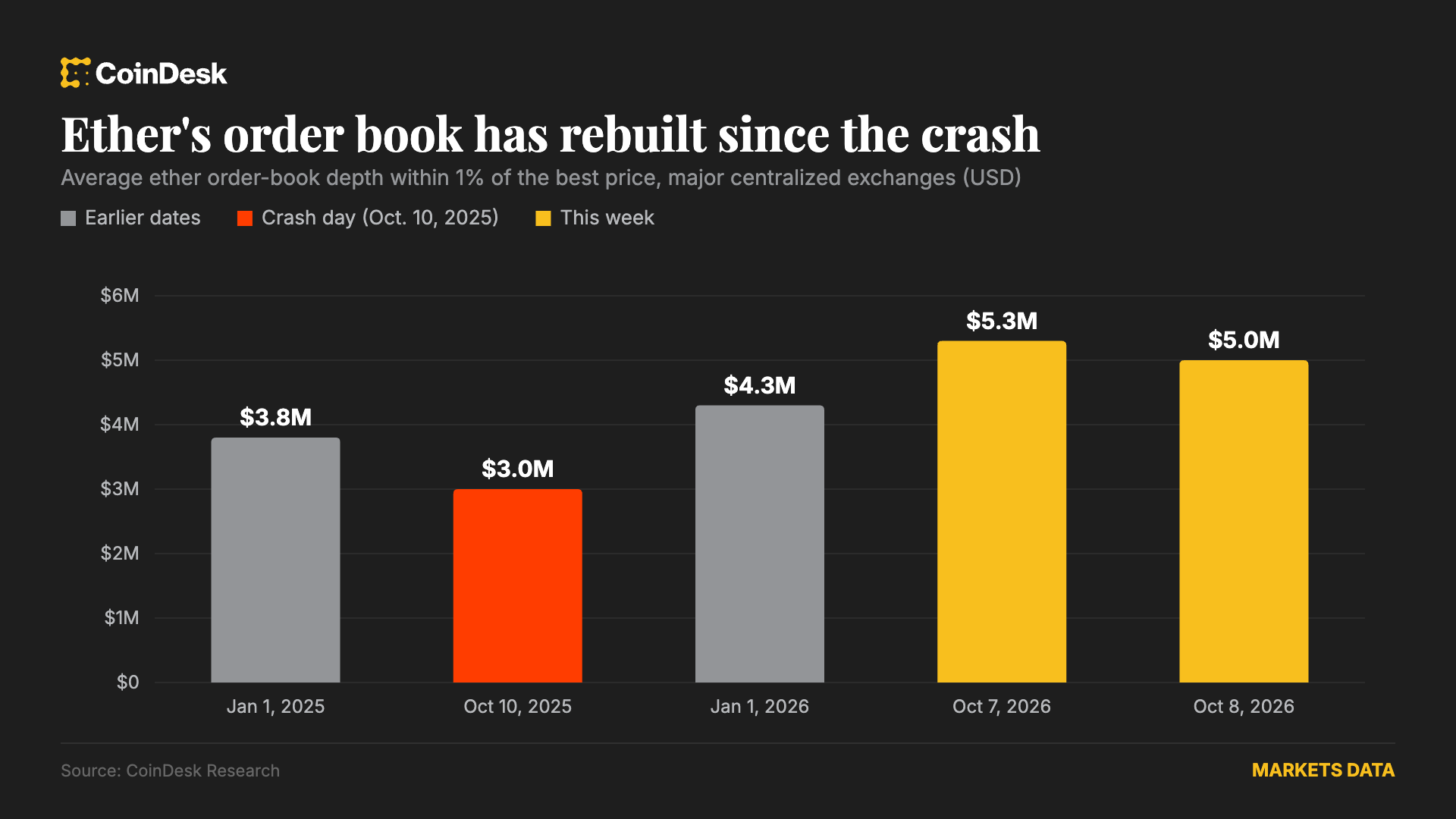
The rebuilt order book faced an early test this week. As markets sold off, Bitcoin’s 1% depth declined by about 12% between October 7 and October 8. Ethereum’s tightest price band slightly thinned, though orders further from price increased.
Altcoins Left Behind
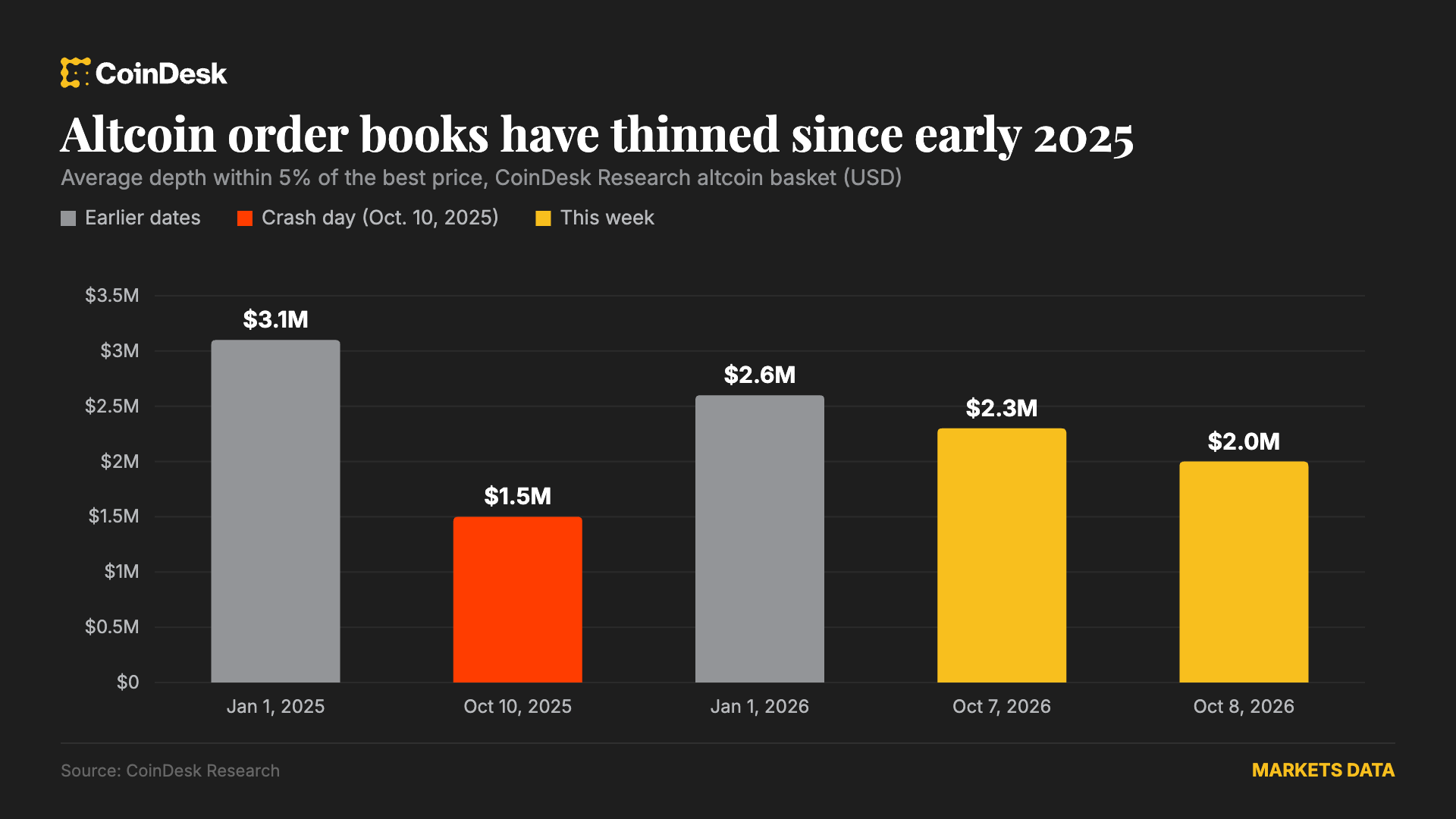
For altcoins, the picture is reversed. In CoinDesk Research’s altcoin basket, dollar depth peaked on January 1, 2025, and has declined at every subsequent measurement point.
Depth at 5% from price has fallen by roughly one-third since early 2025, down to about $2 million. Within 1% of price, depth has declined by about one-sixth.
When measured in token units, altcoin depth appears healthier: it peaked on January 1 and has only moderately retraced. However, analysts note that this “recovery” in token terms primarily stems from price declines, obscuring the ongoing erosion of committed capital.
Spot Trading Continues to Shrink
Spot trading has not recovered. According to CoinDesk Research, average weekly spot volume on centralized exchanges through September 27 was approximately $279 billion—nearly two-thirds lower than the $801 billion recorded during the crash week.
Activity bottomed in August, when weekly volume fell to around $13.5 billion, since which it has doubled. Yet it remains far below pre- and post-crash levels.
What This Means
On October 10, 2025, crypto liquidity evaporated within hours. Where it would go next remained uncertain.
"A year ago, we wrote about thin, fragmented liquidity and uncertainty over where capital would rotate after the dust settled. Now we have an answer: Bitcoin and Ethereum," said Joshua de Vos, Research Director at CoinDesk. "Market makers have returned to major coins, with liquidity now exceeding pre-crash levels, while altcoin liquidity continues to trend downward overall. Aside from a select few, I expect this divergence to persist into next year, as major coins continue to dominate institutional interest and trading volume."
Author: Oliver Knight, Translated by DeepTide TechFlow
Disclaimer: Contains third-party opinions, does not constitute financial advice
3 Years of Profits Relying on Just 15 Days: Market Trend Analysis and Position Building Guide for the Current Crypto Version
13 hours ago
The leading on-chain options protocol DRV hits new highs—what other projects offer interaction opportunities?
15 hours ago
Polls: Trump's approval rating drags down Republicans, 26% of his own supporters call for distancing
16 hours ago
Bitcoin Life Insurance Company Meanwhile Completes $37.5 Million Funding Round Led by Bain Capital Crypto
16 hours agoASML to uniformly increase prices of lithography equipment components for Samsung and SK Hynix by 10%, AI expansion boom driving up equipment costs
17 hours agoA major whale adds to HYPE buy order, with a long position plan during pullback reaching $10.8 million
17 hours ago
SUPRO Finance Launches First USDT Maritime Credit Vault, Early Users Can Achieve Target Annualized Returns of Up to 15%
17 hours ago


