Billions of dollars in cryptocurrency assets are exposed to risk— who will provide coverage?
Billions of dollars in cryptocurrency assets are exposed to risk— who will provide coverage?


The interest in addressing insurance issues within the crypto space has long been insufficient, as evidenced by the industry's typical response to persistent challenges. Insurance is arguably the most critical component of today’s crypto ecosystem, and the sector urgently needs new metrics to demonstrate meaningful progress from its current state.
Consider this: when was the last time the crypto world went two consecutive months without a protocol treasury being hacked? Never.
DeFi protocols and various smart contracts remain vulnerable to attacks, and trust is gradually eroding.
In just the first five months of 2026, over 50 incidents occurred, resulting in losses exceeding $840 million—a 70% increase compared to the same period in 2025. If we extend the timeline to recent events, this figure has now surpassed $2.68 billion.
The problem is clear: existing on-chain financial security infrastructure is weak, leaving users exposed. Yet, hacking incidents themselves are no longer shocking; the industry seems to have normalized them. What truly matters is what happens afterward.
What About Insurance?
On April 18, attackers drained 116,500 rsETH via KelpDAO’s LayerZero bridge—worth approximately $292 million—making it one of the most significant DeFi exploits of the year.
These uncollateralized tokens were deposited into Aave as collateral, generating roughly $190 million in bad debt and triggering contagion.
In response, Aave froze affected markets, causing TVL to drop from over $26 billion to below $14 billion within days. Currently, Aave’s TVL stands at around $18.8 billion, indicating signs of recovery.
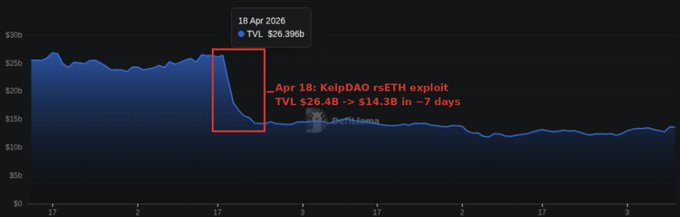
Such attacks ripple across multiple protocols and users; at least nine protocols were impacted in the KelpDAO incident.
Although rsETH has fully recovered, what truly drew attention was the industry’s reaction after the attack.
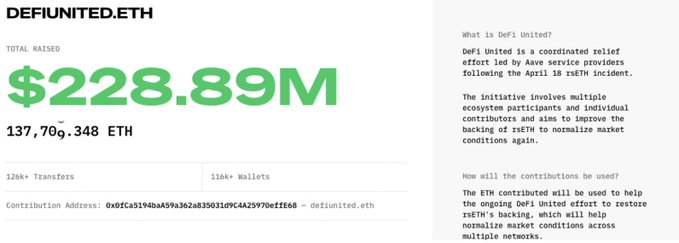
Any traditional finance observer would immediately ask: where is the insurance? And then discover that the response resembled a makeshift fundraising effort: protocols that happened to be closest to the fire banded together—DeFi United, the coordinated rescue initiative launched by Aave service providers following the rsETH event.
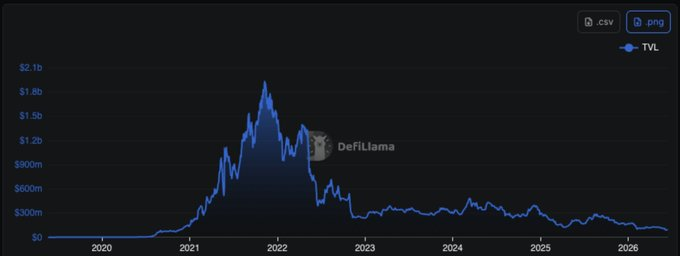
This outcome is unsurprising. The "insurance" sector in crypto has been shrinking for years. Total Value Locked (TVL) in on-chain insurance protocols currently sits at $126 million, down from a historical high of $1.9 billion in November 2021.
One reason for this decline may be that many early on-chain insurance protocols were built as single-cooperative models—one shared fund covering broad risks, with governance, underwriting, claims assessment, and capital management all tightly coupled within a single system.
This structure simplified coordination but also concentrated exposure, turning the protocol itself into a single point of failure.
Capital providers bear losses across the entire portfolio rather than clearly segmented portions, making it difficult to isolate tail events, accurately price exposure, or precisely allocate capital. Once a position blows up, everyone in the pool suffers, regardless of what they originally thought they were insuring.
In response, both established and emerging risk protection protocols are beginning to adopt principles from traditional insurance, reinsurance, and structured finance.
The focus shifts to sharper questions: who bears the first loss? Then, capital is segmented by risk characteristics, with dedicated pools or treasuries created so providers can choose the exact exposure they’re willing to accept.
Protocol Protection Landscape
In traditional insurance, equity layers or specific reinsurance tranches typically absorb initial losses. In early DeFi protection, staked capital providers (underwriters) usually bore the first loss in a shared pool.
But as previously noted, this is changing. Providers now have options to select more conservative base layers or higher-yield, higher-risk tranches—while simultaneously improving overall capital efficiency and capacity.
Below are some notable protocols in this category.
Nexus Mutual
Nexus Mutual remains a veteran in the on-chain protection space, but has evolved into a more granular risk modeling system, enabling tiered coverage provision.
The mechanism allows users to purchase “cover” (protection) for specific protocols, custodians, yield tokens, or depegged assets.
Capital providers stake NXM (or wrapped versions) to underwrite; they earn premiums but bear first-loss exposure. Claims are assessed through member voting or structured processes.
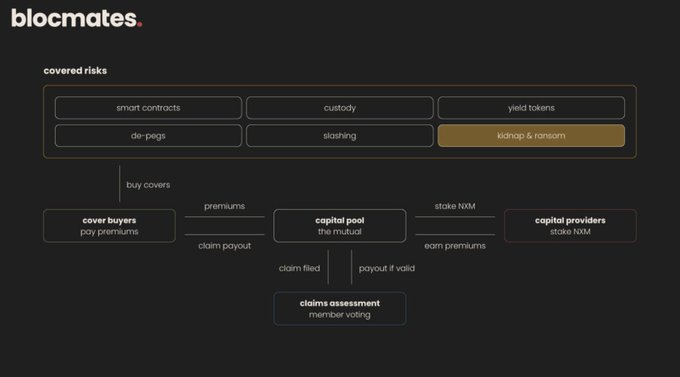
Nexus’s risk products have expanded beyond pure smart contract risk to include custody, slashing, and hybrid offerings such as crypto kidnapping and ransom protection (co-managed with traditional partners for incident response and ransom reimbursement).
Nexus Mutual currently segments capital across more than 70 distinct coverages—not a single pooled fund. Stakers bear first-loss exposure, but diversification and efficiency tools reduce systemic pressure.
Nexus Mutual also partners with distributors like OpenCover to streamline access and packaging of products—for example, the “Base DeFi Pass,” a multi-protocol coverage bundle for Base.
OpenCover
OpenCover acts as a distribution and structuring layer for on-chain insurance, simplifying the path to acquiring coverage across multiple underwriters—currently, most capacity is supplied by Nexus Mutual.
Beyond aggregation, the platform is developing new risk management products atop existing insurance infrastructure.
Its flagship product, Covered Vaults, was launched in collaboration with Nexus Mutual, Morpho, Kiln, and Symbiotic.
Users deposit into supported vaults and can activate coverage by staking vault shares, protecting against specific technical and economic loss events—without deviating from their underlying strategy.
OpenCover’s “Covered Vaults” model moves DeFi insurance from standalone policies toward integrated, portfolio-level risk management.
Firelight Protocol
Another noteworthy protocol comes from the XRP ecosystem—Firelight.
Firelight directly addresses the question of who bears first loss, while advancing capital segmentation and drawing inspiration from traditional insurance and structured finance concepts.
The protocol assigns first-loss responsibility to stakers within the protection treasury. They bear the primary risk, with their capital directly backing valid claims—creating an incentive alignment similar to traditional mutual or pooled underwriting models.
In terms of capital segmentation and specialized structures, Firelight uses dedicated non-custodial vaults and protection pools instead of a single pooled fund.
This enables finer-grained risk exposure and capital allocation. Staked assets—particularly high-cap, low-correlation assets like XRP—are specifically selected to enhance capital efficiency and resilience.
Embedded Protection
A minority of protocols assume underwriting risk directly, while most crypto or DeFi platforms adopt an embedded approach.
These platforms integrate risk controls—such as automatic stop-losses, liquidation buffers, and downside caps—into the core mechanisms of leveraged tokens and yield vaults.
This shifts the burden of first-loss protection from external underwriters to the product architecture itself, allowing users to pursue higher yields while programmatic rules cap tail-end exposure.
Examples
Gearbox Protocol offers credit accounts for leveraged farming and strategies, incorporating liquidation protection and isolated risk layers within each account.
Dolomite provides a money market with structured lending functionality and customizable risk parameters to limit excessive exposure.
Toros Finance delivers leveraged tokens with embedded stop-loss logic and recovery mechanisms, automatically capping losses without requiring manual intervention.
This integration draws from structured finance, embedding protective measures directly into the tooling.
It reduces friction for users seeking protection—eliminating the need to purchase separate policies—and enables protocols to handle product-level risks more efficiently than broad cooperative models.
Conclusion
In reality, the development of on-chain risk protection economics still lags far behind the pace of attacks.
The gap is vast—but these discussions are essential. For on-chain insurance to mature, the industry must move beyond obsession with Total Value Locked (TVL) and instead listen to voices advocating for more meaningful metrics: Total Coverage Value.
Currently, less than 2% of DeFi TVL is explicitly covered. To reignite trust in DeFi, TVC is the metric to watch. The widening gap between locked value and insured value represents a massive opportunity for anyone capable of solving the crypto insurance crisis.
Written by: blocmates, Compiled by: AididiaoJP, Foresight News
Disclaimer: Contains third-party opinions, does not constitute financial advice
Three-week streak of net inflows comes to an end, with Bitcoin spot ETFs recording net outflows of $681 million last week
15 mins ago
Papertrade Unfilled Contract Margin Drops to $6.4 Million, Down Nearly 70% in 24 Hours
24 mins ago
Within less than a day of launch, a wallet drained $1.28 million from Papertrade
1 hour ago
Project Research: After Citrini mentions $DRV, the price surges — is the current chain-based options leader overvalued?
1 day ago
10/10 Anniversary: Bitcoin and Ethereum Liquidity Recoupment, Altcoin Bloodletting Continues Deeply
1 day ago
3 Years of Profits Relying on Just 15 Days: Market Trend Analysis and Position Building Guide for the Current Crypto Version
1 day ago
The leading on-chain options protocol DRV hits new highs—what other projects offer interaction opportunities?
1 day ago


