Mixin Completes $23 Million Redemption: A Three-Year Commitment Journey—What Else Has Been Verified Beyond Trust?
Mixin Completes $23 Million Redemption: A Three-Year Commitment Journey—What Else Has Been Verified Beyond Trust?


Introduction
In the crypto industry, accountability is a rare phenomenon—especially after a cyberattack.
According to CertiK’s《Hack3d: The Web3 Security Report 2023》, over 751 security incidents—including hacking, fraud, and exploit events—occurred across the crypto sector in 2023.
Tracking these attacked projects reveals a harsh reality:
While project teams can issue statements, propose solutions, and make promises within hours of an incident, only a handful truly examine user losses and consistently fulfill redemption commitments.
This is both an attitude issue and an execution capability challenge.
At this point, some may wonder: Why choose data from 2023 specifically?
On one hand, three years is sufficient time for project teams to demonstrate redemption sincerity and deliver tangible results;
On the other hand, a recent project has finally delivered on its promise made three years ago following a historic hack.
On September 23, 2026, Mixin announced full redemption of MDTu representing $23 million USD.
Three years after trust was shattered, a concrete payout gradually re-welds that broken bond—endowing this redemption with significant narrative weight.
Yet, if one merely focuses on the $23 million redemption figure, they might miss the core lesson worth deep analysis.

A Three-Year Redemption Journey
On social platforms, users have begun sharing real experiences of receiving their Mixin MDTu redemptions:
The crypto space still hosts long-term projects.
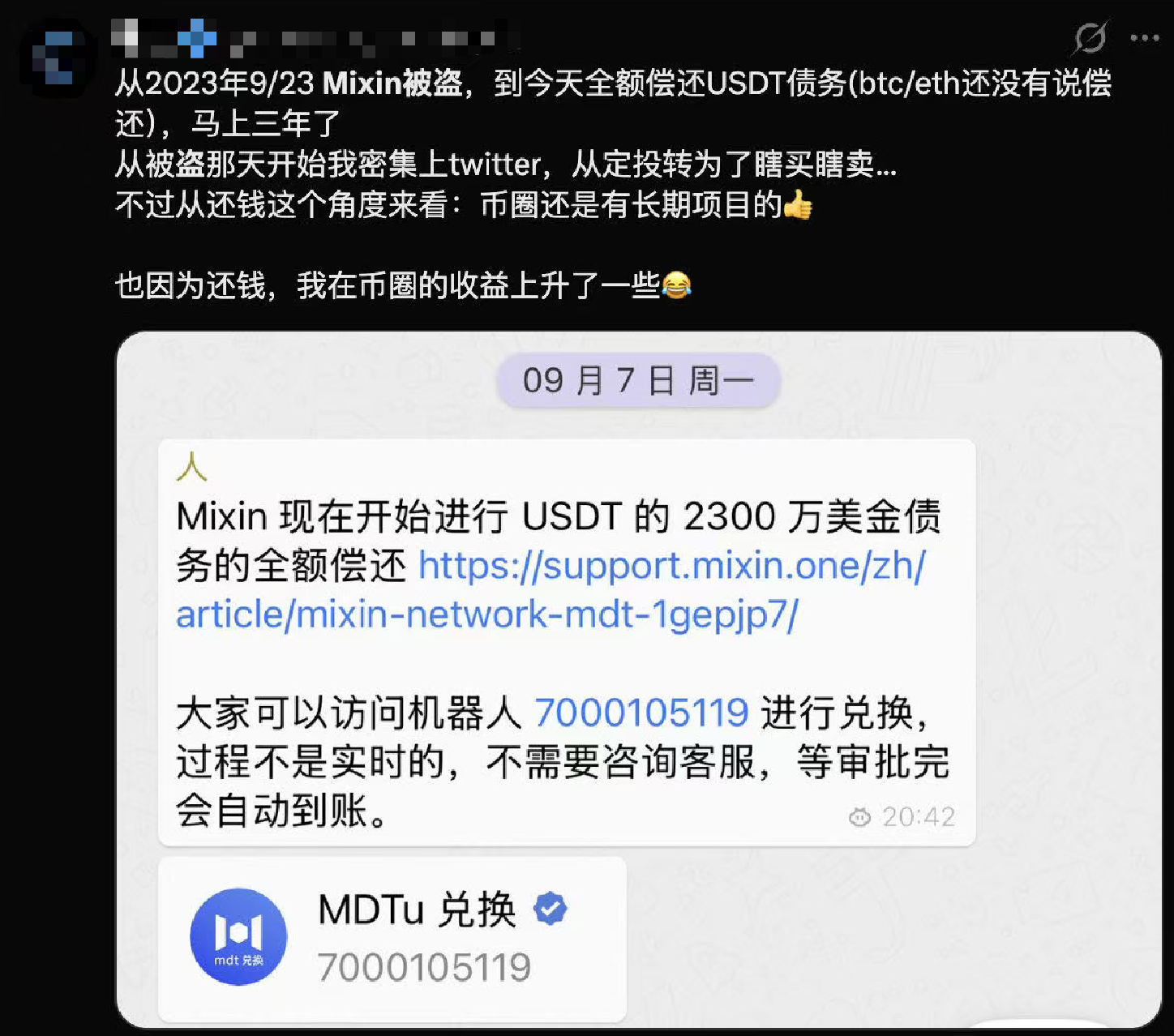
Three years of waiting, culminating in full MDTu redemption.
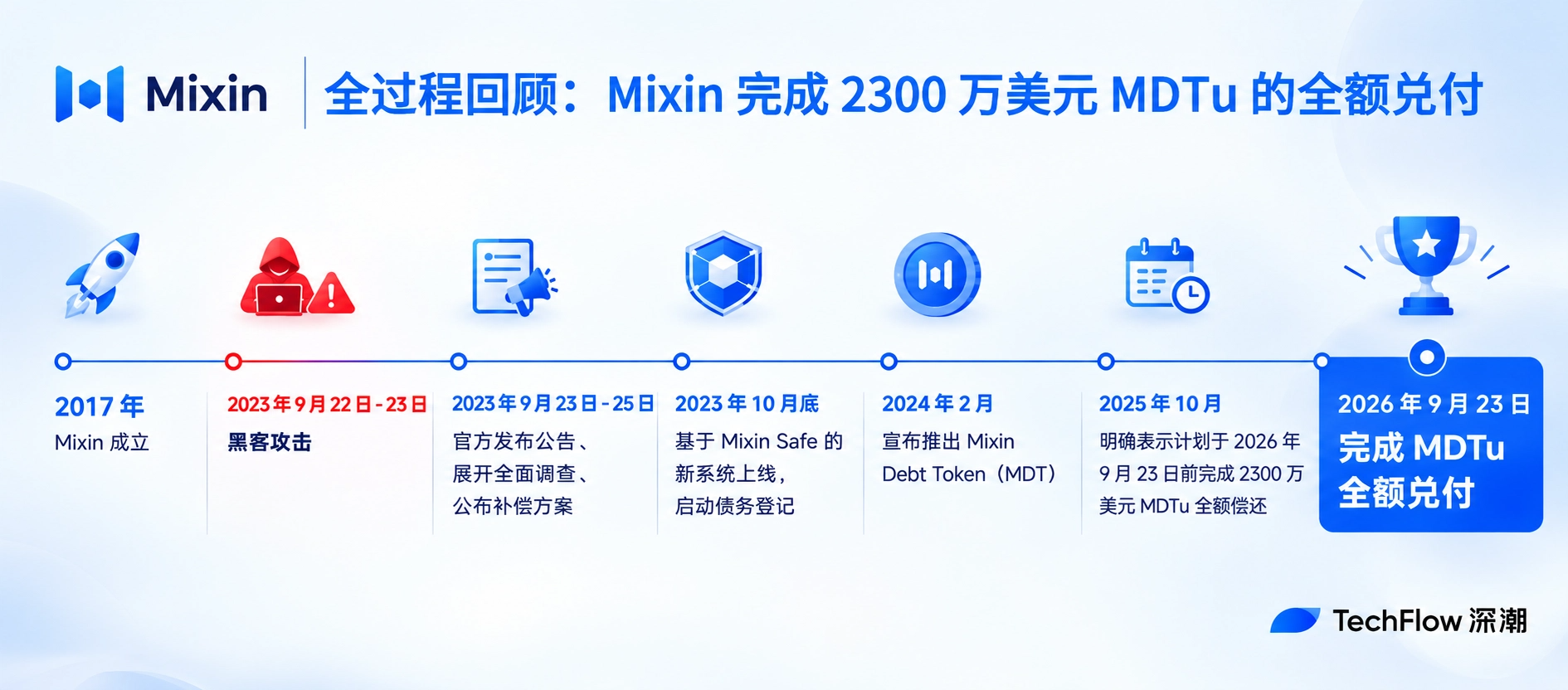
Looking back at this three-year redemption journey, each milestone stands clearly defined—largely due to Mixin’s transparent and principled approach to handling crises:
No evasion—face consequences head-on;
No embellishment—be candid and fact-based;
No ambiguity—explicitly lay out solutions and timelines.
On the evening of September 23, 2023, Mixin detected a cyberattack, suffering major losses in BTC, ETH, USDT, equivalent to approximately $150 million at the time.
Immediately upon detection, besides implementing emergency measures and investigating root causes, Mixin initiated meticulous loss accounting and team solvency assessment.
On September 25, 2023, Mixin announced the issuance of MDT tokens—MDTu, MDTe, and MDTb—representing ERC20-USDT, ETH, and BTC assets respectively—and committed to redeeming users via token buybacks using future operational profits.
Additionally, Mixin pledged that prior to full repayment, if stolen assets were returned by hackers, users could redeem corresponding MDT tokens for their original lost assets.
Embedding such commitments directly into tokenomics reflects not just intent but unwavering resolve.
Naturally, when losses occur, promises must go beyond public announcements.
After all, “speaking” is far easier than “acting.”
Moreover, many projects prior to this had promised redemptions to calm distressed users—but most ultimately fell through. Mixin, having made such a commitment, had to prove its credibility through action.
It wasn’t until September 23, 2026, that Mixin officially confirmed full redemption of $23 million in MDTu.
Choosing to complete redemption exactly three years after the attack, on the same date, appears deliberate: a financial act serving as a closed-loop “trust reconstruction” moment.
But rather than fixating on the outcome of “what was done,” what truly matters is understanding the underlying logic of “why it was possible”:
Three years of sustained operations provided the financial foundation for the $23 million MDTu redemption;
And more fundamentally: why did a project severely damaged by a major security breach avoid dissolution, abandonment, silence, or mere survival—instead maintaining operations for three years and progressively fulfilling its original promises?
The answer lies deeply in Mixin’s initial choice of this “trust economy playbook.”
From Redeeming Existing Trust to Producing Incremental Trust
Mixin’s product strategy offers the most direct explanation.
This “social + capital” vision was further demonstrated this year at Singapore’s TOKEN2049: beyond on-site booths and community engagement, Mixin co-hosted a unique Web3 HUNT After Dark event with BigONE, transforming NFT fragment scavenger hunts into interactive social experiences—participants scanned QR codes to collect, trade, and assemble fragments, unlocking final rewards.

The playful event spurred high user engagement, reinforcing Mixin’s strategic thesis:
When communication, assets, and human collaboration converge in a single environment, the product transcends mere functional access and becomes a nexus for relationship-building and value circulation.
Transactions connect capital between people; social interaction connects emotions. The former enables value flow; the latter fosters relational depth. Their tight integration allows human relationships to carry value transfer.
Thus, since its inception in 2017, Mixin has centered on a “privacy-first encrypted chat + multi-chain wallet” model, aiming to integrate communication, payments, trading, and asset management within one application.
In short, Mixin isn’t just a transaction tool—it’s a tightly woven network of relationships. Users aren’t merely sending funds; they’re chatting, joining groups, collaborating. Asset flows are no longer isolated—they’re embedded in daily life.
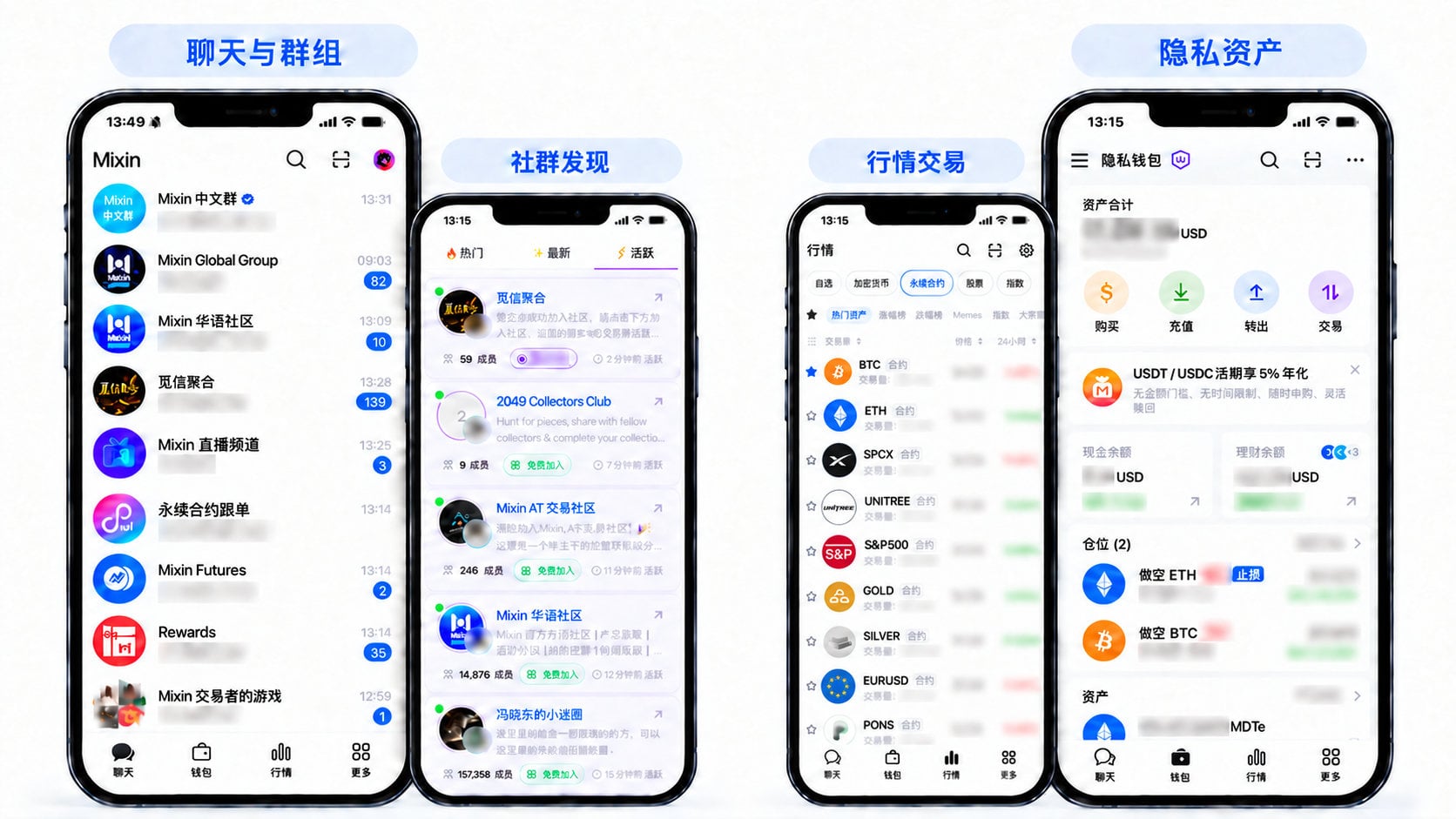
To make this model work, two pillars are essential:
Usability: broadening entry points so users can easily enter the ecosystem through existing relationships;
Safety: laying a solid foundation so users feel secure bringing both capital and social connections into the platform.
Following these two pillars clarifies Mixin’s focus over the past years:
On one hand, adhering to the principle that “if a product needs a manual to use, it’s not finished yet,” the team launched a minimalist identity and asset control system featuring a 6-digit PIN for login and asset management. It also supports social recovery mechanisms, zero-friction transfers, robot ecosystems, and multiple service access points—all designed to deliver a Web2-level seamless experience.
On the other hand, the product prioritizes “protecting user assets and social safety” at its core. Network-level security is backed by PoS + BFT + DAG architecture, complemented by mature cryptographic solutions like MPC and multisig. Furthermore, Mixin treats privacy as the default configuration for digital financial security, embedding privacy-by-design at the protocol level—supporting end-to-end encryption via Signal Protocol, transaction and balance privacy, self-destructing messages, private groups, and more—continuously strengthening security and trust.
To date, Mixin has accumulated over 10 million users and manages over $1 billion in self-custodied digital assets.
This explains, in part, why, despite massive financial losses and collective panic post-2023 incident, Mixin survived and was able to sustain operations to fulfill MDTu redemptions:
Transaction relationships are fragile; social relationships are resilient—these don’t vanish overnight;
Entry points remain—and keep lowering barriers to new chains and assets;
The trust foundation remains—and keeps strengthening.
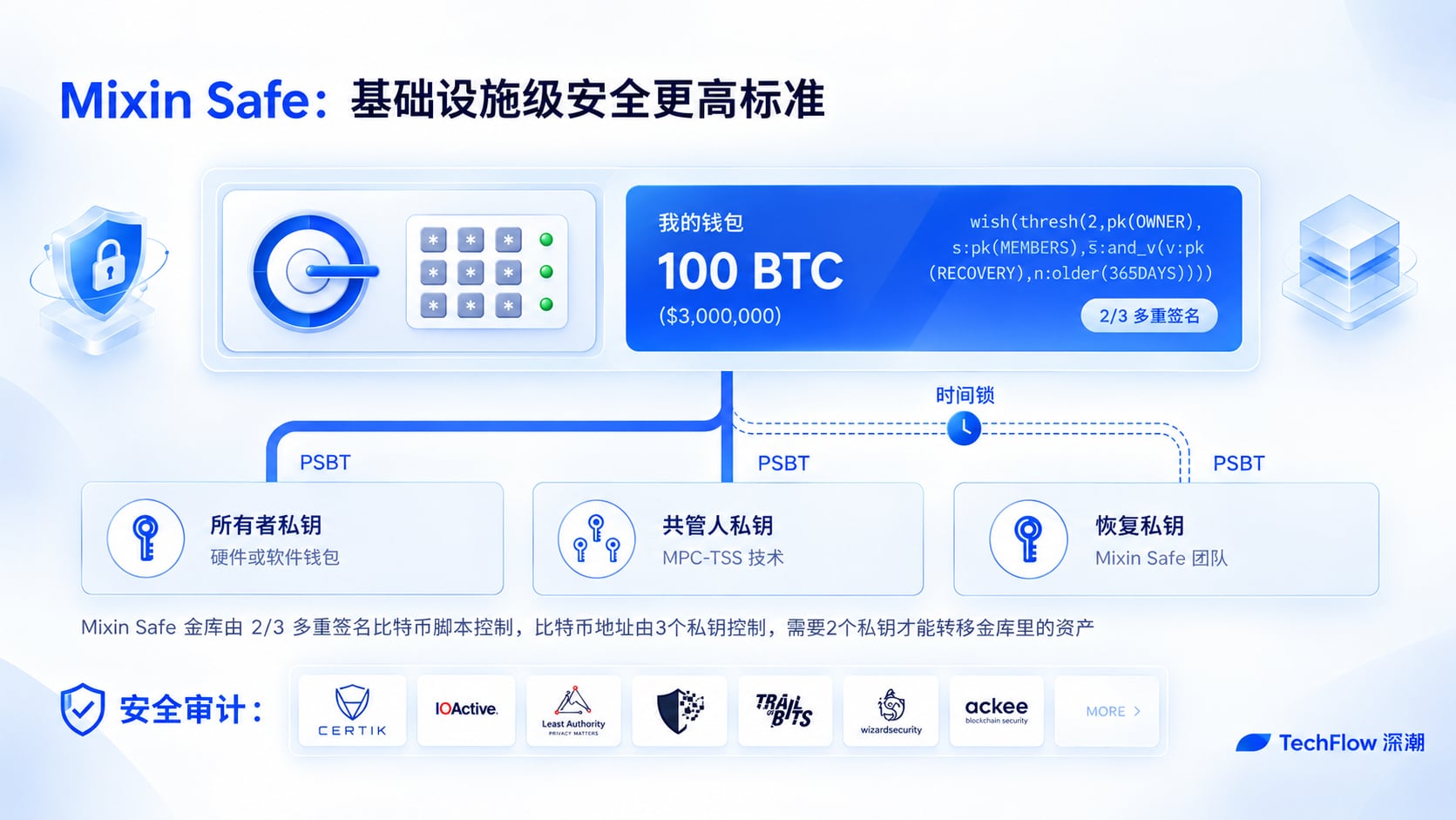
The 2023 security breach underscored the urgent need for decentralized management, risk isolation, and robust recovery mechanisms for large-scale digital assets. Addressing single-point risks tied to individual private keys and limitations of traditional multisig in coordination and asset recovery, Mixin Safe delivers a decentralized, non-custodial multisig cold wallet and asset management solution.
Take Bitcoin vaults as an example: Mixin Safe combines native chain multisig, decentralized MPC, and time-lock mechanisms, constructing a layered security architecture using three key types:
Regular transactions require joint approval from Owner Key + Members Key;
Only when one key is lost and time-lock conditions are met does the Recovery Key + another valid key unlock the recovery path.
The core design philosophy of Mixin Safe is not to grant any party greater control—but to prevent any single individual, device, key, or institution from independently moving assets, fully reflecting the team’s principles of non-custodial ownership, asset safety, recovery resilience, and shared governance.
Through this architecture, Mixin Safe integrates user autonomy, multi-party management, and delayed recovery—elevating security from theoretical decentralization to practical resistance against infrastructure compromise, while advancing exploration into large-asset protection, decentralized recovery, and digital inheritance scenarios.
Meanwhile, Mixin maintains continuous security audit processes, further ensuring the safety of all infrastructure components.
More importantly, security investments build “pre-event trust”—but Mixin’s demonstrated “post-event responsibility” during this redemption process has become a publicly verifiable credit record, signaling to potential users how the platform responds after incidents—substantially enhancing trust before user adoption.
Viewed from this angle, the $23 million redemption represents Mixin’s fulfillment of existing trust—and perhaps marks the beginning of Mixin’s journey toward producing incremental trust.
Why Is This Redemption Worth Deep Analysis?
The core reason lies in scarcity.
In crypto, trust is the most expensive asset.
When a crypto project is hacked, multiple outcomes are possible—but regardless of the script, users who suffer actual losses are inevitably left to bear the cost. Mixin’s response stands as a powerful rebuttal to this default outcome:
Hacks happen often; promises are common; but long-term operation and consistent redemption? That’s exceptionally rare in crypto.
From a project perspective, the lesson is equally pragmatic:
Security breaches can shatter trust—but they don’t necessarily mean inevitable collapse. As long as the business retains vitality, projects may still resolve historical issues through sustained operations.
Beyond scarcity, Mixin also provides a clearer practical blueprint for the Debt Token redemption path.
Though issuing Debt Tokens post-hack is common—exemplified by Bitfinex’s 100% redemption via BFX tokens—Mixin’s significance doesn’t lie in being “first.”
Rather, under more complex asset conditions, Mixin clearly structured several critical steps into a complete, traceable redemption pipeline:
Issuing redemption vouchers, sustaining operations, phased execution, public timeline, and staged redemptions.
For many project teams, Mixin’s structured, verifiable approach offers a highly referenceable model.
Even broader: stepping back, this redemption raises deeper questions about the fundamental basis of “security assessment”:
Traditionally, discussions around platform security focused heavily on technical architecture, risk control maturity, and whether assets had been breached…
All important—but the focus remained on “defense.”
As the old saying goes: It’s easy to be a thief for a thousand days, but nearly impossible to defend for a thousand days.
Technology grows increasingly complex; hackers grow more sophisticated; attack vectors evolve rapidly. No platform can realistically claim “never to fail.”
Thus, “defense” is vital—but cannot be the whole story.
With Mixin’s redemption now completed, the long-discussed security standard is once again brought into sharp focus:
Pre-event: must withstand attacks;
Post-event: must absorb and recover.
The former tests technology, risk controls, and infrastructure;
The latter tests responsibility, operational capacity, and long-termism.
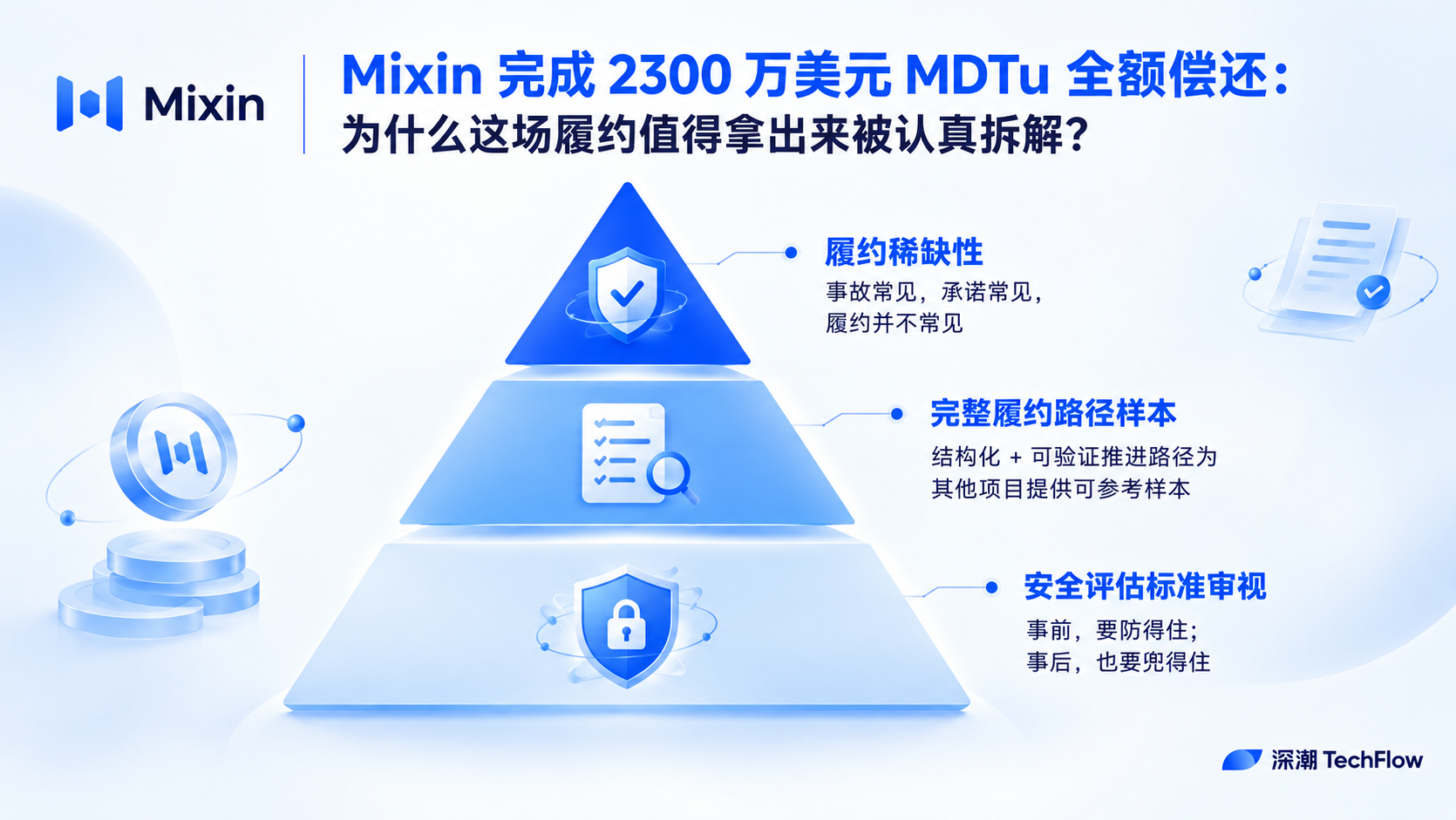
Three years ago, Mixin stood on the edge of a trust cliff due to a security incident.
Over the next three years, with the $23 million redemption now complete, Mixin has walked back from the brink—perhaps standing even higher than before.
In an industry where promises are cheap and redemption is scarce, only those willing to invest time, cost, and action in trust deserve to hold user confidence—and inspire user anticipation for the future. Only then can true, bottom-up progress drive the industry to rethink, pursue, and establish the most authentic security standards.
This is, perhaps, the essence of why this redemption deserves to be remembered.
Author: DeepChain TechFlow
Disclaimer: Contains third-party opinions, does not constitute financial advice
Bitcoin breaks below $80,000 ahead of Fed decision, put option demand still dominant
30 mins ago
Japanese GMO Hit by Hackers Demanding $50 Million Ransom, Customer Data Possibly Leaked
36 mins agoGalaxy Digital Turns Profitable in Q3, Achieves $323 Million Net Profit
42 mins agoBitcoin at $80,000: A Tug-of-War with No Winners
2 hours agoSTRC holders will vote on daily dividends, with Saylor controlling 32.9% of voting power
2 hours agoSony's L2 Soneium Launches ipUSD and IP Vault, Allowing Users to Purchase Music Copyright Funds on-chain
3 hours agoWall Street Cracks Down on "Shadow Stocks," Bullish Partners with Multiple Financial Giants: Bringing True Shareholder Rights to Tokenized U.S. Equities
3 hours ago