Founder of Real Vision: Why Do Most Public Blockchains Ultimately Fade Away?
Founder of Real Vision: Why Do Most Public Blockchains Ultimately Fade Away?


But looking back now, this chain has essentially become a ghost town. Only a handful of validators remain operational, with hundreds of wallets repeatedly transferring small tokens, whose prices have long since fallen far below the purchase cost for believers.
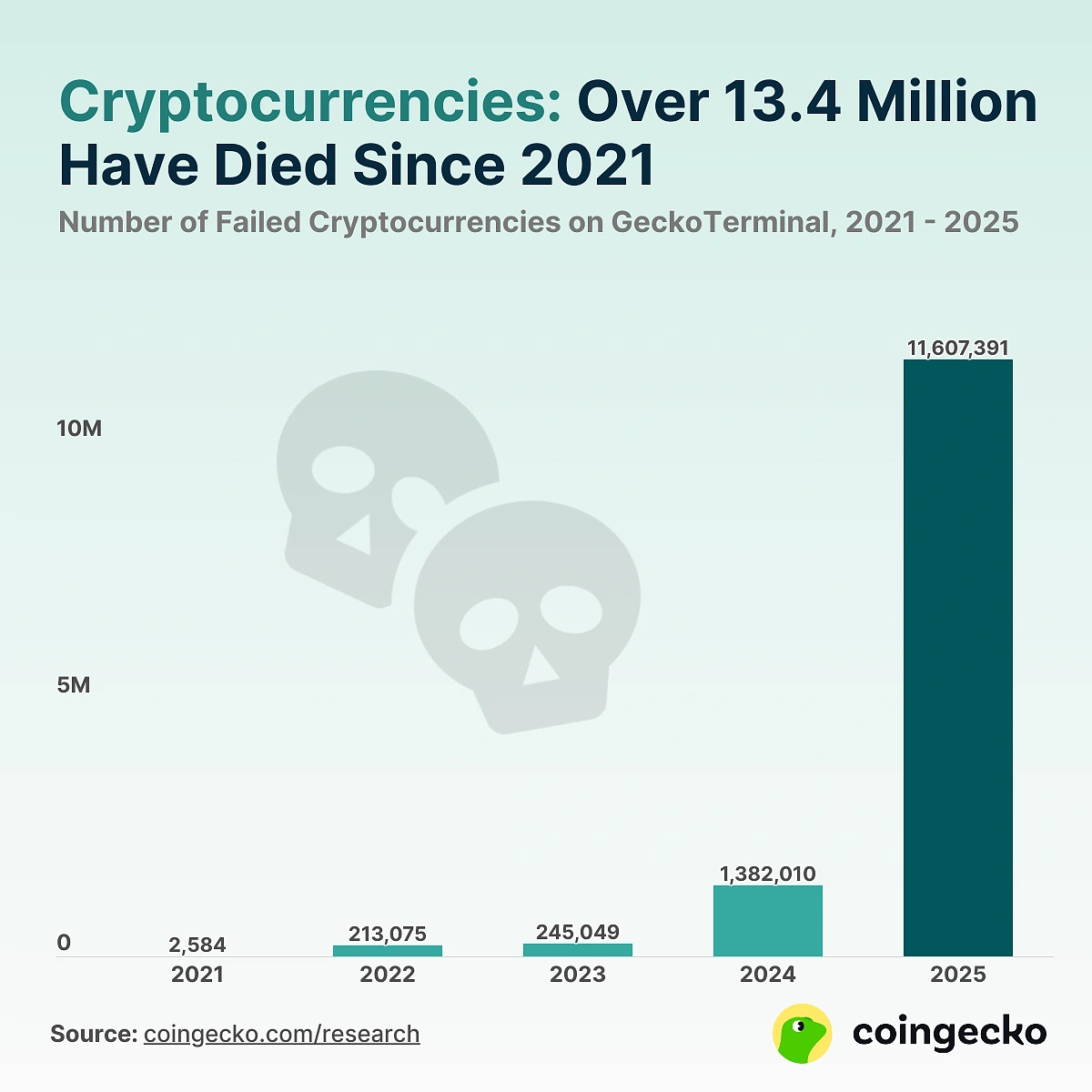
CoinGecko statistics show that by the end of last year, over 13 million tokens had ceased trading, the vast majority of which perished in 2025. Many of the underlying public blockchains they relied on have met the same fate.
Over the past thirteen years, I’ve seen similar sentiments emerge on social media during every bear market: “Cryptocurrency is a scam,” “It’s always been a casino,” “I told you so.”
But this mass extinction is not scandalous—it’s simply a matter of basic probability.
I wrote these words in December 2020, when I thought it was self-evident, but others didn’t agree. Tokens are merely risk investments priced in real time by market cap. If you hold an early seed-stage project where the valuation resets every second, you’ll see exactly the same outcome: roughly 80% ultimately go to zero, 19% create some value, and only 1% capture most of the gains. The crypto market just broadcasts this process live to everyone, and the real-time price volatility easily triggers panic.
I also applied this standard to myself at the time. If Real Vision had been evaluated daily since inception based on real-time valuation, I suspect its value would have nearly hit zero six times. Project value comes from adoption, which ultimately stems from revenue—most projects never reach that point. Most don’t survive. This is reality, whether you like it or not—this is capitalism.
So the real question has never been “Will most public blockchains die?” They will inevitably die. The real question is: Which ones will survive, and how can we identify them before price signals reveal the answer?
We’ve Seen This Script Before
Twenty-one years of writing experience taught me to look for precedents—and here, the key precedent is the dot-com bubble burst.
In November 2018, Bitcoin was deep in a bear market. I wrote then that this moment closely resembled the dot-com crash of 2000 and 2001: grand visions, but flawed business models. Yet, phoenixes would rise from the ashes. I was confident the crypto market would reenact this cycle, though I admitted at the time I couldn’t tell which projects were phoenixes and which were ash.
Admitting uncertainty was the correct answer, because in 2000, no one could pick the eventual winners. Infrastructure was overbuilt; the Nasdaq index plummeted 78% over two and a half years from its peak, and the vast majority of stocks lost all value. But a few companies emerged from the fire, leveraging the fiber-optic infrastructure built by failed firms, growing into the world’s largest enterprises. Looking back, the crash was just a brief detour on the upward trajectory; in the moment, it felt like the entire industry’s ideology had collapsed.
This pattern has repeated across every major platform market since. In cloud computing, only about five top players remain; operating systems and mobile ecosystems follow the same trend—most value is concentrated among the top four. Public blockchains are fundamentally no different.
A Public Blockchain Is an Economy, Not Just a Token
Since it’s a platform market, what is its product? The answer is simple: blockspace.
The winner will use technology or narrative (or both) to make its blockspace more attractive, drawing in users and capital to transact on-chain. Everything else is just marketing fluff.
This is why general-purpose blockchains shouldn’t be viewed as companies, nor reduced to mere tokens. Ethereum, Solana, Sui are independent economies with their own GDP, money supply, and monetary policy. Evaluating them should be done like assessing a nation—by measuring actual economic activity on-chain.
Four Paths to Survival
The competitive landscape is far simpler than most imagine. For a project to survive, there are only four viable paths:
First, become an independent economy. Ethereum, Solana, Sui, and a few others possess sufficient throughput, composability, and developer density to support a global tokenized economy.
Second, pursue vertical specialization. Hyperliquid is the quintessential example—a unified exchange that happens to use a blockchain as its execution layer. Specialized exchanges often profit, but their upside is capped by niche market constraints. They should be valued like high-moat exchanges, not open-ended, unlimited economies.
Third, operate as a Layer 2. Build applications atop a Layer 1, leasing its security. Some L2s become high-quality businesses, but fundamentally they’re franchises—like stores on Shopify. Even if an L2 collapses, its on-chain state can be migrated elsewhere. This is why they can’t accumulate value like L1s: L1s offer data permanence; L2s only rent security.
The fourth category is special: BNB. The market prices it as an independent economy, but it isn’t. It’s not decentralized—the real backing is Binance’s balance sheet. It’s a solid business model, but fundamentally a centralized platform token disguised as an L1.
Why Most Blockchains Are Doomed
The vast majority of remaining blockchains—those launched in the last two cycles—don’t fit into any of the above four categories. They’re generic public blockchains trying to compete with independent economies, lacking the conditions to win; too narrow to dominate a dedicated niche; yet too centralized to leverage the balance sheets of large platforms. They’re simply “a blockchain.” A blockchain without moats ends up with zero value.
This is structural. And operationally, what truly kills them is the token issuance mechanism.
Since summer 2024, I’ve studied low circulating supply, high fully diluted valuation (FDV) tokens—this pattern hasn’t changed: markets hate such assets. Early on, circulating supply is tiny, often triggering immediate drops of 70% or more, as the market prices in future unlock pressures. In bull markets, low-circulating tokens can surge if backed by genuine demand. But in bear markets, unless unlocks are largely complete or demand is genuinely sustainable, these assets severely underperform the broader market. And for blockchains without moats, demand is never real—it only generates short-term hype, which is hard to convert into lasting adoption. Most such hype evaporates instantly.
Thus, the issuance structure merely accelerates the demise of these homogenous blockchains. Even without flawed issuance, the market would eventually deliver the same result.
The Race to Zero-Cost
Most existing valuation frameworks fail here.
The core dimension of blockchain competition is operational efficiency. Winning chains will continuously drive the marginal cost per transaction toward near-zero. If plugged into a discounted cash flow model, the conclusion becomes inverted: the leading chains would appear undervalued compared to challengers, because they charge the least in fees per transaction. This model yields exactly the opposite result.
To assess blockchain value, think backward. Imagine shutting down Ethereum: all Layer 2s collapse, most stablecoin markets vanish, DeFi, NFTs, tokenized assets all suffer, and the possibility of building future financial systems on this infrastructure disappears. That is Ethereum’s true value. No one evaluates TCP/IP by counting each packet’s revenue. You assess it by measuring the entire internet built upon it.
This race will accelerate further. A new class of users is about to enter. I previously explained that AI agents cannot use traditional banking systems—they must rely on on-chain settlement channels. Agents have no inherent preference; they automatically choose the cheapest, fastest, most efficient network. As soon as a lower-cost option appears, they immediately migrate away from higher-fee chains. Solana and Sui have already driven stablecoin transfer costs close to zero—this is Le Chatelier’s Law playing out in real time.
Some applications require Ethereum’s security; others prioritize maximum speed. Different blockchains serve different use cases. Market dominance will be concentrated at the top—not one chain dominating everything. But tail blockchains have no share of the pie.
Everyone Misjudges the Metrics
I can explain why industry metrics are fundamentally flawed—I myself once fell into this trap.
Early this year, I attempted to build an L1 blockchain valuation framework, starting with fully diluted valuation and common metrics analysts track: Total Value Locked (TVL), fee revenue, DEX volume, stablecoin market cap. Correlations looked strong—I thought I’d found the right method.
But the truth is, the entire logic is circular. TVL’s unit is the token being valued; DEX volume fluctuates with speculative trends, and fees move with volume. It’s like using data derived from token price to explain token price. We’re observing appearances, not substance.
So I removed price distortion and converted metrics into price-independent ratios. Using data from January 2025 peak across 12 blockchains, I asked one question: Which metric predicts which chains will suffer the smallest decline over the next 13 months?
Fee yield showed no predictive power. Bull market fees only reflect speculative heat, not real value creation. TVL/FDV (crypto’s version of P/B ratio) was equally useless.
The only metric correlated with asset returns was capital turnover rate: how quickly funds circulate on-chain. But the correlation was inverse. In January 2025, Solana’s capital turnover reached 200x its locked value, while Ethereum was just 7x. The faster the capital turns over, the worse the chain performs over the next 13 months. Chains with capital that stays and accumulates demonstrate stronger resilience.
My current understanding is this: turnover reflects entropy; capital stickiness reflects order. When funds come in and stay, used for lending, swapping, restaking, they build economic connections, attracting more capital. Capital that rushes in and out treats the chain as a casino—when the frenzy fades, nothing remains. So high trading volume at market peaks is actually a red flag; chains that appear calm, with capital deeply embedded, are better equipped to withstand downturns.
Characteristics of Survivors
From this, I’ve distilled three key observation dimensions—all independent of price:
First, can per-user economic density be maintained during a token price crash? From the December 2024 peak to February 2026, one tracked blockchain saw its token price drop 83%, TVL fall 78%, and active addresses drop by 75%. Yet, capital per active user remained nearly unchanged: around $2,100 at the peak, still $2,100 at the trough. Speculative visitors and bots exited; those who stayed continued economic activities at similar scale. Among the blockchains I analyzed, only three L1s preserved this density metric through the downturn: Ethereum, Solana, Sui. All others saw both token price and user economic density shrink simultaneously. One major L1 with deep funding saw its user economic density collapse by 83%—meaning retained users effectively stopped all on-chain activity.
For clarity: I do work for the Sui Foundation. But I discovered Sui belonged to this group only after completing the analysis—data doesn’t lie.
Second, can stablecoin reserves keep growing during token depreciation? On-chain USD stablecoins don’t depreciate with the token. If dollar-denominated capital keeps flowing in and staying during bear markets, it signals a long-term commitment from external investors. All three surviving chains saw stablecoin balances grow during the downturn—even the one whose token dropped 83% saw its stablecoin size increase by about half.
Third, continuous developer inflow is my highest-weighted indicator. Developers are the most scarce capital in the ecosystem. Users can pull out their funds in minutes; developers invest years learning specific languages and architectures, with extremely high migration costs. Developers continuing to migrate to a chain during a bear market represent the most knowledgeable minds in the industry, making high-cost, high-certainty choices. Price charts can never capture this.
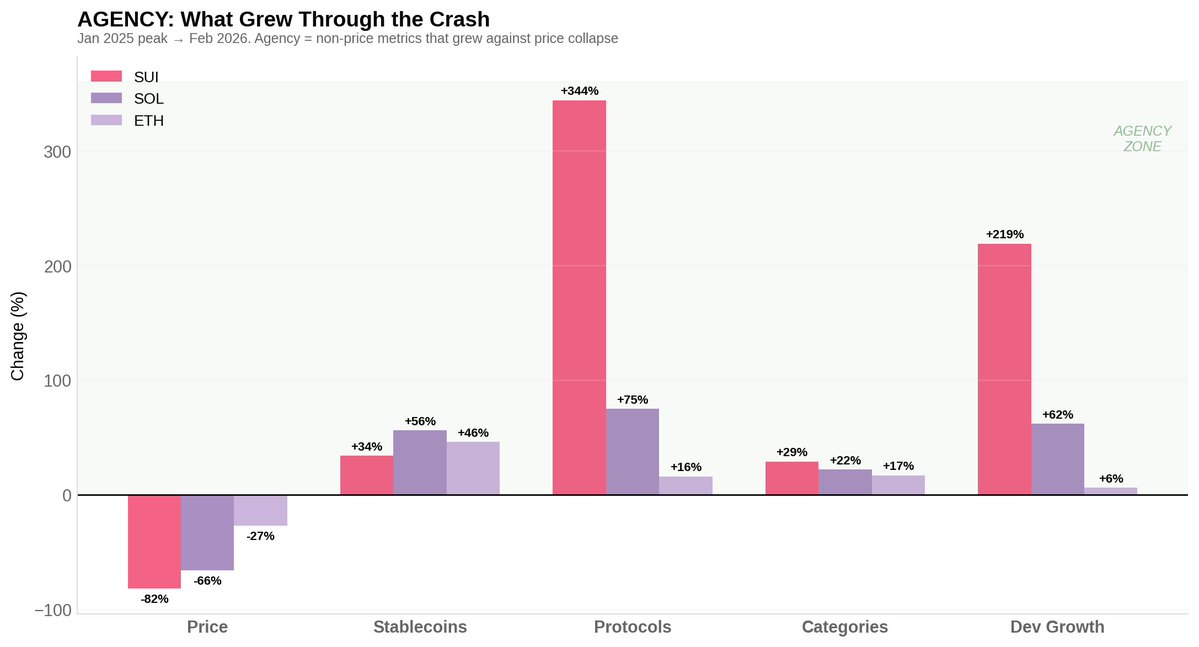
Growth in wallet count, rising on-chain transaction value, developers entering first—all these metrics persist even during market corrections. This is what defines a resilient asset. Only when these conditions are met should deeper research begin. Otherwise, you’re holding a commodity-like token.
Such assets may experience 90% price drawdowns mid-S-curve. But the few survivors will achieve exponential growth over time, consistently setting new highs. After thousands of projects pass through survival filters, network effects kick in, and the ecosystem takes off.
Long-tail projects will keep multiplying. Each cycle brings countless new token launches. Many dream of finding a hundred-bagger among the sea of long-tail projects, ignoring the clear mainstream opportunities. Focus on adoption, not token price.
The vast majority of projects will perish. The few survivors are the core of the game.
By Raoul Pal, Founder of Real Vision | Translated by Chopper, Foresight News
Disclaimer: Contains third-party opinions, does not constitute financial advice
Bitcoin breaks below $80,000 ahead of Fed decision, put option demand still dominant
29 mins ago
Japanese GMO Hit by Hackers Demanding $50 Million Ransom, Customer Data Possibly Leaked
35 mins agoGalaxy Digital Turns Profitable in Q3, Achieves $323 Million Net Profit
41 mins agoBitcoin at $80,000: A Tug-of-War with No Winners
1 hour agoSTRC holders will vote on daily dividends, with Saylor controlling 32.9% of voting power
2 hours agoSony's L2 Soneium Launches ipUSD and IP Vault, Allowing Users to Purchase Music Copyright Funds on-chain
3 hours agoWall Street Cracks Down on "Shadow Stocks," Bullish Partners with Multiple Financial Giants: Bringing True Shareholder Rights to Tokenized U.S. Equities
3 hours ago