Billions in U.S. Treasuries Flow On-Chain—Why Only 2% Enter DeFi?
Billions in U.S. Treasuries Flow On-Chain—Why Only 2% Enter DeFi?


U.S. Treasury bonds, gold bars in Swiss vaults, SpaceX equity, home equity loans, auto loans—these assets have all been tokenized on-chain. Yet the vast majority of them remain idle, merely stored and inactive.
Charts don’t reveal this reality. Every few weeks, the same price chart resurfaces: continuous growth in on-chain Real World Asset (RWA) volume. Everyone nods in agreement—the path to tokenization has been proven.
In a sense, yes. The charts only reflect capital flowing into the chain—not where it goes after. The gap between capital arriving on-chain and capital actually circulating is the RWA liquidity shortfall.
This gap is critical because a large number of investors are betting that it will eventually close. The bullish thesis is that RWA will become the most important gateway for traditional off-chain capital to enter the crypto ecosystem. Investors buying tokenized U.S. Treasuries aren’t purchasing crypto per se—but their capital now accesses blockchain infrastructure, enabling one-click access to all other on-chain assets.
But this only holds if capital can flow. If a token sits untouched in a wallet for a full year, it may be on-chain, but it lacks liquidity—like a car parked in a garage, never driven.
To analyze this, I’ve examined four major RWA categories: U.S. Treasuries, commodities, equities, and credit assets, addressing two core questions:
The conclusion drawn is far more nuanced than what the charts suggest: U.S. Treasuries are largely intentionally idle; gold is primarily held; equities trade normally; and credit assets are genuinely active in circulation.
All categories passed the first test (continuous capital inflow), but only credit assets clearly passed the second (active capital movement). In this piece, we begin with the largest “asset parking lot” on-chain: tokenized U.S. Treasuries.
U.S. Treasuries: The Largest On-Chain Asset Parking Lot
Tokenized U.S. Treasuries represent the largest RWA category. Over the past year, their market size grew from ~$8.9 billion to $14.82 billion—a 66.5% increase. But issuance volume tells only half the story. What matters more is how capital behaves after it enters the chain.
What Exactly Is Being Tokenized?
The U.S. government finances itself through Treasury bills, notes, and bonds—assets backed by the full faith and credit of the U.S. government, considered the safest in financial markets. Tokenized Treasuries bring exposure to these instruments onto the blockchain. BlackRock’s BUIDL, Circle’s USYC, and Ondo’s USDY offer tokenized products to qualified investors, providing yield backed by U.S. Treasury holdings.
The underlying asset remains traditional sovereign debt. The only difference lies in the ownership instrument—now transferable via blockchain infrastructure.
Why the Surge in Demand?
The rise in popularity of tokenized Treasuries stems from two key factors: declining credibility of native crypto yield strategies, and rising attractiveness of traditional bond yields.
First, the crypto industry crisis exposed hidden risks behind on-chain yields. The collapse of Terra in May 2022 was followed by failures at Celsius and Three Arrows Capital. These events revealed fragile peg mechanisms, excessive leverage, and flawed yield strategies—all dependent on token incentives or favorable market conditions rather than sustainable cash flows.
For DeFi investors, this pushed them to seek yield outside the crypto ecosystem.
Meanwhile, government bonds regained appeal. After the Fed began its hiking cycle, short-term U.S. Treasury yields surpassed 5% in 2023. Concurrently, many DeFi yield sectors weakened. Investors could now earn returns via U.S. government bonds without relying solely on trading activity, leverage, or protocol token incentives.
Tokenization bridges two worlds. Tokenized U.S. Treasury products allow crypto-native funds, protocols, and institutional investors to access Treasury yields through blockchain channels. Investors need not exit the on-chain ecosystem to hold these stable, interest-bearing assets within it.
The combination of mature underlying assets, attractive yields, and potential on-chain utility made tokenized Treasuries among the earliest and most successful RWA applications. Subsequently, traditional finance players like BlackRock’s BUIDL and Franklin Templeton’s on-chain money market fund entered the space.
Yet market growth has been uneven—few platforms capture the lion’s share of capital, with their products dominating the market.
Market Dominance by a Few Platforms
The tokenized U.S. Treasury market is highly concentrated among top platforms. The top five collectively account for ~77% of the $14.82 billion market.
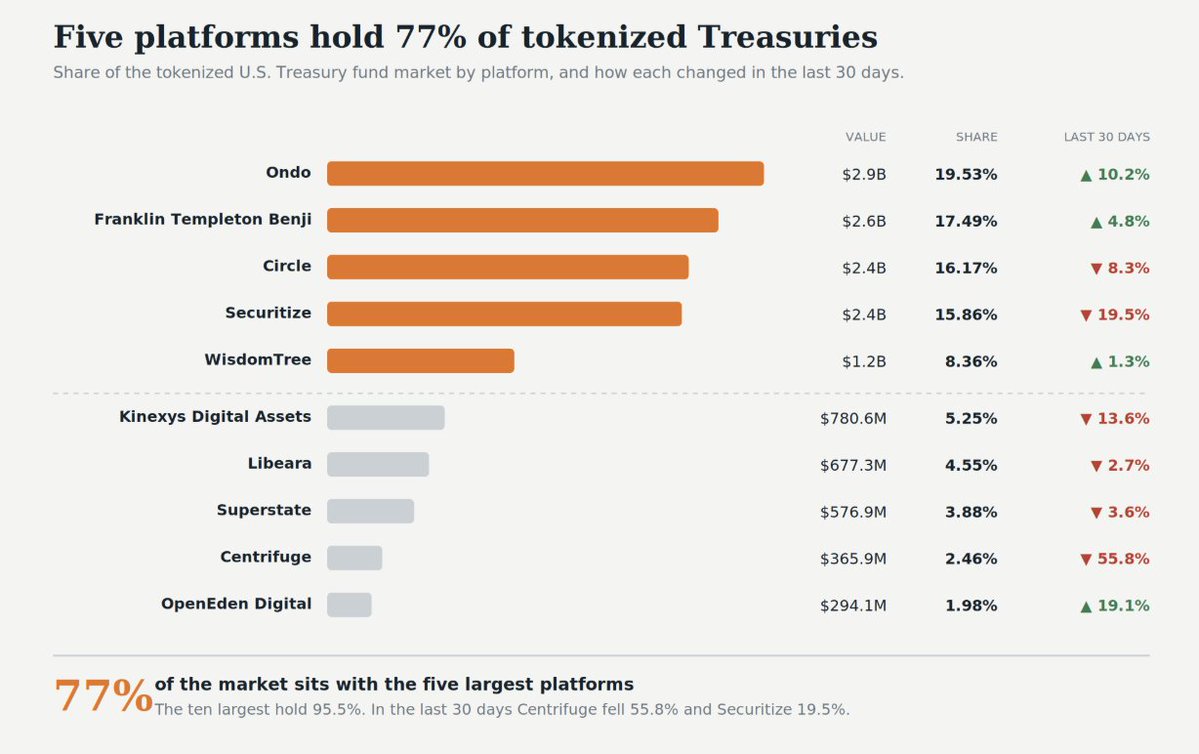
Each platform has flagship products carrying Treasury exposure:
Product concentration is equally pronounced: the top ten products account for ~86% of the market, representing ~$12.8 billion. But market size reflects only how much capital entered the chain—not how it’s used afterward.
Limited Circulation of Capital
I selected eight top-tier tokenized U.S. Treasury products on DeFiLlama, covering ~$10.1 billion—68% of the total $14.82 billion market. Of this, only ~$200 million (2%) is locked in DeFi active positions.
Even among leading products, the vast majority of Treasury assets remain unutilized in measurable DeFi applications. The real question isn’t just low utilization—it’s where the capital actually goes.
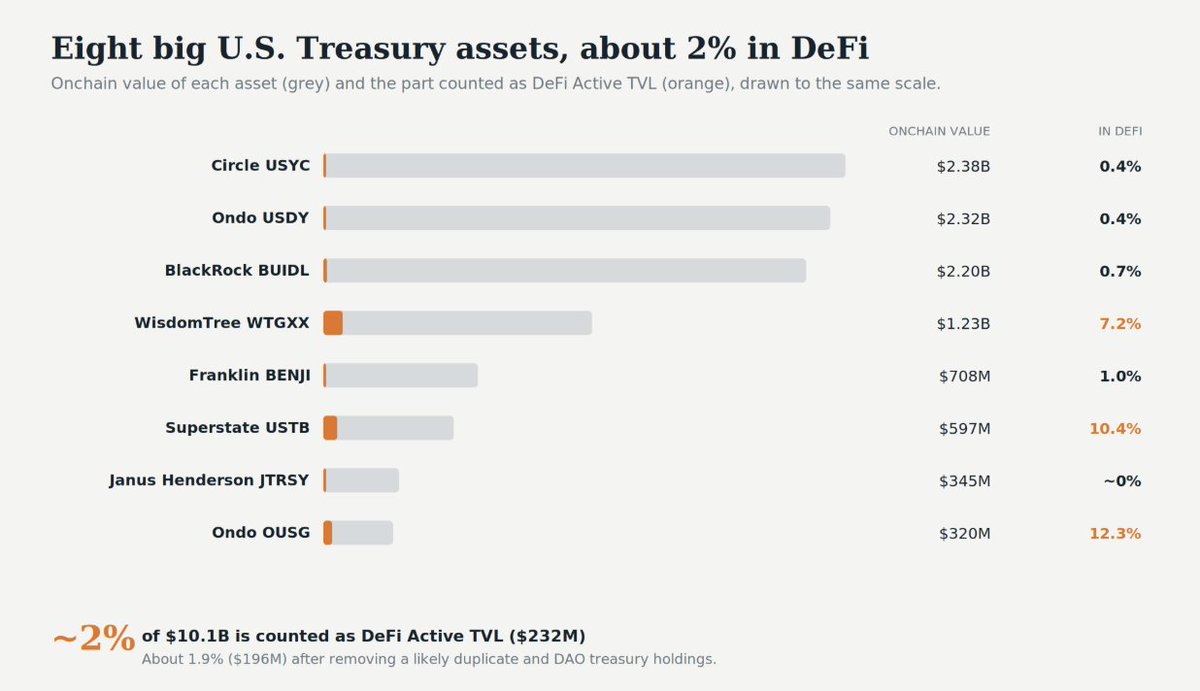
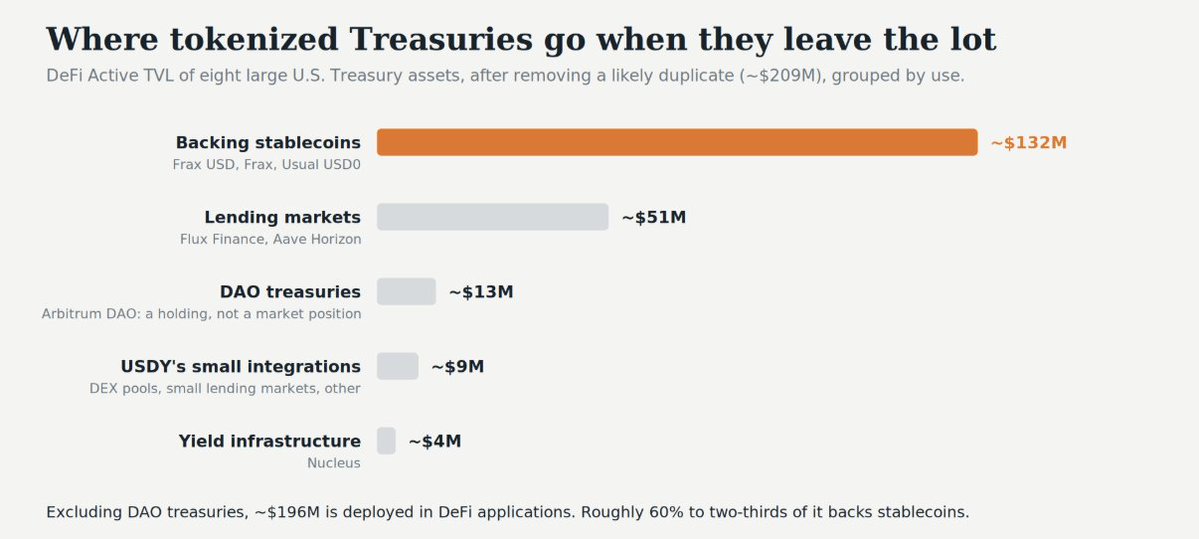
In visible use cases, stablecoin reserves account for two-thirds. WisdomTree’s WTGXX, Superstate’s USTB, and BlackRock’s BUIDL are deployed within Frax’s frxUSD ecosystem; Circle’s USYC can be deposited to mint Usual’s USD0. In such models, the underlying Treasury product continues generating yield while serving as reserve backing another dollar-denominated asset. The asset enters DeFi—but not necessarily for lending or trading.
Lending collateral use accounts for roughly the remaining quarter. Notable examples include Ondo’s OUSG on Flux Finance and Superstate’s USTB on Aave Horizon. A small portion goes into trading pools and yield strategies; some assets sit in protocol treasuries, such as Franklin Templeton’s BENJI in the Arbitrum DAO treasury.
Here’s a crucial distinction: an asset can function within DeFi without being frequently traded. Most measurable uses serve as stablecoin reserves—not for lending or trading.
Why Are Treasury Assets Rarely Used in DeFi?
Three factors explain the low utilization of tokenized U.S. Treasuries in DeFi: imbalanced economic incentives for lending, restricted transfer permissions, and extreme ownership concentration.
(1) Borrowing Against Treasuries Is Often Unprofitable
The appeal of tokenized Treasuries is clear: earn Treasury yields without leaving the on-chain ecosystem. But current yields have declined. By October 2026, tokenized Treasury yields were around 3.7%, down from ~5.3% in early 2024.
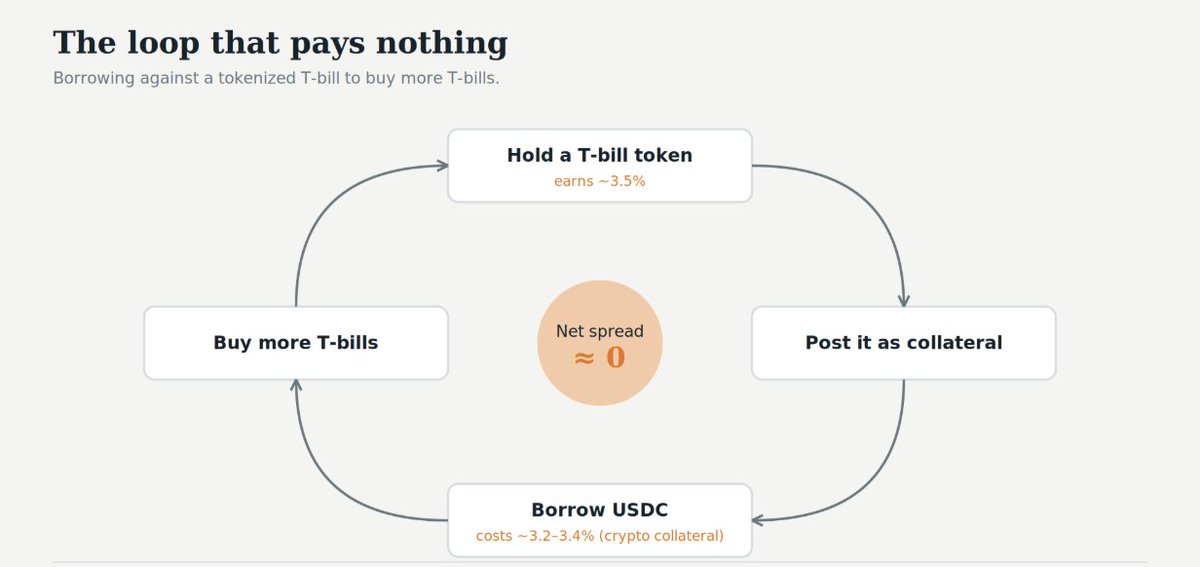
This is critical. One potential use case for tokenized Treasuries is collateralizing stablecoin loans, then leveraging to buy more of the same asset. This strategy only works if incremental yield exceeds borrowing costs and other expenses.
With Treasury yields near overnight funding rates, leveraged long positions in Treasuries have become less cost-effective. After accounting for borrowing costs, protocol fees, and liquidation risk, the additional return rarely covers the downside. This doesn’t mean using Treasury tokens as collateral is impossible—but the economic incentive has diminished significantly. Asset utilization is jointly influenced by market access, collateral parameters, liquidity, and yield.
Reserve management operates under a different logic. Treasury-backed tokens held as stablecoin reserves don’t require refinancing or further leverage. They generate continuous yield while supporting another dollar-pegged product. That’s why even as leveraged borrowing strategies lose appeal, demand for Treasury tokens as reserve assets persists.
(2) Most Tokenized Treasuries Are Permissioned Assets
The vast majority of tokenized Treasuries allow transfers only to vetted wallets or require other access controls. USDY and mTBILL are exceptions—permitting non-custodial secondary transfers within product rules.
But open transfers don’t guarantee DeFi usability. According to my snapshot data, only 0.4% of USDY’s assets are deployed in tracked DeFi applications; mTBILL shows only ~$1,300 in integrated use cases.
Ownership data offers further insight. On Ethereum, the top ten addresses hold ~95% of USDY supply; for mTBILL, the top ten hold over 99%. Even on Solana, where USDY has over 8,000 holders, the top ten addresses still control 96% of the supply.
These figures don’t prove concentration causes low utilization—but they do show: mere transferability isn’t enough to drive deployment into diverse DeFi applications.
(3) Holders Are Not Typically Traders
The entire market has ~86,000 token holder addresses. Dividing $14.82 billion by that number gives ~$170,000 per address—but this does not represent retail investors. Ownership is highly concentrated, and one wallet does not equal one independent investor.
Product-level concentration is even starker: Circle’s USYC ($2.38 billion) resides in just 35 addresses; BlackRock’s BUIDL ($2.2 billion) spans 105 addresses; JPMorgan’s on-chain liquidity fund (~$738 million) is held by only 7 addresses.
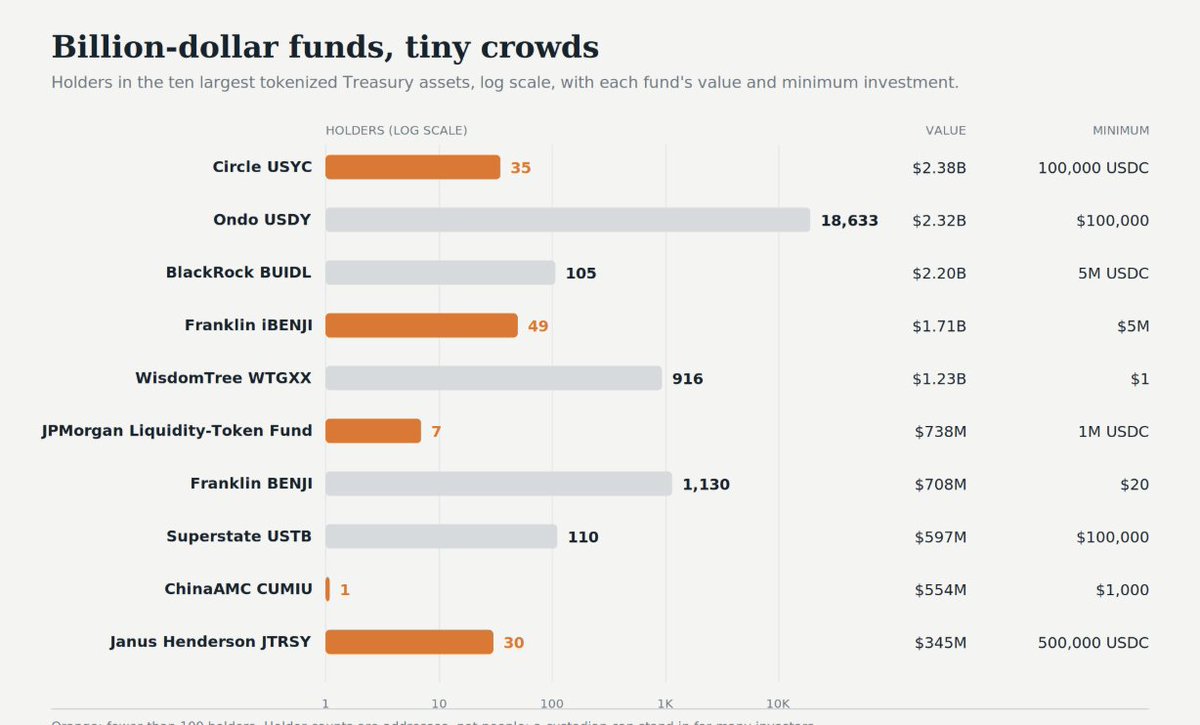
Cross-chain data shows similar patterns:
These are snapshot figures across chains. Large wallets likely belong to custodians, cross-chain bridges, or protocols—not individual investors. This proves high address count doesn’t imply broad distribution.
This also explains persistently low trading activity. Some assets are held by institutional treasuries, custodians, or stablecoin reserves—functioning more like cash on balance sheets than actively traded investments. Without clear use cases, assets remain dormant.
Address count only reflects token distribution breadth—not the number of independent investors or actual usage intensity.
Why Is the Market Growing Despite Falling Yields?
An apparent contradiction exists: yields have dropped from above 5% to 3.7%, yet market size has grown by two-thirds. If the sole motivation were yield, such growth would be hard to justify.
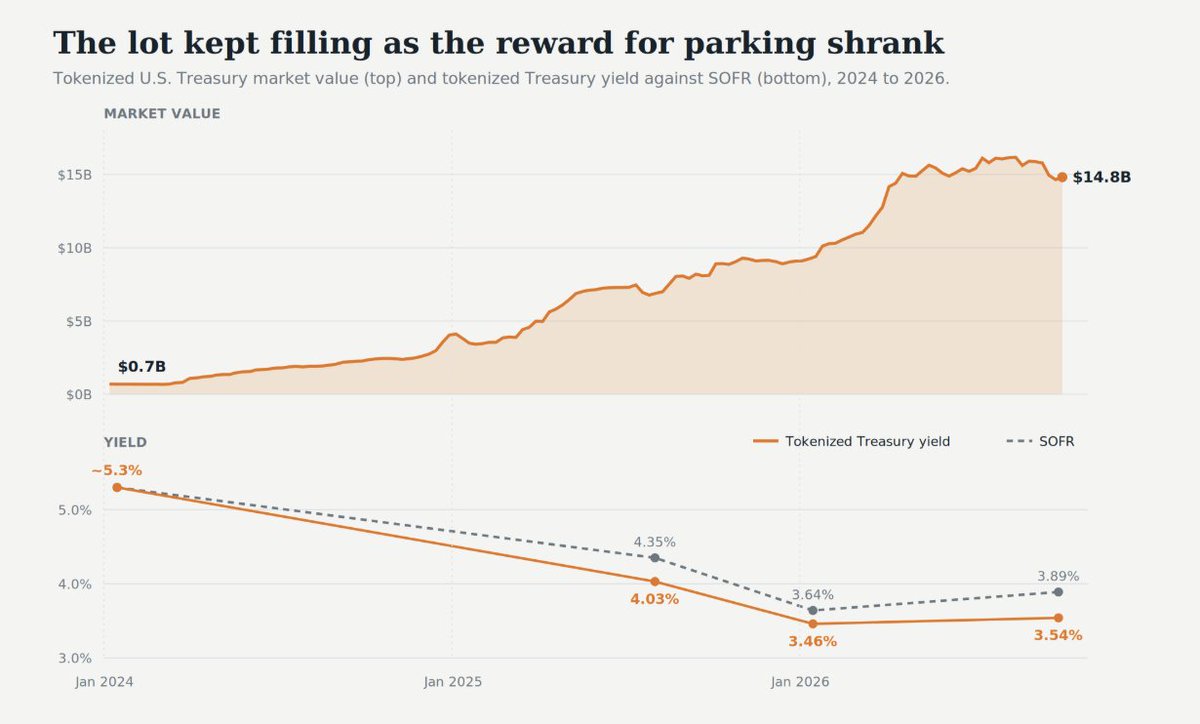
My interpretation: investors buy not just for yield, but for access to blockchain infrastructure. A tokenized Treasury can serve as stablecoin reserve, enable cross-chain settlement, or act as collateral when supported by lending protocols. Even if mostly idle in wallets, this optionality alone holds value.
But optionality isn’t actual utilization. Institutions want to allocate to Treasury exposure on-chain, driving market growth. Meanwhile, transfer restrictions, insufficient collateral support, and high financing costs collectively limit capital movement.
What’s Next?
Low utilization doesn’t signal failure. The underlying infrastructure for on-chain Treasury operations is still nascent. Idle assets today are typical of early-stage adoption. To change course, four breakthroughs are needed:
The first phase—moving Treasuries on-chain—is already achieved. The next phase is making assets circulate. Asset pools with real usage pathways will continue expanding; others will remain static.
Summary
Returning to the opening questions: Is new capital entering? Yes. Despite yields falling from above 5% to 3.7% by October 2026, market size grew 66.5% to $14.82 billion. Capital keeps flowing in—even as yields shrink—and remains parked.
Can capital circulate after reaching the chain? Hardly. Among the eight products I analyzed, only ~2% is locked in DeFi active positions—most of which serve as stablecoin reserves. These roles are functional but static.
The root issue isn’t infrastructure failure—it’s economic logic. When financing costs approach or exceed Treasury yields, leveraged gains struggle to cover fees and liquidation risk. Simply enabling transfers won’t fix the problem. Wallet data shows extreme concentration, but current data cannot confirm concentration is the primary cause of low utilization.
Thus, this asset parking lot is full—largely by design. On-chain Treasuries resemble cash on balance sheets, waiting for specific use cases. Until then, they remain idle.
This isn’t failure. Phase one—bringing Treasury exposure on-chain—is complete. Phase two—expanding usable scenarios in DeFi—is underway, though at limited scale.
By: Ishita, Translated by: Luffy, Foresight News
Disclaimer: Contains third-party opinions, does not constitute financial advice
U.S. SEC Approves Cboe Listing of Binary Options Tied to Key Performance Indicators of Companies
13 mins ago
LITE longs suffer $7.35M liquidation, four other whales also wiped out on overnight US stock positions
15 mins agoThe crypto market sees a universal decline, with long positions liquidated for $860 million in the past 24 hours
47 mins agoSilentSwap partners with NEAR Protocol to deliver private cross-chain access
49 mins agoFrom Institutional Settlement to Open Ecosystem: Can Canton Replicate Robinhood Chain’s Development Path?
53 mins ago
Bitcoin breaks below $81,000, down over 3% in 24 hours
57 mins agoEight U.S. States Sue OpenAI Over User Security Concerns
3 hours ago
