From Institutional Settlement to Open Ecosystem: Can Canton Replicate Robinhood Chain’s Development Path?
From Institutional Settlement to Open Ecosystem: Can Canton Replicate Robinhood Chain’s Development Path?


Robinhood started from user acquisition. It first amassed millions of funded accounts, then launched tokenized assets, and finally opened its chain to developers. Canton, on the other hand, began with institutional settlement, privacy, and regulated financial infrastructure. Only now is it beginning to open more accessible environments to developers. I believe this divergence explains their current positions and what Canton must do next.
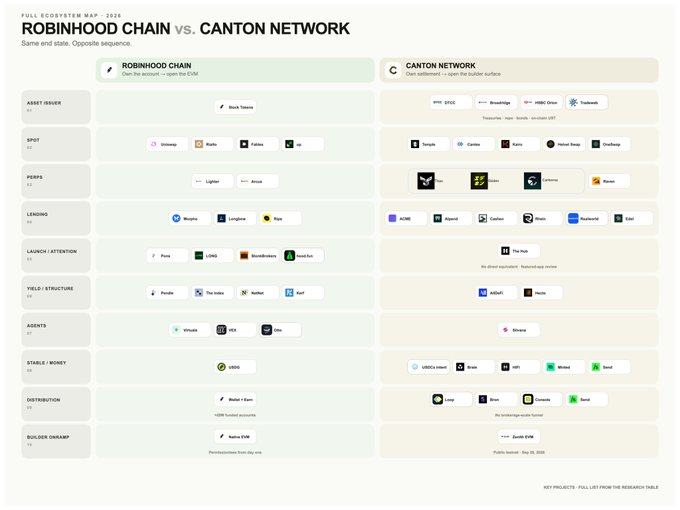
One from users, one from institutions
Robinhood Chain is an L2 built on Arbitrum Orbit, launching its public mainnet on July 1, 2026. It uses ETH for gas payments and supports permissionless deployment.
The core product is Stock Tokens—tokenized debt securities issued by Robinhood Assets (Jersey) Limited. These track the economic performance of U.S. stocks and ETFs but do not confer legal ownership of the underlying equities. The products are available across over 120 countries, excluding U.S. users.
The primary advantage lies in distribution. Robinhood already has approximately 28 million funded accounts, backed by Robinhood Wallet and Robinhood Earn. Early partners include Uniswap, Chainlink, BitGo, Morpho, Lighter—any independent team can deploy products without permission.
Canton took a different path. It is a privacy-centric L1 developed over roughly ten years by Digital Asset. The Daml architecture enables selective sharing of transaction data among participants rather than exposing the full network state. Its initial customers were not retail users, but financial institutions.
Broadridge’s DLR repurchase platform runs on Canton. DTCC is driving the tokenization of U.S. Treasury bonds via DTC custody, targeting commercial service launch by October 2026. Euroclear co-chairs the Canton Foundation alongside DTCC. LSEG, Visa, and a16z crypto are members of the super-validator set.
Digital Asset also closed a $355 million funding round in June 2026, led by a16z crypto, with participation from BNP Paribas, Citadel Securities, HSBC, Tradeweb, and ADIA. In late September, Hong Kong saw a record HK$20 billion digital green bond issuance settled through HSBC Orion on Canton.
In my view, the contrast is clear: Robinhood controls user relationships, lowers barriers, and enables applications to grow on public EVM chains; Canton controls institutional settlement and collateral processes, protects sensitive transaction data, and only now is inviting broader developer access. Robinhood is bottom-up; Canton is top-down.
Two ecosystems, where they stand today
Robinhood’s open ecosystem scaled rapidly. By late September, DeFi TVL across various tracking platforms ranged between $900 million and $1.6 billion, stablecoin liquidity approached $1 billion, and active RWA market value stood at approximately $150 million to $260 million. Figures vary slightly, but the direction is unmistakable: capital is flowing in quickly and finding multiple use cases.
Uniswap became the primary liquidity source, Morpho the lending layer, now supporting the Robinhood Earn market around USDG. Lighter and Arcus launched stock-to-crypto perpetual contracts. Pons captured most launchpad activity, followed closely by Long, ClutchMarkets, and several smaller platforms.
Meme coins and stock-matched tokens generated initial trading volume. Subsequently, Stock Tokens gave users a reason to keep funds on-chain, as they could serve as collateral, trading pairs, and derivative underlyings.
What concerns me is that Robinhood’s core distribution channel remains underutilized. Johann Kerbrat noted that integration with Robinhood’s core app is still early-stage. While the chain itself is operational, the end-to-end user journey—from brokerage account to on-chain interaction—has not yet materialized.
Canton is nearly the opposite. Its institutional infrastructure is already production-grade. Network reports indicate monthly tokenized RWA activity of ~$9–10 trillion, primarily driven by repo transactions. RWA.xyz shows represented asset value at ~$32.6 billion, mostly from Broadridge DLR. This reflects institutional collateral activity, not broad retail liquidity. Depending on sources and methodologies, network participants number between 500 and 780.
Canton lacks a mature public application layer. Wallets exist, several DEXs and lending protocols are under development, and curated app incentives are moving through governance—but user and liquidity loops remain limited. Zenith launched its public EVM testnet on September 28, 2026, and Kaiko deployed an institutional-grade oracle two days later. I see Zenith as Canton’s first credible Solidity developer entry point, but it remains a testnet—not an active application economy.
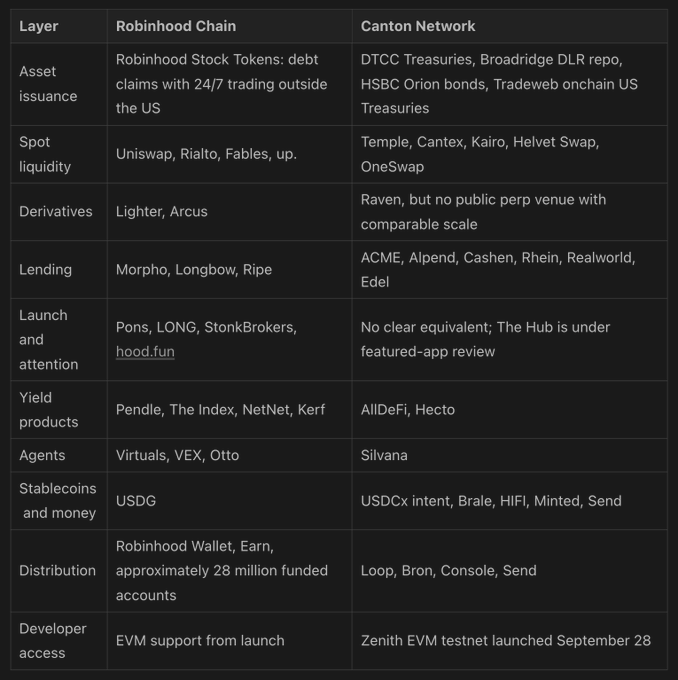
What Robinhood still lacks
Robinhood has users and applications, but not the institutional assets already supported by Canton.
Stock Tokens offer economic exposure, not direct custody within DTC infrastructure. U.S. users remain excluded. This chain was not designed for banks managing bilateral repo positions, intraday margin requirements, or private trade books. These institutions need controlled access and selective disclosure. Private equity, real estate, and art remain future product categories, not established on-chain markets.
In my view, Robinhood’s speculative and trading layers are developing faster than its long-term allocation layer. This helps attract liquidity but also exposes the limitations of its current asset base.
What Canton still lacks
Canton already has high-quality institutional assets and settlement activity—what it lacks is distribution and an open composability loop.
There is no simple 7×24 stock product enabling non-institutional users to buy, lend, or trade against. No Pons-like role to drive new issuance and attention. No Morpho-scale market making tokenized Treasuries a standard collateral for open lending. Public DEX liquidity remains limited compared to Uniswap on Robinhood Chain. Most importantly, Canton lacks a major consumer-facing platform capable of guiding funded users toward these products. Zenith may solve developer access, but it alone cannot solve distribution.
How Canton can replicate Robinhood’s success
I don’t believe Robinhood succeeded because its chain technology is fundamentally superior. It succeeded because Robinhood already controlled user distribution, launched an easily understandable asset class, and allowed developers to build around it.
Meme coins and launchpads attracted attention; Stock Tokens retained capital; Morpho enabled asset use as collateral; Lighter and Arcus let traders hedge and speculate. Canton shouldn’t copy every product—it should leverage its institutional advantages to replicate this sequence. I see three priorities.
First, build a Morpho-like credit layer around institutional collateral
This represents the highest-confidence opportunity for me. Canton already hosts DTCC Treasuries, Broadridge repo collateral, and regulated bond infrastructure—but lacks an open credit market turning these assets into widely usable collateral.
Robinhood demonstrated how fast lending can aggregate liquidity. Within weeks, Morpho became one of the primary destinations for USDG and Stock Token-related capital. Canton can build a stronger version, given the underlying collateral benefits from clearer legal and institutional claim rights.
I envision this structure: a permissioned primary market for regulated institutions; a more open secondary market for developers and qualified users; privacy preserved on the institutional side; transparent collateral, interest rates, and liquidation rules at the application layer. This balances institutional needs while providing external developers with a solid foundation to build upon. Without an open credit layer, Canton’s tokenized assets will continue circulating only among approved institutions, unable to catalyze a broader ecosystem.
Second, secure a major retail distribution partner
Canton doesn’t need another hundred wallets. It needs a broker, neobank, or consumer finance app with funded users, fiat on-ramps, and a clear product interface.
Robinhood’s real advantage isn’t AMM or EVM—it’s the account users already use to hold and move capital. Canton needs a similarly simple product: hold tokenized Treasuries, earn transparent yields, trade stock tokens backed by actual DTC-held inventory, and access everything 7×24 via existing financial accounts.
Send, Loop, and Bron can provide critical infrastructure, but infrastructure won’t automatically generate demand. Curated app incentives may attract developers and short-term capital, but they can’t replace a true consumer distribution channel. Without it, rewards will likely attract scalpers, not long-term users.
Third, defer derivatives and issuance until collateral flows
Before the underlying assets and lending market are operational, I wouldn’t prioritize large perpetual contracts or launchpads. Arcus and Lighter make sense on Robinhood Chain because users are already trading the underlying assets. A perpetual market on Canton or Zenith without liquid retail underliers would remain a constrained product. Launchpads face the same issue.
Robinhood Chain benefits from stock-matched tokens and active retail issuance because the environment already has attention, liquidity, and familiar assets. Canton can adopt a more focused model. Rather than building a generic meme coin platform, it should support issuances tied to tokenized companies, funds, private markets, or regulated assets. This preserves Canton’s financial positioning while creating new products for traders and developers.
Sequence matters: collateral → credit → distribution → derivatives and issuance. If Canton prioritizes speculation before establishing this foundation, liquidity will be fleeting.
Conclusion
I don’t expect Canton to catch up with Robinhood’s retail user count in the near term. That’s not the comparison I care about. I want to see whether Canton can create the same composability loop—while offering stronger assets, better privacy, and clearer legal claims.
Robinhood has proven that when familiar assets connect to lending, liquidity, derivatives, and distribution, users enter the ecosystem. Canton already has assets with significant institutional demand. Its challenge is making these assets accessible and usable beyond closed settlement workflows.
The upcoming DTCC service in October and the future Zenith mainnet present a crucial window. If, after both launches, Canton still lacks a major lending market or retail-facing product in the next quarter, I’ll conclude that most institutional activity remains closed off to the broader ecosystem. The network will continue handling massive transaction volumes, but the open application layer will still rely on funding and incentives.
If Canton launches a serious collateral market and secures an effective retail distribution partner, my view will shift rapidly. This is the gap I’m willing to bet on.
Written by: Nick_Researcher, Translated by: AididiaoJP, Foresight News
Disclaimer: Contains third-party opinions, does not constitute financial advice
Anthropic Revenue Explodes—Why Is the AI Market Still Diving?
9 days ago
Podcast Notes | Taiki Maeda: Continue Bullish on ZEC to $20,000 – Buy Bitcoin a "Quantum-Resistant" Insurance
10 days ago
Former PayPal President: How to Rebuild the Payment System in the Age of AI Agents After Apps and Buttons Disappear?
10 days ago
$20 Billion Short, How OpenAI Revenue Controversy Is Impacting AI Market Trends
11 days ago
Optimism Takes Over Multiple L2s Including Unichain—Is Single-Point Risk on the Rise?
12 days ago
Building the "AWS of the AI Era": B.AI Unveils Major Upgrade to Multimodal Matrix and Responses API, Unlocking Computational Advantages to Establish an Inclusive Intelligent Foundation
12 days ago
Pearl: Can AI Inference and Mining Coexist? | Project Introduction
15 days ago


