
ChainThink
Stay ahead, master crypto insights
Binance Alpha: Development and Analysis
Binance Alpha: Development and Analysis

2025-06-26 10:23
Alpha essentially migrates and encapsulates the original on-chain market distribution and incentive mechanisms into the Binance ecosystem, with Alpha users directly capturing this value.
Binance leverages its strong traffic gateway and resource integration capabilities, enabling a fully closed-loop process from "fundraising—preheating—token issuance—listing" through token incentives and on-chain/off-chain synergy. The Web3 project launch pathway is accelerating toward platform centralization.
1. Introduction and Development History of Alpha
1) Alpha 1.0 Phase
In early 2025, Binance launched the Alpha section within its Binance Web3 Wallet, primarily showcasing early-stage projects on BNB Chain across hot sectors such as AI, Meme, and DeFi, aiming to attract new users and inject on-chain vitality into BNB Chain.
Although the section featured early exposure and community recommendation mechanisms, the lack of direct incentives and yield expectations led to low user engagement and weak trading activity, resulting in limited real-world impact on traffic generation and ecosystem activation.
1) Alpha 2.0 Phase
Main Development Milestones:
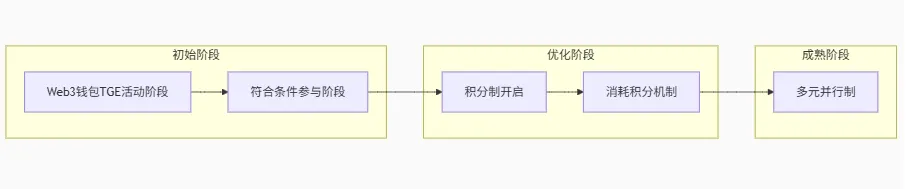
Initial Phase:
Binance initiated its first Web3 Wallet TGE event for $SHELL in early February. Participants needed to commit 3 BNB as subscription funds. The $SHELL project delivered a daily return of $280 on launch, peaking at $583. Subsequent events saw uniformly strong performance, generating significant market enthusiasm.
However, due to bot farms and studio accounts mass-registering, returns began to decline. Consequently, Binance introduced eligibility criteria for TGE participation—primarily requiring users to trade Alpha tokens or hold them.
Optimization Phase:
Points = Trading Points + Balance Points
Users meeting the minimum point threshold could participate in TGE events and receive direct Alpha token airdrops. Later, a penalty system was further refined, with each participation costing 15 points.
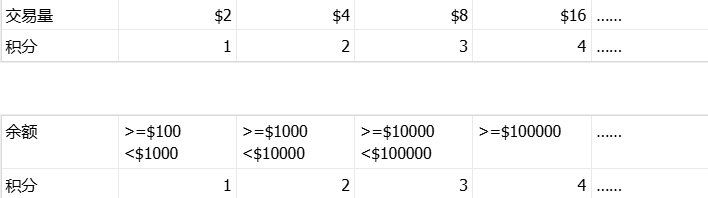
The design and implementation of the points system effectively fostered healthy competition within the Alpha ecosystem, maintaining system fairness via incentive mechanisms and providing institutional safeguards for long-term platform vitality. However, bot-driven behavior—using low-quality tokens as stablecoins to inflate trading points—temporarily boosted volume but planted seeds for future market risks.
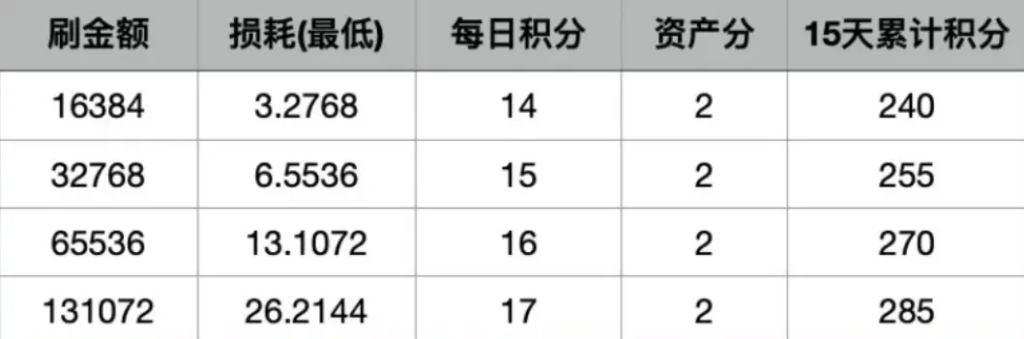
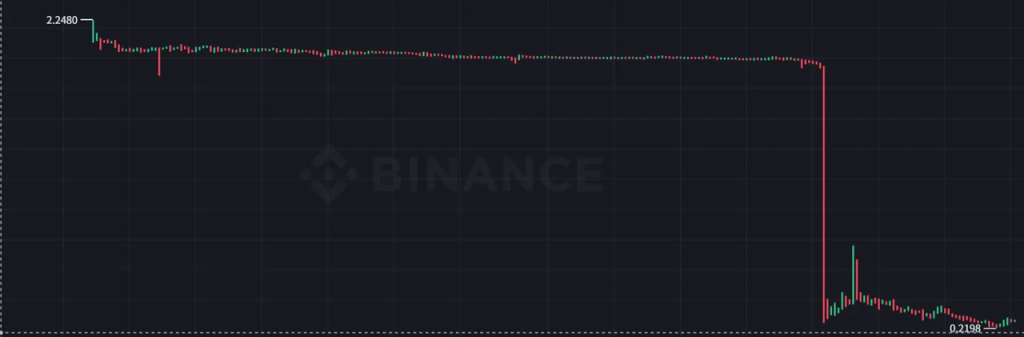
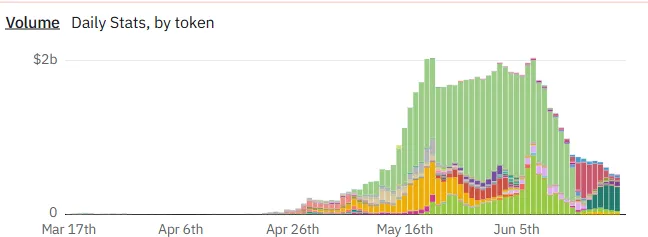
To maximize points while minimizing transaction slippage, users increasingly favored low-volatility, low-slippage tokens for point farming. ZKJ and KOGE, due to their high liquidity and stability, were jokingly dubbed “Alpha Stablecoins” by the market. At their peak, these two tokens collectively accounted for over half of Alpha’s total trading volume.
Yet, the crash on June 15 served as a wake-up call—both “star tokens” collapsed sequentially, suffering drops exceeding 100%. Countless point-farming users suffered severe losses, severely damaging confidence in the Alpha market. Post-collapse, trading enthusiasm visibly declined, and market sentiment turned colder.
Alpha’s trading volume has since declined from a peak of over $2 billion to around $500 million today (the light green portion in the chart represents the former share of ZKJ and KOGE).
Maturity Phase:
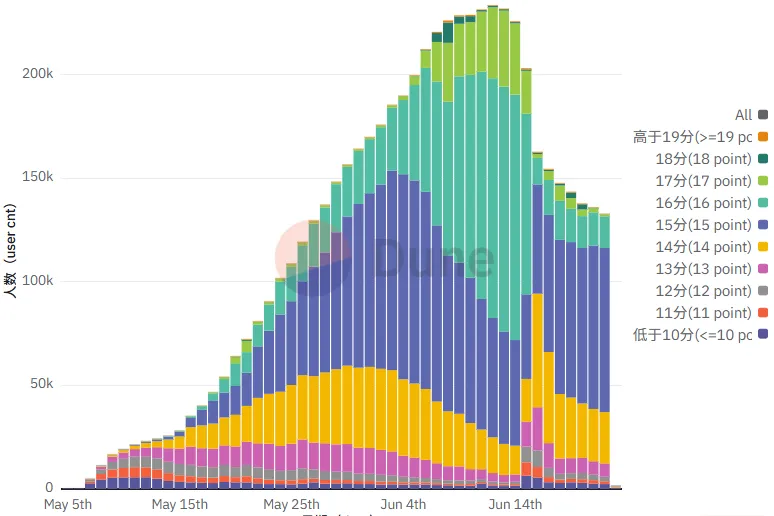
After the collapse of low-quality tokens, overall trading volume on the Alpha section dropped significantly, yet point thresholds remained high, while airdrop yields continued to fall—creating a clear mismatch between high input and low output.
This shift stems from dual pressures: frequent new project launches and continuous user saturation. The chart below shows that despite a cooling market, thousands of users still persistently farm 15 points daily, transforming Alpha into an intense battleground of strategic gaming.
To address inequities caused by bot farms and studios, Binance repeatedly introduced new regulations—such as staged airdrop distributions and task-based participation.
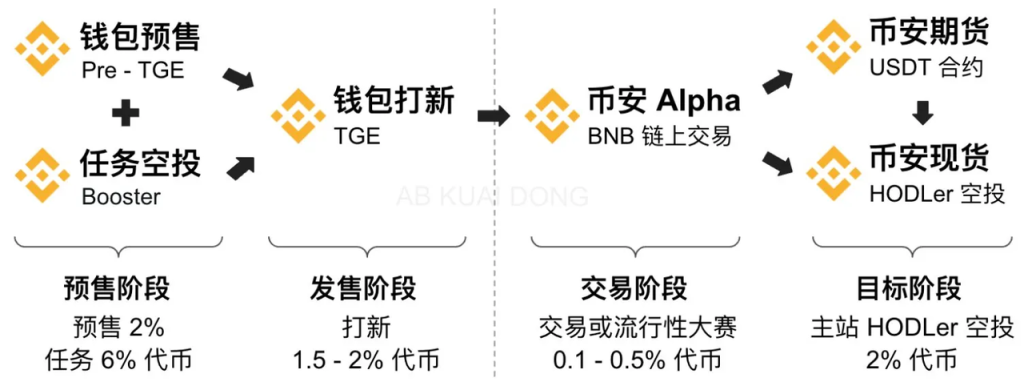
New rules clearly separate TGE, pre-sales, and tasks into three distinct participation pathways, establishing a new tripartite distribution framework.
This signifies Binance’s formal integration of “discounted pre-sales + task-based airdrops + Alpha points mechanism,” directly competing with CoinList, Galxe, and Kaito.
Beyond revised pre-sale and task airdrop policies, Binance Square has also entered the scene, launching a task-based incentive platform akin to the social incentive protocol Kaito.

2. Evaluation of Alpha
1) Performance Analysis of Alpha
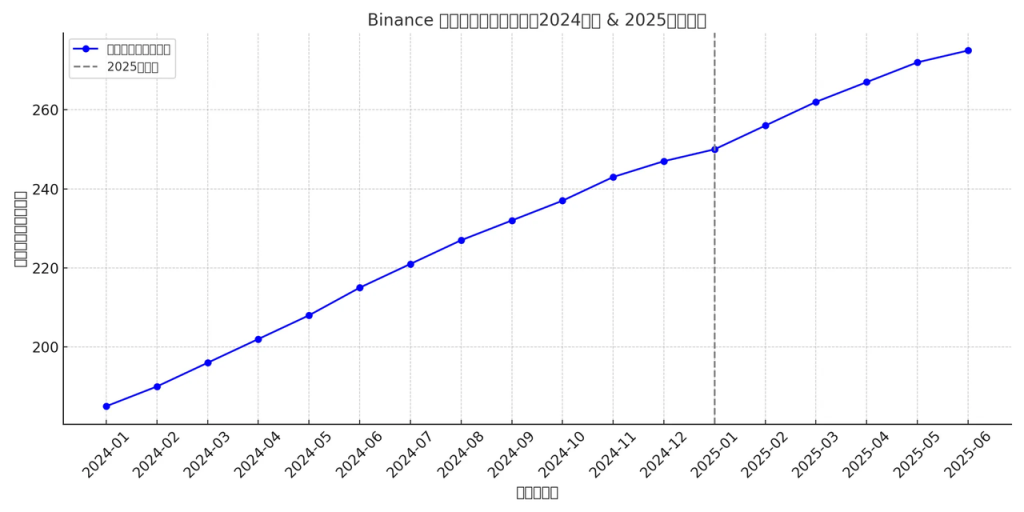
Undoubtedly, Alpha has driven substantial traffic and revenue growth for Binance. Trading volume on the Web3 Wallet surged, and user registration growth became markedly faster.
The blue line represents monthly users (in millions), steadily increasing from 185 million in January 2024.
The dashed gray line (2025-01) marks the beginning of 2025, clearly showing a faster growth rate in the first half of 2025.
Comparative observation:
First half of 2024: 185M → 200M, a 15-million increase over six months.
First half of 2025: 250M → 275M, a 25-million increase over six months, indicating a significant rise in monthly growth rate.
Note: Due to Binance not regularly disclosing user data, potential discrepancies may exist.
2) Fundamental Analysis of Alpha (Binance Completes the Closed Loop: Financing–Preheating–Token Issuance–Listing; Web3 Project Pathways Fully Platform-Centric)
Project teams listing on Alpha are required to allocate approximately 5% of their total token supply for distribution via Alpha.
Before Alpha, this portion of tokens was typically used for on-chain early airdrops or community incentives. In essence, Alpha consolidates and encapsulates what were previously decentralized market distribution and reward mechanisms into the Binance ecosystem, allowing Alpha users to directly capture this value.
Building on this foundation, Binance reintroduced task mode (Booster Airdrops), mirroring on-chain platforms like Galxe. Social media “mouth-slinging” campaigns (via Binance Square) emulate chain-native protocols like Kaito. This unifies all channels for token promotion and issuance into a single integrated system.
Web3 project launches and community incentives are evolving toward platformization and standardization. Binance is now fully integrating the entire lifecycle—from early-stage project initiation to circulation.
Disclaimer: Contains third-party opinions, does not constitute financial advice


AI Practical Guide
This column focuses on the real progress of Agents: technological evolution, application implementat

Crypto Weekly
Tracking on-chain movements of the smart money and institutions

Frontier Insights
Spotlight on Frontier, trending projects, and breaking events

Blowup Alert
As the 2026 crypto bear market deepens, exit scams and project blowups are becoming increasingly fre

Regulatory Watch
American Crypto Act – timely interpretations of policies worldwide

Popular Airdrop Tutorial
Selected potential airdrop opportunities to gain big with small investments

FusnChain
FusnChain