
ChainThink
Stay ahead, master crypto insights
begins to correct, is it the top?
begins to correct, is it the top?

2025-06-27 18:31
Circle went public with a market capitalization of $58.2 billion, and its valuation sustainability heavily depends on the core revenue engine - the supply volume of stablecoin USDC. As a key entry point for institutions into the regulated digital asset field, over 95% of Circle's revenue comes from interest income (such as U.S. Treasuries and cash) on USDC reserve assets and minting and redemption fees. Therefore, its stock price is extremely sensitive to changes in USDC supply volume and short-term interest rates. This article decomposes the USDC supply curve and builds a forecasting model to analyze the core drivers of Circle's valuation.
Circle Valuation Structure
Circle currently has a P/E ratio more than 8 times that of Visa (around 15 times), and institutional holdings (such as ARK and BlackRock) reflect the market's long-term expectations for its "digital dollar infrastructure." Its profit formula can be simplified as:
Revenue = USDC Supply Volume × (Net Interest Margin NIM + Minting Fee)
- NIM: Dependent on the yield of reserve assets such as U.S. Treasuries; there is pressure to compress during the Federal Reserve's rate-cutting cycle;
- Supply Flow Fees: Increase with the growth of USDC minting and redemption volumes, requiring expansion of the ecosystem scenario.
The market pricing logic lies in: an increase in USDC usage rate on the payment network will offset the impact of falling interest rates. As of 2025, the circulation of USDC reached $61.2 billion, with a daily trading volume of $31.5 billion (a 406% increase from 2021), making it one of the most capital-efficient stablecoins on-chain.
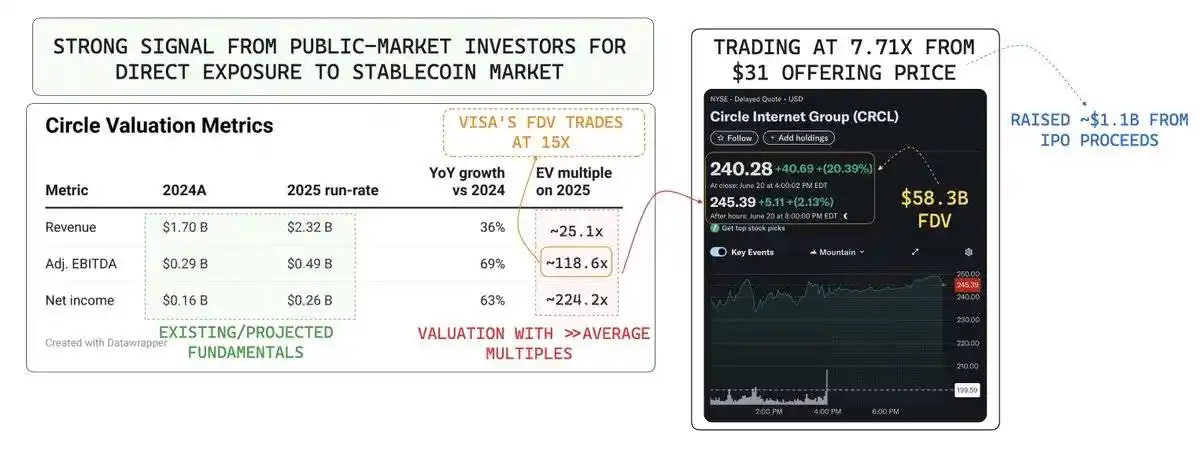
USDC Supply Dynamics: A Qualitative Shift from Scale to Efficiency
1. Market Landscape and Growth Drivers
The total supply of stablecoins reached $251 billion, with USDT (62.1%) and USDC (24.2%) accounting for 86% combined. USDC growth is driven by three forces:
- DeFi Resurgence: Crypto-native users have regained engagement;
- Traditional Finance Penetration: Settlement and cash management scenarios are being implemented;
- Coinbase Partnership: Leverage the world's largest crypto platform for ecosystem distribution.
2. Capital Efficiency: The Hidden Advantage of USDC
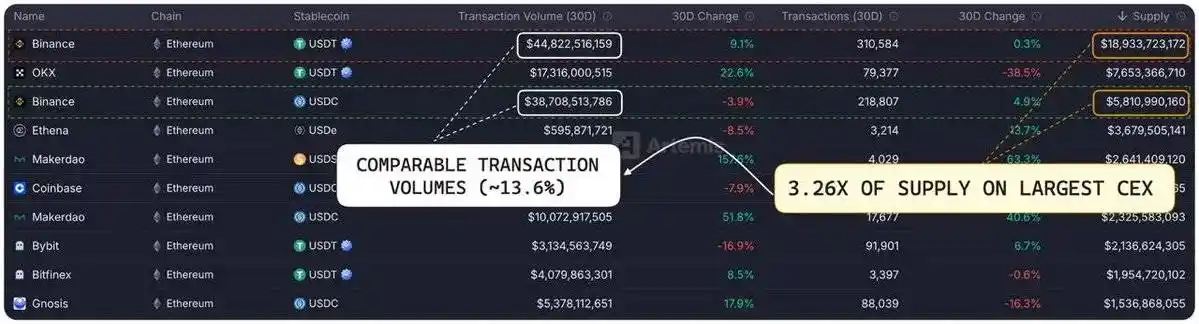
Although USDC supply (5.81 billion) is only one-third of USDT (18.9 billion), its 30-day trading volume reached 38.7 billion (only 13.6% behind USDT). Calculating the velocity of funds (trading volume / supply volume) shows:
- USDC fund velocity: 6.66 times (each dollar traded 6.66 times within 30 days);
- USDT fund velocity: 2.37 times;
USDC's on-chain capital turnover efficiency is 2.81 times that of USDT, reflecting its high-frequency usage characteristics in transaction and settlement scenarios.
3. Chain-Level Expansion: From Ethereum to Multi-Ecosystem Penetration
USDC supply is migrating from Ethereum to Layer2 and Alt-VM chains such as Solana and Arbitrum:
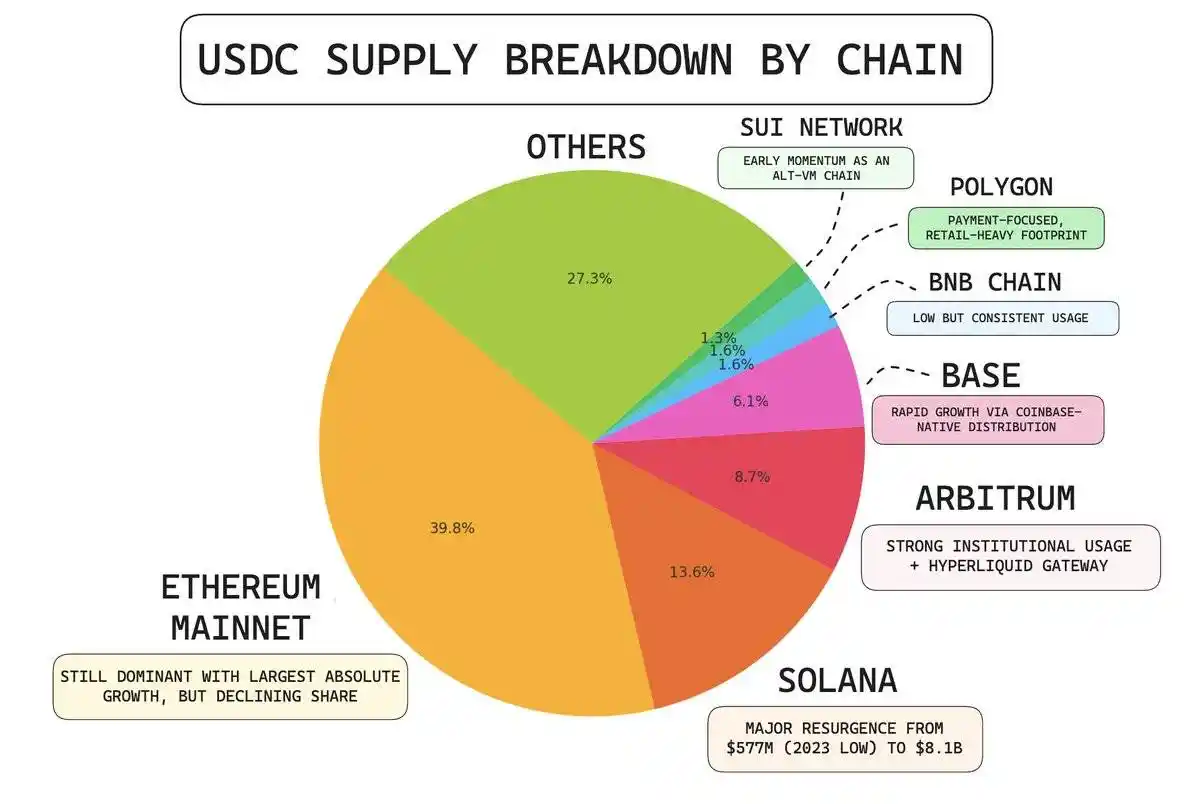
- Solana: USDC accounts for over 96% of stablecoin trading volume, becoming the core payment tool of the ecosystem;
- Arbitrum: With the explosion of protocols like Hyperliquid, USDC supply volume exceeded USDT, with bridge deposits reaching 3.62 billion (a 601% increase from Q4 2024).
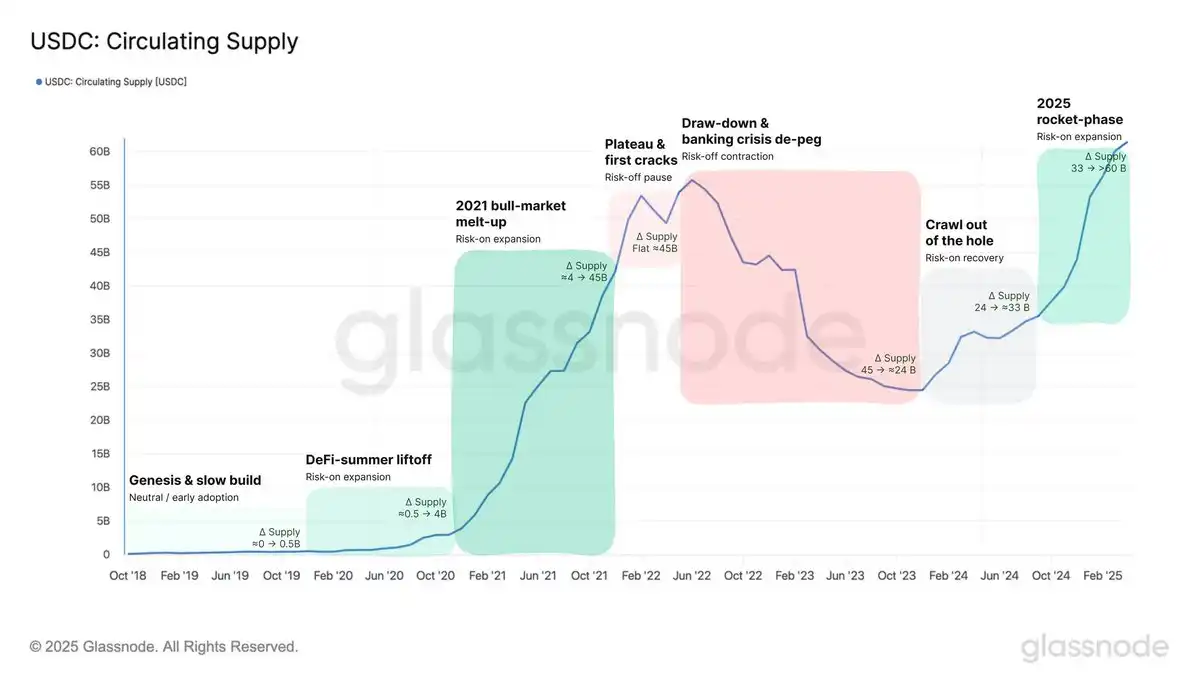
Supply Forecast Model
To quantify USDC supply dynamics, we built an autoregressive model (AR model):
- Feature Variables: Using moving average supply volumes of 1 day, 3 days, 7 days, etc.;
- Calibration Mechanism: Training with a 90-day sliding window to ensure adaptation to market changes;
- Prediction Accuracy: Since 2022, the 7-day supply volume prediction error has been controlled within ±1.5%.
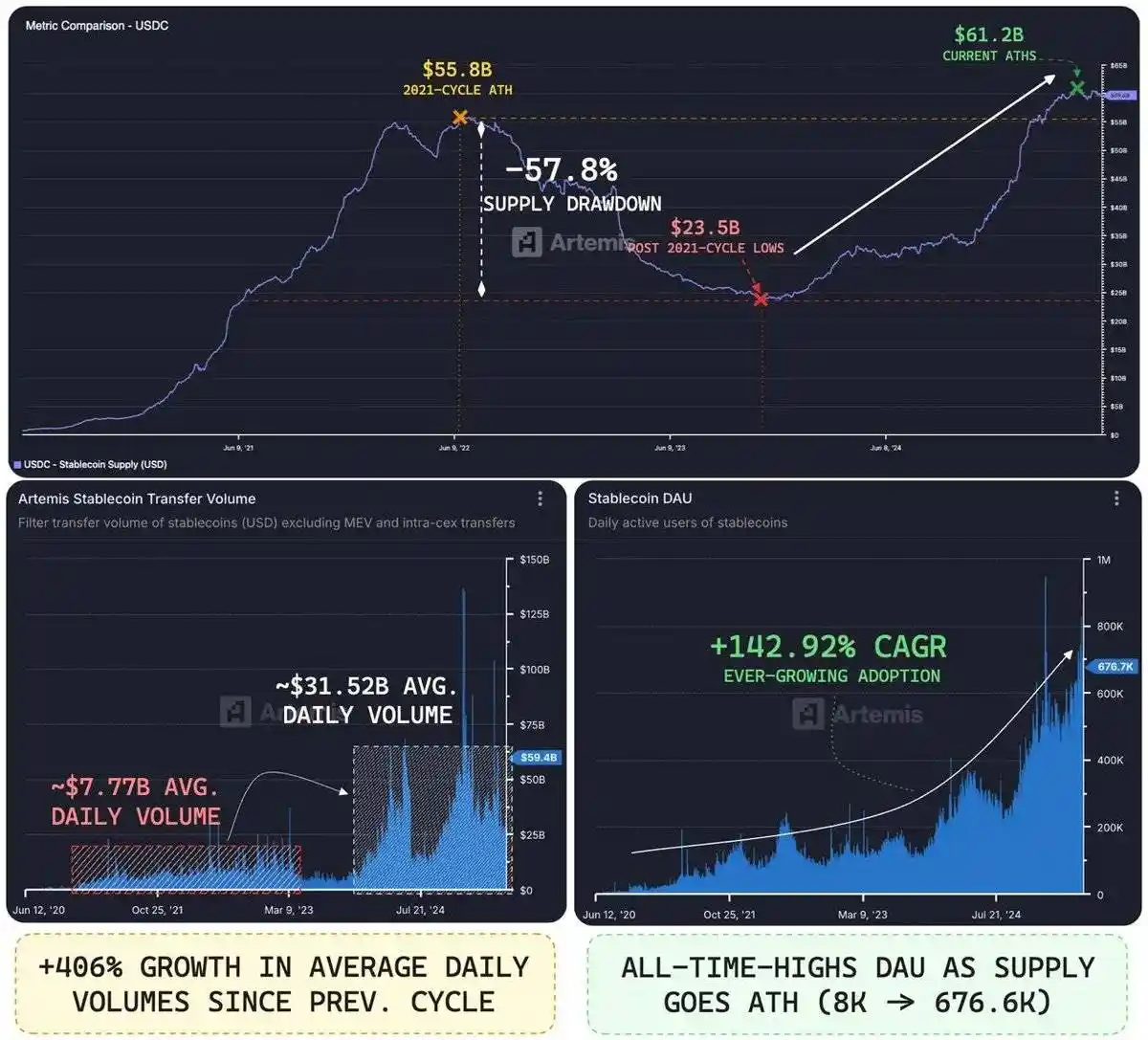
This model can directly convert supply increments into EBITDA sensitivity analysis, providing a fundamental proxy indicator for Circle's stock price - when the weekly USDC supply growth rate exceeds 5%, it often signals quarterly earnings exceeding expectations.
Valuation Inflection Point and Risk Warnings
Circle's $58.2 billion market capitalization essentially represents a "USDC ecosystem premium": if USDC supply growth slows down (e.g., due to regulatory policy shocks or a DeFi liquidity retreat), its high valuation will face correction pressure. Currently, two signals need close attention:
- On-chain Fund Velocity: If USDC trading frequency decreases, it may indicate a decline in ecosystem activity;
- Federal Reserve Policy: Whether the compression of NIM during the rate-cutting cycle exceeds the fee compensation brought by supply growth.
For investors, the short-term volatility of Circle's stock has moved beyond the traditional broker valuation framework and is deeply tied to on-chain native metrics of USDC (supply volume, trading volume, cross-chain flow). This characteristic brings both β opportunities in the crypto industry and hidden risks of stablecoin regulation and liquidity crisis.
Disclaimer: Contains third-party opinions, does not constitute financial advice


AI Practical Guide
This column focuses on the real progress of Agents: technological evolution, application implementat

Crypto Weekly
Tracking on-chain movements of the smart money and institutions

Frontier Insights
Spotlight on Frontier, trending projects, and breaking events

Blowup Alert
As the 2026 crypto bear market deepens, exit scams and project blowups are becoming increasingly fre

Regulatory Watch
American Crypto Act – timely interpretations of policies worldwide

Popular Airdrop Tutorial
Selected potential airdrop opportunities to gain big with small investments

FusnChain
FusnChain