Robinhood Bets on Tokenized Stocks, Thoroughly Igniting the On-Chain Broker Competition
Robinhood Bets on Tokenized Stocks, Thoroughly Igniting the On-Chain Broker Competition


Can a brokerage disrupt not only the commission system, but also the underlying architecture of global asset trading? Robinhood seems to have given its own answer. Just after the recent Cannes conference in France, this major player in the U.S. securities industry, known for zero-commission trading, unveiled an imaginative vision to the outside world: using blockchain and tokenization to bring stocks, derivatives, and even private equity onto the chain, ultimately building a new Layer2 public blockchain capable of supporting global real assets - Robinhood Chain.
This conference was more than just a product list; it was a declaration of Robinhood's vision for the next decade. The European, American, and global markets were each assigned different breakthrough points, yet they resonated with each other, collectively painting a new order of round-the-clock trading driven by tokenized assets. This article will be divided into three parts, analyzing this "on-chain brokerage" strategy in depth, combining information from the Robinhood conference and the broader industry context.

For the European Market: Tokenized U.S. Stocks + Perpetual Futures + All-in-One Investment App
Key Product Information:
1. Robinhood launches tokenized trading for over 200 U.S. stocks and ETFs, based on Arbitrum, expanding more assets by year-end
2. The European App upgrades from Robinhood Crypto to "Robinhood", positioning as an integrated investment platform
3. Perpetual futures will launch this summer, with simpler mobile orders
4. Bitstamp serves as the liquidity engine for perpetual and derivative products
5. Tokenized stocks support real-time dividends and stock splits
6. Europe covers 31 countries, starting in July, users can apply for SpaceX and OpenAI private token
Notable Details:
1. Three-stage path:
a. TradFi custody → Robinhood minting tokens
b. Bitstamp takes over weekend trading → 24/5 liquidity
c. Ultimately supports self-custody and cross-chain
2. Deposit before July 7th gets 2% reward 3. App name change and UI upgrade, strengthening "investment super app" positioning
Robinhood views European users as the vanguard of its tokenization strategy, and the reason is easy to understand: the EU recently implemented MiCA (Markets in Crypto-Assets Regulation), which is relatively clearer than U.S. regulations, and Robinhood's penetration rate in the EU is far from saturated.
At the conference, Robinhood announced that over 200 U.S. listed stocks and ETFs will be tokenized through Arbitrum Layer2, allowing European users to buy and sell these tokenized stocks on the Robinhood platform as if trading digital currencies. Due to the introduction of on-chain settlement mechanisms by Robinhood, dividends, stock splits, and other rights will automatically update in the token holders' accounts. Users do not need to learn complex blockchain details, almost seamlessly obtaining a 24/5 tradable U.S. stock token market.
Robinhood stated that it will continue to expand tokenized assets by year-end, planning to cover "thousands of U.S. stocks and ETFs." Technically, all transactions at this stage will be completed through collaboration between Robinhood and traditional brokers to purchase stocks and mint equivalent tokens, ensuring a 1:1 real holding. In the future, this process will gradually move to the self-developed Robinhood Chain, enabling cross-chain and self-custody capabilities.
In addition to tokenized stocks, Robinhood also announced the launch of perpetual futures trading in Europe, supported by Bitstamp for trade matching and settlement. This is the first deep integration after Robinhood's $200 million acquisition of Bitstamp last year. Robinhood particularly emphasized the user experience innovation in perpetual futures: on the mobile interface, originally complicated margin, stop-loss, and take-profit configurations have been simplified into sliding bar operations, allowing retail investors to access advanced leverage tools with lower barriers.
To respond to these major updates, Robinhood renamed the original "Robinhood Crypto" European app to "Robinhood," positioning it as an All-in-One investment super app, integrating cryptocurrency, tokenized stocks, and perpetual futures, aiming to establish a first-mover advantage in the EU 31 countries + EEA.
The most surprising to the industry was Robinhood's announcement of the "private equity token" plan at the event: starting from July 7th, European Robinhood users will be able to apply for the first batch of tokenized equity of SpaceX and OpenAI. This means that Robinhood has broken the traditional model of private equity long dominated by the wealthy and institutions, opening up shares of the world's most closely watched tech startups to retail users in the form of tokens.
This approach actually answers a long-discussed question in the blockchain circle: how can ordinary people fairly participate in future wealth accumulation? Robinhood's answer is: private equity should be tokenized, and equal access should be ensured.
For the U.S. Market: Advanced Cryptocurrency Trading + AI Assistant + Staking
Key Product Information:
1. Advanced charts and indicators of Legend platform will support mobile in the future
2. Launch Smart Exchange Routing, automatically matching the lowest fees
3. Provide precise position selection, convenient for tax management
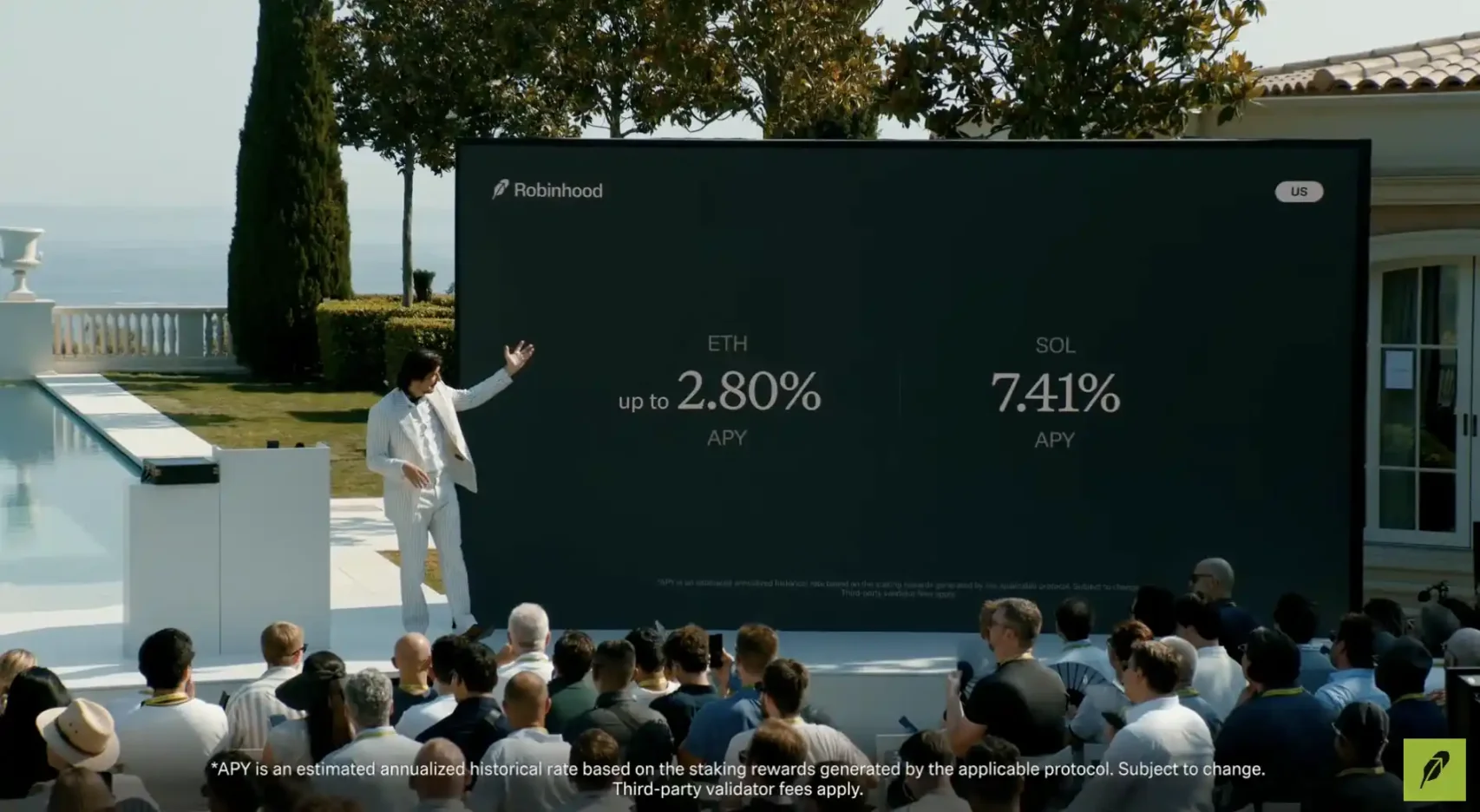
4. Staking will be launched in the U.S., initially supporting ETH, SOL
5. AI assistant Cortex serves Robinhood Gold users
6. Rabbit Gold Card can later offer crypto cashback 7. These features will be expanded to Europe in the future
Notable Details:
1. Staking activity offers 2% reward and removes the threshold
2. Cortex information stream includes token dynamics and on-chain events
3. Smart Routing for large transactions can go as low as 0.1% all-in
4. Staking is positioned as a "community security" participation method
If Europe is Robinhood's tokenization test field, then the U.S. is undoubtedly its most solid main battlefield. Robinhood released product upgrades targeting the U.S. market during this conference, aiming to solidify its position as the preferred platform for active traders through in-depth tools and richer investment scenarios.
First, Robinhood announced the launch of staking products in the U.S., initially supporting Ethereum and Solana, and removing the minimum stake threshold. During the campaign, users can enjoy a 2% deposit reward regardless of the amount staked. CEO Vlad Tenev repeatedly mentioned another meaning of staking: it is not only a way to earn rewards, but also an opportunity for every user to participate in maintaining network security. He said, "The security of blockchain comes from people, and staking is also Robinhood's way of involving users in the construction of the financial system."
In terms of trading tools, Robinhood's flagship product Legend (currently mainly on desktop) announced that it will migrate advanced charts, customizable indicators, and deep order book functions to mobile this summer. This move is especially attractive to mobile traders, as Robinhood previously had significant gaps in mobile functionality compared to its professional desktop version.
Combined with Legend, Robinhood also launched the Smart Exchange Routing feature, seeking optimal liquidity across multiple exchanges and automatically routing it, dynamically calculating fees based on 30-day rolling transaction volume, as low as 0.1%, while eliminating the traditional maker/taker distinction. This logic is highly similar to the "smart quote routing" commonly used in the U.S. stock industry, marking a key step for Robinhood to attract large-scale and quantitative crypto traders.
In addition, Robinhood also announced the AI investment assistant Cortex at the meeting, which will be available to Robinhood Gold users in the future, providing comprehensive analysis integrating market dynamics, large on-chain transfers, token news, and even company earnings reports. The goal of Cortex is to help users understand the fundamental reasons behind digital asset fluctuations, not just provide simple price reminders.
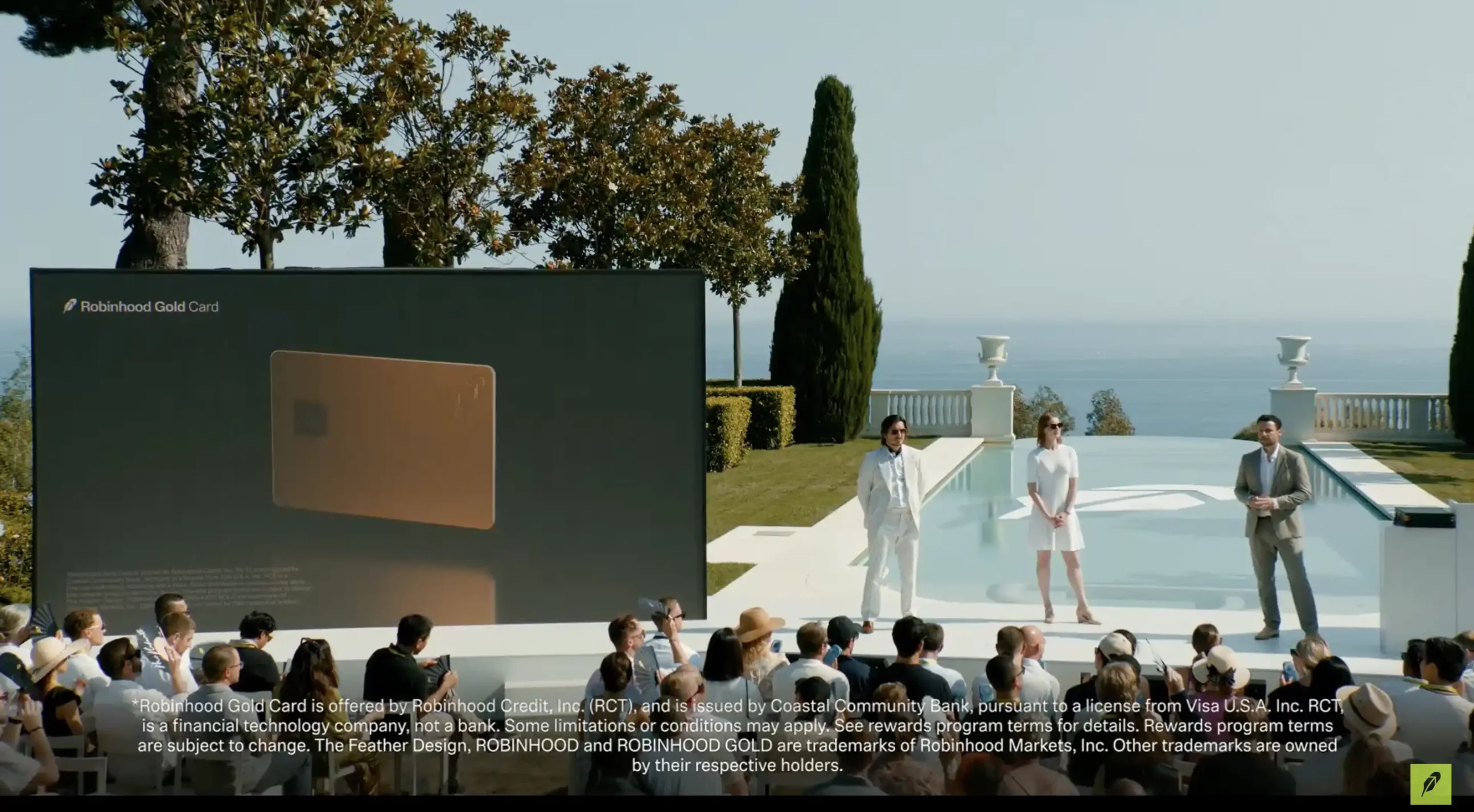
Finally, the Robinhood Gold credit card (Rabbit Gold Card) will add a "crypto cashback" feature, allowing cardholders to automatically convert daily spending cashback into selected cryptocurrencies. Robinhood stated that this is an innovation breaking the traditional cashback logic, aiming to seamlessly integrate users' daily lives with on-chain asset management.
Overall, Robinhood is upgrading from a "zero-commission broker" to an "all-in-one on-chain asset management platform" in the U.S. market, reflecting further deepening of its user lifecycle management through staking, AI, credit cards, and smart routing.
Global Strategy: Robinhood Chain + Private Equity Token + Full Ecosystem On-Chain
Key Product Information:
1. Robinhood Chain is built on Arbitrum
2. Mid-term switching between Bitstamp/TradFi liquidity
3. Long-term allows self-custody and cross-chain migration
Notable Details:
1. SpaceX and OpenAI private equity tokens will be launched first, private tokens are seen as a key to breaking high-net-worth barriers
2. Collaborating with regulators to promote compliant on-chain, and opening up to developers to promote RWA ecosystem in the future
All these products mentioned above will eventually converge into Robinhood's "global strategy" - Robinhood Chain.
Robinhood Chain evolved from the Arbitrum technology stack, and is positioned by Robinhood as the "first Layer2 public blockchain dedicated to real assets." It will not only carry Robinhood's tokenized stock trading, but also support the tokenization of all types of real assets in the future, including real estate, bonds, art, and carbon credits.
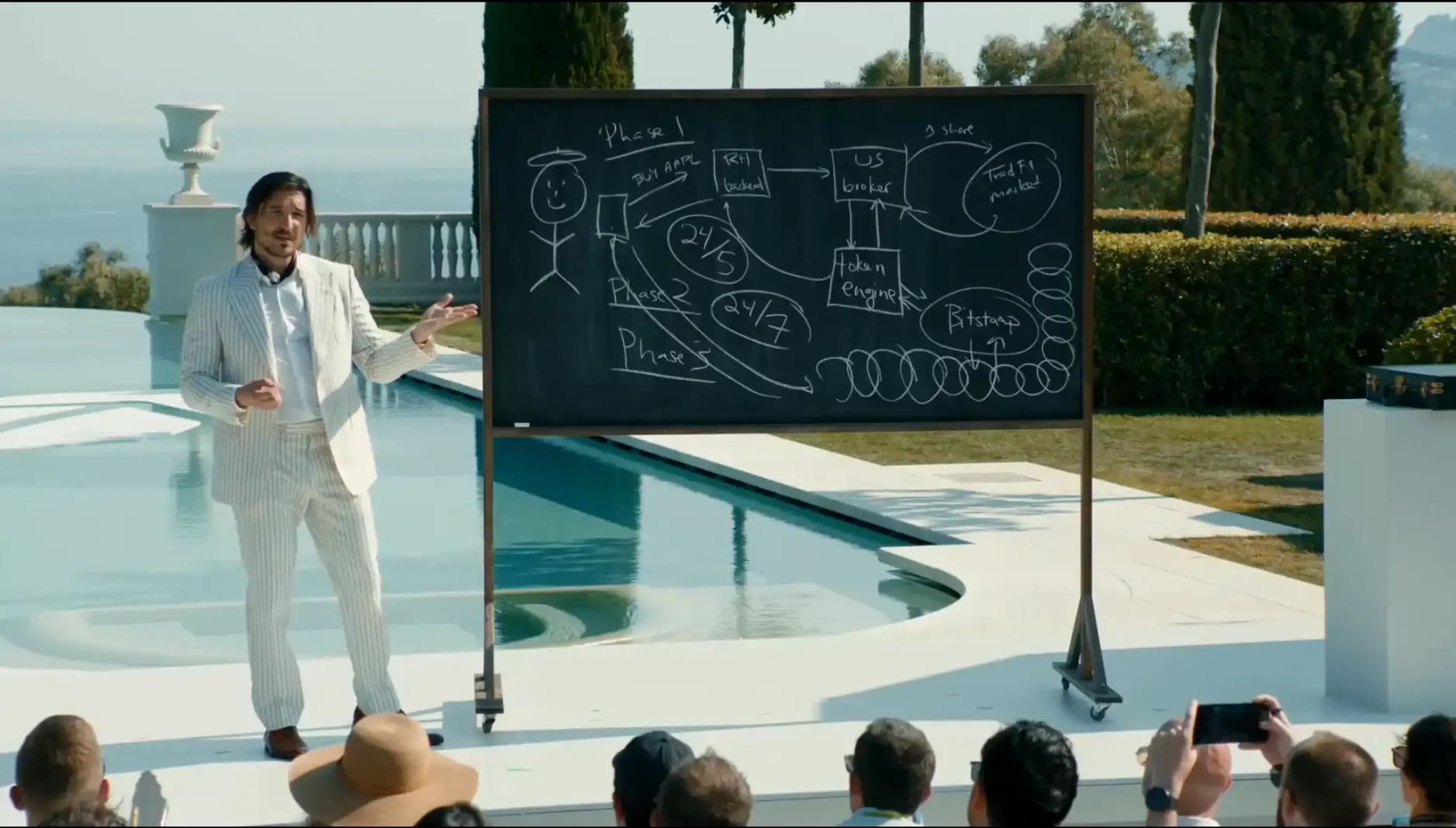
At the conference, Vlad Tenev presented a "three-stage" plan:
First stage: After users place orders, Robinhood's U.S. brokers purchase stocks from traditional exchanges and hold them, and Robinhood generates tokens and distributes them synchronously, ensuring a 1:1 match with physical assets.
Second stage: Integration of Bitstamp and TradFi liquidity, enabling continued trading when traditional stock markets are closed (such as weekends, holidays).
Third stage: Fully unlock the self-custody transfer capability of tokens, allowing users to migrate these Robinhood-generated assets cross-chain to personal wallets or other DeFi protocols for use.
In other words, Robinhood Chain is not only Robinhood's own "Layer2 settlement network," but also a public blockchain ecosystem open to global developers in the future, allowing third-party projects to issue real asset tokens on it.
This model forms a direct competition with Coinbase and Kraken's recent exploration of RWA (Real World Assets) strategies. Unlike them, Robinhood has a brokerage license and started with U.S. stock tokenization, having a complete compliance brokerage chain, which allows it to more quickly connect traditional finance and blockchain compliance channels than purely exchange-based platforms.
Especially worth noting is that Robinhood simultaneously announced the immediate distribution of OpenAI and SpaceX private equity tokens at the event. These tokens can flow on Robinhood Chain even on weekends, not relying on a single custodian, and allow free cross-chain usage afterwards. This attempt may change the liquidity structure of the entire private investment industry, just like Robinhood's previous push for the zero-commission revolution, possessing strong disruptive potential.
From the perspective of industry observers, if Robinhood successfully turns Robinhood Chain into a global real asset base, not only stocks or futures, but also real estate, art, and even carbon emission credits, could become combinable assets in Robinhood users' wallets in the future. This would be a very profound transformation of the global financial system.
The Prototype of an On-Chain Brokerage
From zero commissions, to fractional stock trading, to today's "Robinhood Chain," Robinhood is writing a continuous innovation path: each step targets the barriers and inefficiencies in the traditional financial system, greatly reducing entry barriers through technological means.
When tokenization moves from a single apple stock to a building, a private equity share, or even an artwork, blockchain is no longer just a buzzword, but truly possesses the significance of an "asset internet." Robinhood has seen this opportunity and hopes to use its user volume and brand trust to get ahead during the window period when regulation becomes clearer.
Ripple and BCG's report predicts that by 2033, the global tokenized real asset market could reach $18.9 trillion. Robinhood obviously does not want to be just a participant, but wants to become the foundation builder of this market. The statement at the Cannes conference might serve as a closing remark: "The foundation of the global financial system of the future is Robinhood Chain."
Disclaimer: Contains third-party opinions, does not constitute financial advice
A whale address has seen its short position losses on BTC and ETH increase to $8.6 million, and has added $8 million in U collateral to avoid liquidation.
09-12
The three major U.S. stock indices all hit new highs, with Circle (CRCL) surging 17.6%, and the new listing Figure (FIGR) closing up 24.44% on its first day.
09-12HYPE surges above $57, setting a new all-time high.
09-12REX-Osprey DOGE ETF Again Delayed to Midweek Next Week for Listing
09-12Musk again warns about the $37 trillion national debt.
09-12LazAI airdrops $CALITH to whitelisted users of Lazbubu, with a total value of 50,000 USD, and the claiming window is open for 72 hours.
09-11Traders are reducing their bets on the European Central Bank's accommodative policy, implying that the rate-cutting cycle has ended.
09-11