
ChainThink
Stay ahead, master crypto insights
Is Bitcoin No Longer Attractive? Four Listed Companies Bet on New Ways to Earn Money with Ethereum
Is Bitcoin No Longer Attractive? Four Listed Companies Bet on New Ways to Earn Money with Ethereum

2025-07-15 12:27
Author: Christopher Rosa
Michael Saylor's innovative strategy at MicroStrategy (formerly MicroStrategy, stock code MSTR) is pioneering. He has significantly increased his Bitcoin holdings using financial instruments, a move that has triggered a trend in the corporate sector. Since then, more than 50 companies have followed his lead by adopting Bitcoin as a core reserve asset, and this number continues to grow. However, a group of forward-thinking companies are taking a different approach: they not only pursue exposure to cryptocurrency but also aim to deeply integrate with Ethereum's economic engine.
In this report, we will focus on the first four U.S. listed companies that have established Ethereum reserves, analyze their fundraising activities, assess their "Ethereum concentration" (the amount of Ethereum held per share), and examine the market premium attributed by investors to these companies' Ethereum-backed reserves. In addition to these metrics, we will also explore the broader impact of this phenomenon on the health of the Ethereum network, the staking ecosystem, and DeFi infrastructure, emphasizing that these reserve strategies not only reshape corporate balance sheets but also directly inject capital into the core of Ethereum's decentralized economy.
SharpLink Gaming (SBET)
Company Background
SharpLink Gaming Ltd. (Nasdaq: SBET) was founded in 2019 as a technology company. The company matches sports enthusiasts with timely sports betting and interactive gaming services through its proprietary platform, converting them into bettors. In addition, the company develops free games and mobile applications and provides marketing services to sports media organizations, leagues, teams, and betting operators to enhance fan engagement. Moreover, SharpLink operates real-life fantasy sports and simulation games with over 2 million users and annual spending of nearly $40 million. Furthermore, the company has obtained operating licenses in all U.S. states where fantasy sports and online gambling are legally permitted.
Last month, SharpLink began accumulating Ethereum (ETH) on its balance sheet and financed these acquisitions through a combination of private placement investments (PIPEs) and at-the-market (ATM) offerings. The company's management team stated that this strategic shift stems from their firm confidence in Ethereum's future, believing that as a yield-generating, programmable digital asset, it can allow the company to profit from staking and related revenue opportunities. Despite adopting this novel financial strategy, SharpLink remains fully focused on its core gaming and interactive betting business, with the Ethereum reserve strategy serving as a supplement rather than a replacement for its core operations.
Fundraising and Ethereum Acquisition
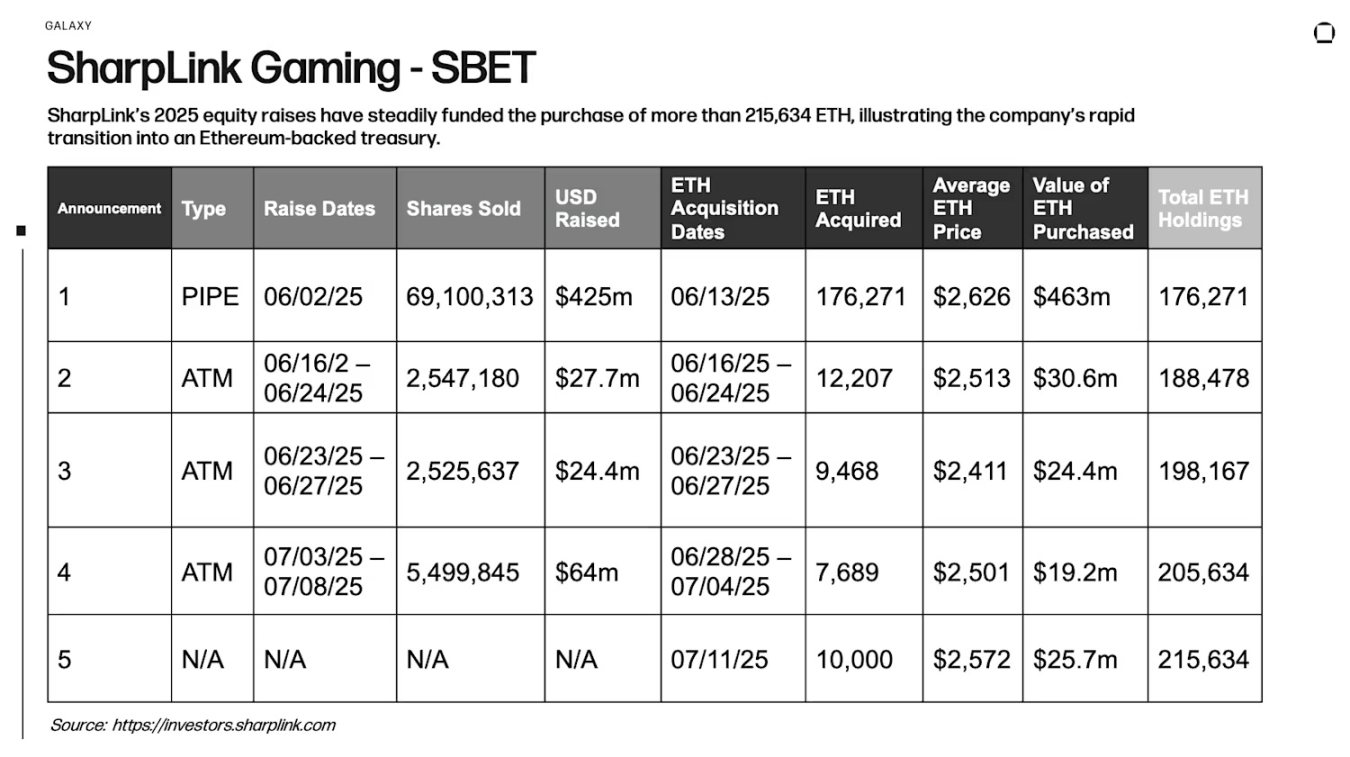
SharpLink raised funds through equity financing in 2025, which have been steadily used to purchase over 215,634 ETH, indicating that the company is rapidly transitioning to an Ethereum-backed reserve model.
Ethereum Deployment and Staking
SharpLink has staked all of its Ethereum reserves, earning 100 ETH in rewards between June 28 and July 4, and a total of 322 ETH in staking rewards since the staking program started on June 2.
Key Points
SharpLink Gaming's strategic move into Ethereum has made it the company with the largest Ethereum reserve among listed companies. Through multiple rounds of equity financing (including a $425 million large-scale private placement investment and subsequent at-the-market offerings), the company has quickly accumulated the largest Ethereum holdings in the industry. Although this reserve strategy carries risks (including the impact of Ethereum price volatility), it also holds significant potential for staking returns, highlighting the appeal of proof-of-stake digital assets as reserve assets. By staking 100% of its Ethereum reserves, SharpLink not only generates income but also directly contributes to the security and stability of the Ethereum network. This enriches the diversity of validator participation and creates a synergy between corporate capital and protocol development.
BitMine Immersion Technologies (BMNR)
Company Background
BitMine Immersion Technologies Inc. (NYSE American: BMNR) is a blockchain infrastructure company based in Las Vegas, engaged in operating industrial-level Bitcoin mining farms, selling immersion cooling hardware, and providing hosting services for third-party mining equipment in regions with lower energy costs such as Texas and Trinidad.
On June 30, the company raised approximately $250 million by issuing 55.6 million shares at a price of $4.50 per share to expand its Ethereum reserves. As part of the transaction, Tom Lee, co-founder of Fundstrat, was appointed as chairman of BitMine's board, adding the guidance of a seasoned cryptocurrency strategist to the company's expansion of Ethereum configuration.
Fundraising and Ethereum Acquisition
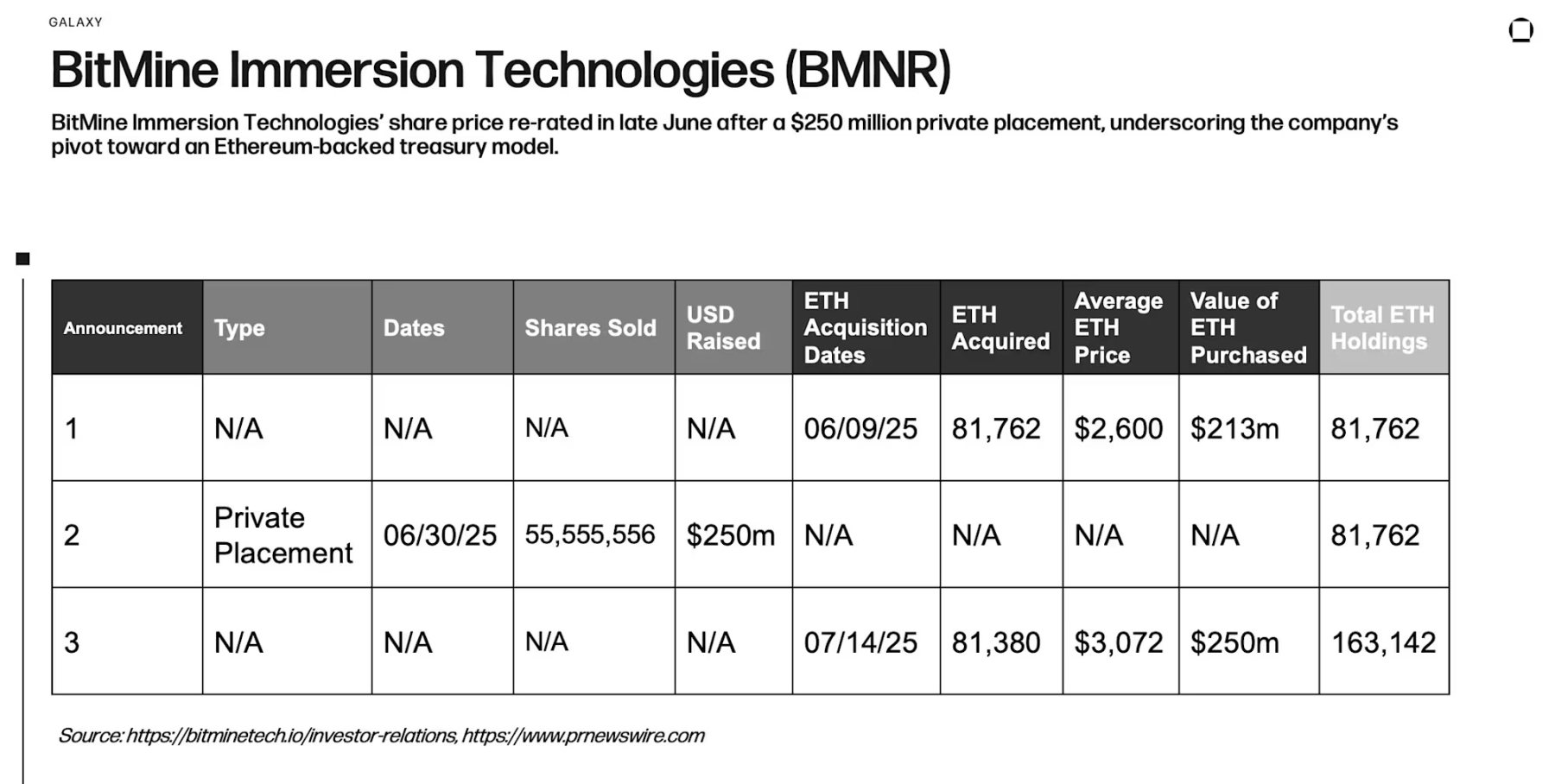
In late June, BitMine Immersion Technologies revalued its stock after completing a $250 million private placement, highlighting its transition to an Ethereum-backed reserve model.
Ethereum Deployment and Staking
BitMine holds a large amount of Ethereum reserves, but as of the writing of this article, there is no public information confirming whether it has used part of the reserves for active staking or deployed them on-chain in other ways.
Key Points
BitMine raised $250 million in financing, adding approximately 81,380 ETH to its balance sheet, bringing its total holdings above 163,000 ETH. To support this reserve accumulation, BitMine expanded its diluted shares to over 56 million, increasing by about 13 times. Such a scale of dilution highlights that implementing a large-scale Ethereum reserve strategy requires substantial equity issuance support, reflecting the capital-intensive nature of accumulating Ethereum in the public market.
Bit Digital (BTBT)
Company Background
Bit Digital Inc. (Nasdaq: BTBT) is a digital asset platform based in New York, founded in 2015, initially operating industrial-level Bitcoin mining farms in the United States, Canada, and Iceland.
In June 2025, the company completed a fully underwritten public offering, raising approximately $172 million; simultaneously, it combined the proceeds from selling 280 Bitcoins with the offering proceeds to reinvest in Ethereum, accumulating approximately 100,603 ETH. Under the leadership of CEO and cryptocurrency veteran Sam Tabar, the company completed its transition to an Ethereum staking and reserve model.
Fundraising and Ethereum Acquisition
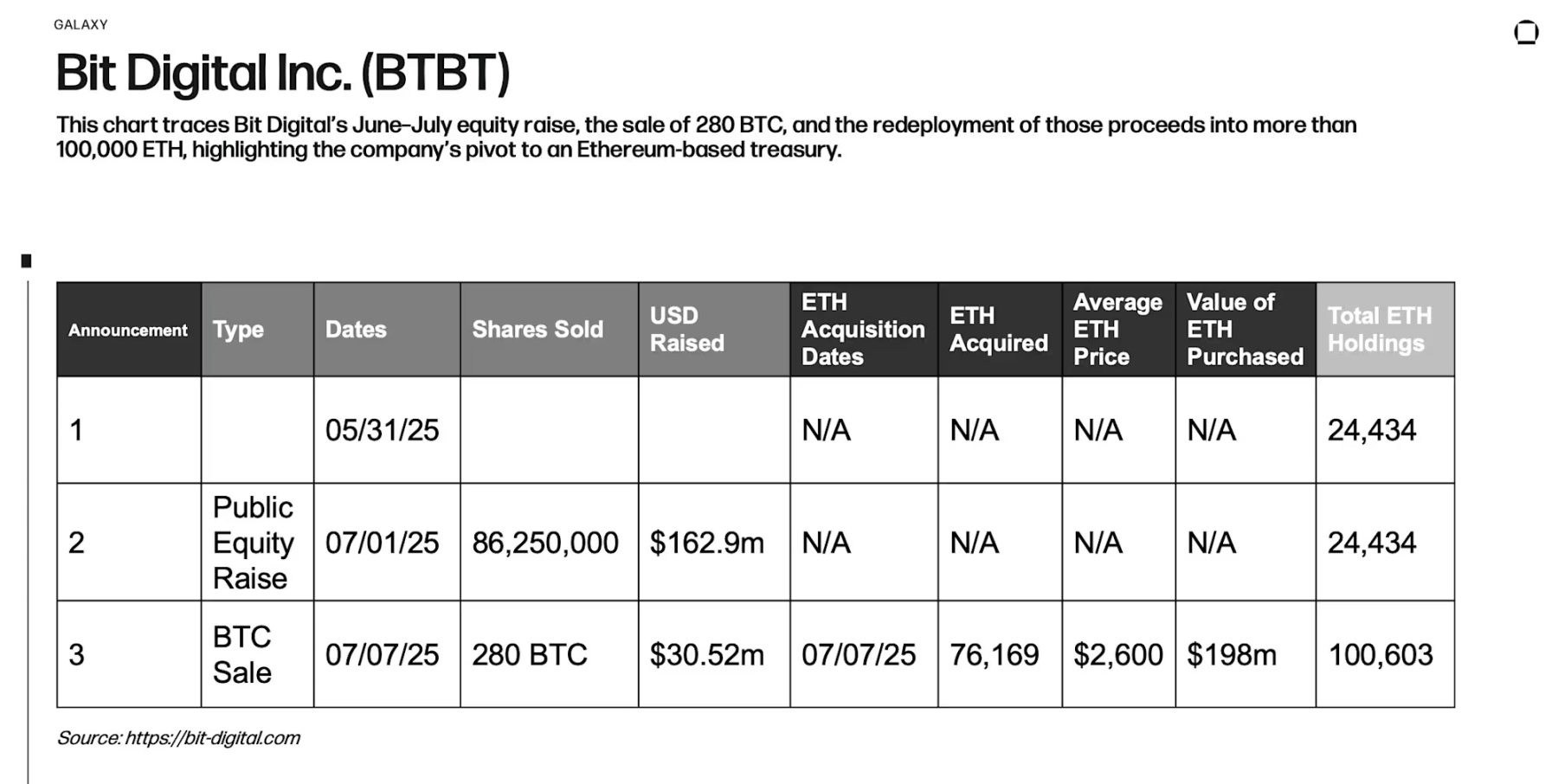
This chart traces Bit Digital's equity financing from June to July, the sale of 280 Bitcoins, and the reallocation of these funds into over 100,000 ETH, highlighting the company's transition to an Ethereum-centric reserve model.
Ethereum Deployment and Staking
As of March 31, Bit Digital held approximately 24,434 ETH, with 21,568 ETH actively staked, and the average annualized yield for Ethereum staking in 2024 was 3.2%.
After the strategic adjustment, Bit Digital significantly expanded its Ethereum reserves through public offerings and the sale of Bitcoin, increasing its total holdings to 100,603 ETH. Although the company has not disclosed specific staking numbers and expected returns after the transformation, based on past operations, it will continue to focus on generating income through Ethereum staking.
Key Points
Bit Digital's reserve transformation is particularly noteworthy: it combines traditional public equity financing with the unconventional measure of liquidating Bitcoin holdings to purchase Ethereum. This strategy makes Bit Digital stand out among listed cryptocurrency companies, demonstrating its strong confidence in Ethereum's ability to generate returns. Compared to Bitcoin's passive role on the balance sheet, Ethereum's advantages are more pronounced.
GameSquare (GAME)
Company Background
GameSquare Holdings (Nasdaq: GAME) is a game media group headquartered in Texas, with brands such as FaZe Clan, Stream Hatchet, and GCN, focusing on creating creator-driven marketing content for global advertisers targeting Gen Z players. In July, the company raised approximately $8 million through a follow-on equity offering and partnered with the cryptocurrency company Dialectic to launch an Ethereum reserve plan, which can be configured up to $100 million in Ethereum with a target return of 8% to 14%.
Fundraising and Ethereum Acquisition
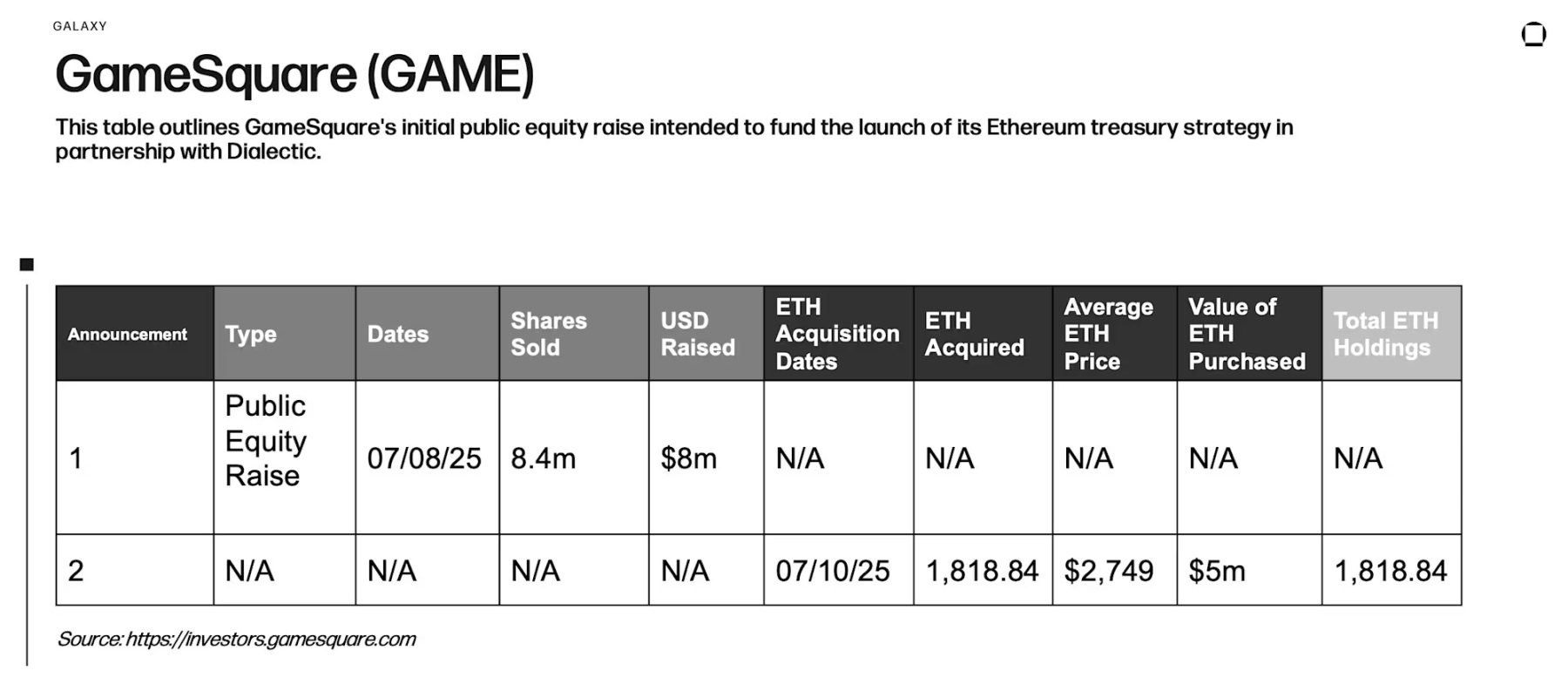
This table outlines GameSquare's initial public equity financing, which aims to provide funding for its Ethereum reserve strategy in collaboration with Dialectic.
Ethereum Deployment and Staking
As part of a broader digital asset reserve strategy, GameSquare has completed its first Ethereum purchase, acquiring $5 million worth of ETH. This move marks the company's official entry into the cryptocurrency reserve field, aiming to achieve asset diversification and support long-term innovation.
Key Points
GameSquare's shift to an Ethereum reserve strategy is a bold expansion beyond its core game media business. By partnering with Dialectic and leveraging its Medici platform, GameSquare plans to invest in DeFi to achieve returns higher than the standard Ethereum staking yield (usually 3% to 4%) (8% to 14%). If this strategy is successfully implemented, it will directly contribute to the stability and development of the entire Ethereum ecosystem by enhancing liquidity in key DeFi protocols and enriching the structure of validator participation. The active participation of corporate capital will further solidify the foundation of DeFi infrastructure.
Ethereum Concentration (ETH Concentration)
The "Ethereum Concentration" metric was initially proposed by SharpLink Gaming, providing investors with a clear and comparable measure to evaluate the exposure of listed companies that have built Ethereum reserves. The metric focuses on the amount of Ethereum held per 1,000 diluted shares, incorporating all potential equity dilution factors such as warrants, stock options, and convertible instruments. The Ethereum holding data presented either comes from direct company disclosures or is estimated based on the company's announced full allocation of equity financing to Ethereum. Diluted share counts come from company filings, Bloomberg, SEC documents, and financial databases, ensuring consistency and accuracy across different companies. This metric provides investors with an intuitive tool to assess relative Ethereum exposure levels on a per-share basis.
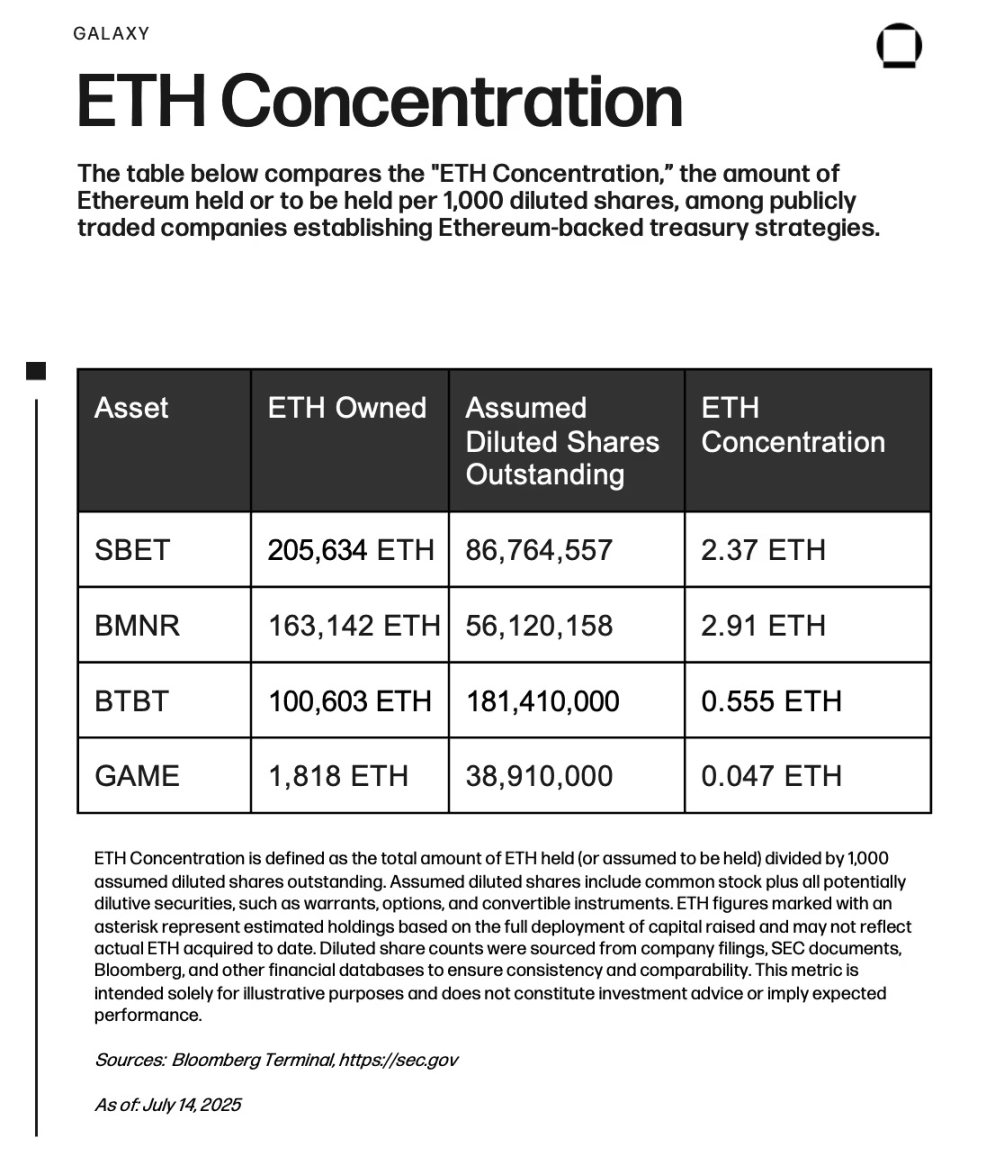
This table compares the "Ethereum Concentration" of listed companies that have adopted an Ethereum reserve strategy, i.e., the amount of Ethereum held or planned to be held per 1,000 diluted shares.
Market Capitalization Premium and Book Value of Ethereum Reserves
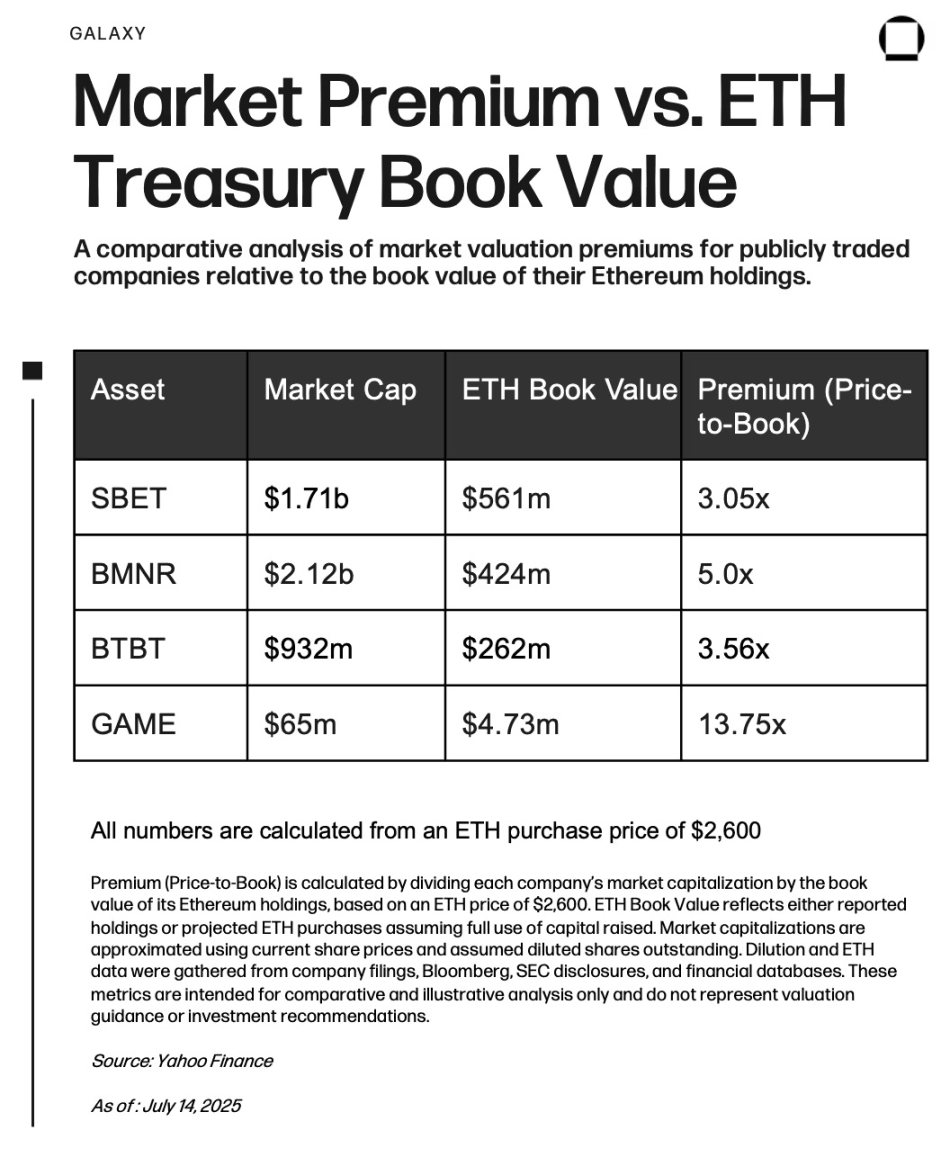
Comparison analysis of the market capitalization premium and book value of Ethereum holdings of listed companies
The above chart shows the relationship between the market capitalization of each company and the book value of its Ethereum holdings (calculated as the total amount of Ethereum held multiplied by the cost price of $2,600 per ETH). The higher the premium multiple, the greater the investor's valuation of the company's strategic flexibility or future earnings, exceeding the value of its underlying Ethereum assets. GameSquare (GAME) leads with a premium of about 13.8 times, highlighting the market's high optimism about its early Ethereum reserve construction; after completing the latest $250 million financing round, BitMine (BMNR) has a premium of about 5 times; Bit Digital (BTBT) and SharpLink (SBET) have relatively moderate premiums, reflecting more conservative market expectations. However, like all cryptocurrency reserve strategies, if the price of Ethereum declines significantly, excessive premiums may exacerbate downside risk.
Comparison of Ethereum and Bitcoin Reserve Models
The rise of Ethereum reserves marks a significant evolution in the strategy of listed companies focused on cryptocurrency businesses. The Bitcoin model centers around "digital gold," emphasizing the passive appreciation or preservation of value. Ethereum goes a step further, creating active income through staking and DeFi strategies, making it more attractive.
All four companies clearly identify Ethereum as a yield-generating reserve asset. SharpLink and BitMine have committed (or plan) to stake 100% of their Ethereum holdings to maximize protocol layer staking rewards; GameSquare, through its partnership with the cryptocurrency company Dialectic, pursues risk-adjusted returns of 8%-14% through more complex DeFi strategies, deepening this model. This preference for "yield-bearing Ethereum" contrasts sharply with the "non-yielding passive model" of Bitcoin reserves, marking a shift in corporate fund management from relying solely on asset price increases to achieving balance sheet growth through active operations.
Unlike many Bitcoin reserve companies that heavily rely on convertible bonds and leverage (see Galaxy's latest research report), the four leading Ethereum reserve companies—SharpLink, BitMine, Bit Digital, and GameSquare—have entirely funded their Ethereum reserves through equity offerings. This means they do not have to bear debt maturity pressures or interest payment obligations, and even in a downturn in the cryptocurrency market, there is no risk of default. The non-leveraged model significantly reduces systemic fragility, avoiding the refinancing and equity dilution risks associated with deep in-the-money convertible bonds.
The key point is that these Ethereum reserve strategies introduce a structural innovation: productive capital. By staking Ethereum, these companies not only gain typically 3%-5% protocol-native returns but also directly contribute to the security and stability of the Ethereum network. The higher the amount of Ethereum staked by corporate holdings, the more stable and predictable the validator ecosystem becomes, thereby creating a long-term synergy between corporate capital and protocol development.
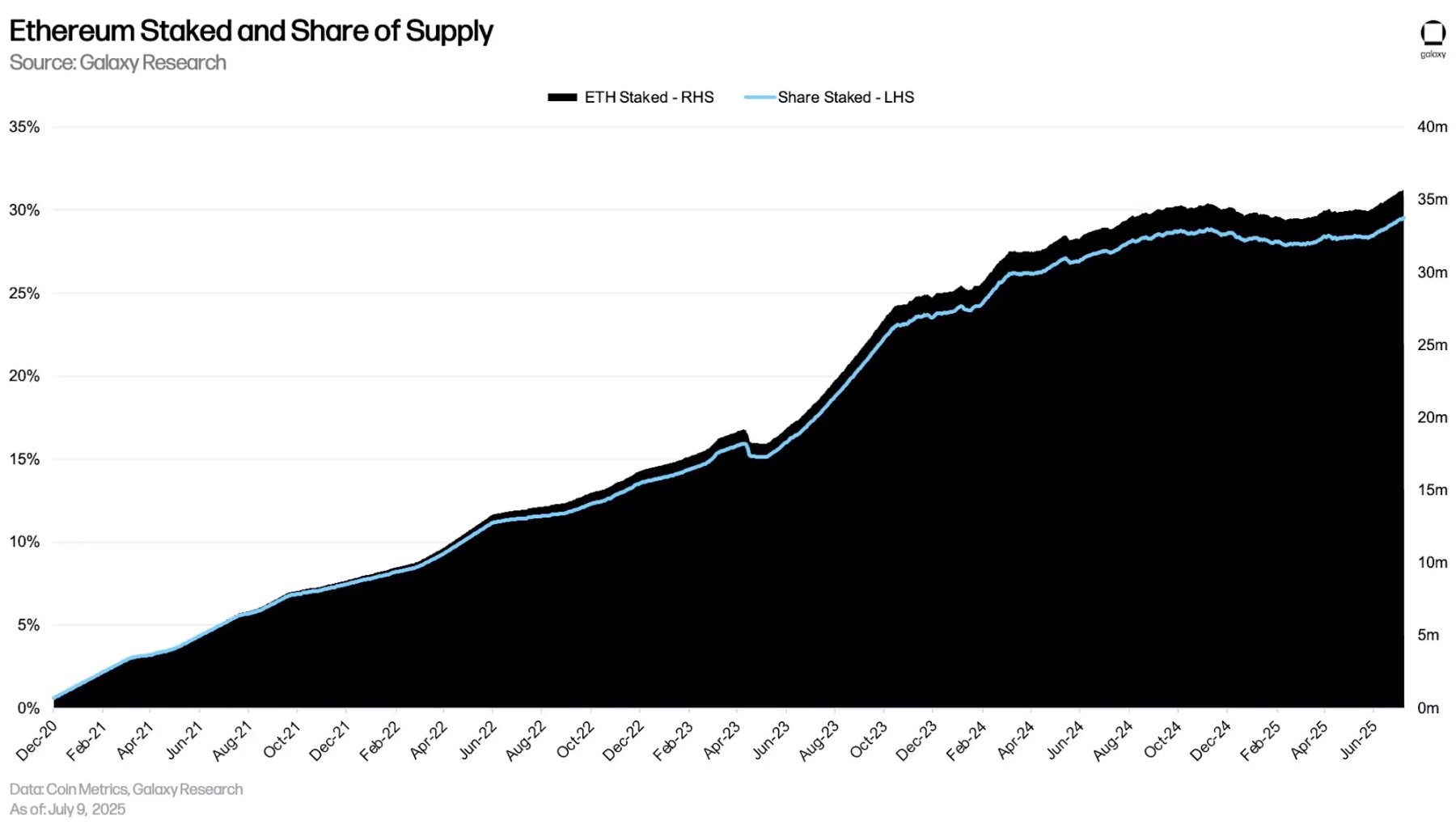
In fact, as of July 9, the Ethereum staking volume has reached a historical peak (over 35 million ETH, accounting for more than 30% of the total supply), and the emergence of Ethereum reserve companies may be one of the reasons driving this trend.
Taking GameSquare as an example, its plan to advance yield-enhancing strategies through partners like Dialectic involves deploying its Ethereum reserves into lending, liquidity provision (market making), and re-staking within DeFi-native infrastructure. This not only amplifies potential returns but also strengthens the foundational infrastructure of the Ethereum core protocol by enhancing liquidity and attracting institutional participation in decentralized markets.
Who Faces the Greatest Equity Dilution Risk?
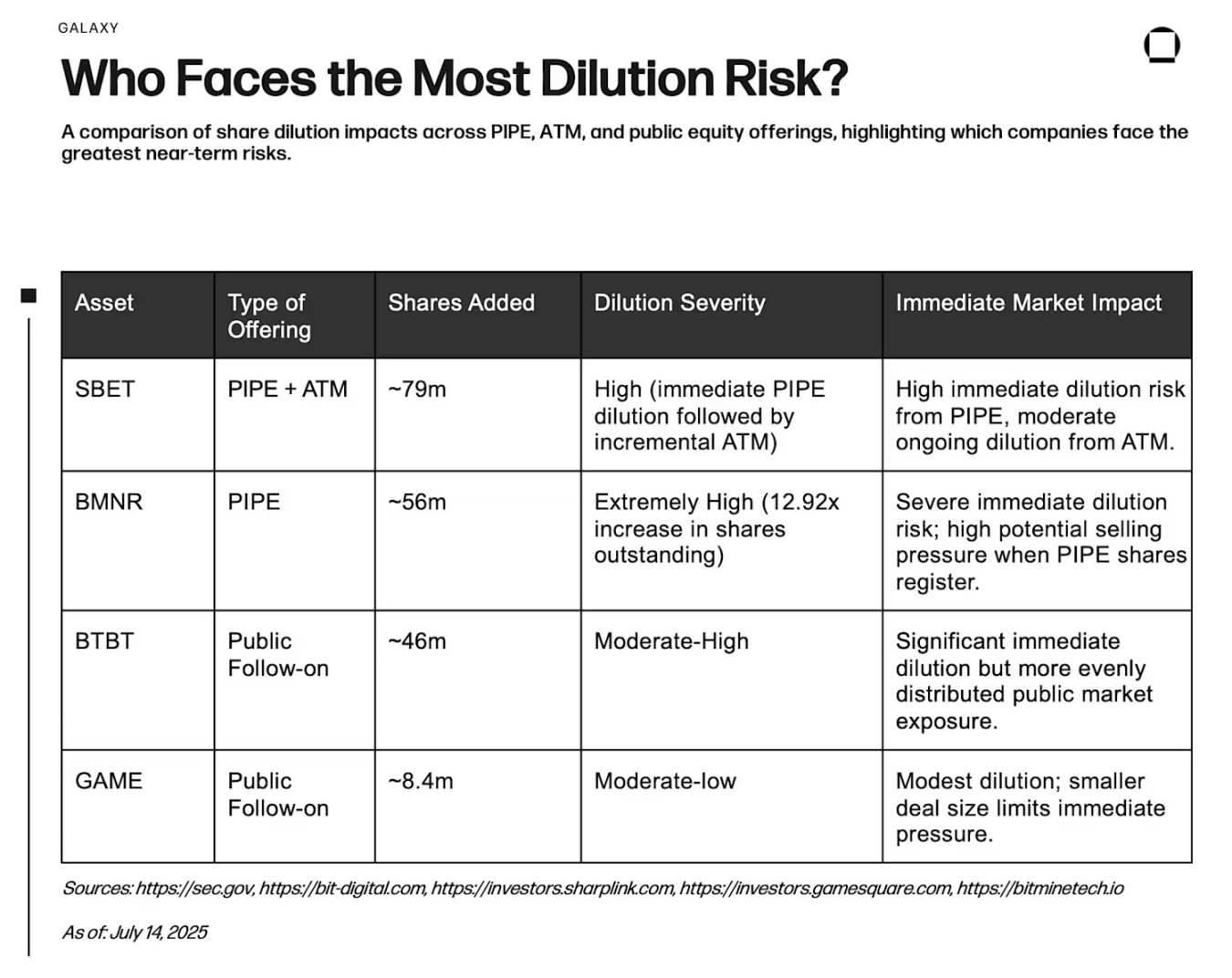
The image compares the impact of private placement investments (PIPEs), at-the-market (ATM) offerings, and public stock offerings on equity dilution, highlighting which companies face the greatest short-term risks.
Investors should carefully assess the behavior of new stock issuance in the market, especially private placement investments (PIPEs), which dilute existing shareholders' equity and put pressure on stock prices. BitMine's large-scale PIPE issuance poses significant dilution risk and stock price volatility in the short term; SharpLink's combination of PIPE and ATM financing causes immediate dilution and continuous incremental pressure. In contrast, Bit Digital and GameSquare use more transparent traditional public offerings, with dilution situations being clear and manageable, resulting in relatively lower market risks.
Overall, compared to at-the-market (ATM) offerings and traditional public offerings, companies that choose PIPE structures face higher initial market shock risks (especially during periods of market volatility). However, all these equity-based financing strategies avoid the "high-leverage convertible bonds" characteristics relied upon by Michael Saylor in MicroStrategy.
Conclusion
On the surface, the volatile fluctuations of stocks related to Ethereum reserves may resemble the "speculative boom and bust cycles" common in Meme coins, but the strategies adopted by the first companies to enter the Ethereum reserve space differ fundamentally. These companies do not rely on hype or passive asset holding but position Ethereum as a "productive reserve asset," generating native yields through staking, or in some cases, investing in more complex DeFi strategies. This characteristic distinguishes them from Bitcoin reserve pioneers who follow a "passive digital gold" model and often finance their positions through high-leverage convertible bonds. In contrast, the four Ethereum reserve companies—SharpLink, BitMine, Bit Digital, and GameSquare—have supported their strategies through equity financing, thus avoiding debt service pressures and structural fragility caused by debt maturity peaks.
Moreover, this capital is not idle. By staking Ethereum, enterprises directly contribute to the security and stability of the network validators; companies like GameSquare, which plan to deploy DeFi-native yield strategies, may also inject vitality into liquidity provision, lending markets, and other Ethereum infrastructure.
Although challenges such as dilution risk, smart contract exposure, and price volatility still exist, investors can comprehensively assess downside risks and upside potential driven by returns through tools such as dilution impact analysis and the ratio of premium to book value. Ultimately, this first wave of Ethereum reserve models demonstrates a more deeply involved and productive capital operation method. Although it creates a class of on-chain enterprise reserves exposed to market volatility, this model may still inject momentum into the strengthening of the Ethereum ecosystem.
Disclosure: As of the date of this report, affiliated entities of Galaxy Digital currently invest in BitMine and SharpLink Gaming.
Disclaimer: Contains third-party opinions, does not constitute financial advice


AI Practical Guide
This column focuses on the real progress of Agents: technological evolution, application implementat

Crypto Weekly
Tracking on-chain movements of the smart money and institutions

Frontier Insights
Spotlight on Frontier, trending projects, and breaking events

Blowup Alert
As the 2026 crypto bear market deepens, exit scams and project blowups are becoming increasingly fre

Regulatory Watch
American Crypto Act – timely interpretations of policies worldwide

Popular Airdrop Tutorial
Selected potential airdrop opportunities to gain big with small investments

FusnChain
FusnChain