Numerous Prestigious Institutions Support Trends, Will It Trigger SocialFi?
Numerous Prestigious Institutions Support Trends, Will It Trigger SocialFi?


On July 17, Mable Jiang, Chief Growth Officer of Stepn's parent company FSL, announced her departure to launch the social protocol Trends. This news quickly attracted attention in the crypto community, backed by early support from dozens of prominent founders and top investors such as Anatoly Yakovenko, co-founder of Solana, Bryan Pellegrino, co-founder of LayerZero, and Tushar Jain, co-founder of Multicoin Capital — whether this new protocol, which aims to "tokenize tweets," could become the key variable to ignite SocialFi?
Star-studded Endorsement: A Collective Bet from Solana Ecosystem to Top-tier Capital
The early supporters of Trends can be described as a "star-studded lineup" in the crypto industry. In addition to core members of the Solana ecosystem (Solana co-founders, foundation chairmen, and co-founders of Jupiter), it also includes partners from leading venture capital firms such as Dragonfly Capital and Multicoin Capital, as well as founders of well-known projects like Magic Eden and Pendle Finance. This multidimensional support across technology, capital, and ecosystem not only injects initial funding into Trends but also lays the groundwork for resource synergy — for example, technical support from the Solana ecosystem may optimize its on-chain performance, while integration with DeFi protocols like Jupiter may ensure token liquidity.
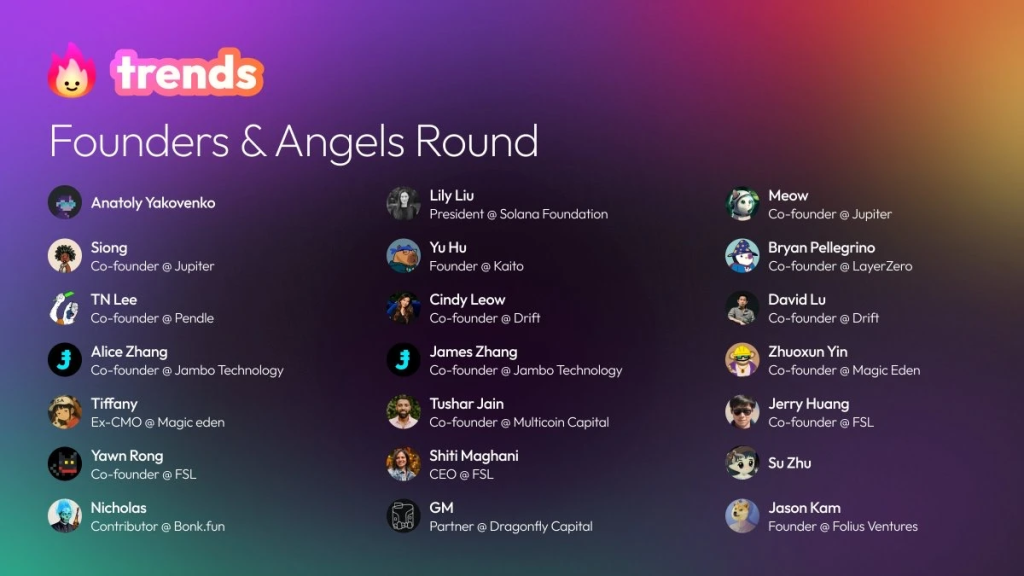
In explaining the vision of Trends, Mable Jiang mentioned that this endorsement is both motivation and responsibility. As a core member who helped Stepn grow from 0 to 1 into a phenomenon-level Web3 game, she has a compelling understanding of "democratizing crypto applications." In her view, past breakthroughs in Web3 innovation (such as the ICO boom of 2017 and the DeFi Summer of 2020) all stemmed from a significant reduction in "value flow friction." Trends' goal is to achieve a 100x efficiency improvement in the fusion of information flow and value flow.
Core Logic: When Every Tweet Becomes a Tradable "Information Asset"
Trends' underlying concept directly addresses the core pain points of Socialfi: how to quantify the value of information, and how to make social behavior inherently economically weighted. Mable Jiang's three "first principles" outline its innovative framework: tokens are essentially information containers, social media is the most active market for information, and the decline in on-chain costs has made "information-value fusion" feasible.
Looking at it more closely, Trends' operational process is clear and aggressive: starting with public social media tweets (such as content on Twitter/X), the platform generates corresponding on-chain tokens for each tweet. Users can buy or sell these tokens on the Trends platform, with token prices automatically calculated by a dynamic bonding curve (DBC) based on buying and selling volumes — meaning that the value of a tweet is no longer measured solely by off-chain data like likes and retweets, but instead forms real-time quantified consensus through "real money transactions."
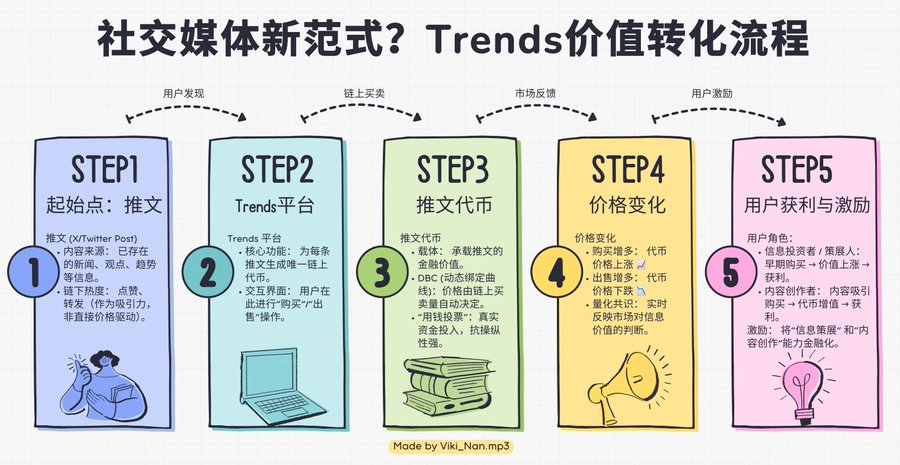
This design directly addresses the core bottleneck of current Socialfi: the problem of "click fraud" on traditional social platforms. Mable pointed out that AI has reduced content production costs to nearly zero, with views, likes, and even entire posts being generated in bulk for just a few cents. However, the involvement of on-chain capital makes "voting with money" the only scarce and transparent genuine signal. "Click fraud requires real money, and open protocols give everyone equal participation opportunities," making the value anchor of information shift from "false engagement" to "real money consensus."
From "Opinion" to "Position": The Financialization of Social Behavior
Trends' ultimate vision is to let "daily social behavior carry economic weight." In Mable's vision, every like and comment a user makes could become a "financial action" — for example, pre-setting "1 like = automatic purchase of the corresponding tweet token," making "opinion equals position" a reality. This design will completely reshape the incentive mechanisms for content creation and information dissemination:
For information curators, early identification of promising tweets and buying tokens, then selling them when their value increases, can generate profit, effectively pricing the ability to "discover high-quality content." For content creators, if their tweets consistently attract users buying tokens, the increase in token value will directly translate into revenue, without relying on traditional models like ad revenue or tips. For ordinary users, browsing and interacting could potentially bring economic returns, greatly lowering the barrier to entry for the crypto world.

This logic of "financializing social behavior" contrasts sharply with previous Socialfi projects. Most Socialfi protocols have remained at a superficial level (such as personal tokens) or struggled to break out due to over-reliance on closed-loop ecosystems. Trends, however, chooses open social platforms (like Twitter/X) as its starting point, first becoming an "on-chain curation layer," and gradually expanding to other content scenarios like TikTok. This "parasitic innovation" may reach mass users more quickly.
Potential and Challenges of Igniting Socialfi
The emergence of Trends comes at a time when Socialfi is "building up momentum." On one hand, traditional social platforms like Twitter/X experimenting with crypto features (such as Musk's plan to introduce "tweet tokenization") validate market demand. On the other hand, the maturation of DeFi infrastructure (lower on-chain transaction costs, widespread cross-chain technologies) provides technical support for the integration of "social + finance." The backing of star institutions not only brings resources but may also drive deeper integration between Solana and Trends, forming a closed loop of "social content - token trading - ecosystem applications."

However, significant challenges remain. First, regulatory risks: directly tokenizing tweets may touch the "securities classification" red line, especially in an era of stricter regulation, determining the nature of "tweet tokens" will be critical. Second, user habit cultivation: convincing ordinary users to understand the logic of "buying tweet tokens" is no easy task, and the initial phase may face the dilemma of "crypto natives can play, but mainstream users don't understand." Additionally, token price volatility may undermine the content ecosystem — if speculation overshadows the intrinsic value of information, tweets may become "speculation targets," deviating from the original goal of "quantifying information value."
Nevertheless, Mable Jiang and her team's experience may provide a way forward. As a core member who helped Stepn popularize "motion mining," she deeply understands the trick of "integrating crypto logic into daily behavior." Whether Trends can replicate Stepn's path to breaking through and transform "tweet tokenization" from concept into a product that the general public can perceive will be the key to whether it can ignite Socialfi.
From an industry trend perspective, the fusion of information and value is an irreversible direction. When Trends allows "every post to have a price curve and every opinion to be directly monetized," Socialfi may truly transition from a "niche experiment" to a "mass application." This innovation backed by a collective bet from star institutions may be standing at the dawn of a new era — regardless of whether it ultimately sparks the market, its exploration will provide important references for the evolution of Socialfi. After all, as Mable said, "Shaping new behaviors is never easy, but 'trend is good.'"
Author: ChainThink
Disclaimer: Contains third-party opinions, does not constitute financial advice
NVIDIA attracts $85 billion in investor demand during massive bond issuance
06-16
Ethereum surges over 10% in 24 hours, currently priced at $1,841.31
06-16Amazon announces a multi-billion dollar investment in Missouri to build a data center campus, expected to create over 400 long-term positions
06-16Binance Platform's SpaceX Perpetual Contract Trading Volume Surpasses $9 Billion, Capturing Over 60% Market Share
06-16Binance platform XLM/USDT short-term spike down to $0.17, now recovered to $0.225
06-16
Trump: The Strait of Hormuz has been fully reopened as of Friday, and all agreements have been signed
06-16SlowMist: Aztec Connect Contract Hacked for $2.19 Million Due to ZK-Rollup L1/L2 State Boundary Vulnerability
06-15
