Ethereum at $3600: A Hidden Liquidation Game
Ethereum at $3600: A Hidden Liquidation Game


The price volatility of Ethereum appears simple: retail enthusiasm surges, prices skyrocket, and market optimism continues to build. But beneath the surface lies a structurally complex market mechanism. The funding rate market, hedging operations by neutral strategy institutions, and recursive leveraged demand intertwine, exposing deep-seated systemic vulnerabilities in the current crypto market.
We are witnessing a rare phenomenon: leverage has essentially become liquidity itself. The massive long positions invested by retail investors are fundamentally reshaping the way neutral capital is allocated, giving rise to new market vulnerabilities that most participants have not yet fully recognized.
1. Retail Long Frenzy: When Market Behavior Is Highly Correlated
Retail demand is concentrated in Ethereum perpetual contracts because these leveraged products are easily accessible. Traders are entering leveraged long positions at a speed far exceeding real demand in the spot market. The number of people betting on ETH's rise far exceeds the number of people actually purchasing Ethereum spot.
These positions require counterparties to take them. However, due to the unusually aggressive buy-side demand, short positions are increasingly being absorbed by institutional players employing Delta-neutral strategies. These are not directional bearish players, but rather funding rate harvesters who do not bet against ETH, but instead exploit structural imbalances for arbitrage.
In fact, this is not a traditional shorting operation. These traders hold equal long positions in spot or futures while shorting perpetual contracts. Although they do not bear the risk of ETH price fluctuations, they profit from the funding rate premium paid by retail longs to maintain their leveraged positions.
As the Ethereum ETF architecture evolves, this arbitrage trade may soon be enhanced by stacking passive income layers (staking income embedded in the ETF packaging structure), further increasing the attractiveness of Delta-neutral strategies.
This is indeed a brilliant trade, provided you can tolerate its complexity.
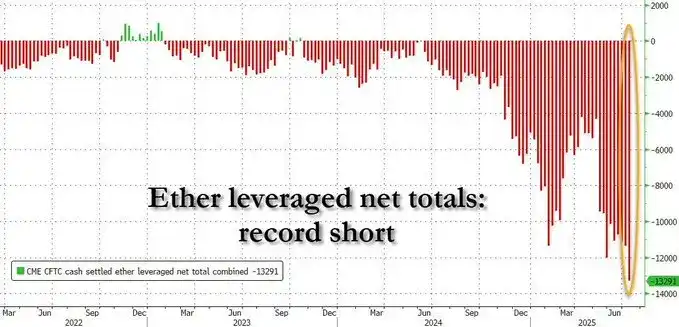
Delta-Neutral Hedging Strategy: A Legitimate "Money Printing" Response Mechanism
Traders take short positions in ETH perpetual contracts to absorb retail long demand, while hedging with long spot positions, thus converting structural imbalances caused by continuous funding rate demands into profits.
In bull markets, funding rates turn positive, and longs pay fees to shorts. Institutional players using neutral strategies earn income by providing liquidity while hedging risks, thereby creating profitable arbitrage operations that attract continuous inflows of institutional capital.
However, this creates a dangerous illusion: the market appears deep and stable, but this "liquidity" depends on favorable funding conditions.
The moment the incentive mechanisms disappear, the supporting structure will collapse. The surface depth of the market instantly becomes void, and as the market framework collapses, prices could experience violent swings.
This dynamic is not limited to crypto-native platforms. Even on the institution-dominated Chicago Mercantile Exchange (CME), most short-term liquidity is not directional bets. Professional traders short CME futures because their investment strategies prohibit opening spot exposure.
Options market makers hedge delta via futures to improve margin efficiency. Institutions handle client order flows. These are all structural essential transactions, not reflections of bearish expectations. Open interest may increase, but this rarely conveys market consensus.
Asymmetric Risk Structure: Why It's Not Fair at All
Retail longs face direct liquidation risk when prices move against them, whereas Delta-neutral shorts typically have more substantial capital and are managed by professional teams.
They collateralize held ETH as security, enabling them to short perpetual contracts under a fully hedged, high-margin-efficient mechanism. This structure can safely withstand moderate leverage without triggering liquidations.
There are structural differences between the two. Institutional shorts have sustained resilience and well-established risk management systems to withstand volatility; leveraged retail longs, however, have weak capacity and lack risk control tools, with almost zero operational tolerance.
When market conditions change, longs quickly collapse, while shorts remain stable. This imbalance triggers a seemingly sudden but structurally inevitable liquidation waterfall.
Recursive Feedback Loops: When Market Behavior Becomes Self-Interference
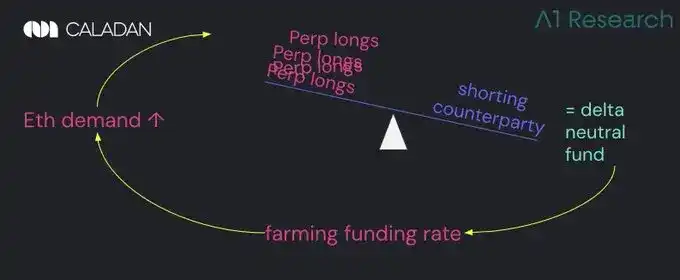
The persistent demand for long positions in Ethereum perpetual contracts requires Delta-neutral strategy traders to act as counterparties for short hedging. This mechanism keeps funding rate premiums ongoing. Various protocols and yield products compete for these premiums, driving more capital back into this cycle.
A never-ending money-making machine does not exist in reality.
This will continue to create upward pressure, but it entirely depends on one prerequisite: longs must be willing to bear the cost of leverage.
The funding rate mechanism has a ceiling. On most exchanges (such as Binance), the maximum funding rate for perpetual contracts is 0.01% every 8 hours, which translates to an annualized return of about 10.5%. When this ceiling is reached, even if long demand continues to grow, profit-seeking shorts will no longer be incentivized to open positions.
Risk accumulation reaches a critical point: arbitrage profits are fixed, but structural risks continue to grow. When this critical point arrives, the market is likely to rapidly unwind.
Why ETH Fell More Than BTC? The Battle of Dual Ecosystem Narratives
Bitcoin is benefiting from non-leveraged buying pressure from corporate treasury strategies, and the BTC derivatives market has stronger liquidity. Ethereum perpetual contracts are deeply integrated into yield strategies and DeFi protocol ecosystems, with ETH collateral continuously flowing into structured products like Ethena and Pendle, providing returns to users participating in funding rate arbitrage.
Bitcoin is usually considered to be driven by ETFs and natural spot demand from corporations. However, a large portion of ETF inflows is actually the result of mechanical hedging: traditional finance basis traders buy ETF shares while shorting CME futures contracts to lock in a fixed spread between spot and futures for arbitrage.
This is essentially the same as ETH's Delta-neutral basis trading, except it is executed through a regulated wrapped structure and financed at a dollar cost of 4-5%. In this light, ETH's leveraged operations have become a yield infrastructure, while BTC's leverage forms structured arbitrage. Both are not directional operations, both aim to capture yield.
Circular Dependency Issues: When the Music Stops
There is a question that might keep you up at night: this dynamic mechanism has an inherent cyclical nature. The profitability of Delta-neutral strategies relies on continuous positive funding rates, which require sustained retail demand and a prolonged bull market.
Funding rate premiums are not permanent; they are very fragile. When the premium contracts, a liquidation wave begins. If retail enthusiasm wanes, the funding rate turns negative, meaning short sellers pay fees to longs instead of receiving premiums.
When large amounts of capital flow in, this dynamic mechanism creates multiple points of fragility. First, as more capital flows into Delta-neutral strategies, the basis will continue to compress. Financing rates decrease, and arbitrage transaction profits also decline.
If demand reverses or liquidity dries up, perpetual contracts may enter a discount state, where contract prices fall below spot prices. This phenomenon will hinder new Delta-neutral positions from entering and may force existing institutions to liquidate. At the same time, leveraged longs lack margin buffer space, and even a mild market correction could trigger a chain of liquidations.
When neutral traders withdraw liquidity, a cascade of forced liquidations by longs emerges, creating a liquidity vacuum. There are no real directional buyers below the price, only structural sellers. The originally stable arbitrage ecosystem quickly flips into an uncontrolled liquidation surge.
Misreading Market Signals: The Illusion of Balance
Market participants often misinterpret the flow of hedging capital as a bearish bias. In fact, the high short positions in ETH often reflect profitable basis trades, not directional expectations.
In many cases, the seemingly strong derivative market depth is actually supported by temporary liquidity rented by neutral trading desks, which generate profits by harvesting funding rate premiums.
Although the inflow of spot ETFs can generate some natural demand, the vast majority of transactions in the perpetual contract market are essentially structural artificial operations.
Ethereum's liquidity is not rooted in belief in its future; it exists as long as there are profitable funding conditions. Once profits disappear, liquidity will also vanish.
Conclusion
The market can remain active for a long time under the support of structural liquidity, creating a false sense of security. But when conditions reverse and longs cannot maintain their financing obligations, a crash happens in an instant. One side is completely crushed, while the other calmly withdraws.
For market participants, identifying these patterns means both opportunity and risk. Institutions can profit by understanding funding conditions, while retail investors should distinguish between artificial depth and real depth.
The driving factors of the Ethereum derivatives market are not consensus on a decentralized computer, but rather the behavior of structural funding rate premium harvesting. As long as the funding rate remains positive, the entire system can operate smoothly. However, when the situation reverses, people will eventually find out: the seemingly balanced facade is nothing more than a carefully disguised leveraged game.
Disclaimer: Contains third-party opinions, does not constitute financial advice
The Crypto Fear Index rises back to 13, with market "extreme fear" sentiment slightly alleviated
9 mins ago
Managing a company valued at nearly a trillion dollars, Anthropic's CEO has only one direct report.
16 mins ago
Analysis: The current Bitcoin top lacks clear speculative signs, potentially leading to a cycle bottom higher than previous bear markets.
39 mins agoA certain ETH swing whale has made $3.67 million in profit within two and a half days, with an 87% win rate.
50 mins agoThe U.S. government has issued export control directives suspending access for foreign nationals to Anthropic's Fable 5 and Mythos 5.
1 hour agoBrazilian Chamber of Deputies Committee Passes Bill to Empower Freeze of Cryptocurrency Assets and Increase Penalties for Online Fraud
1 hour agoThe largest long position on Hyperliquid, worth $36.4 million in SPCX, was liquidated, resulting in a loss of approximately $300,000.
1 hour ago
