
ChainThink
Stay ahead, master crypto insights
Coinbase faces strong pressure from Robinhood, how did COIN repeatedly overcome difficulties?
Coinbase faces strong pressure from Robinhood, how did COIN repeatedly overcome difficulties?

2025-08-12 11:34
Recently, Robinhood's market capitalization broke through the $100 billion mark, while Coinbase's market capitalization fell back to $82 billion. The competition between these two largest U.S. financial service providers has attracted more attention. In terms of annual performance, Robinhood rose 135%, while Coinbase only increased by 30%, mainly from the past month. Coinbase is questioned for its weak growth after losing its compliance reputation, but Coinbase continues to exert efforts in multiple business lines. As the first listed Nasdaq exchange giant, how has Coinbase once again overcome difficulties? Can it successfully maintain its leading position as a listed company?
Origin
In 2012, Brian Armstrong, an Airbnb engineer, created a small website in a San Francisco shared apartment that allowed anyone to buy Bitcoin with one click; a few weeks later, he met Fred Ehrsam, a former Goldman Sachs trader, on Hacker News. The two entered YC - the launch of Coinbase: making the entry point of cryptocurrency as simple as using an email.

In 2013, funds and reputation both took off: USV led the Series A round, and a16z followed with the Series B round. That catchy slogan deeply impressed people — "The easiest way to buy Bitcoin." They integrated ACH/bank cards, reduced waiting time and failure rate, giving the first generation of American retail investors a "formal channel."
Rapid Growth
Afterward, Coinbase actively embraced KYC/AML, established a compliance team to do the "ask first, then go" slow work, not pursuing wild growth; in 2015, Coinbase introduced traditional financial shareholders such as NYSE and USAA in the Series C round, achieving the "license + bank relationship + clearing and settlement" triple set.
Then they expanded their product lines: Coinbase Exchange/GDAX (later merged back into Advanced Trade) for professional traders; Coinbase Custody obtained the New York Trust license, providing institutional custody; and together with Circle, they launched USDC (stablecoin infrastructure). The entry point was not only for retail investors, but also for institutions.
At this point, the business flywheel was formed: fiat deposit → spot/holding → OTC/institutional → compliant listing assets. Coinbase used the "whitelist mindset" to screen projects, sacrificing speed for compliance credit — which became the most essential difference between Coinbase and most global exchanges.
2021 highlight: Coinbase directly listed on NASDAQ (stock code: COIN). Without traditional underwriters pricing, all historical shareholders and employees directly faced the secondary market. This was the first time that an exchange itself was placed under the spotlight of the U.S. main board market by a crypto company.
Getting Through the Cold Winter
The winter was equally real: in 2022, industry liquidity suddenly declined, the company cut costs, and regulatory investigations intensified. Coinbase upgraded its positioning from "trading platform" to "compliance infrastructure": transparent disclosure, risk isolation, and regular audit and reporting, maintaining institutional trust through "clean books."

Using two cards to fight back and get out of the growth dilemma: Base blockchain — a Layer2 based on OP Stack, focusing on "low fees + ease of use + compliance-friendly", bringing creators and brands onto the chain through Onchain Summer; International derivatives — offering tools like perpetual contracts for non-U.S. users, completing the product matrix.
"Custody business" became a super channel: since 2024, several U.S. Bitcoin spot ETFs have chosen Coinbase to provide custody and clearing services. Compliance became distribution — ETFs, institutions, and compliant funds pass through it to "go on-chain," making it more like a "crypto clearing house + bank."
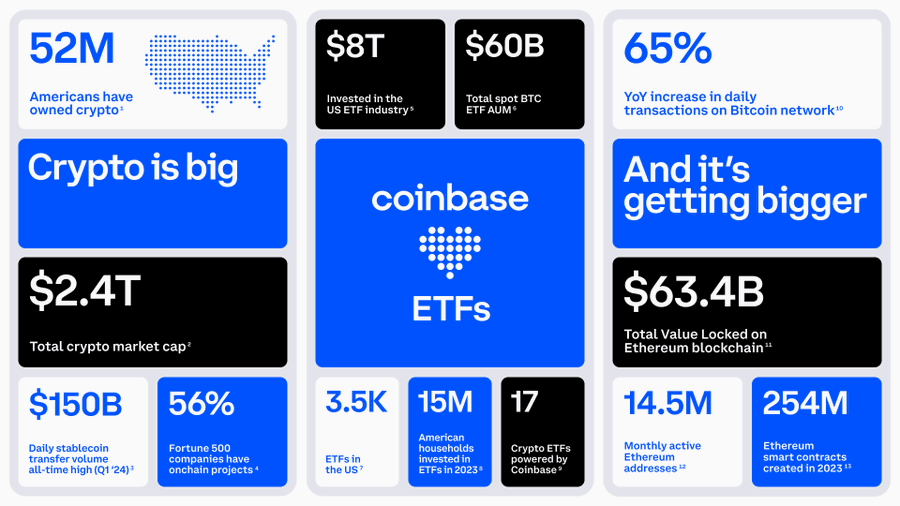
We can see that Coinbase's real product is not trading, but a "trusted entry point." From a small YC team to building its own L2 and handling ETF custody, Coinbase's compliance moat is not easy to break. Perhaps when compliant funds and developers both go on-chain, the entry point is not just a buy/sell button, but the interface of the new finance.
New Intense Competition
U.S. Bank analyst Craig Siegenthaler recently raised Robinhood's target price to $119, while lowering Coinbase's from $383 to $369, citing the reason: "Robinhood's crypto revenue surged, while Coinbase's over-reliance on retail users is abandoning volatile altcoins." Robinhood's rapid growth has put pressure on Coinbase.
Meanwhile, Kraken has seen the most significant increase in U.S. market share this year, and Kraken has also been rumored to be preparing for an IPO in the U.S. Other exchanges such as OKX, BULLISH, etc., are following closely. With the opening of regulation and compliance channels, Coinbase faces more direct competitors.

Currently, Coinbase's global market share has dropped from 5.65% to 4.56%, with a slight recovery in July. Coinbase is facing a dilemma: reducing fees harms profit margins, or sticking to high fees risks losing traders. Let's wait and see what exciting blockchain stories the service providers will tell in the upcoming intense competition.
Original author: @KKaWSB
Original title: Coinbase's Brief History: From Hackers' Apartment to NASDAQ, Making "Compliance Entry" a Moat
Adapted by: ChainThink
Disclaimer: Contains third-party opinions, does not constitute financial advice


AI Practical Guide
This column focuses on the real progress of Agents: technological evolution, application implementat

Crypto Weekly
Tracking on-chain movements of the smart money and institutions

Frontier Insights
Spotlight on Frontier, trending projects, and breaking events

Blowup Alert
As the 2026 crypto bear market deepens, exit scams and project blowups are becoming increasingly fre

Regulatory Watch
American Crypto Act – timely interpretations of policies worldwide

Popular Airdrop Tutorial
Selected potential airdrop opportunities to gain big with small investments

FusnChain
FusnChain