
ChainThink
Stay ahead, master crypto insights
Will gold continue to rise? Should we give up Bitcoin to embrace gold?
Will gold continue to rise? Should we give up Bitcoin to embrace gold?
2025-04-21 00:28
Author: Huali Huawai

Recently, a friend left a message in the background asking: Since the crypto market is currently in a bear market, should we give up Bitcoin and embrace gold?
This sounds like an interesting question.
As for whether it is currently a bull or bear market, we have already discussed this in several articles recently. Here, we will not elaborate further. Today, we mainly continue to briefly discuss gold and Bitcoin.
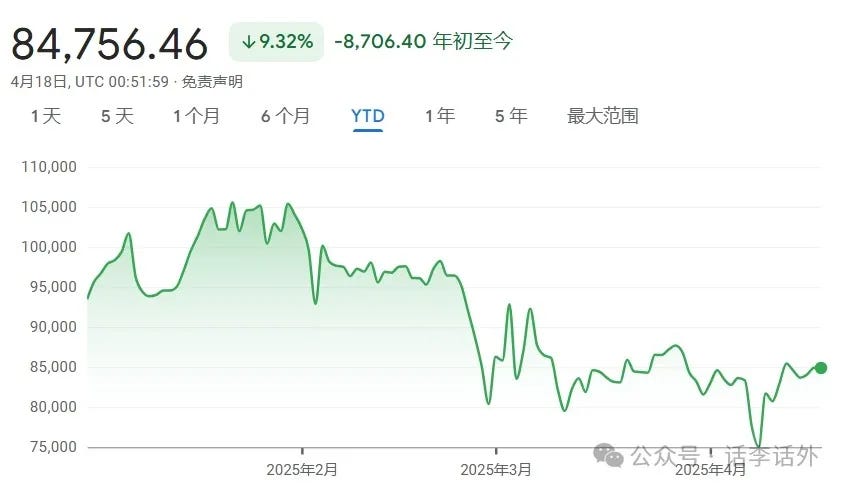
In recent times, many people have been attracted by the rise in gold, while stocks and cryptocurrencies seem less appealing. From the beginning of the year (YTD), gold has achieved a return of 26.75%, while the S&P 500 has a return of -10.2% and Bitcoin has a return of -9.3%. As shown in the figure below.
If we make a simple comparison between the historical performance of gold and the S&P 500, we can see that since 2020, the performance of the US stock market and gold has already started to show significant differences. As shown in the figure below (the blue line represents gold, and the red line represents S&P500).
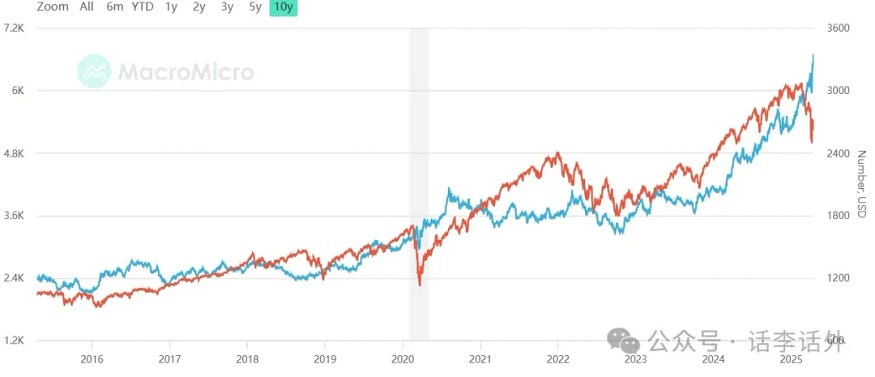
In February 2020, the US stock market began to drop rapidly, and gold began to rise quickly, and a similar situation seems to have occurred again in February 2025. Of course, the factors causing the US stock market to crash and gold to surge differ in different periods. For example, the previous time was mainly due to factors such as the global pandemic, while this time is mainly due to factors such as US tariffs (you can refer to our article published on April 14th).
In fact, the basic logic behind the rise in gold seems quite simple. As long as the world is not peaceful, the US stock market and cryptocurrencies will crash, while the price of gold will surge.
1. Should we give up Bitcoin and embrace gold?
According to data from The Kobeissi Letter, the net inflow into gold funds this year has reached a record of $80 billion, which is twice as high as the previous high in 2020. Investors are injecting funds into the gold market at a record pace for risk aversion (and some funds may be for short-term speculation). As shown in the figure below.
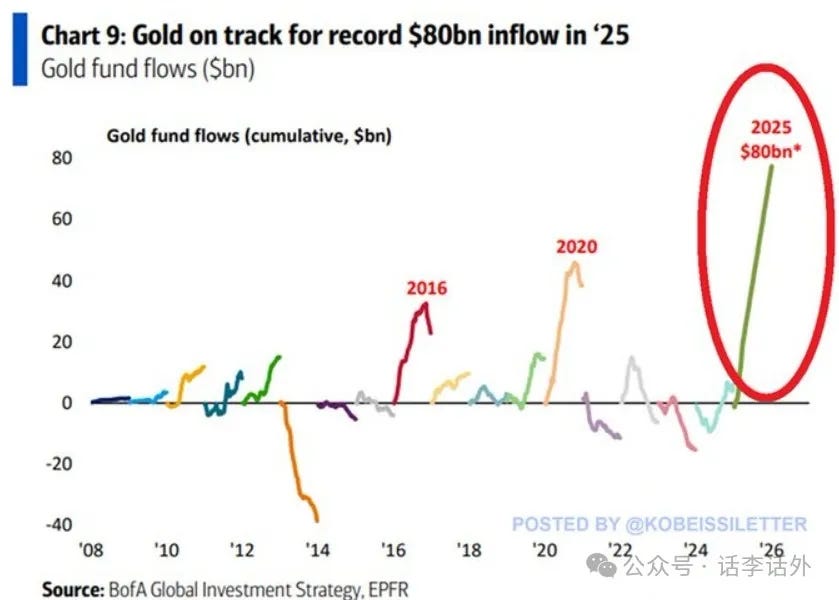
If we remain in a continuous and uncertain environment for some time, then in the medium to long term, the price of gold is likely to continue to rise, especially when the dollar may face some crises, this bullish sentiment will be even stronger.
So, should we give up Bitcoin and embrace gold now? This depends on your position ratio and risk preference!
The position ratio refers to your asset allocation ratio:
For example, if you have 10 million RMB, how would you plan this part of your assets, such as what percentage you would use to buy real estate (such as houses), what percentage you would invest in traditional finance (such as deposits, financial products, funds), what percentage you would invest in the stock market (such as A-shares, Hong Kong shares, US stocks), what percentage you would invest in precious metals (such as gold), and what percentage you would invest in cryptocurrencies (such as BTC)...
Here, the risk preference refers to your specific investment strategy:
If you put 1 million RMB (which is 10% of your total assets) into cryptocurrency, then the first thing you need to understand is that cryptocurrency is both a field with high returns and a high-risk field. You should always be prepared to lose this 10% of your assets mentally.
Next, you need to customize your investment strategy, i.e., you need to consider the investment cycle of long-term, medium-term, and short-term, and combine it with your personal time and energy to choose specific fields or assets. For example, you can divide the 1 million RMB into 9:1, 5:3:2, or 6:2:1:1, etc. Take 5:3:2 as an example, 50% of the position can be used for long-term investment in Bitcoin (mainly long-term investment), 30% can be used for blockchain finance (mainly flexibility), and 20% can be used for high-risk dog games (mainly short-term speculation).
In short, before making an investment decision, you need to first think clearly (plan well):
- Your asset allocation method
- Your specific allocation mode or strategy under different allocations
Then comes the execution of specific investment choices (gold, Bitcoin, etc.) and investment plans:
- Establish and form your own trading system or trading logic based on different strategies
- Achieve the maximum possible return on the overall asset scale over time, based on your trading system/logic
Therefore, returning to the question of whether to give up Bitcoin and embrace gold now: if you didn't know before, you should have some ideas now. If after reading the above thoughts, you still don't know what to do, our advice is to keep your money safely in the bank and not to engage in any risky investments (including gold, stocks, and cryptocurrencies).
Especially now, gold is already at a relatively high level in the short term, and ordinary people should not directly speculate and chase high prices unless they know what they are doing. If you are a long-term investor, for example, aiming for trends in the next few years, you can consider buying gold in batches during its short-term corrections.
2. Gold and Bitcoin
We once specifically sorted out the topic of gold and Bitcoin in an article from last year (August 3, 2024). As shown in the figure below.
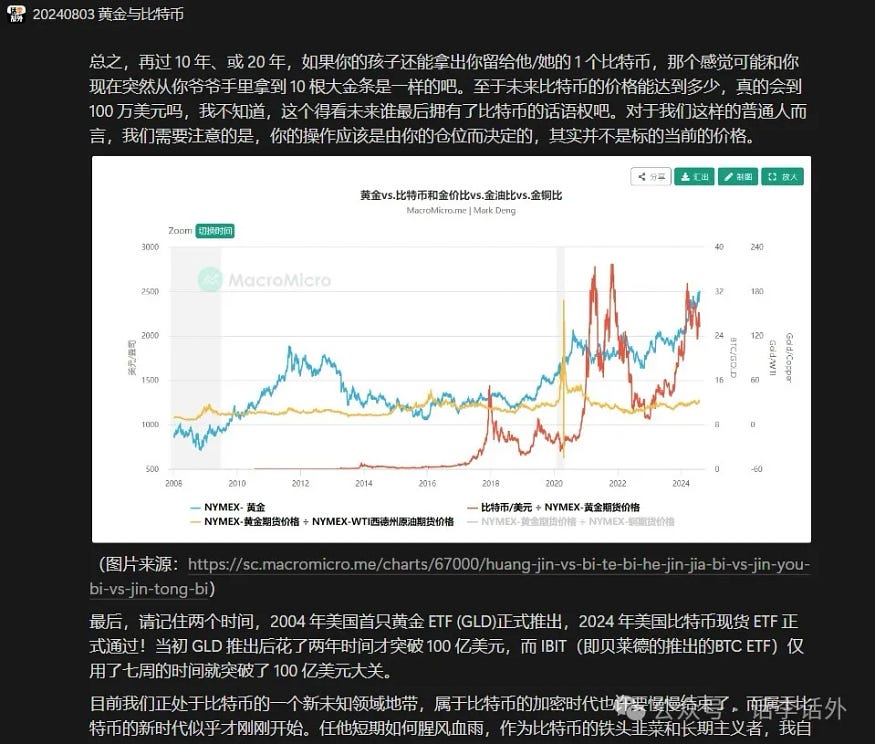
We continue to expand on the above topic. In the medium to long term, gold is still the best asset to hedge against inflation (although gold also has about 3–5% inflation per year) and to deal with the uncertainty of the global environment. If your investment cycle is 5 years, 10 years, 15 years, or 20 years, you can buy and hold gold at any time without worrying too much. Just allocate a certain proportion of funds to regularly invest in gold.
If you are seeing the recent rise in gold and want to take a short-term speculative position, you need to manage your position allocation and risk management yourself, and you also need to choose the right asset, such as whether you want to buy physical gold, gold ETFs, or gold stocks (such as FSM, PPTA, DRD, etc.), etc.
As for Bitcoin, although many people compare it to "digital gold," at the current stage, Bitcoin does not yet have the properties of gold (it cannot directly replace gold unless the major countries of the world eventually establish Bitcoin reserves, complete the distribution of interests, and form corresponding mechanisms in terms of encryption policy). However, if you still believe in the long-term prospects of the crypto field, Bitcoin is still the best choice.
1) From the perspective of decentralization
Gold and Bitcoin both belong to decentralized assets. For example, the main holders of gold are central banks and investment institutions around the world, but it is also a public asset, meaning that a lot of gold is held by the public. For instance, India's private gold holdings are estimated to be around 25,000 tons, China is about 16,000 tons, and the United States is about 8,000 tons.
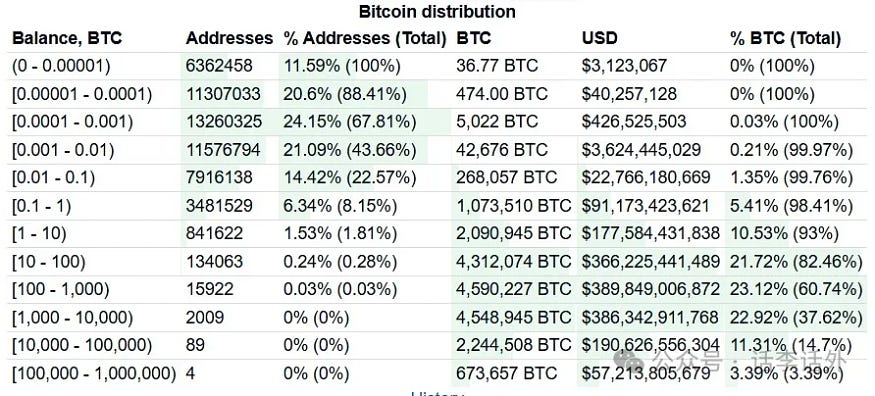
The main holders of Bitcoin are countries, whales, and investment institutions (as the U.S. and other countries' national strategic reserve plans develop, Bitcoin may become increasingly concentrated in the hands of countries and investment institutions). However, many retail investors also hold Bitcoin, as shown in the figure below.
2) From the perspective of mining costs
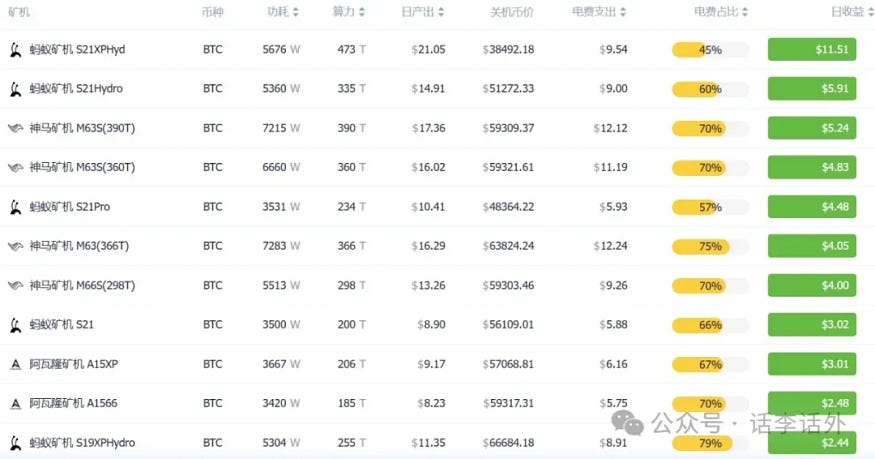
Gold and Bitcoin are different in terms of mining costs. For example, the current mining cost of gold is approximately $1,000–$1,400 per ounce (different countries have different costs), and the mining cost of Bitcoin is approximately $40,000–$60,000 (different mining machines have different costs), as shown in the figure below.
However, gold has some inflation, while Bitcoin has a fixed supply of 21 million coins.
3) From the perspective of consensus
Gold and Bitcoin are both considered Store of Value (value storage) assets, but their sources of consensus, nature of consensus, and stability are also different.
For example, from the perspective of the source of consensus, the global consensus of gold is definitely stronger, as gold has gone through thousands of years of human use, while Bitcoin has only existed for a few decades.
It can be said that gold is more of a consensus accumulation of human "history", while Bitcoin is a "future" consensus attempt.
Of course, besides the above-mentioned perspectives of decentralization, mining costs, and consensus, there are many other ways to find the similarities or differences between gold and Bitcoin.
Since gold is a consensus accumulation of history and Bitcoin is a consensus attempt for the future, therefore, giving up Bitcoin to embrace gold, or giving up gold to embrace Bitcoin, these two approaches seem to be rather extreme choices.
In short, we can choose to buy gold only at certain stages, or buy Bitcoin only at certain stages, or buy both gold and Bitcoin for long-term reserves. This is determined by your personal preferences, position allocation, and risk management. Short-term investments look at technology (the ability to grasp indicators, the ability to filter information, the ability to analyze data, etc.), while long-term investments look at mindset (investment logic, the ability to grasp the cycle trend, values, etc.). If your vision is limited to the present, but you don't have good technical support for transactions, such as seeing a project rise or become popular, and then directly abandoning the existing project to chase high prices or hot spots, repeatedly in this investment mindset, the final result may end up getting nothing.
Disclaimer: Contains third-party opinions, does not constitute financial advice


AI Practical Guide
This column focuses on the real progress of Agents: technological evolution, application implementat

Crypto Weekly
Tracking on-chain movements of the smart money and institutions

Frontier Insights
Spotlight on Frontier, trending projects, and breaking events

Blowup Alert
As the 2026 crypto bear market deepens, exit scams and project blowups are becoming increasingly fre

Regulatory Watch
American Crypto Act – timely interpretations of policies worldwide

Popular Airdrop Tutorial
Selected potential airdrop opportunities to gain big with small investments

FusnChain
FusnChain