
ChainThink
Stay ahead, master crypto insights
Is Base Abandoning Ethereum?
Is Base Abandoning Ethereum?
2025-04-22 12:02
Is Base "stealing" Ethereum's GDP?
Original author: Michael Nadeau, founder of The DeFi Report
Original translation: xiaozou,
Standard Chartered recently released a report titled "Ethereum's Midlife Crisis," which sparked heated discussions. The report estimated that Base caused a $50 billion loss in Ethereum's market value and "stole GDP," leading to the adjustment of ETH's year-end price target from $10,000 to $4,000. This raises a core question: did Standard Chartered misjudge ETH at the bottom of the L2 "J-curve," or is structural decline truly ongoing?
In this article, we will re-examine Standard Chartered's conclusions and present our own insights.
1、Base and Ethereum's "Partnership"
Imagine you are Ethereum, and I am Base. We are both building critical infrastructure for web3. One day, I propose to you: why not collaborate instead of building a separate L1 competition?
As Base, my collaboration needs are:
· Share Ethereum's security and settlement layer (building your own validators is too expensive)
· Establish native cross-chain bridges to access Ethereum users and assets
· Share liquidity and developer ecosystem
· Reduce operational costs
· Be compatible with EVM and surrounding infrastructure
As Ethereum, you hope:
· To acquire new users through the Coinbase channel
· To increase demand for ETH (transactions and on-chain services)
· To gain enterprise customer feedback
· To generate transaction fee income for validators
· To improve throughput and user experience
The two parties form a synergistic effect of 1+1>3. Now, after two years, let's verify the results with on-chain data.
2、Base Economy and On-chain Data
User Fees
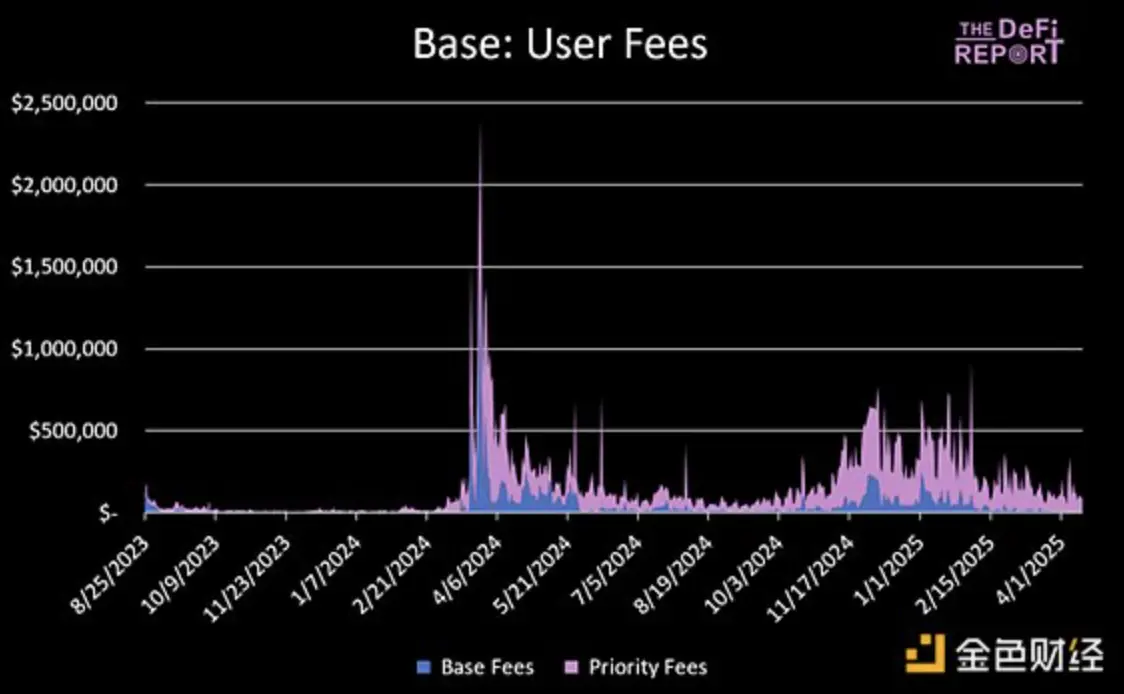
Since its inception, Base has generated $24.8 million in base fees and $81.9 million in priority fees. In 2024, Base revenue (74 million USD) accounted for 1.1% of Coinbase's total annual revenue.
Base is currently the fastest-growing and most profitable Ethereum L2, launched two years after its largest competitor, Arbitrum.
Base GDP
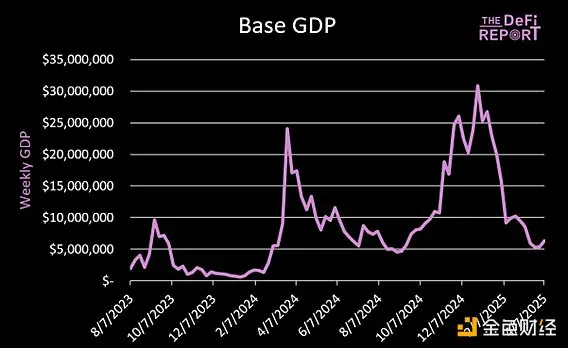
On-chain applications on Base have generated $768 million in fees (cumulative "GDP"), mainly contributed by DeFi protocols such as Uniswap and Aerodrome.
"GDP" measures the fees paid by end users for using on-chain applications (excluding gas fees).
Daily New Addresses
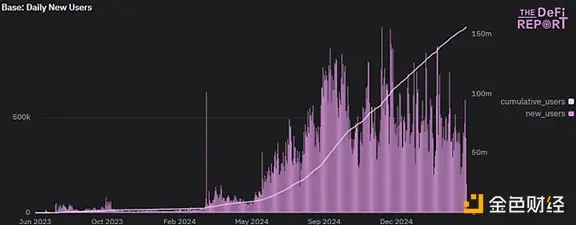
In the past 30 days, Base has added an average of 412,000 new addresses daily. Since its launch in August 2023, Base has attracted 155 million address interactions. Base is bringing new users to the Ethereum ecosystem.
Base Bridge ETH
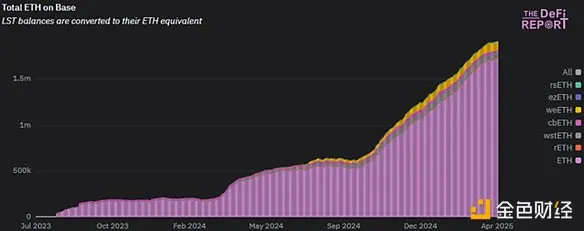
Currently, there are 1.917 million ETH (including LST) on the Base chain, accounting for 1.6% of the circulating supply, creating new demand for ETH.
Daily Bridged Assets

Through the native cross-chain bridge, $0.5 to $2 billion in assets flow between L1 and L2 daily (ETH accounts for 80%). In the past 30 days, $503 million in assets flowed back to Ethereum from Base. In the past 90 days, $3 billion in assets flowed back to Ethereum from Base, confirming that Ethereum remains the cross-chain hub.
Stablecoin Supply
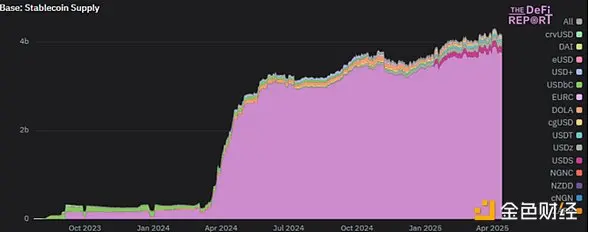
Stablecoin holdings on the Base chain reach $4.2 billion (USDC accounts for 91%), with a total value locked of $9.9 billion, of which $6 billion are native assets and $3.3 billion are from Ethereum cross-chain. This creates more use cases for Ethereum.
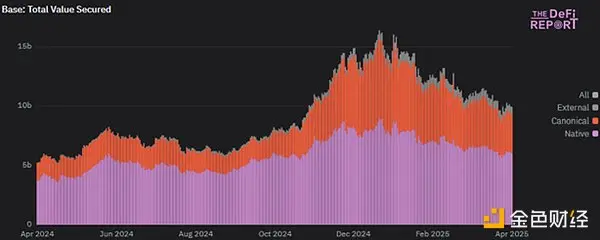
Base's current valuation is $9.9 billion. Of this, $6 billion are "native" assets, meaning these assets were issued on Base. $3.3 billion are "canonical" assets, meaning these assets were bridged from Ethereum. $600 million are considered "external" assets, meaning these assets were bridged from other chains.
Similarly, Base creates net new demand for ETH through its native tokenized assets.
In summary, within less than two years, Base has leveraged Ethereum to:
• Become the largest and fastest-growing L2, earning $106 million in user fees.
• Bring in 157 million new addresses (including some L1 users migrating).
• Build an application ecosystem generating $768 million in fees.
• Cross-chain 1.91 million ETH, creating additional on-chain service demand.
• Increase stablecoin value by $4 billion (Coinbase holds about 50% stake in USDC).
• Issue $6 billion in native assets, while introducing $3.3 billion in Ethereum assets.
We believe Ethereum has achieved a 1+1=3 partnership value. But how much does Ethereum itself benefit?
3、Base's Contribution to Ethereum's "Security Franchise"
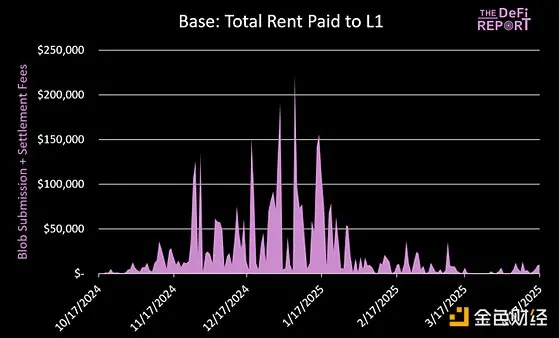
Base has cumulatively paid $4.5 million in blob and settlement fees to L1 (destroyed), with a recent six-month on-chain profit margin of 91% (excluding off-chain costs). Note that Base has paid a total of $24 million in L1 fees, with 80% occurring before the implementation of EIP4844 (cheaper blobs), and our analysis does not include the previous call data phase.
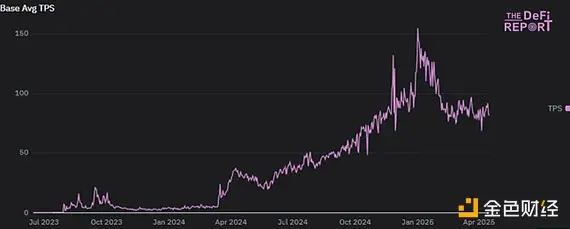
Currently, Base processes an average of 93 TPS, effectively expanding Ethereum's capacity.
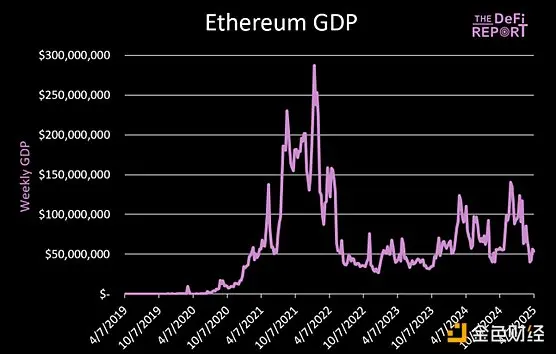
Since Base launched in August 2023, Ethereum's weekly GDP has increased by 75%, but it is still 80% below the peak in early 2022. Currently, the daily GDP of L1 applications is $57 million, while Base applications have an average weekly GDP of $6.8 million.
Returning to the core question: Is Base "stealing" Ethereum's GDP?
The answer is yes!
This is precisely the significance of the L2 roadmap. Top applications (such as Uniswap, Aave) are expanding to Base, and new projects (such as Aerodrome) are directly choosing Base over L1. User migration to L2 leads to a decrease in L1 transaction fees and ETH burning, and Ethereum is shifting towards a more enterprise/B2B-oriented business model.
Only when L2s cannot compensate for the gap through blob fees in the future will this become a "bug" for Ethereum.
4、Base Growth Projections and ETH Value Capture
Based on current data, we believe Ethereum is investing in the long-term future through the L2 roadmap, sacrificing short-term GDP, fees, and ETH burning, hoping that Base can scale up, establish a replicable template (traditional finance?), and drive positive ecosystem development.
Current Analysis:
• L2s currently process about 165 TPS and compete for blob space.
• 3-4 L2s continuously fill the current 3 target blobs per block (maximum 6), and whenever this happens, L2s bid against each other, increasing fees.
• The target blobs per block is currently 3 (maximum 6), but next month, with the Pectra upgrade, it will increase to 6 (maximum 9 blobs per block). Therefore, in our initial scenario analysis, we assume the target is 6 blobs, with a maximum of 9 blobs.
• We are using the Blob Simulator created by Tim Robinson.
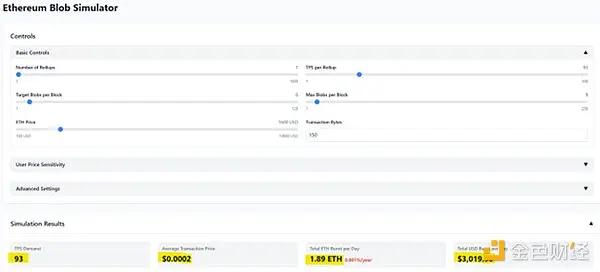
From the above chart, it can be seen that the current situation has a negligible impact on Ethereum's economy, with L2 average fees of $0.0002
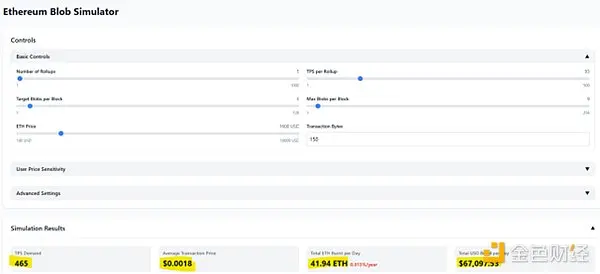
Base TPS increasing fivefold would lead to slightly higher L2 fees, while bringing more value to Ethereum L1 (annualized $24.5 million).
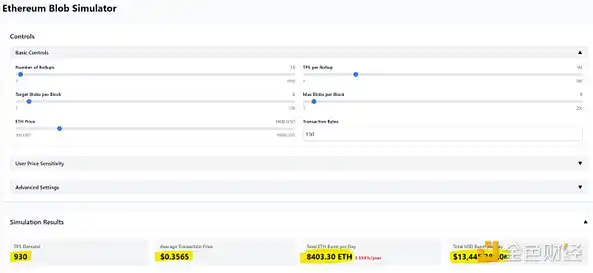
Base TPS increasing tenfold would lead to a 200-fold increase in L1 annual revenue to $4.9 billion (validators would be pleased). However, we also create another problem: L2 average cost per transaction would rise to $0.35 (unacceptable).
PeerDAS and Fusaka upgrades (expected in Q3/Q4 this year) will increase the number of blobs per block to 12 (final goal 48, maximum limit 72). Assuming Base TPS increases tenfold and completes the initial Fusaka upgrade:
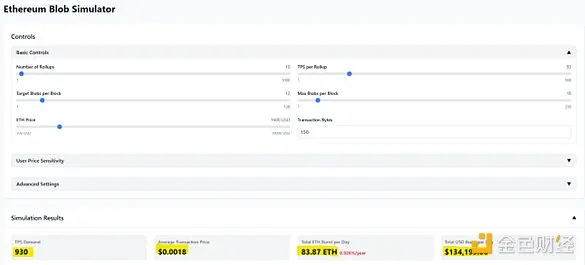
• L2 average fees can be kept under $0.0018
• L1 annual revenue of $489 million
If Arbitrum and Optimism also achieve tenfold expansion at the same time:
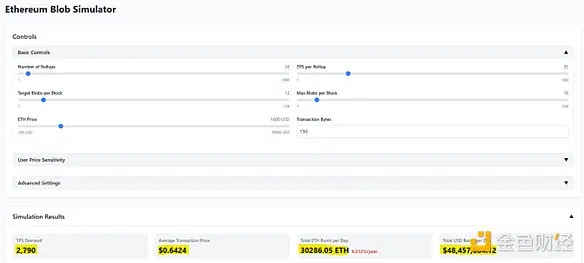
• L1 annual revenue could reach $17.7 billion (nearly twice the 2021 peak)
• However, once again, we create a bottleneck, with average L2 cost per transaction rising to $0.64. This is not feasible.
Let's make an optimistic estimate that the target blobs per block will increase to 24 in one year:
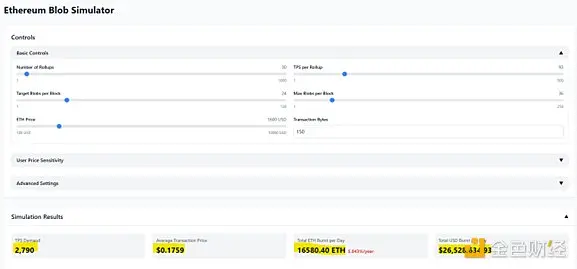
• L1 annual revenue drops to $9.6 billion
• L2 average fees remain at $0.17
To keep L2 average fees below $0.02, we need 33 target blobs per block, at which point L1 annual revenue is only $1.4 billion — matching the actual revenue over the past 365 days.
Summary:
We have tried to simplify the analytical model to clarify two core mechanisms: 1) the impact of L2 transactions per second (TPS) on blob pricing; 2) the transmission effect of increasing the number of target blobs per block on Ethereum's economic model and L2 user fees. In reality, we fully recognize the dynamics and unpredictability of the market environment — in the near future, hundreds of L2s may simultaneously compete for blob space.
We are confident that L1 will continue to carry out a large amount of on-chain activity, continuously generating transaction fees and promoting ETH destruction. However, the specific use cases and transaction volumes are currently unclear.
According to the simulator's results (assuming the three major L2s all reach 10 times the current TPS of Base), when the total TPS of L2s reaches 2,790, even after completing the Pectra technical upgrade, the Ethereum network will still face overload pressure (at this point, the cost per L2 transaction is $0.35).
By comparison, Solana has consistently handled 1,078 TPS over the past 90 days, with an average fee of only $0.016 (including base fee + priority fee), and actual user fees are even lower — because its network uses a dynamic pricing mechanism based on transaction types, and its performance upgrade solution Firedancer has not yet been officially launched.
5、Conclusion
"There is no perfect solution, only trade-offs." This is particularly applicable here. Base has quickly started through the L2 model and currently achieves ideal returns, but it has also tied itself to an Ethereum expansion path it cannot control, potentially facing "vendor lock-in" and technical debt risks.
Ethereum seems to have gained enterprise customers by sacrificing L1 fees, creating new demand for ETH and better user experience. However, the long-term sustainability of the economic relationship is questionable — scenario analysis shows that expansion bottlenecks may persist. If L2s cannot expand quickly, they may need to issue more ETH to maintain validator earnings (after EIP4844, ETH supply has shifted from deflationary to possibly exceeding BTC).
We believe Base is satisfied with the current status, but if Ethereum's blob expansion fails, it may seek alternatives like Celestia. Ethereum urgently needs to shift its culture from "value alignment" to a "security-as-a-service" business model for enterprises.
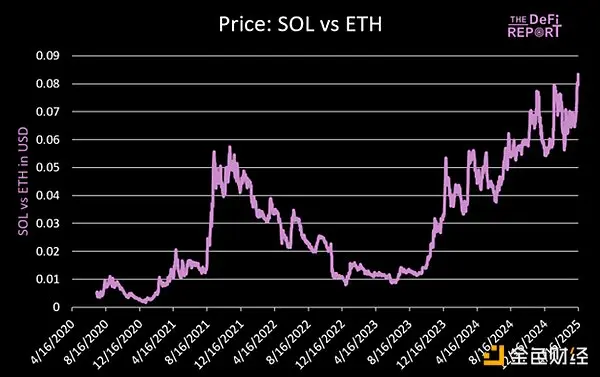
Returning to the original question: Did Standard Chartered misjudge at the bottom of the L2 "J-curve"? We believe that in the short term, Ethereum's fundamental structural decline will continue. Although the potential for traditional finance to move onto the blockchain may improve market sentiment, there are no fundamental improvement catalysts. As shown in the following chart, there is still a long way to go.
Disclaimer: Contains third-party opinions, does not constitute financial advice


OpenClaw Practical Guide
This column focuses on the real progress of Agents: technological evolution, application implementat

Crypto Weekly
Tracking on-chain movements of the smart money and institutions

Frontier Insights
Spotlight on Frontier, trending projects, and breaking events

Blowup Alert
As the 2026 crypto bear market deepens, exit scams and project blowups are becoming increasingly fre

Regulatory Watch
American Crypto Act – timely interpretations of policies worldwide

Popular Airdrop Tutorial
Selected potential airdrop opportunities to gain big with small investments

FusnChain
FusnChain