
ChainThink
Stay ahead, master crypto insights
Textbook-Level Operations! Decoding the Underlying Logic Behind WLFI's $30 Billion Valuation
Textbook-Level Operations! Decoding the Underlying Logic Behind WLFI's $30 Billion Valuation

2025-09-01 18:35
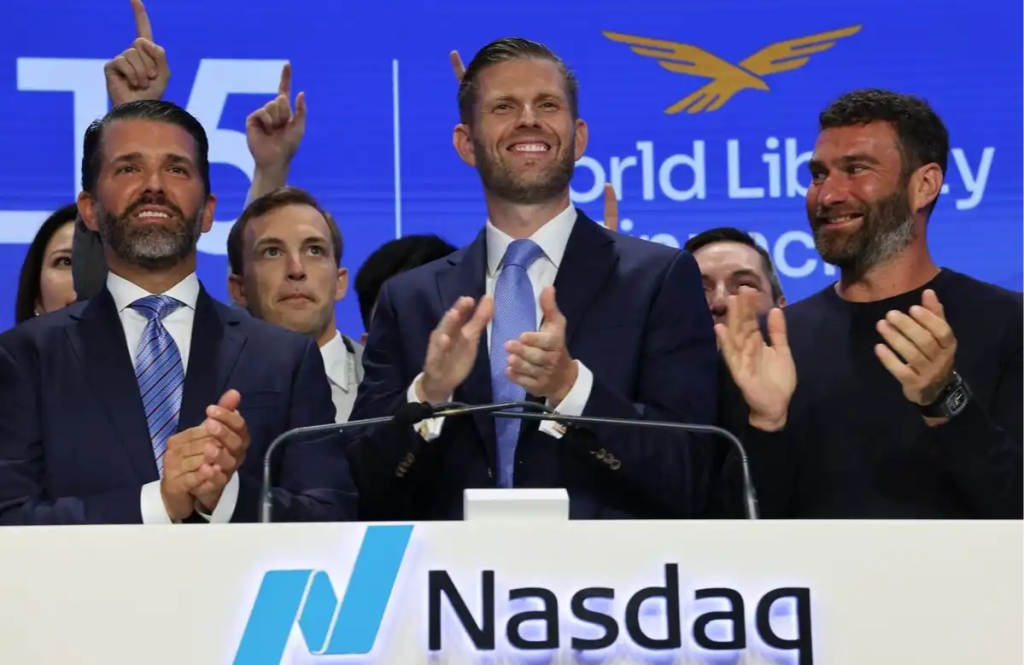
On September 1, the official launch of the World Liberty Financial (WLFI) token drew renewed attention from the entire crypto market toward the Trump family. In just six months, this project—originally perceived merely as an Aave fork—has evolved from a fringe experiment into a core component of the Trump family’s crypto strategy.
The dramatic narrative unfolds against a backdrop of shifting dynamics. A year ago, market perceptions of Trump’s involvement in crypto were largely confined to jokes like “Trump Coin.” But with Trump’s return to the White House, his family moved beyond speculative NFTs or meme coins and instead focused on foundational financial instruments such as stablecoins, lending protocols, and treasury-backed assets. WLFI’s positioning has thus transformed from a simple lending protocol into a "DeFi Super App" aiming to integrate stablecoins, treasury assets, trading, and payments.
This evolution is not merely about launching a protocol—it marks a pivotal convergence of politics and capital. Trump’s son personally attended a conference in Hong Kong, becoming a star on Asia’s Web3 stage; the Abu Dhabi sovereign fund used the WLFI-backed stablecoin USD1 to complete a $2 billion investment in Binance; prominent crypto OGs including CZ, Sun Yuchao, DWF Labs, and Ryan Fang have publicly endorsed the project. The deep integration of political influence and crypto resources has elevated WLFI far beyond the scope of a typical DeFi initiative.
Why should we care about WLFI? Because it raises a fundamental new question: When a sitting U.S. president’s family enters the space directly, could stablecoins be redefined? And when capital, policy, and narrative are fused, will the very order of the crypto industry be rewritten?
The Trump Family’s Panoramic Strategy
The Trump family’s move into crypto was not impulsive but rooted in a clear strategic logic. Long before Trump’s re-election in October 2024, World Liberty Financial (WLFI) had already been announced publicly. Market interest was modest at the time, and the ICO took time to sell out—but the project’s positioning was already evident: nearly all family members were listed as “Co-Founders,” signaling their deep alignment and ambitious intent.
From a holistic perspective, WLFI continues the Trump family’s consistent approach in crypto: they aim to stake claims across every major sector. From early meme coins like Trump Coin, to DeFi protocols, stablecoins, Bitcoin mining, and even treasury asset management companies, the family has covered the full spectrum of crypto. WLFI stands as the most emblematic of these efforts—an evolution from a simple Aave fork into a “full-stack” DeFi Super App, far exceeding initial expectations.
Today, WLFI is preparing to launch its own stablecoin and is tied to DAT’s treasury model, emerging as the most tangible flagship product in the family’s crypto ecosystem. While exact token holdings remain undisclosed, industry consensus suggests WLFI follows a pattern similar to Trump Coin: aside from investors and public ICO sales, the majority of supply remains firmly under the control of the Trump family. In other words, despite co-founders and external investors, true decision-making power still rests with the Trump family and their closest allies.
What Is the Actual Relationship Between WLFI and the Trump Family?
Although President Trump is officially listed as a “Co-Founder” of World Liberty Financial (WLFI), he does not participate in day-to-day operations. According to team disclosures, the core leadership is jointly driven by the Trump family and the Witkoff family—longtime players in New York real estate—with key allies including Dolomite and select veteran figures from the crypto world. In short, this project’s foundation is not hastily assembled but built on deep familial ties and long-standing commercial relationships.
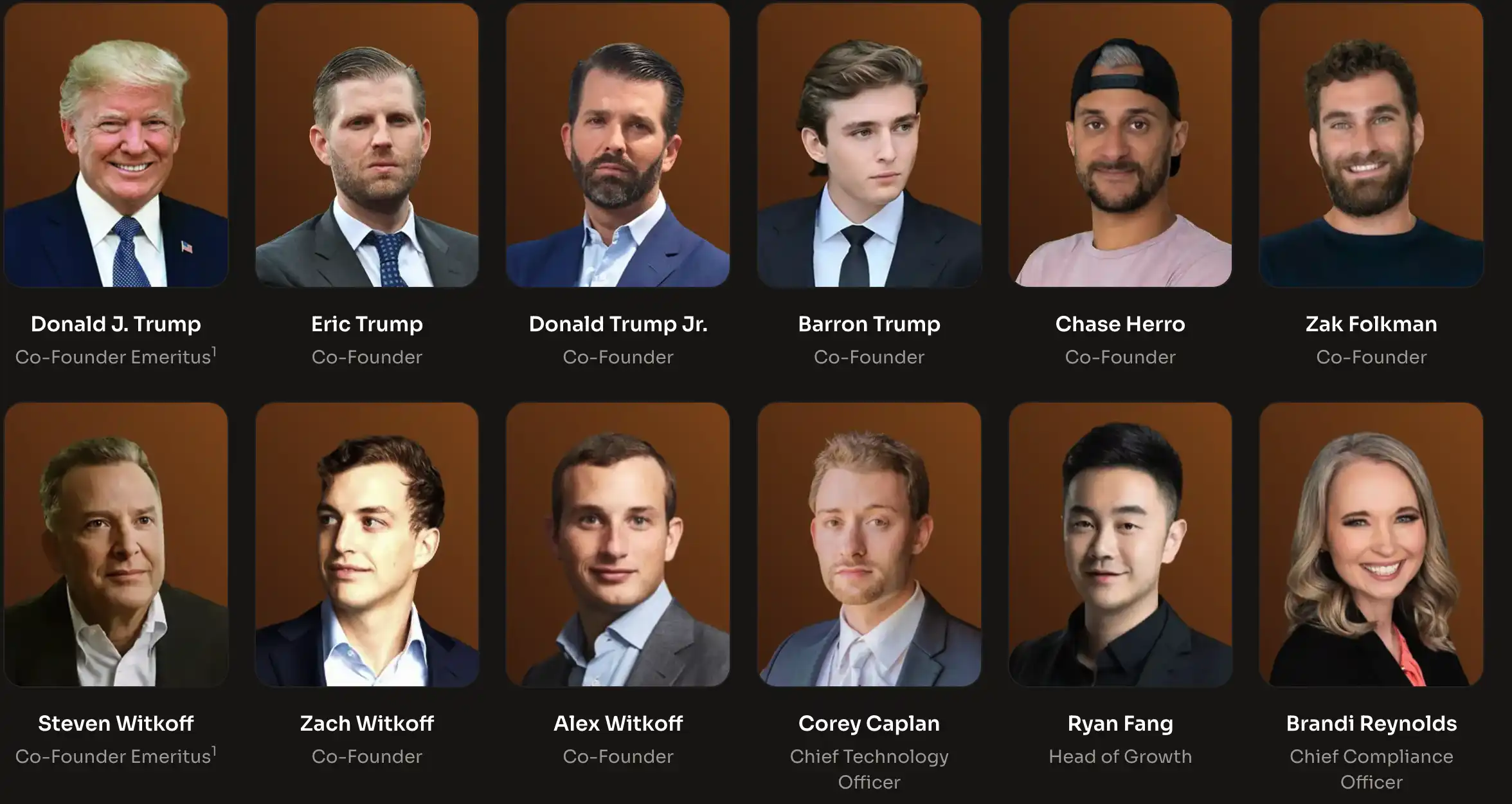
As the team expanded, WLFI quickly forged connections with native crypto communities, especially within the Chinese-speaking ecosystem. Founders like Ryan Fang (Ankr), Rich Teo (Paxos), and Sandy Peng (Scroll) joined early. There were even rumors that the project initially planned to launch on Scroll—a Layer2 chain developed by a Chinese team—but those plans faded. More prominently known are Sun Yuchao and the controversial market maker DWF Labs, both deeply aligned with WLFI. DWF not only invested in the token but also launched the USD1 stablecoin on its own platform, Falcon Finance, immediately after its release.
At a higher level, WLFI has mobilized institutional resources through partnerships with the Abu Dhabi sovereign fund MGX. In March 2025, this fund made a $2 billion investment in Binance—settled using the Trump family’s USD1 stablecoin. This move caused USD1’s market cap to surge from $100 million to $2 billion in days, with over 90% of reserves held directly on Binance. Subsequently, Binance rapidly integrated USD1 across the BNB Chain ecosystem—from meme coin liquidity provisioning to pre-launch participation services. Exchanges like HTX followed suit, listing USD1 promptly. Falcon Finance even incorporated it into its collateral framework, enabling users to borrow directly against USD1.
This strategy delivered immediate results. Leveraging Trump’s political and commercial influence, combined with resource allocation from Binance, DWF, and Sun Yuchao—the crypto OGs—USD1 swiftly established a robust circulation network across the global crypto market. Whether top-tier exchanges or secondary platforms, almost all were rapidly integrating this new stablecoin. In essence, WLFI transformed what would normally be a complex, slow process into a “fast lane” powered by elite resource coordination. This explains why WLFI gained rapid traction so quickly.
How Did WLFI Rapidly Open Its Ecosystem in Just Six Months?
Over the past six months, World Liberty Financial (WLFI) has delivered a performance that has left the entire DeFi industry envious. For most DeFi projects, gaining user adoption and building effective ecosystem support typically requires years of accumulation—relying on exchange listings, cross-protocol integrations, and strong network effects. Especially for stablecoins, breaking into the market is often a protracted battle. Yet WLFI managed to roll out its entire ecosystem in less than half a year—a rare feat in the fiercely competitive crypto landscape.
So what exactly is WLFI? What is its product logic and development path? Tracing back from the beginning, WLFI started as a straightforward fork of Aave. Aave is one of the most iconic lending protocols in crypto, allowing users to collateralize BTC, ETH, and other assets to borrow stablecoins. WLFI’s initial model closely mirrored Aave, positioning itself as a standard DeFi lending project. But as the project evolved, it expanded toward more ambitious goals—particularly stablecoin issuance. WLFI’s USD1 stablecoin aims to compete directly with USDT and USDC, becoming a central strategic pillar.
Meanwhile, WLFI has crossed into traditional finance by establishing Alt5 Sigma Corporation, a publicly traded fintech company listed on the U.S. stock market, with plans to use WLFI tokens as reserve assets—mirroring MicroStrategy’s “flywheel” model. The team has even declared ambitions to enter crypto payments, incorporating nearly every trending topic into its roadmap. In effect, WLFI has evolved from a basic lending protocol into a “token-issuing, whitepaper-updating” entity. With each version update, its vision grows ever grander, progressing toward a fully integrated DeFi Super App: stablecoins enable yield-bearing products, treasury instruments, lending, arbitrage—and potentially extend into trading and derivatives—building a comprehensive “super app” covering all DeFi domains.
From an industrial synergy standpoint, other Trump family ventures are now interacting with WLFI. For instance, Trump Media & Technology Group Corp (DJT), a media-tech firm valued in the tens of billions, has begun exploring crypto payment integration. Future family-controlled fintech firms may soon interoperate with WLFI’s stablecoin and lending products, forming a closed-loop ecosystem between family industries and DeFi protocols. This “complementary industrial chain” not only provides real-world use cases for WLFI but also strengthens its financial ambition.
In terms of external messaging, the WLFI team consistently emphasizes their mission: “Bank the Unbanked”—enabling access to financial services via DeFi and Web3 for those excluded from traditional banking systems. While this slogan is common in crypto circles, closer inspection reveals a far more complex execution than the rhetoric suggests.
Initially, WLFI was little more than a copy of a lending protocol. Soon, however, it entered the stablecoin arena. Its USD1 stablecoin adopts a centralized issuance model similar to USDT and USDC: users deposit fiat dollars, and the team mints equivalent USD1 tokens on-chain. This isn’t novel, but thanks to massive resource aggregation and capital mobilization, USD1’s scale surged from $100 million to $2 billion in days—rewriting market expectations around speed.
Yet if you visit WLFI’s official website today, you’ll find most products still marked “Coming Soon”: whether lending, exchanges, or other features, everything remains in “launching soon” status. In other words, WLFI’s product matrix is still largely unlaunched. Yet its influence and narrative have already permeated the industry: the stablecoin is live, the token has completed multiple rounds of sales, generating substantial revenue, and went live on major global exchanges on September 1.
This is WLFI’s reality: a project with enormous vision and narrative potential, but still in early stages of product delivery. Its model resembles “first paint the picture, then build momentum”—leveraging political clout and capital alliances to rapidly convert narrative into tangible influence. Though actual applications remain limited, its explosive growth of USD1 and deep family ties have made it a dominant talking point. Put simply, WLFI may still be in the “blueprint phase” of city-building—but the shadow of that city is already unmistakably visible.
Is “Bank the Unbanked” Just a Slogan? From DeFi Protocol to Stablecoin
Many assume the Trump family’s entry into DeFi was merely a hype-driven speculation. But analyzing WLFI’s trajectory reveals this view is inaccurate. While Trump previously dabbled in NFTs and meme coins—short-term gambits chasing market sentiment—WLFI’s positioning is fundamentally different. It represents the most strategically significant piece in the family’s crypto portfolio, not only in scale but also in addressing real pain points and long-term planning.
The root lies in the visceral experience of being “debanked.” After Trump’s first term ended, hundreds of family bank accounts were abruptly closed overnight, and their real estate entities lost basic banking services from giants like JPMorgan and Bank of America. His son recalled the moment with visible anger. Whether due to political retaliation or regulatory scrutiny, this “DeBanking” event taught the Trump family firsthand that the traditional financial system is unreliable. If Trump leaves office in 2028 and Democrats regain power, a repeat scenario is highly likely. Traditional industries like real estate and media would have no defense. But if the family’s core assets were already migrated to crypto, the situation would be entirely different. Thus, the creation of WLFI is a logical response to past trauma—strategically sound from the Trump family’s perspective.
The history of cryptocurrency itself is a story of resistance against traditional banking. From China to the U.S., facing regulation, crackdowns, and bans, crypto rose through persecution and eventually built a $4 trillion market and a mature DeFi infrastructure. The Trump family understands this deeply, which is why they’ve shifted their business focus to the crypto track. This is not just defensive—it’s offensive: leveraging their current political power to push legislation, embedding crypto finance into U.S. law, ensuring that even after regime change, their crypto empire enjoys institutional protection.
Viewed this way, WLFI is not a fleeting speculation but a calculated, dual-purpose strategy. It frees the family’s wealth from reliance on banks while building a firewall against future uncertainty. More importantly, unlike passive investments in existing protocols like Aave, WLFI is a true entrepreneurial venture. Its value extends beyond the token itself—by integrating stablecoins, lending, derivatives, and more, it binds Trump’s political influence with global crypto capital, offering a much higher ceiling than simple investment.
How Is Trump Turning Presidential Influence into Value?
Understanding the Trump family’s calculus reveals that World Liberty Financial (WLFI) is not a simple crypto gamble but a grand strategic chess game. Today, they leverage Trump’s status as U.S. President to convert political and social capital into a new form of monetization. The term “monetization” is in quotes because the family may not see it that way—but externally, this is clearly a path to capitalize on influence.
The brilliance of this approach lies in its ability to generate visibility while attracting the most powerful players in crypto. By riding the wave of presidential prestige, they first build influence in the crypto space, then leverage blockchain’s censorship resistance and anti-government intervention properties to establish a durable moat for future commercial gains. Even after Trump leaves office, the family can maintain a sustainable competitive advantage.
Even smarter is how the Trump family deploys influence globally. Real estate and media businesses rely heavily on local markets and banking systems. Crypto, by contrast, is decentralized and global—making it far more efficient for capitalizing on influence worldwide. For example, at Trump’s private dinners, 30–40% of attendees are of Chinese descent, and WLFI’s strongest supporters are concentrated in Asia—especially offshore exchanges in Greater China. Crypto offers global reach far superior to traditional real estate ventures.
Beneath this, figures like CZ of Binance and Sun Yuchao’s cohort of Chinese OGs play critical roles. Today, the primary use cases for WLFI’s USD1 stablecoin are on Binance and HTX. On the BNB Chain, protocols like ListaDAO, Plume Network (actively building RWA in Hong Kong), and StakeStone are tightly linked to Binance. High-profile players with Chinese backgrounds—including DWF Labs’ investment in Falcon Finance, Ankr founder Ryan Fang, and Paxos co-founder Rich Teo—are deeply involved in WLFI. In short, WLFI’s global influence is accelerating through the Asian crypto community network.
More intriguingly, last week CFTC signaled openness for non-U.S.-based exchanges to re-enter the American market. These offshore giants—Binance, OKX—could leverage this compliance window to reestablish presence in the U.S. If they strengthen ties with the Trump family, they could gain advantages in legislation, licensing, and competitive positioning. Therefore, WLFI is not just a tool for the Trump family to monetize influence—it’s a strategic pawn in building a global alliance network. It serves current political capital while securing safe ground for post-presidency business expansion.
Why Do So Many Crypto OGs Accept USD1 Even If It Doesn’t Profit Platforms?
Why do so many crypto OGs support World Liberty Financial (WLFI)? Clues come from rumors. For example, some speculate CZ’s support stems partly from hope of future “amnesty.” Similarly, Sun Yuchao was asked if this support amounted to “political currency.” Regardless of truth, for top offshore exchanges, this is a smart trade: exchanging capital for political resources often yields higher returns than pure commercial investment.
On another front, Trump himself possesses immense attention gravity—almost a “black hole” of public interest. Whether it’s a new token, NFT, or public statement, he instantly captures global attention. For exchanges, backing such a project carries low risk: the Trump family’s backing virtually eliminates fears of rug pulls or hacks. Take USD1: this deal with Middle Eastern capital is a shrewd move for Binance. Since the investor is putting money in, the choice of stablecoin is irrelevant. Using Trump’s stablecoin incurs no extra cost and earns goodwill from the Trump camp.
More realistically, the U.S. market holds vast potential. Over the next three years, giant exchanges like Binance and OKX are far more likely to return to the U.S. than to China. Aligning with the Trump family means greater ease in U.S. compliance and legislative processes. Coinbase, though cautious, supported Trump Coin immediately upon launch. Each exchange weighs the pros and cons, but politically and economically, this is a highly favorable bet.
Regarding Binance accepting nearly $2 billion in USD1 stablecoin, outsiders often ask: Was this a good deal? On the surface, Binance sacrificed significant yield. Had the funds been deposited in USD or USDC, interest income alone could have reached $80 million to $100 million annually, plus distribution partner subsidies for USDC. By accepting new USD1, those revenues were forfeited. However, Binance may gain far more:
First, USD1 is compliant and fits within the U.S. stablecoin regulatory framework—potentially qualifying it alongside USDC and USDT for mainstream adoption. Rumors suggest a “back-to-back” agreement between Binance, the Trump family, or the Middle Eastern fund—for example, profit-sharing on interest or liquidity support incentives—meaning Binance didn’t lose as much as it appears. Second, the funds are controlled by the Middle Eastern fund—not Binance. Steven Witkoff, as a Middle Eastern envoy and co-founder of WLFI, may have explicitly mandated USD1 as the investment vehicle. Binance naturally complied. The logic is clear: this is a result of political-capital fusion, not a purely commercial decision. Third, for Binance, USD1 is a strategic option. Since BUSD was effectively killed by regulators, Binance has lacked a truly integrated, compliant stablecoin. FDUSD exists but lacks clarity. In contrast, USD1 boasts Trump family endorsement and U.S. regulatory legitimacy—making it a potential candidate to become Binance’s “default stablecoin.” Success here would cement a deeper strategic alliance.
In short, by having Middle Eastern capital invest in Binance via WLFI and USD1, the project secured broader Asian exchange support—a highly strategic move. It placed OGs on the side of potential power and laid groundwork for future U.S. market re-entry. In this light, WLFI resembles a mutual selection: Trump trades influence for capital and support, while exchanges bet on future political protection and market access.
What Is the Relationship Between WLFI and World Liberty Financial? How Does Its Token Model Work?
WLFI is the governance token of the World Liberty Financial protocol, but its design differs from typical governance tokens. First, it offers no dividend rights and cannot map to equity in the underlying legal entity. Thus, real decision-making power does not reside with token holders. In essence, WLFI functions as a “pure governance token,” but whether it truly enables governance remains questionable—since key decisions are still made by the company, not via on-chain governance mechanisms.
Token distribution is highly centralized. Trump is rumored to hold over 15% of the supply, while Sun Yuchao, due to prior large-scale purchases, controls approximately 3% of circulating supply. Additionally, several whales acquired substantial holdings through on- and off-chain transactions. Overall, about 30% of the total supply was sold during the ICO, with the remaining 70% retained by the project team. How these internal allocations are distributed, their vesting schedules, and future sale potential remain completely opaque—creating significant uncertainty around future sell pressure.
On issuance design, WLFI follows many standard DeFi patterns. For example, in October 2024, during the pre-sale phase and whitepaper release, the token was set as non-transferable—a common tactic in U.S. markets to avoid regulatory scrutiny, similar to strategies used by EigenLayer and others. Lock-ups typically last a full year. Now, WLFI is gradually enabling transferability and listing eligibility—partly due to clearer U.S. legislative clarity, and partly because of a shift in SEC leadership and a friendlier regulatory tone, clearing the path for token circulation and exchange listing.
From a tokenomics perspective, WLFI shares similarities with other DeFi projects: it supports on-chain voting and distribution mechanisms. Even during the non-transferable phase, holders can participate in governance votes. This structure is common among U.S.-based projects and seen as a protective design to reduce regulatory pressure. However, whether WLFI will truly deliver governance value—or merely function as a politically branded instrument—remains a focal point of external scrutiny.
What Was the Controversy Around WLFI and Aave’s Token Allocation? Are Resource-Driven, Innovation-Lite Projects Always Winners?
Last October, WLFI proposed a governance proposal on both its own and Aave’s forums, claiming to build a lending protocol based on Aave v3. The two-part proposal included: 1) allocating 20% of future protocol fees to the Aave DAO treasury; and 2) transferring 7% of WLFI’s total token supply (based on a hundred-billion-coin baseline) to Aave for governance, liquidity incentives, or decentralization efforts.
On August 23, Aave’s founder confirmed the proposal was “valid,” but WLFI team members later publicly denied the authenticity of the “7% quota.” Domestic media inquiries to the WLFI team received a “fake news” reply. The Aave founder expressed outrage, and community sentiment turned sharply negative. Roughly estimated, the 7% allocation equated to a value in the “billions,” directly fueling community fury.
Factually, the proposal had only reached the “temperature check” stage—far short of binding governance. Such checks are usually symbolic expressions of intent, and approval does not imply executable code. Without a linked smart contract, governance outcomes can be reversed by subsequent proposals at any time.
In short, without on-chain enforceability, a “passed” vote is akin to a non-binding memorandum of understanding (MOU)—legally and technically unenforceable. Moreover, such large-scale token giveaways are uncommon in industry practice (e.g., Spark’s collaboration with Aave). Thus, the apparent generosity of the original proposal deviated from norms, raising questions about ambiguous justifications. Committing fixed percentages of total supply and long-term revenue sharing without verifying Aave’s actual contribution is unusual.
Returning to the timeline: Q4 2024, WLFI still faced skepticism over credibility and inflated valuation, compounded by a history of past projects being hacked. Consequently, token sales were underwhelming. In this context, leveraging Aave’s brand and security reputation to “launder” credibility was a comprehensible PR and market strategy—“Fork + Fee Sharing/Token Transfer” combo. It mitigated moral concerns about copying while easing safety-related anxieties.
But over the following months, WLFI surged in popularity and pivoted its strategic focus toward USD1 stablecoin as the core of its DeFi hub. The original “lending protocol” positioning receded. As the narrative shifted, earlier static promises of fixed ratios naturally needed renegotiation—likely evolving into dynamic incentives tied to actual usage and contribution, or dedicated token pools for Aave-specific marketing campaigns.
Here, Liu Feng references a 2018 interview between Laura Shin and Multicoin’s Kyle Samani, where Kyle stated: “In crypto, technology doesn’t matter—how you go to market and operate is everything.” At the time, this view was widely questioned. But today, such dynamics are increasingly common.
Can USD1 Evolve from “Exchange-Driven Liquidity” to “Real User Adoption”?
Currently, the general outlook for stablecoins is bleak. From a crypto-native perspective, aside from a few leaders (USDC, USDT), most lack real daily use without yield stacking. USDE, despite $2 billion injected, shows little organic retention. FDUSD is mostly used for exchange-based staking strategies, rarely used otherwise—indicating that “scale” does not equal “user demand.”
Against this backdrop, USD1 faces three major hurdles: First, the dual-edged effect of political and banking channels. Political visibility helps rapidly organize liquidity on offshore exchanges but may create resistance within domestic financial systems. Whether major U.S. banks will offer friendly settlement and custody remains uncertain. Some jurisdictions and institutions may even avoid association due to political sensitivity (e.g., Hong Kong figures avoiding events due to Eric Trump’s visit).
Second, channel and distribution bottlenecks: currently, USD1 leverages offshore exchange resources. Achieving “real user use” requires integration with banks, payment rails, e-commerce, and embedded scenarios in social/super apps—all slow-moving variables requiring heavy licensing, risk control, and complex negotiations. Absence of such integration risks turning stablecoins into mere “exchange-to-exchange settlement tools.”
Third, self-sustaining product and incentive design: crypto-native users generally reject “networking narratives” and prioritize verifiable reliability and clear use cases. To break through USDT/USDC’s entrenched inertia, USD1 must establish stable expectations across reserve transparency/audit frequency, multi-chain availability and bridge UX, wallet/native custody integration, merchant fee and rebate structures, and seamless redemption in regulated regions. Early resource advantages must be converted into long-term incentives tied to actual usage—not one-time market-making subsidies.
Yet WLFI’s “resource pool” undeniably holds unique spillover value: by aligning the Trump family’s personal stakes and policy drivers, it may pave the way for broader on-chain innovation. The first step—“stacking on-chain liquidity”—is already visible. But transitioning from “passive liquidity” to “active usage” hinges on leveraging existing ecosystem credibility to continuously attract high-quality applications and achieve cross-domain distribution.
Short-term dominance over USDT/USDC remains unlikely. More realistic is USD1’s role as a universal settlement stablecoin across multiple exchanges. However, USD1 lags in progress on bank gateways, payment/e-commerce/salary pilots, and default support in mainstream wallets and custodians. Combined with the marginal shifts in the U.S. political environment, this dual-edged sword is not necessarily an advantage.
Original Title: “Shell + Trump = $30 Billion, WLFI’s Textbook-Level Operations”
Original Author: BUBBLE, kkk
Disclaimer: Contains third-party opinions, does not constitute financial advice


AI Practical Guide
This column focuses on the real progress of Agents: technological evolution, application implementat

Crypto Weekly
Tracking on-chain movements of the smart money and institutions

Frontier Insights
Spotlight on Frontier, trending projects, and breaking events

Blowup Alert
As the 2026 crypto bear market deepens, exit scams and project blowups are becoming increasingly fre

Regulatory Watch
American Crypto Act – timely interpretations of policies worldwide

Popular Airdrop Tutorial
Selected potential airdrop opportunities to gain big with small investments

FusnChain
FusnChain