
ChainThink
Stay ahead, master crypto insights
Conversation with the HYPE Whales: After Breaking All-Time Highs, What Marvels Can Hyperliquid Still Create?
Conversation with the HYPE Whales: After Breaking All-Time Highs, What Marvels Can Hyperliquid Still Create?

2025-09-10 09:28
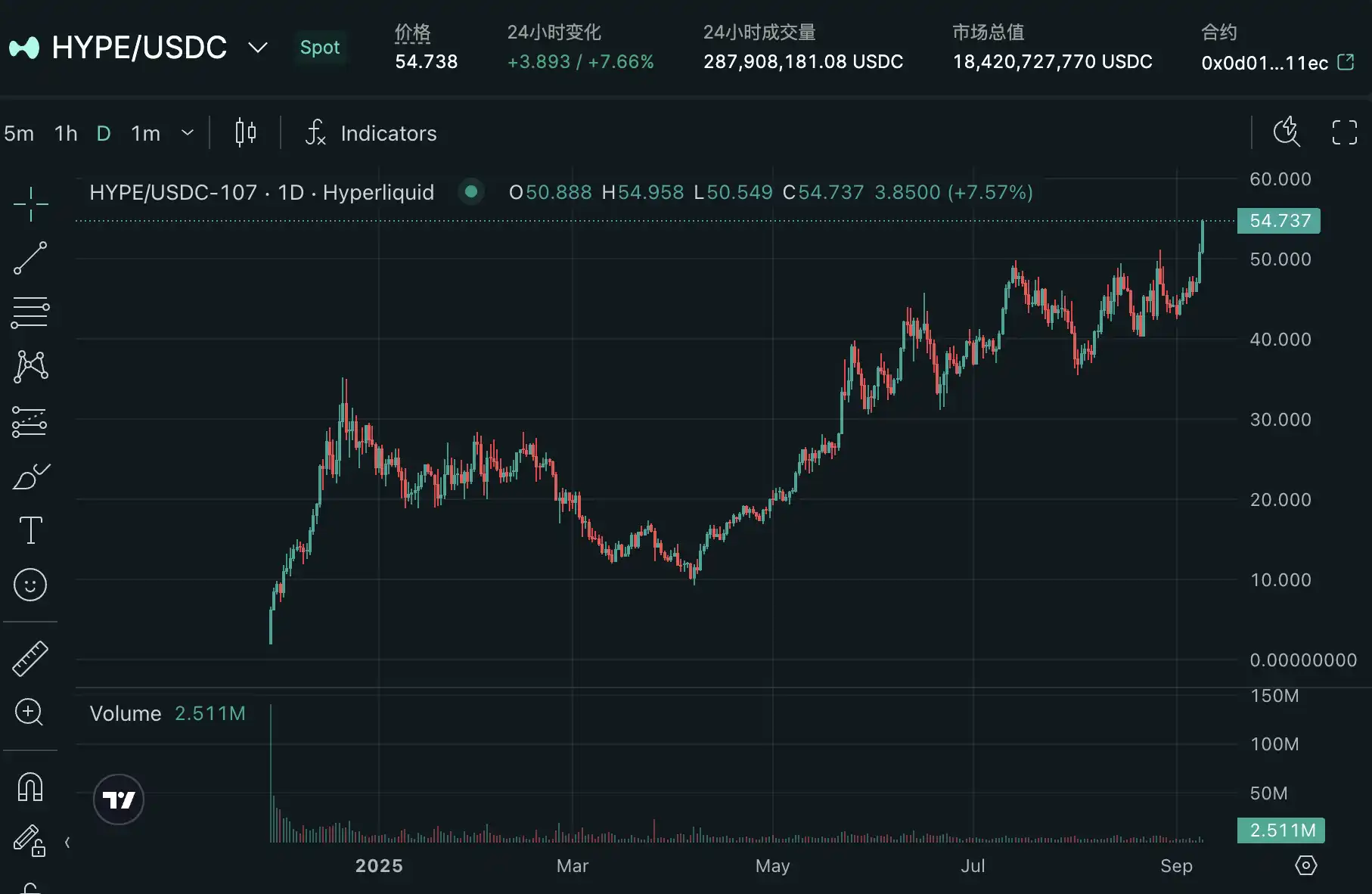
Over the past year, Hyperliquid has surged in user acquisition with trading volume far surpassing that of numerous competitors. Driven by continuous buzz and a robust community ecosystem, its governance token $HYPE has consistently climbed in value. With the recent launch of the stablecoin USDH auction and proposal within the Hyperliquid ecosystem, market attention has been reignited, pushing $HYPE to a new all-time high at $54.7 today.
Among the most successful companies in this crypto cycle, two sets of compelling data stand out. First is protocol revenue: in August, Hyperliquid's protocol fee income reached $110 million, with full-year projections exceeding $1.1 billion.
The second is valuation. According to Coingecko data, Hyperliquid’s current market cap exceeds $12 billion, ranking it 18th in the crypto market. If stablecoins and pegged assets are excluded, it would rank within the top ten. Just last December, its market cap was under $2 billion.
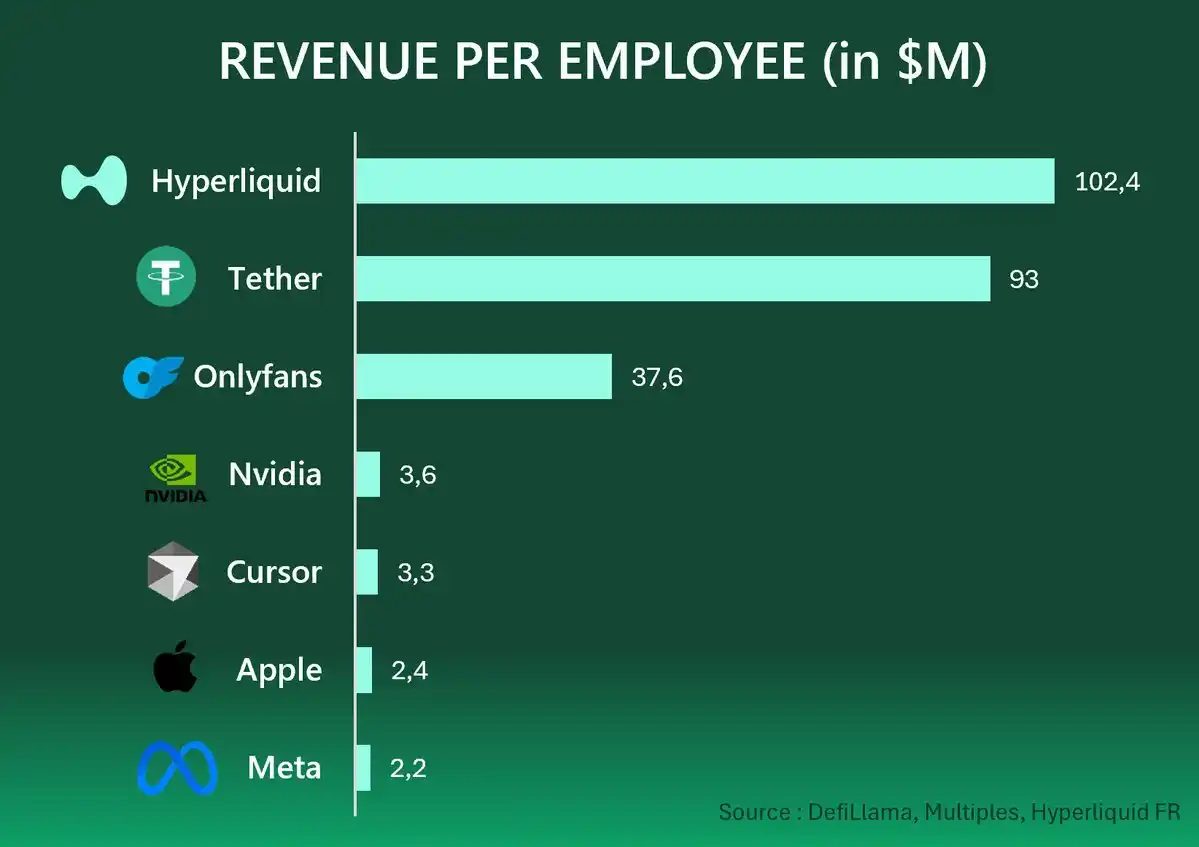
In the world of Crypto—where "fat protocol, thin app" dominates—application valuations have traditionally lagged behind protocol valuations. However, this narrative is reversing in the current cycle, with Hyperliquid serving as the quintessential example. Another intriguing point: founder Jeff revealed in an interview that the company currently has only 11 team members, meaning each member generates over $100 million in annual revenue. This makes Hyperliquid one of the highest-per-capita revenue-generating companies globally.
So what mechanisms has it innovated? What has the team gotten right? And how will it evolve? In the latest episode of Web3 101, we invited Xiaohuanxiong, a veteran DeFi community player, to discuss. His Telegram channel is among the most active and influential in the Chinese-speaking community. He is also a deep participant in Hyperliquid and a major holder of HYPE. The following insights are derived from podcast content (listen to the podcast: E61|Challenging Binance: Why Do Whales Prefer Hyperliquid?).
TL;DR
Xiaohuanxiong’s early involvement: He joined Hyperliquid during its Private Beta in August 2023, initially recommended by the community, then drawn in by the team’s professionalism and liquidity mechanism (HLP). Through early participation and long-term commitment, he has earned gains exceeding millions of dollars in tokens.
Hyperliquid’s product advantages: It employs a CLOB + proactive market-making model, delivering high liquidity efficiency and stability, with user experience approaching that of centralized exchanges (CEXs) at ~90%. Even during extreme market volatility, it maintains smooth operations. Compared to GMX’s GLP physical settlement model, HLP’s cash settlement approach is closer to CEXs, enabling broader trading pairs and deeper liquidity—but with risks more dependent on team risk management.
Evolution of Perp DEXs: From dYdX (trading mining → reliance on token price manipulation), to GMX (GLP model → steady but limited scalability), to Hyperliquid (CLOB + HLP → fast execution, rich trading pairs, deep liquidity), the trajectory increasingly mimics a centralized experience.
No-VC liquidity flywheel: The founding team has direct market-maker background, injecting over $100 million in initial liquidity. They leveraged features like copy-trading pools, Friendtech indices, Purr airdrops, and points systems to continuously acquire and retain users. Through the narrative of “points + airdrops + transparent whale positions,” they rapidly built community consensus and trading activity.
Why whales prefer Hyperliquid: Beyond low fees and speed, on-chain transparency allows funds to be “followed” to boost returns, while protecting identity and avoiding CEX ban risks. Massive open positions visible on-chain become topics of discussion and traffic drivers for the platform.
Formation of whale consensus: Rapid update cycles (weekly/monthly optimizations), timely responses to controversies, and consistent action instill user confidence. Early holders of Purr and points airdrops evolved into a stable group of large token holders, establishing strong consensus.
HyperEVM and HIP-3: Core ecosystem components include Unit (cross-chain asset packaging), Kinetic (largest HYPE staking protocol), and Supercell/Inselico (third-party frontends). HIP-3 enables users to collateralize HYPE and launch white-labeled exchanges, lowering costs for new teams or enabling broader asset integration.
Weaknesses and challenges: Subpar mobile experience, high fiat on/off ramp fees, insufficient customer support and education infrastructure. The XPL pre-market incident exposed systemic flaws and eroded user trust. With only 11 team members, if they cannot sustain development pace and ecosystem expansion during a bear market, long-term competition with Binance may prove unsustainable.
Future outlook: Short-term advantages are clear, but long-term competitiveness hinges on team expansion and ecosystem collaboration. Hyperliquid’s true test lies in navigating the next cycle.
First Impressions: Why Did DeFi OGs Embrace Hyperliquid?
Xiaohuanxiong: I’m Xiaohuanxiong, running a Telegram community and Twitter account focused on DeFi. I’ve been active in various protocols since 2020. I was among the first users to join Hyperliquid during its private beta phase. Since then, I’ve followed the project across spot and perpetual markets. After token issuance, I continued monitoring closely—making me one of the most knowledgeable figures in the Chinese-speaking community about Hyperliquid. Hope today’s discussion helps everyone better understand this project.
Liu Feng: Thanks, Xiaohuanxiong. Jack already highlighted Hyperliquid’s significance. In my view, decentralized perpetual trading is the crown jewel of Web3—extremely profitable. Consider this: in August, Hyperliquid’s trading volume surpassed $400 billion, double Robinhood’s monthly volume. So profitability is entirely justified.
There’s also a rumor circulating that you made over $10 million from HYPE tokens—is that true?
Xiaohuanxiong: Yes.
Liu Feng: We can only envy. Let’s clarify: Xiaohuanxiong has vested interests in Hyperliquid, whereas Jack and I are not major token holders—we only received minor airdrops. Today’s episode is purely educational, not investment advice.
JACK: My first question: How did you initially discover Hyperliquid, Professor Xiaohuanxiong?
Xiaohuanxiong: Initially, it was introduced by fellow community members. At the time, they posted four or five projects daily, so I didn’t pay much attention. But later, a team member DM’d me on Twitter, introducing their project. They were familiar with our community, knowing we were previously active in GMX.
Based on that, I judged they had conducted systematic market research on product-market fit (PMF). Their quality must be solid—they’d done due diligence before launch. That prompted me to dive deeper, eventually joining their private beta and following subsequent updates.
I sensed that although the project appeared fair-launch, the team behind it was highly experienced industry veterans with significant resources. That’s why I gradually invested more time.
Liu Feng: Roughly when?
Xiaohuanxiong: Private beta began in August 2023; it exploded in September—though not significantly earlier than others.
JACK: You mentioned Hyperliquid seemed like a fair launch—a truly open, accessible entry point for retail investors—but simultaneously, the team demonstrated exceptional professionalism. Where exactly did you sense that professionalism?
Xiaohuanxiong: First, in the HLP (liquidity pool) design. Unlike GMX/dYdX’s AMM or passive market-making models, Hyperliquid’s approach resembles proactive market-making at competitive price levels within the order book, especially near the middle of the book. This leads to higher capital efficiency.
Later, beyond technical aspects, their GTM strategy and incentive mechanisms—including community marketing—were impressively mature.
They reached out to our community, but that’s just one part of the Chinese ecosystem. They also engaged prominent KOLs and leaders in English-speaking regions—seasoned influencers who wouldn’t be easily found without deep industry knowledge. Early on, they adopted a copy-trading strategy, targeting smaller creators (with only a few thousand followers) whose audiences were highly active, not those with tens of thousands of followers but minimal engagement. Combined with project team and VC involvement, their marketing became comprehensive.
But even that wasn’t enough. Their points system was cleverly designed—for example, a 1.5-quarter incentive between Q1 and Q2 rewarded users who traded consistently even without points, reducing the proportion of “airdrop farmers.”
This combination of early community outreach and strategic incentives made me feel the team was highly professional.
Liu Feng: On the product side, what was your first impression?
Xiaohuanxiong: Initially, nothing stood out—just smooth, fluid performance. Over time, I realized its exceptional stability. Fewer issues than competitors, no liquidity withdrawal during volatile markets. Overall experience approaches 90% of a CEX, but its true advantage lies in reliability.
History of Perp DEX Evolution
JACK: Please trace the evolution from dYdX to GMX to Hyperliquid. You noted Hyperliquid’s market-making mechanism differs from predecessors, using a central limit order book (CLOB) and proactive market-making. Could you provide a concise history for listeners unfamiliar with Perp DEXs and highlight key products?
Xiaohuanxiong: When discussing on-chain decentralized perpetual exchange platforms, we must start with dYdX. Before dYdX, perpetual exchanges weren’t in the spotlight. dYdX offered massive airdrops and pioneered moving CEX capabilities on-chain, introducing a “matching-transaction mining” mechanism—similar to Fcoin—but on-chain with weekly settlements: trade volume determined airdrop rewards.
The problem: early trading volumes spiked artificially. For example, spending $1 million in fees could yield $1.2 million in tokens—guaranteed profit, mathematically calculable, effectively “official encouragement to pump volume.” When tokens rose, volume surged; when they fell, volume vanished overnight. Later NFT launches and native chain initiatives couldn’t offset the decline caused by falling token prices. I consider this dYdX’s “death spiral.”
Following dYdX, numerous VC-backed exchanges emerged—MCDEX and others on BSC, Polygon, etc.—but none gained traction. They didn’t “lose money to buy data” like dYdX. Conservative strategies failed to attract volume.
Then came GMX. Originally operating binary options on Ethereum, it lost momentum and shifted to BSC to focus on perpetuals. But BSC’s competition was fierce, and strained relations with Binance hindered growth. Only after migrating to Arbitrum did it thrive, becoming a top-tier project on a major chain. Its biggest contribution was naming and architecture: liquidity providers became known as GLP (thus Hyperliquid’s LP is called HLP). GLP’s core feature is physical settlement: the pool holds real BTC, ETH, and USD. To go long BTC, you borrow USD to buy BTC from the pool.
Benefits: no liquidation risk. In extreme conditions, as long as the protocol isn’t compromised, you get your position opened and profits paid—most secure. But the downside: liquidity can’t be leveraged. Pool size limits leverage capacity. In CEXs, open interest (OI) typically exceeds actual spot holdings—industry standard. GLP’s physical constraints lead to higher fees and funding rates. Though stable, it can’t scale beyond the core 500 users demanding decentralization and security.
Subsequently, cash-settled solutions emerged, then faded. Finally, Hyperliquid arrived. When many thought the space was dead, Hyperliquid returned to a hybrid model—not fully centralized, not fully decentralized—using a few nodes for on-chain matching. Unlike dYdX, which moved all trades on-chain, Hyperliquid uses a small set of nodes for faster execution. It’s cash-settled, not physically delivered, allowing more assets and eliminating BTC/ETH limitations.
This enabled broad coverage of long-tail assets. Proactive market-making provided thick liquidity at relatively low operational cost. Initial liquidity pools were around $200 million, yet launched with depth comparable to OKX (not quite Binance, but close), now approaching Binance-level depth. Liquidity and speed became the key factors in defeating prior competitors.
JACK: So, the emergence of Hyperliquid in the crypto market likely stems from four critical factors. First, continuous innovation in Perp DEX mechanics—from dYdX’s gamified incentives encouraging volume pumping, to GMX’s GLP model, to Hyperliquid’s enhancements across multiple dimensions. Second, the maturation of on-chain solutions for off-chain problems is central to Perp DEX success—Hyperliquid may represent one of the best fully on-chain perpetual trading solutions to date. Third, transaction speed and cost are crucial—perpetual traders prioritize speed above all. Fourth, the breadth of tradable pairs and liquidity depth are key competitive advantages for Hyperliquid.
Core Logic and Comparison: GLP vs. HLP
JACK: Can you explain the underlying logic of GLP and HLP, and what key improvements Hyperliquid’s HLP offers over GMX’s GLP?
Xiaohuanxiong: Think of ETFs—physical redemption vs. cash redemption. GLP is a physical delivery liquidity pool; HLP is a cash-settled liquidity pool.
“Physical” means the pool holds real funds and assets: e.g., a $300 million pool with $100M BTC, $100M ETH, $100M USD. To go long BTC, you use pool USD to buy BTC from the pool. The pool directly provides liquidity. Benefit: no margin call risk. In extreme markets, as long as not hacked, the protocol opens your position and pays your profit—most secure model.
But it can’t leverage liquidity. Pool size determines maximum leverage. In CEXs, OI usually exceeds spot holdings—standard practice. GLP’s physical constraints result in higher fees and funding rates. While stable, it can’t break through the 500-core-user barrier seeking strong decentralization and security.
HLP shifts to holding only USD (or stablecoins), settling all pairs in cash. This allows unlimited trading pairs—100+ possible—while settling everything in USD, calculating profits/losses numerically without requiring actual BTC/ETH/SOL holdings. Closer to CEX model. It has downsides, but the market now considers them negligible, in exchange for higher liquidity, lower fees, and better funding rates.
What are the downsides? New pair launches carry higher risks—since new pairs can be added indefinitely. For instance, certain tokens (like XPL) with incorrect leverage settings caused price distortions, leading to unreasonable losses for HLP holders. HLP’s performance depends heavily on the quality of the market-making strategy: good strategy = higher returns; poor strategy = lower returns. GLP doesn’t face this issue—it merely adjusts BTC/ETH/USD ratios, with stable returns unaffected by sudden swings. During quiet periods, it won’t suffer abrupt losses. HLP, however, faces significant losses if long-tail pairs are manipulated or leverage misconfigured.
HLP design is deeply reliant on team and risk control parameters: e.g., BTC allows 100x leverage, mid-cap pairs 10x, small-cap pairs 2x, with maximum position limits, and ongoing, active adjustments. New assets start with high liquidity, so higher leverage is acceptable; as market cap declines, leverage and position caps must be reduced. This requires constant monitoring of each asset’s liquidity and market cap. GLP doesn’t need this—because you can only trade if real assets exist. Even if GLP’s team “goes passive,” major issues are unlikely. HLP demands active oversight.
Thus, GLP and HLP represent different philosophies: GLP prioritizes “stability,” HLP prioritizes “scalability,” but with higher risk. This is an improvement—closer to CEX mode. While HLP has drawbacks, the market believes they’re negligible. Hence, users accept HLP for higher liquidity, lower fees, and better funding rates.
How Does Hyperliquid Generate Its Liquidity Flywheel Without VC Backing?
JACK: Another fascinating aspect: Hyperliquid started without VC backing. Many large projects rely on substantial liquidity or funding subsidies to attract users—but Hyperliquid rapidly accumulated vast protocol liquidity in under 1.5 years. It’s now arguably the largest decentralized perpetual contract product in the industry, with user numbers far exceeding GMX’s 500–600 base users. How did it achieve such rapid liquidity and early user growth? Let’s first discuss liquidity sources—how did its “flywheel” start?
Xiaohuanxiong: Saying “no VC backing” isn’t to imply success despite lack of VC, but rather that the team themselves fulfilled the VC role: brand endorsement, market resource access, and providing the foundational liquidity.
Jeff has a market-maker background—he was among the top five market-makers at OKX, with strong capital control. Thus, he didn’t rely on external funding (from VCs or retail) to provide base liquidity. The team initially injected over $100 million in liquidity—though imperfect, it was sufficient to create a viable starting point. They then continuously improved user experience. The team could also directly engage industry leaders, project teams, and prolific Twitter contributors, bypassing the need for VC networks. So “no VC” wasn’t a limitation—it was because they could already act as VC.
Two early pools existed: HLP and the liquidation pool. The team provided over $100 million in liquidity across both—now approximately $300 million (including some external funds). External market makers also contribute via API, but the team provides a safety net, giving the project a much higher starting point than grassroots initiatives.
Early users mainly came from the “copy-trading” gun-pool mechanism. Mid-sized KOLs could drive volume by launching copy-trading pools—similar to Bitget’s early growth strategy—bringing in directional buy/sell pressure. These orders are healthier for market makers and LPs than arbitrage, scalping, or hedging flows that only extract 0.1% profit.
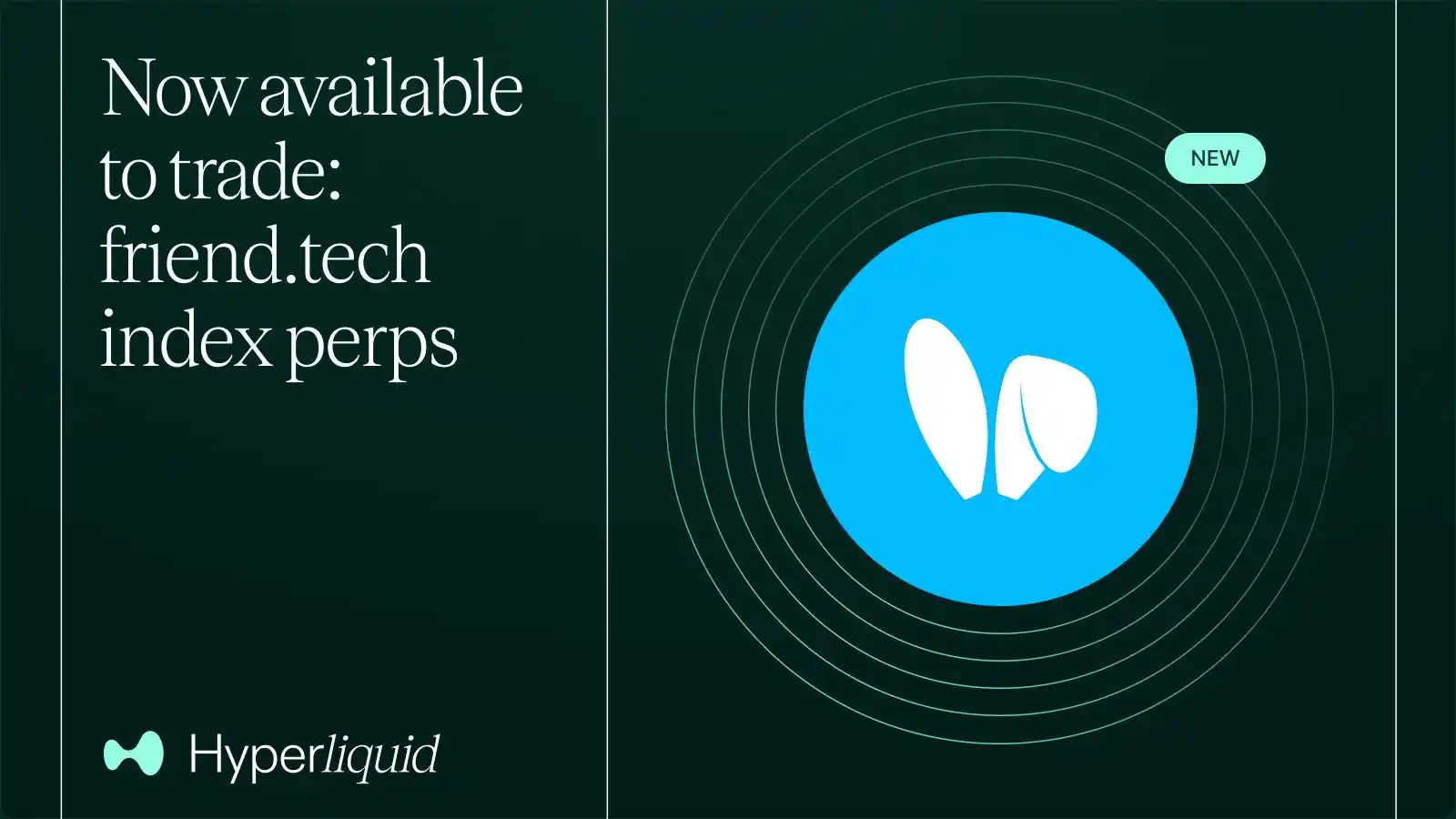
First wave: Friendtech-related index (combining the top 50 friend tokens into an ETF-like product). Competing factions on Twitter fought hard for users. Hyperliquid was more aggressive in recruitment, even if the product wasn’t profitable, it generated massive attention.
Second wave: Airdropping Memecoins Purr instead of waiting 1.5 years for governance tokens—an unexpected reward for early users. Then, adding a “1.5 quarter” between Q1 and Q2: users who remained active after the Purr airdrop and hadn’t sold all their airdrop tokens received additional points airdrops—announced unexpectedly. This reinforced the perception that “the team genuinely rewards users.”

Third wave: Launching the Q2 plan with dynamic, unannounced changes to points rules for major, minor, and spot trading pairs (updated weekly). Users speculated on rules—“try everything”—sparking spot trading excitement. There was even a “ticker auction every 48 hours”: project teams bought tickers and listed assets, boosting project revenue. First wave attracted attention, second brought users, third boosted revenue—though the spot product later failed, users weren’t keen to trade spot on Hyperliquid.
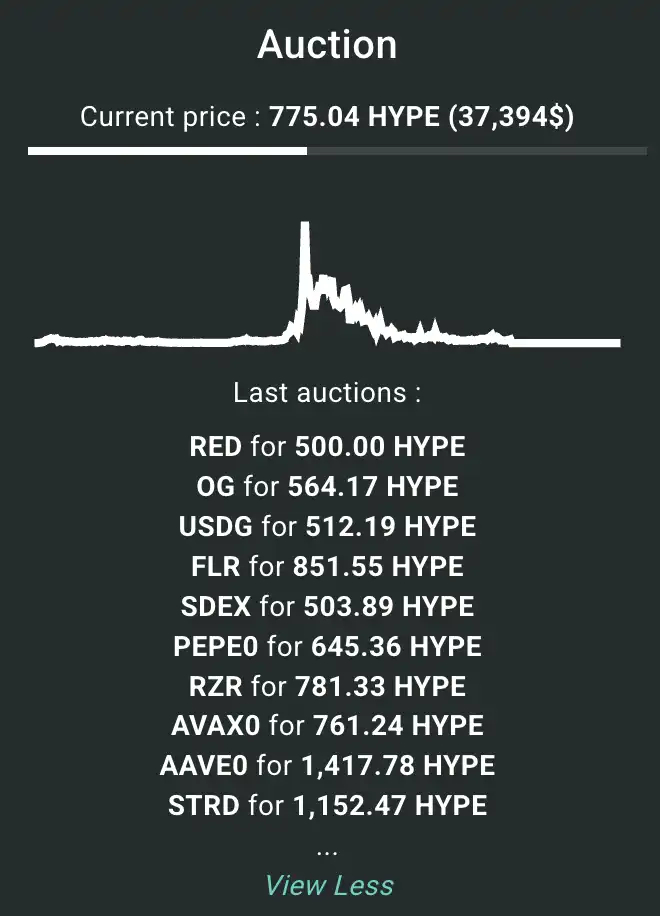
Many teams competed fiercely for “listing fees” on token tickers—a first in decentralized protocols. This was the first time users associated Hyperliquid with CEX-like behavior. It proved Hyperliquid had achieved significant traction and traffic—project teams believed it could deliver liquidity, hence willing to pay. Highest ticker fees approached $1 million. Later, as spot interest waned, many project teams had little connection with HYPE, and the HYPE community was unwilling to buy their tokens—making sustained hype difficult.
Then came the governance token HYPE. Since early adopters with high points were mostly those active throughout the first two quarters and hadn’t sold their early Purr airdrops, they received larger HYPE allocations and were more willing to hold. Like “if you don’t eat the first candy, I’ll give you five”—you’re less likely to sell. Combined with market makers maintaining a stable holding community, HYPE’s price grew steadily, amplifying visibility.
Most recent momentum came from “transparent whale positions”: unlike CEXs, on-chain transparency reveals who is long and short. Media actively covered large positions like James W or G.T., sparking stories—some jokingly calling it “insider info.” While I don’t see it that way, it creates narrative potential. CEXs remain black boxes—this transparency boosts media reach.
Also, you’ll notice they keep “phasing out old lines”: HLP’s trading volume now accounts for only ~10% of total volume. Early copy-trading vaults, Purr, and spot have been marginalized. The team evolves quickly—this has pros and cons.
Today’s core appeal remains: low fees, CEX-like experience, and the cool factor of decentralization. Not absolute claims like “never banned” or “no latency,” but rather “cheaper, same experience.”
For many U.S. users, Hyperliquid is a solid option—especially since they can’t use Binance.
Recently, I was stunned by the depth of liquidity. Example: a Bitcoin whale converted nearly $3 billion in BTC to ETH in a very short time—likely on Hyperliquid. I also heard he feared being banned on Binance.
Why Do Whales Prefer Trading on Hyperliquid?
JACK: The most discussed topic is why Hyperliquid hosts so many whales. Why do they take high leverage—up to 50x? Why do they conduct massive cash trades here? Is it just low fees and censorship resistance—or are there other reasons?
Xiaohuanxiong: A common theory in the community is that funds hope others “follow their trades” to achieve better results. Not automated gun-pools, but seeing a whale go long, you follow suit—driving prices up faster. This is only possible on a transparent, public platform like Hyperliquid. On Binance, positions are invisible and unverifiable.
Second factor: censorship resistance and privacy. Not implying illicit funds, but a desire to hide real identities. People see “a powerful ID” but don’t know the real name. As long as addresses are properly isolated, real identity and on-chain identity can be separated—better protection of personal safety and privacy. CEXs require KYC, which doesn’t guarantee data is protected. Breaches pose real safety risks.
Third: ban risk. These are the core reasons whales favor Hyperliquid.
JACK: Sounds like a relatively organic process?
Liu Feng: “Organic” is spot-on. The rise of whales in decentralized perpetuals began with GMX. The most famous figure from that era was Andrew Kang—opening multi-million dollar orders. Others watched his trades, copied them or took opposing positions—greatly boosting platform liquidity. This only happens on decentralized exchanges due to transparency and observability. On CEXs, “I opened a huge position” is often met with skepticism—“photo-shopped?”
In the Hyperliquid era, whale trades became phenomena. Many now watch whale positions, triggering more copying or counter-trades—further enhancing liquidity.
This seems counterintuitive—usually whales seek privacy. But distinguish between “identity privacy” and “position privacy.” On Hyperliquid, identity is easier to protect, but positions are exposed. If you want to conceal strategy, Hyperliquid isn’t ideal. But if you want “impact” and don’t mind visibility, it’s perfect.
JACK: In sum, whales are a pivotal keyword in decentralized perps—they bring attention and liquidity. Hyperliquid gained widespread industry discussion precisely because of these massive whale trades.
How Did Whale Consensus Form So Quickly Post-HYPE Token Launch?
JACK: Another phenomenon: many of my Hyperliquid whales formed strong consensus immediately after token issuance, supporting the protocol persistently—even before massive whale trades. Understanding how whale consensus crystallized is challenging. As an ecosystem heavyweight, why do you think the team succeeded in uniting whale communities? How did they achieve this?
Liu Feng: First, define “whale”: HYPE holders, right? Sounds like Xiaohuanxiong—holdings worth millions or tens of millions? Are there many such people?
JACK: I’d say $1 million is reasonable.
Liu Feng: Then Xiaohuanxiong is a “super whale.” Tell us about your “whale lifestyle.”
Xiaohuanxiong: I know many with hundreds of thousands to millions in holdings. They trust the team because they’ve stuck with it long-term. Most don’t explore new projects—they focus on just a few large ones, like WFI. They’ve followed this project through thick and thin, witnessing rapid iterations and timely communication. They care about real users.
Customer service is indeed poor, but on Twitter and other channels, Jeff and team members respond swiftly to controversies. On CEXs like Binance or OKX, fast replies are standard; on-chain projects often go days without response. Hyperliquid’s response speed rivals CEXs—typically 24–48 hours on Twitter.
Project updates are fast—new versions every one to two months. Small updates like UI improvements, especially mobile optimization, and desktop enhancements with more order types—almost weekly maintenance. Users feel the team isn’t resting, the development pace is steady—more reassuring. Many on-chain projects jump from V1 to V2 to V3, with over a year between V2 and V3—no weekly/monthly updates.
This gives users confidence: “They’re doing something.” Whales are more willing to support. Final point: many whales are early airdrop holders who kept using the platform. If you sold Purr or stopped trading after Q1, you’d miss out on future airdrops and never become a whale. Those who stayed are more inclined to hold.
Communication channels: Some private Telegram/Discord groups require wallet verification—team members are present. I’m no longer in most, as I no longer use my own wallet, so I’m unsure if they still use these channels.
Key Projects in the HyperEVM Ecosystem
JACK: Many anticipate Hyperliquid’s EVM ecosystem, HyperEVM—allowing other teams or apps to directly tap into Hyperliquid’s liquidity pool for building projects. Which ones are worth watching?
Xiaohuanxiong: Unit is worth noting. It packages BTC/ETH and other assets into Hyperliquid’s spot market—essentially a wrapper bringing spot assets onto the Hyperliquid exchange. Potential revenue is significant, and they’ve bought many mainstream token tickers, driving spot volume.
Unit functions as a cross-chain product bringing assets into Hyperliquid. It’s decentralized and permissionless. Unlike Thorchain/Rune, it’s tightly integrated with Hyperliquid—so searching shows BTC directly, not unitBTC. This gives it “authenticity” in ticker listings. Some joke that the whale who swapped BTC to ETH might consider using Unit to mine for airdrops—pure humor. Many use spot trading with a “chance for airdrop” mindset. But I lean toward using what’s useful, not chasing airdrops—otherwise, missing out affects mood.

Kinetiq has grown rapidly—I missed it. It’s now the largest LST protocol. Previously stHYPE, now kHYPE. I see most underlying systems now use Kinetiq HYPE, so it holds the largest share of liquid staked value. This greatly facilitates HIP-3, which requires collateralizing 1 million HYPE—few have that access. Crowdfunding kHYPE could give early advantage in HIP-3 launch.

kHYPE staked on Kinetiq exceeds $2 billion
Supercell and Inselico Terminal are third-party frontends. Using “builder code” (like referral codes), they drive traffic to Hyperliquid and offer enhanced frontends. Supercell focuses on mobile; Inselico Terminal targets desktop professionals with more order types. Both now generate high revenue.
They primarily earn through referrals—splitting Hyperliquid’s fees. Because their frontends are better. Limited storytelling potential—similar to the “wallet sector.” Hard to make big money from issuing tokens. Look at countless wallets (Magic Eden, Trust Wallet, SafePal)—all ordinary. The third-party frontend space resembles the wallet space—unless transitioning to HIP-3, hard to scale. Use what works.
Decoding HIP-3 and Its Impact on Hyperliquid
JACK: Many whales and active users frequently mention HIP-3. HIP is akin to Ethereum’s EIP—Hyperliquid’s upgrade proposal. Now entering its third generation. My understanding: HIP-3 allows users with sufficient HYPE holdings to deploy their own perpetual trading pairs on the protocol. This is widely viewed positively by HYPE holders and ecosystem observers. What changes will HIP-3 bring to the ecosystem? What does “transitioning to HIP-3” mean?
Xiaohuanxiong: HIP-3 lets me collateralize 1 million HYPE to list my own trading pair. Underlying matching engine is Hyperliquid’s, frontend hosted by me, offering richer trading experiences than official frontends. This is similar to a “white-label exchange.” Previously, many teams wanted to build—like Odon—but lacked users and struggled to launch white-labels.
Liu Feng: Collateralizing HYPE tokens grants white-label access to list desired pairs. This increases HYPE staking.
Xiaohuanxiong: But “more” is limited. Over 1 million HYPE, no difference (check docs)—more like a “margin deposit,” not “more is better.”
JACK: Why would someone want to create a white-label?
Xiaohuanxiong: Sure, you could raise VC funds to build a Hyperliquid competitor, but you can’t sustain it long-term. dYdX was VC-backed; dozens of VC-funded exchanges between dYdX and GMX vanished. GMX, without VC, rose. VCs won’t endlessly burn money in unprofitable sectors. Once they realize they can’t beat Hyperliquid, they may choose “integration” over “competition.”
Building your own exchange means needing BTC/ETH inventory—you must source it yourself and maintain thick inventory. You pay market makers, raise more capital—all expensive. Building on Hyperliquid means using existing liquidity for BTC/ETH/SOL, only adding your desired assets—like gold, silver, oil CFDs. Overall tech and liquidity costs drop significantly.
Who Are Hyperliquid’s Competitors?
JACK: Related to the next question: aside from direct competition, applications or frontends in HyperEVM may eventually become Hyperliquid’s “white-labels.” If you’re building a decentralized perpetual today, how do you differentiate from Hyperliquid? Where can Hyperliquid improve? Are there other notable Perp DEXs?
Xiaohuanxiong: After reviewing, none come close to half Hyperliquid’s level. Some decent products hit 40–50% of its performance. I haven’t calculated precisely, but using it feels lacking in something. (Side note: Backpack is currently a CEX but plans to go on-chain.)
Your assumption that “CEX is always better than Hyperliquid” doesn’t hold. Hyperliquid now outperforms many CEX perpetuals. Two years ago, this would’ve been unimaginable.
I recently tried Lighter—among the best alternatives. Though I have criticisms. I’m biased—$HYPE-heavy. It fully uses ZK for order book matching—very promising.
I’m also exploring Pacific—currently poor product (~1–2/10). But I’d rather see “different philosophy” than “70% copy of Hyperliquid.” Competition doesn’t need to be better—it needs to be different. Lighter is too similar to Hyperliquid—about 80% identical. Esta pushes many “grid apps” (mobile); Pacific focuses on AI—each name brings unique traits Hyperliquid lacks. Lighter has everything Hyperliquid has.
What Are Hyperliquid’s Weaknesses?
Xiaohuanxiong: Three main areas. First, mobile experience. One past optimization raised it from 4 to 5/10—still barely acceptable. This isn’t solely Hyperliquid’s fault—MetaMask, Trust Wallet, Coinbase Wallet, OKX/Bybit wallets also struggle with complex contract interactions on mobile. Network and gas design perform poorly on mobile. Currently, using Hyperliquid smoothly without an app on mobile is nearly impossible. I rarely use mobile. But mobile is essential—many office workers can’t trade from desks. CEXs like OKX/Binance have excellent mobile experiences. Hyperliquid’s only “rescue” is third-party mobile apps (like Base or Supercell). Whether third parties can compete is uncertain—if others move fast and aggressively, they can. The opponent is “third party,” not “Hyperliquid official,” so small teams can’t match official budget for ultimate UX.
Second, on/off ramps. Many users can’t access funds—not due to inability to withdraw, but excessively high fees. MoonPay? Fees near 5%—retail won’t pay. Even “credit card deposit at 2%” seems high to retail. Many currencies (EUR, JPY, Lira) converting to USDT carry even steeper fees. Hyperliquid hasn’t balanced convenience and pricing below 2%. I’m unsure how to solve this—CEXs have deep fiat on/off ramp inventories, OTC desks, broad integrations, and pricing advantages.
Third, inadequate customer support and user resources. Two aspects: first, user documentation. Current docs are concise, lacking step-by-step tutorials—assuming users know on-chain operations. Many newcomers have never bought crypto—you can’t expect them to start with Hyperliquid. Much reliance on TikTok/YouTube KOLs for recommendations and onboarding tutorials. I believe an official education platform—like Binance Academy—is needed: hand-holding beginners, lowering barriers. Doesn’t need to be on the main site, but requires official backing. Second, human interaction and response. For occasional withdrawal delays, immediate resolution isn’t always possible—but a real person should respond promptly to calm users. This is a CEX strength. Hyperliquid has only 11 people—Twitter replies can’t cover Facebook, Instagram, Weibo, Xiaohongshu, etc. To expand reach, relying solely on Twitter/Telegram isn’t enough—need larger support and ecosystem teams. Ideally, ecosystem teams should handle this and earn from it.
These three areas (mobile, on/off ramps, support) can be addressed by third parties—but only with proper “ecosystem revenue sharing or incentives.” For example, Inselico Terminal publicly complained: they found earnings from Hyperliquid lower than before, so had to raise fees to cover costs. Previously, third-party frontends charged no extra fees; now, they must increase pricing to survive. This discourages effort to “support Hyperliquid” versus “launching new projects.”
My recommendation: the team should offer more traffic or fee incentives to “ecosystem partners”—not necessarily direct cash, but gas discounts or product benefits. Let ecosystem teams earn profit—then they’ll voluntarily grow the ecosystem, not leave to build elsewhere. Hyperliquid has already been generous to token holders and users. Next, it should show greater “vision” toward ecosystem teams.
Liu Feng: This leads to another question: when communicating with the team, how do they prioritize tasks? Recently, they announced a support fund and token buyback program. Soon, a massive team token unlock will occur in October/November.
Xiaohuanxiong: I sense their current priority is “fixing mechanism gaps,” like the recent XPL incident. First, “stop making mistakes,” stabilize the foundation, then slowly push forward HIP-3. The unlock issue is being handled—publicly emphasizing “at most 10% will be sold,” discussed in interviews. The roadmap appears: stabilize first, then advance HIP-3. Market expectations for “next airdrop” may be overly optimistic.
Liu Feng: You mentioned “patching holes” and the XPL manipulation controversy. Can we elaborate? Jack, first provide context?
JACK: XPL is the native governance token of Plasma, the stablecoin chain launched by Tether (USDT issuer). Before the token officially launched, Hyperliquid enabled pre-market trading. During pre-market, XPL experienced a five-minute spike and crash—rapid surge followed by sharp drop—triggering mass liquidations, hurting both longs and shorts. Community questioned manipulation.
Indeed, it looked suspicious: an address named silent_trader went long early, then used massive buy orders to inflate XPL price, causing extensive short liquidations. Price soared from $0.6 to nearly $2 in minutes, then crashed dramatically—pre-market chaos ensued. Xiaohuanxiong, please detail what happened? Who’s responsible?
Xiaohuanxiong: Mechanistically, Hyperliquid anticipated “higher volatility in pre-market” and displayed prominent warnings. But many normal hedgers hadn’t encountered such scenarios—expecting higher protection. The warning didn’t work. I believe Hyperliquid bears ~70% responsibility.
I don’t think it was hacked, but the mechanism was flawed. Biggest issue: post-event, Hyperliquid blamed users for not reading the docs. I reject this. In product design, premarket and live market were colocated—users assumed equal protection. If Hyperliquid is seen as an exchange, users expect “peaceful trading.” You can say “it’s a battleground,” but that’s not most users’ expectation. Can’t just cite “docs written” as excuse—ignore user losses, even blame them. Estimated loss ~$4 million. Maybe not suitable for direct compensation, but offering related users discounts—e.g., future fee reductions—would help. CEXs have handled similar issues repeatedly. For example, one exchange gave $10 fee waivers per user after a listing delay—small amount, but users felt acknowledged, not ignored. That’s a “tone.”
Especially affected were “real users,” not pure speculators. These XPL users were genuine Hyperliquid users. For such supporters, I believe more humanity and empathy are needed—beyond rigid rulebook adherence.
This incident impacted holders, whales, and active users—but not fatally. Every exchange has faced similar issues. Key is post-event handling. If they continue this approach, trust will erode slowly.
Another impact: “new coin trading.” After XPL, some new coins (like WLFI) now trade at only a quarter of Binance volume—previously, new coins often reached half Binance volume. Confidence in the “new coin track” weakened. Some users think: “I won’t buy new coins on Hyperliquid—only old ones.” Not all users, but this sentiment is real. Bitcoin, Ethereum, etc., aren’t affected—core perpetual markets remain healthy, core business untouched.
How Long Can Hyperliquid’s Momentum Last?
Liu Feng: Looking further ahead—can Hyperliquid sustain this edge? When will it become Binance’s “killer”?
Xiaohuanxiong: I believe the bottleneck is “only 11 people.” Can 11 people really beat Binance? Relying on “genius engineers minority” is hard—I’ve always worried about this. Binance started with few offline hires but later invested heavily in low-ROI brand-building—sponsorships, team partnerships. This is brand exposure.
If Hyperliquid relies solely on third-party inputs, Unit/Kinetiq ecosystem teams, and tokenholder communities, it can gain strong support during bull runs. But in bear markets, no community exists. Even with a community, they won’t spend money helping—everyone’s broke. Then it’s down to core team “holding the line.”
Beating Binance isn’t a single-cycle task—it takes two to three cycles. Along the way, there will be phases where tokens drop 75%, halving project teams and retail. Can these 11 people “rise again”? This determines whether they can “win the entire war.” I hope they don’t need to scale to 200–300 people, but at least 30–40—better than 11. These are salaried employees—bear markets can sustain development, weathering the “community evaporates” phase.
To date, their advantages and momentum are clear. Challenge lies in effectively expanding during current favorable conditions—building ecosystem, improving product, pushing upward. Otherwise, once in bear market, current advantages may not be sustainable.
They haven’t experienced a real bear market. Bear markets are irrational. Product metrics improve, quality rises, experience gets better—but tokens fall, attention and traffic drop. This is counterintuitive: mediocre products fly in bull markets; excellent products lose users in bear markets. How to survive bear markets is what they haven’t experienced. Team morale stability is worth observing. If they can’t withstand bear markets, they can’t beat Binance—impossible in one cycle.
Disclaimer: Contains third-party opinions, does not constitute financial advice


AI Practical Guide
This column focuses on the real progress of Agents: technological evolution, application implementat

Crypto Weekly
Tracking on-chain movements of the smart money and institutions

Frontier Insights
Spotlight on Frontier, trending projects, and breaking events

Blowup Alert
As the 2026 crypto bear market deepens, exit scams and project blowups are becoming increasingly fre

Regulatory Watch
American Crypto Act – timely interpretations of policies worldwide

Popular Airdrop Tutorial
Selected potential airdrop opportunities to gain big with small investments

FusnChain
FusnChain