
ChainThink
Stay ahead, master crypto insights
How to Reduce Gas Costs Efficiently Using JustLend DAO's "Energy Leasing and GasFree" Dual Strategies: A Comprehensive Guide to TRON's Energy Mechanism and Gas Cost Saving Tips
How to Reduce Gas Costs Efficiently Using JustLend DAO's "Energy Leasing and GasFree" Dual Strategies: A Comprehensive Guide to TRON's Energy Mechanism and Gas Cost Saving Tips

2025-09-11 22:51
As the world's largest stablecoin network, Tron carries about 60% of stablecoin transaction traffic. According to a CoinDesk report in August, in the 50 countries surveyed, 35 countries directly listed Tron as the preferred blockchain for stablecoin payments. This global popularity means that every change in on-chain gas fees on Tron always captures the attention of global users.
At the end of August, Tron experienced its largest fee optimization since its mainnet launch: "Energy," as a core component of Tron's gas, saw its price drop from 0.00021 TRX to 0.0001 TRX, a reduction of nearly 60%. At the same time, it also implemented a quarterly dynamic adjustment mechanism to ensure that fees can flexibly adapt to ecological demand. This major adjustment quickly sparked excitement in the crypto community, with "How to achieve optimal gas fees on Tron?" becoming a hot topic among community members.
As the official lending platform in the Tron ecosystem, JustLend DAO has always been committed to "reducing users' on-chain costs" and has launched two key cost-saving solutions: Energy Rental service allows users to rent energy on demand without long-term staking TRX, directly cutting the gas cost of each transaction; GasFree smart wallet function completely breaks the traditional limitation of "must use native assets to pay gas fees", supporting users to directly deduct fees using transferable tokens (such as USDT), greatly simplifying the on-chain transfer process.
Now, on the Tron network, users only need to use JustLend DAO's "Energy Rental + GasFree" two functions to easily achieve optimal gas fee experience, without worrying about the reserves of native tokens or bearing high fees, truly enjoying the convenience and affordability of on-chain interactions.
Tron Energy Mechanism and "Energy Rental Business": The Resource Allocation Logic Behind Low-Cost Interactions
In terms of gas fee management, the Tron network adopts a unique "Bandwidth + Energy" dual-resource model. This differentiated resource allocation for different on-chain operations not only enables developers to achieve precise cost control but also forms a core advantage distinct from other public chains, especially suitable for high-frequency, small-value, and complex on-chain interaction scenarios such as DeFi and GameFi.
They correspond to different resource requirements for on-chain operations: Bandwidth can be regarded as the basic resource of the Tron network, mainly used to measure the storage and network resource usage of transactions, all on-chain operations require bandwidth consumption, and can be completed just by bandwidth alone; Energy is more like an advanced resource, specifically supporting smart contract-related operations, such as DeFi calculations, NFT minting, TRC20 token creation, and Meme token transfers, which are complex DApp interactions that cannot be done without energy.
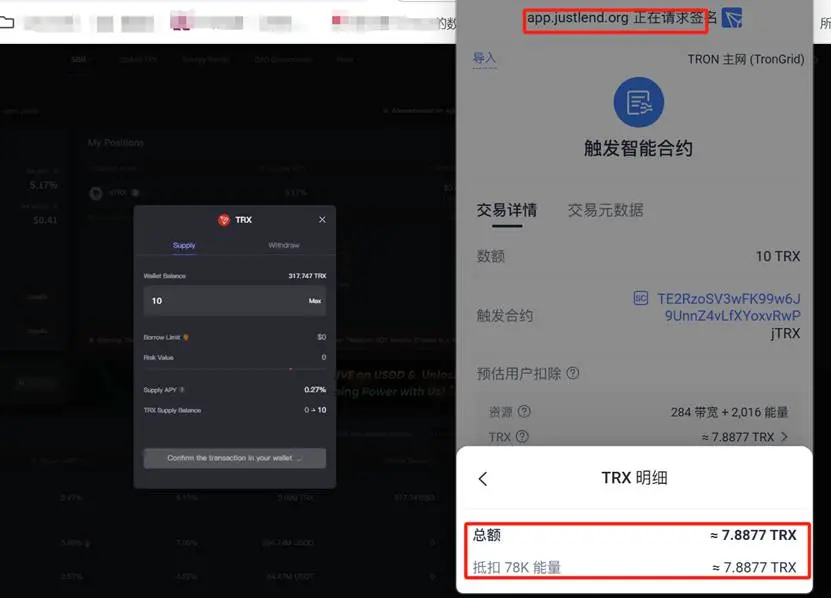
In short, basic on-chain operations such as TRX transfers, voting, and staking do not require calling smart contracts and can be completed by consuming bandwidth alone; if using DApps (such as depositing and borrowing TRX on JustLend DAO), which touch contracts, then "bandwidth + energy" combination payment is required.
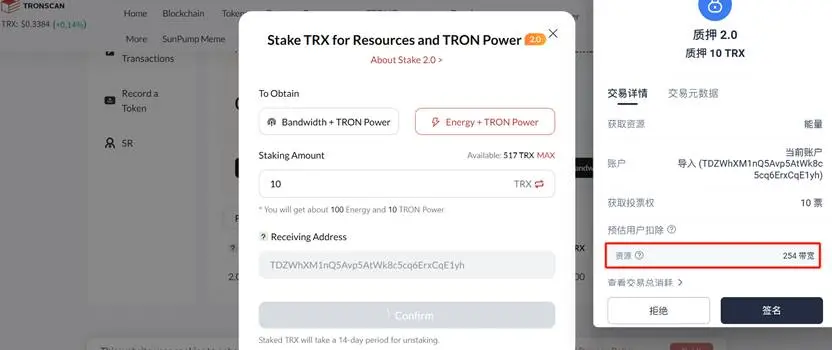
[Staking TRX only consumes bandwidth]
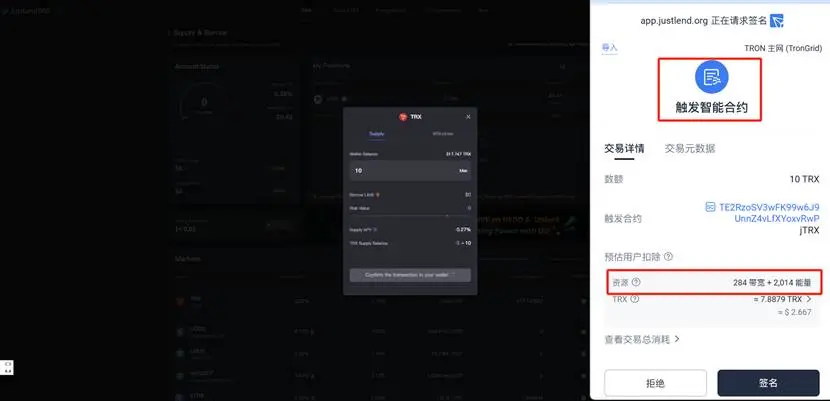
[Using JustLendDAO to store TRX triggers a smart contract, requiring the consumption of energy and bandwidth.]
This "bandwidth + energy" dual-resource model design is the biggest difference between Tron and EVM networks such as Ethereum, BNB Chain, and Base. In EVM networks, all operations are uniformly priced according to gas fees, whether they are simple transfers or complex smart contract calls. Miners prioritize processing high-gas transactions, which makes even small transfers expensive during network congestion, with cost fluctuations far exceeding people's expectations. Tron's bandwidth and energy adopt a separate design, cleverly avoiding the above problems: simple transactions rely on bandwidth, and complex contract operations are charged based on energy. It not only ensures the fairness of contract execution, but also makes the cost more transparent and predictable, preventing ordinary users from being deterred by high costs and avoiding unnecessary waste of resources in complex operations.
Regarding acquisition methods, bandwidth and energy have both connections and differences: both can be obtained by staking TRX, but bandwidth provides 600 free units per day, sufficient to cover daily transfer needs. If the free quota is exhausted, users can choose to stake TRX to obtain bandwidth or directly burn TRX to purchase, with the price of each unit of bandwidth fixed at 0.001 TRX. Energy has no free quota, and each interaction related to a contract requires consuming energy, with the amount consumed proportional to the complexity of the contract, so the unit price of energy directly determines the cost of DApp usage. Each transaction will first use the energy already available in the wallet address for deduction, and if insufficient, TRX needs to be burned to exchange for energy.
With the prosperity of the Tron ecosystem (such as increased USDT circulation and more DApp interactions), energy consumption has been increasing year by year, and the rising price of TRX has also simultaneously driven up energy costs. To reduce network gas fees, Tron has reduced the energy price twice since September last year, with each reduction exceeding 50%: first, the price of each unit of energy was reduced from 0.00042 TRX to 0.00021 TRX in September last year, and the most recent one was on August 29 this year, when the energy price was reduced from 0.00021 TRX to 0.0001 TRX, directly reducing the energy cost of smart contract operations by 60%, while introducing a quarterly dynamic adjustment mechanism, with super representatives optimizing the unit price based on TRX price and network activity indicators every quarter to ensure that costs match ecological needs.
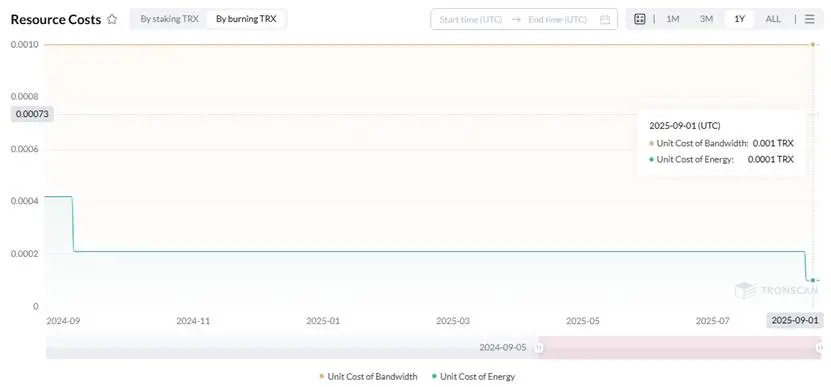
Currently, there are three main ways for users to obtain energy:
First, staking TRX to obtain, with daily energy allocated based on the proportion of staked TRX in the total network staking. For example, on September 5, each staked 1 TRX would get 10 units of energy;
Second, burning TRX to purchase, with the current energy price at 0.0001 TRX;
Third, renting, temporarily using idle energy from others' staking, for example, on JustLend DAO, 2.6 TRX can rent 100,000 units of energy, which is enough for two transactions.

[Method 1: Obtain energy by staking TRX]
[Method 2: Directly burn TRX to obtain energy]
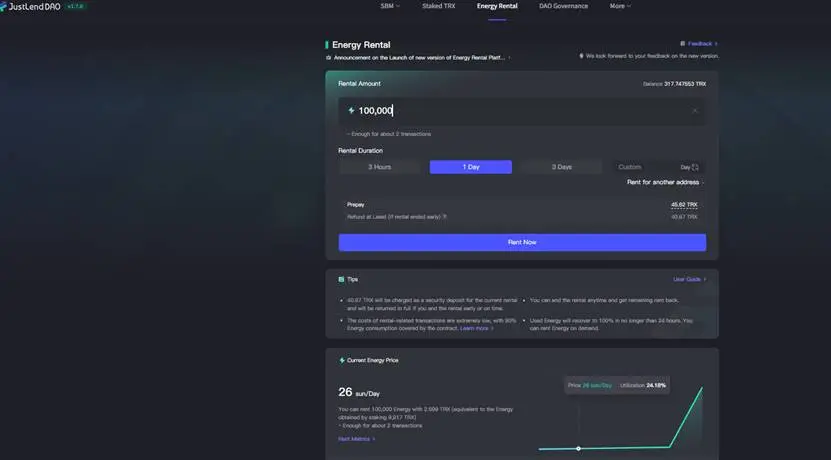
[Method 3: Rent energy]
The most notable is "renting energy," which is a unique economic ecosystem within the Tron ecosystem, relying on the shared nature of Tron's energy: TRX stakers can share their energy with other addresses, granting any user the right to "temporarily use others' idle energy." In the rental model, users don't need to stake large amounts of TRX for a long time, just pay a small rent to get the corresponding amount of energy on demand, meeting short-term on-chain operation needs.
Whether it's personal temporary transfers of USDT, team development of contracts, or project teams frequently calling contract interfaces, they can "rent as needed" flexibly. This rental model achieves a win-win situation where "users save costs and stakers earn profits." For on-chain users, they don't need to lock up TRX for a long time, and by renting energy through a rental platform on demand, they can easily complete short-term operations (such as participating in DeFi mining, minting NFTs), saving the opportunity cost of capital occupation and significantly lowering the entry barrier for using complex DApps; for TRX stakers, by renting out their daily idle energy, they can gain rental income, transforming "stake TRX" from a mere "ecological contribution" into a "contribution + profit" dual value, greatly improving the efficiency of capital utilization.
Currently, a large number of professional energy rental platforms have emerged in the market, including the Energy Rental service offered by JustLend DAO, the official lending platform of the Tron ecosystem, as well as professional third-party rental platforms such as Catfee and TRONEnergy. These platforms precisely match supply and demand, offering diverse service models such as "pay-per-use" and "customized on demand," allowing idle energy to break through the limitations of "only held by individuals," promoting efficient circulation within the ecosystem and further releasing resource value.
Today, the energy rental business has become a distinctive and vibrant financial scenario in the Tron ecosystem. It not only lowers the on-chain participation cost for ordinary users but also activates the idle assets of stakers. Through efficient resource allocation, it enhances the overall efficiency of TRX staking. From three dimensions - user experience, asset value, and ecosystem circulation - it jointly consolidates Tron's core competitive advantage of "low cost and high vitality."
JustLendDAO Official Energy Rental Service (Energy Rental): The Core Tool for Saving Over 70% on Single Gas Cost on Tron
Currently, in the Tron network, whether it's low-frequency operations for ordinary users or project parties, developers, and traders who frequently call contracts, obtaining energy through rental is the optimal solution. Compared to directly consuming TRX to obtain energy, the rental model can help users save about 70%-80% in fees for a single smart contract operation (such as transfer, minting, lending).
The Tron ecosystem lending platform JustLend DAO introduced energy rental services (Energy Rental) as early as 2023, and due to its advantages of "no staking required, safe and flexible, cost controllable," it has become a core tool for users to reduce on-chain costs, and is currently the largest energy rental channel in the Tron network.
The energy rental market is still in its early stages, and ordinary users often face concerns about "doubts about the security of third-party platforms and unclear price details." However, as the official lending application in the Tron ecosystem, JustLend DAO has a locked-up cryptocurrency asset value (TVL) exceeding 8 billion USD, and its energy rental service comes with a "safe and reliable" trust foundation. Plus, the service has transparent fees with no hidden costs, and the operation chain directly connects to the Tron mainnet, making it the "safe preferred platform" for users to obtain energy.
According to official website data, JustLend DAO's energy rental service provides over 50 billion units of energy daily, with daily rental volumes exceeding 10 billion units, and a cumulative 68,300 users participating.
The operational logic of JustLend DAO's energy rental service is very clear. Users only need to click a few times to quickly complete the rental process, without any complicated steps. Specifically, the operation is divided into the following three stages:
1. First, fill in the rental data: rental amount, rental duration, rental address.
Rental amount refers to the number of energy units needed, with the minimum rental unit being 100,000 (note that a single USDT transfer requires approximately 120,000 energy, and users can match as needed);
Rental duration supports hourly and daily rentals, with a maximum of 30 days per rental. Users can choose based on their operation frequency, for example, for high-frequency interactions on a single day, choose "1 day," and for long-term project development, choose "30 days";
The receiving address is where the energy will be allocated. If it's for oneself, no need to fill in, and if it's for someone else, the corresponding address must be accurately filled in.
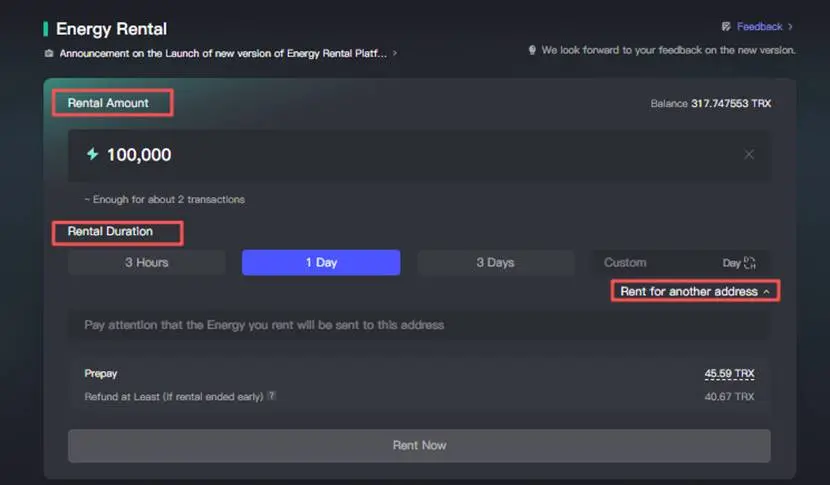
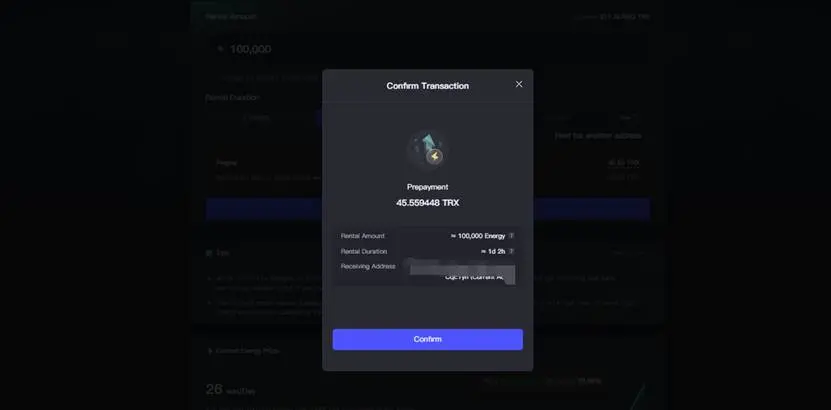
2 Submit the rental order and pay the deposit: Energy rental uses a "prepayment model," requiring payment of three parts of fees: energy rental fee (core cost), deposit (refundable after the rental ends), and penalty fee (guarantee fund to avoid violations). All fee details are real-time and transparent, with no hidden costs.
For example, renting 100,000 units of energy for 1 day, a total of 45.5 TRX needs to be paid in advance.
3. End the rental and refund the deposit: After the rental is completed, users can manage the order in real-time on the "Energy Rental Interface": support refunding the rental fee (ending the rental early), extending the rental period (requires additional fees), and viewing remaining energy and rental period.
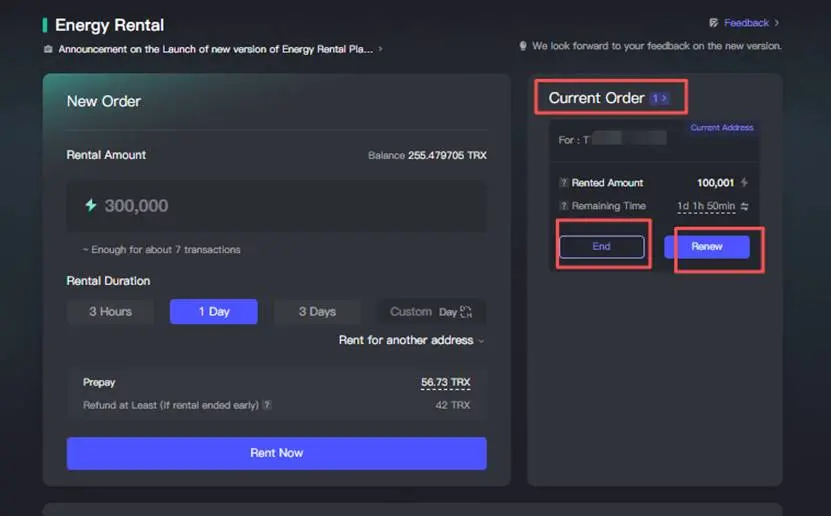
Tip: If you only need to complete a single transaction, it is recommended to return the energy immediately after the operation to avoid additional fees caused by idle energy; if daily transactions are frequent (such as multiple DeFi operations per day), it is recommended to choose a 30-day long-term rental.
From a practical cost perspective, JustLend DAO's rental service has significant advantages: taking the common USDT transfer on Tron as an example, burning TRX directly requires a corresponding energy cost of about 4.3 USD, while renting energy through JustLend DAO only needs 1.17 USD, saving more than 3 USD per transaction, with a cost reduction of over 70%.
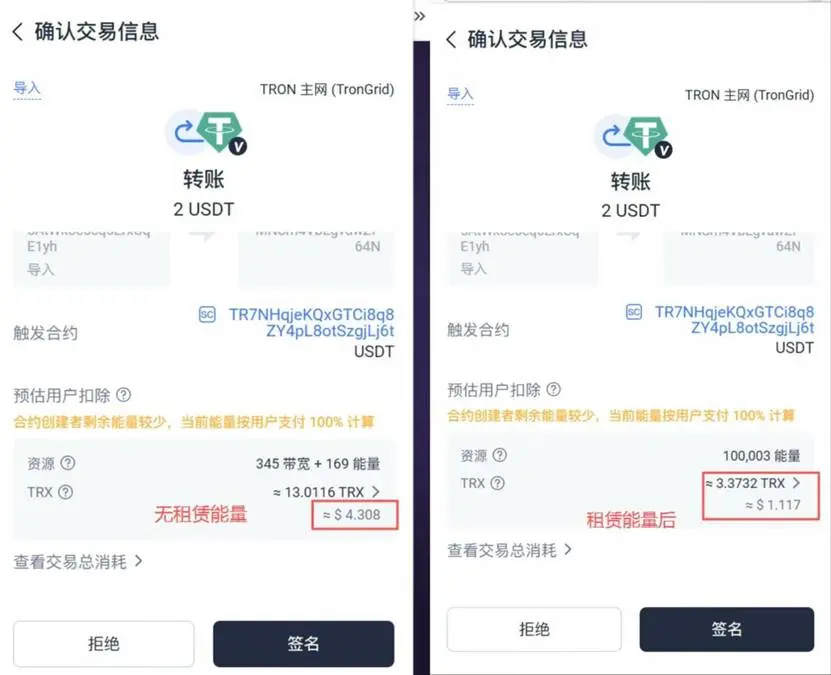
[Cost Comparison of USDT Transfer Without Energy Rental vs. With Energy Rental]
From the above operation process, it can be seen that JustLend DAO's energy rental has three core advantages:
First, no need to lock up funds, flexible capital. Users don't need to stake large amounts of TRX for a long time to get energy, but can "rent as needed," renting the corresponding amount based on actual needs, avoiding the opportunity cost of capital being tied up for a long time, especially suitable for temporary needs for energy, such as single NFT minting, short-term DeFi interactions, etc.
Second, simple operation, supporting multiple scenarios. The service is open to all Tron users, supporting "one-to-many rental," both for their own addresses and for others' addresses, meeting the needs of individuals, teams, and project parties.
Third, cost controllable, friendly for high-frequency use. Having energy can directly deduct gas fees for smart contract operations. For high-frequency traders, such as GameFi players and DeFi arbitrageurs, long-term rental can continuously compress costs, avoiding the problem of "accumulated TRX burning costs being too high."
More importantly, with the energy price on Tron dropping by 60% on August 29, JustLend DAO responded on September 1, reducing the energy rental "basic tax rate from 15% to 8%." Users can now enjoy the dual benefits of "reduced energy base price and lower rental tax rate" when renting energy on JustLend DAO.
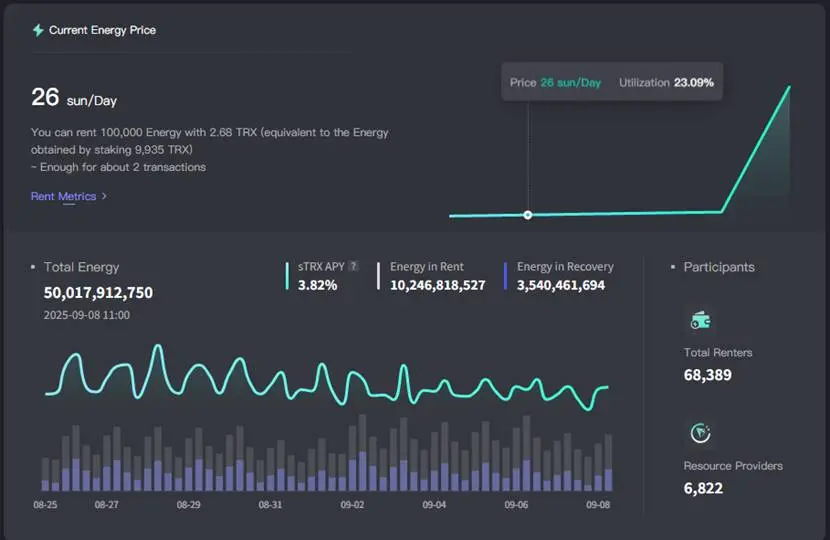
Currently, the energy price of JustLend DAO's energy rental service is approximately 26 SUN/day, requiring only 2.62 TRX to rent 100,000 units of energy (equivalent to the energy obtained by staking 9935 TRX), which is sufficient for two contract transactions, further amplifying the cost advantage.
JustLend DAO Launches GasFree Smart Wallet: Pay Gas Fees Directly with Transferable Tokens, Making Crypto Transfers as Simple as Sending Messages
In terms of improving user on-chain interaction experience, JustLend DAO not only has the energy rental service to reduce gas costs, but also launched the innovative GasFree smart wallet feature in March. This further solves the core pain point of crypto transfers: users no longer need to hold the network's native token to pay gas fees (such as TRX). Whether transferring TRC20 or ERC20 tokens, the fee can be directly deducted from the transferred token. This mechanism breaks the traditional restriction of "must use native tokens to pay network fees," providing a frictionless gas payment solution for token transfers, making crypto transfers more in line with daily usage habits.
However, GasFree's ultimate vision goes beyond this: it hopes that users can complete asset transfers on the same interface regardless of whether they use Tron, Ethereum, or other blockchains - without understanding the underlying technical details or preparing various native tokens. Ultimately, GasFree aims to achieve "crypto transfers as simple as sending emails," while maintaining the security of the decentralized environment and interoperability required for global payments, making blockchain transfers truly integrated into daily life.
This innovative design of "transfer what token, pay what fee" simplifies the originally cumbersome process of "exchange native coins → initiate transfer → pay gas" into "initiate transfer directly → deduct the corresponding token as gas." This not only significantly improves operational efficiency but also greatly reduces the learning cost for new users, making crypto transfers more intuitive and easy to use. Both newcomers and experienced users can enjoy a seamless asset transfer experience, no longer worrying about "accumulating native coins to pay gas."
At the Hong Kong "BUIDL 2025" crypto conference in April, the founder of Tron, Sun Yuchao, stated that for individual users, GasFree eliminates the need to concern themselves with gas fee payment and calculation; for institutional users, it is a significant solution. Many institutions want to access blockchain technology for efficient settlement but are unwilling to hold volatile cryptocurrencies. GasFree allows institutions to send and receive funds through addresses without touching native cryptocurrencies, significantly lowering the entry barrier, promoting broader ecosystem access, and driving the widespread adoption of blockchain technology.
When GasFree was launched, the Tron ecosystem wallet TronLink was the first to integrate this feature. Users only need to open the TronLink application or browser extension plugin, click GasFree, and immediately experience this new way of transferring. Currently, this feature supports TRC20-USDT transfers, and will expand to more asset types in the future. Additionally, to improve user experience, JustLend DAO has simultaneously launched a 90% fee subsidy policy. Under the support of the subsidy policy, users only need to pay approximately 1 USDT per USDT transfer. It should be noted that when using GasFree smart wallet for the first time on TronLink, a one-time activation fee needs to be paid, currently only 1 USDT.
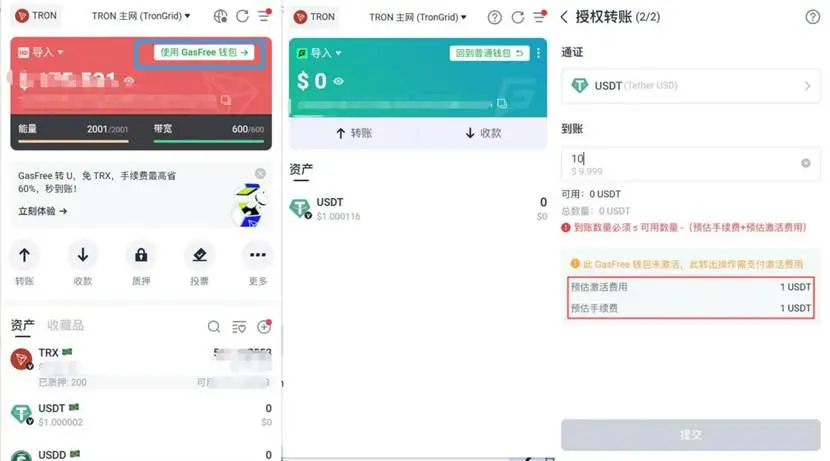
[Using GasFree to transfer USDT only needs to pay 1 USDT]
As of now, dozens of mainstream wallets such as imToken and Klever have integrated GasFree. In the future, it is expected that more platforms will support it, further expanding its usage range.
From a practical effect perspective, GasFree has shown strong ecological value: as of September 8, the feature has completed a cumulative transaction volume of 15.8 billion USD, with over 750,000 transactions, saving nearly 2.2 million USD in gas fees for users, intuitively demonstrating its role in "cost reduction and efficiency improvement."
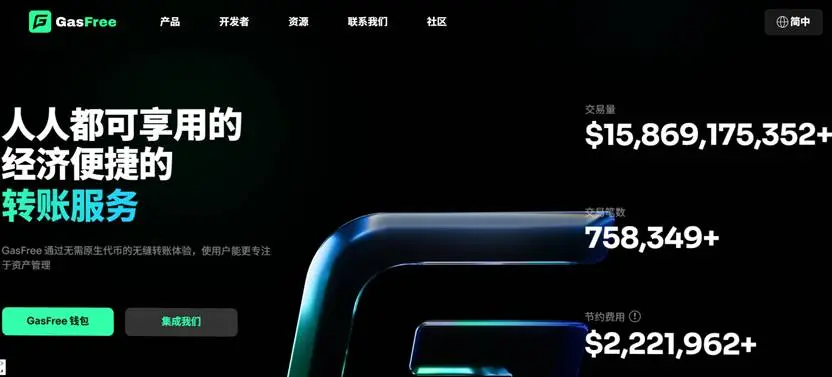
In addition to the innovation in payment experience, GasFree also excels in technical compatibility: it is compatible with any TRC20 or ERC20 token, does not depend on specific token implementation logic, and provides standardized interfaces and smart contract templates, allowing projects to achieve "one-click deployment" of gas-free transaction systems, greatly lowering the threshold for new tokens to join the ecosystem, further expanding the coverage and application scenarios of GasFree.
To comprehensively reduce the cost for users and developers, GasFree recently officially launched the Developer Center (Developer Center), which provides a one-stop energy management service tool covering "energy cost prediction, automatic energy rental, optimization suggestions," helping developers effectively control energy consumption when integrating GasFree features, simplifying the DApp development and deployment process, thus enabling developers to focus more on product innovation without overconcerning about network-level energy cost issues, achieving "convenient transfer on the user side + efficient development on the developer side" dual optimization.
The launch of GasFree marks another solid step forward for the Tron ecosystem in continuously innovating and improving user experience. With more wallets and platforms joining, users will enjoy lower transfer costs and more convenient operation processes. This not only optimizes the interaction experience within the Tron ecosystem but also provides a feasible reference for the popularization of the entire blockchain industry through the innovative model of "breaking the dependence on native tokens."
Disclaimer: Contains third-party opinions, does not constitute financial advice


AI Practical Guide
This column focuses on the real progress of Agents: technological evolution, application implementat

Crypto Weekly
Tracking on-chain movements of the smart money and institutions

Frontier Insights
Spotlight on Frontier, trending projects, and breaking events

Blowup Alert
As the 2026 crypto bear market deepens, exit scams and project blowups are becoming increasingly fre

Regulatory Watch
American Crypto Act – timely interpretations of policies worldwide

Popular Airdrop Tutorial
Selected potential airdrop opportunities to gain big with small investments

FusnChain
FusnChain