
ChainThink
Stay ahead, master crypto insights
Arthur Hayes' New Article: Bitcoin Will Return to "Gold-Grade" Safe Haven, the Altcoin Season May Follow Soon
Arthur Hayes' New Article: Bitcoin Will Return to "Gold-Grade" Safe Haven, the Altcoin Season May Follow Soon
2025-04-23 17:03
Original Title:“Ski Cut”
Edited & Translated: Patti, ChainCatcher
This mid-March, my ski season in Hokkaido came to a successful end. However, the lessons learned from the mountain unexpectedly resonated with the tariff controversy surrounding Trump. Every day is unique, filled with various interacting variables—you can never predict which snowflake or ski turn will trigger an avalanche. All we can do is try to estimate the probability of an avalanche. In skiing, there's a technique called ski cutting, which allows for a more accurate assessment of slope instability.
Before skiing, one of the skiers on the team would cross the starting area, trying to trigger an avalanche by jumping up and down. If successful, the way the instability spreads would determine whether the guide considered the slope suitable for skiing. Even if an avalanche was triggered, we might still choose to ski, but we had to carefully select our direction to avoid triggering a larger avalanche. If we saw cracks expanding or large slabs loosening, we would evacuate immediately.
Applying this skiing wisdom to the financial markets, Trump's "Liberation Day" on April 2nd was undoubtedly a bold cut on this steep and dangerous slope of the global financial market. Trump's team's tariff policy drew inspiration from the economic treatise "Balanced Trade: The Unaffordable Cost of Ending America's Trade Deficit" and took an extreme stance. The announced tariff rates exceeded even the worst expectations of mainstream economists and financial analysts. In terms of avalanche theory, Trump's move triggered a continuous weak layer avalanche, threatening to destroy the entire false fractional reserve fiat financial system.
The initial tariff policy brought the worst results, as both the United States and China took extreme opposing positions. Although the financial asset markets experienced severe sell-offs, leading to losses of tens of billions of dollars globally, what was truly concerning was the surge in the MOVE index, which measures the volatility of the U.S. bond market. The index nearly reached a historical intraday high of 172, and then the Trump team quickly fled the dangerous area. Within a week of announcing the tariffs, Trump eased his plans, pausing the implementation of tariffs on all countries except China for 90 days. Shortly after, Boston Federal Reserve President Susan Collins wrote in the Financial Times that the Fed would take all necessary measures to ensure the market functioned normally. A few days later, when volatility remained high, U.S. Treasury Secretary Scott Bensons said in an interview with Bloomberg that his department would significantly accelerate and increase the pace of Treasury repurchase agreements. These events, which I describe as a sharp shift from "everything is normal" to "everything is terrible, we must do something," caused the market to surge. Most importantly, Bitcoin rebounded from its bottom. Yes, I declare the local bottom at $74,500.
Whether you view Trump's policy changes as a retreat or a shrewd negotiation strategy, the fact is that the government deliberately triggered a financial market avalanche, and the situation was so severe that they had to adjust their policies within a week. As market participants, we now have some valuable insights. We understand how the bond market performs under the worst conditions, recognize the volatility levels that trigger market behavior changes, and know how policymakers will pull the monetary lever to alleviate the situation. With this information, as Bitcoin holders and crypto enthusiasts, we are confident that the bottom has arrived. Because the next time Trump strengthens his tariff rhetoric or refuses to lower tariffs on China, Bitcoin will rise due to the expectation that the monetary authorities will fully activate the printing press to ensure that bond market volatility remains low.
Why Did Tariffs Cause Bond Market Dysfunction?
This article will delve into why taking an extreme tariff stance leads to bond market dysfunction, as shown by the MOVE index. Subsequently, I will discuss Bensons' solution - Treasury repurchase agreements, and how this measure will inject a large amount of USD liquidity into the system (although technically, purchasing old bonds with new bonds does not directly increase USD liquidity in the system). Finally, I will compare the current Bitcoin and macro environment with the situation in the third quarter of 2022 when Bensons' predecessor Yellen increased Treasury bill issuance to drain the reverse repo program (RRP).
After the FTX event, Bitcoin hit a local low in the third quarter of 2022, and now, after Bensons pulled out his "non-quantitative easing quantitative easing cannon," Bitcoin hit a local low in the second quarter of 2025.
The Greatest Pain
I want to reiterate that Trump's goal is to bring the U.S. current account deficit to zero, and achieving this requires painful adjustments. Tariffs became the preferred tool of his administration. I don't care whether you think it's good or bad, or whether Americans are ready to work longer hours in iPhone factories. Trump was elected partly because his supporters believe globalization has cost them. And his team is determined to fulfill their campaign promises, placing the interests of "Main Street" (the common people) above "Wall Street." All of this is based on the assumption that those around Trump can be re-elected along this path, but this is not a given.
The financial markets dropped sharply on "Liberation Day" (the day Trump announced his tariff policy), because foreign exporters earned less or no dollars due to the tariff policy, thus unable to buy many or any U.S. stocks and bonds. Moreover, if exporters needed to change supply chains or rebuild supply chains in the U.S., they would have to sell their held liquid assets (such as U.S. bonds and stocks) to fund the reconstruction. This led to crashes in the U.S. market and any markets overly dependent on U.S. export income.
However, at least initially, there was a silver lining: panicked traders and investors rushed into the Treasury market. Treasury prices rose, and yields fell. The 10-year Treasury yield dropped significantly, which was good news for the U.S. Treasury Secretary, as it helped him push more Treasury bonds into the market. However, the significant fluctuations in bond and stock prices increased market volatility, which was fatal for certain types of hedge funds.
Hedge funds, by definition, sometimes hedge risks, but they always use a lot of leverage. Relative value (RV) traders usually identify relationships or spreads between two assets and use leverage to buy one asset and sell another, expecting the spread to revert to the mean. From a macro perspective, most hedge fund strategies implicitly or explicitly short market volatility. When volatility decreases, mean reversion occurs; but when volatility increases, the market falls into chaos, and the stable "relationships" between assets collapse. This is why when market volatility rises, banks or exchanges' risk managers (who provide leverage to hedge funds either explicitly or implicitly) increase margin requirements. When hedge funds receive margin calls, they must liquidate immediately to avoid being liquidated. Some investment banks are willing to force clients to liquidate through margin calls during extreme volatility, taking over the positions of bankrupt clients and profiting when policymakers print money to suppress volatility.
We are really concerned about the relationship between stocks and bonds. Since U.S. Treasuries are regarded as a risk-free asset and a global reserve asset, when global investors flee the stock market, Treasury prices rise. It makes sense because paper money must be placed somewhere to generate returns, and the U.S. government, due to its ability to operate a printing press at zero cost, will never voluntarily go bankrupt in terms of dollars. Although the actual purchasing power of Treasuries may decline, policymakers do not care about the actual value of paper asset holdings worldwide.
In the first few trading days after "Liberation Day," stocks fell and bond prices rose/interest rates fell. However, something happened afterward, causing bond prices to fall alongside stocks. The volatility of the 10-year Treasury yield was unprecedented since the early 1980s. The question is, why? The answer, or at least the answer the policymakers believe, is crucial. Is there a structural problem in the market that needs to be addressed through some form of money printing by the Federal Reserve and/or the Treasury?
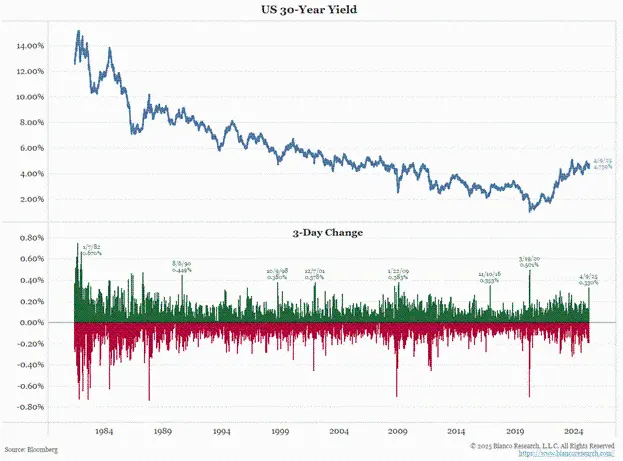
Bianco Research's bottom panel shows the abnormality of the three-day change in the 30-year bond yield. The degree of change caused by the tariff incident is comparable to market volatility during the 2020 pandemic, the 2008 global financial crisis, and the 1998 Asian financial crisis. This is definitely not good news
One possible issue is the unwinding of the relative value (RV) fund's base trade position in U.S. Treasuries. How large is this position?
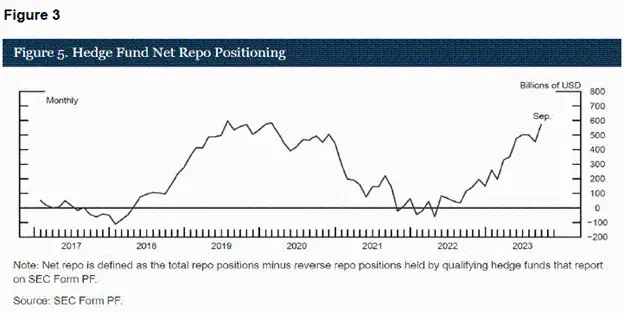
February 2022 was an important month for the Treasury market, as President Biden decided to freeze Russia's U.S. Treasury holdings, and Russia is one of the largest commodity producers in the world. This action effectively indicated that property rights are not rights, but privileges, regardless of who you are. Therefore, foreign demand continued to weaken, but relative value funds filled the gap, becoming the marginal buyers of Treasuries. The chart clearly shows the increase in repurchase positions, which can serve as an indicator of the size of the base trade position in the market.
Base Trade
A base trade refers to an investment strategy where investors simultaneously buy cash-on-the-run bonds and sell bond futures contracts. In this trade, the margin requirements from banks and exchanges are key factors. RV funds are limited in their position sizes by the required margin amounts. Margin requirements vary with changes in market volatility and liquidity concerns.
Bank Margin
To obtain funds to purchase bonds, funds conduct repurchase agreements (repos), where banks agree to provide cash immediately at a small fee for settlement, and collateralize the bonds to be purchased. Banks will require a certain amount of cash margin as collateral for the repo transaction.
The more volatile the bond prices, the higher the margin required by the banks.
The lower the liquidity of the bonds, the higher the margin required by the banks. Liquidity is always concentrated in certain maturities on the yield curve. For the global market, the 10-year Treasury is the most important and most liquid. When the latest issued 10-year Treasury is auctioned, it becomes the on-the-run 10-year bond, the most liquid. However, over time, it gradually moves away from the center of liquidity, becoming an off-the-run bond. As the on-the-run bonds naturally transition to off-the-run, the amount of cash required to fund the repo transactions increases, and the funds wait for the basis to narrow.
Essentially, during periods of high volatility, banks worry that if they need to liquidate the bonds, the prices will drop rapidly, and there won't be enough liquidity in the market to absorb their sell orders. Therefore, they increase the margin limits.
Exchange Margin
Each bond futures contract has an initial margin level, which determines the amount of cash margin required per contract. This initial margin level fluctuates with changes in market volatility.
Exchanges are concerned about their ability to liquidate positions before the initial margin is exhausted. The faster the price fluctuates, the harder it is to ensure solvency; therefore, when volatility increases, margin requirements also increase.
Concerns About Unwinding Positions
The huge impact of the Treasury base trade on the market and the ways in which major participants finance their positions have been hot topics within the Treasury market. The Treasury Borrowing Advisory Committee (TBAC) provided data in recent quarters' refinancing announcements, confirming that from 2022 onwards, the marginal buyers of U.S. Treasuries have been relative value (RV) hedge funds engaged in base trades. Here is a link to a detailed paper submitted to the Commodity Futures Trading Commission (CFTC), which relies on data provided by TBAC in April 2024.
This cycle of market chain events amplifies fear in each cycle:
- If bond market volatility increases, RV hedge funds will need to pay more cash margins to banks and exchanges.
- At some point, these funds will be unable to bear additional margin calls and must liquidate simultaneously. This means selling the spot bonds and buying back the bond futures contracts.
- As market makers reduce their quote sizes at given spreads to protect themselves from toxic one-way flows, the liquidity in the spot market declines.
- With both liquidity and prices declining, market volatility further increases.
Traders are well aware of this market phenomenon, and regulators and their financial journalists have already issued warning signals. Therefore, as bond market volatility increases, traders will act before the forced selling wave, exacerbating market downturns and causing the situation to deteriorate rapidly.
If this is a known source of market pressure, what policy can U.S. Treasury Secretary Bensons implement within his department to maintain the leverage (leverage) of RV funds?
Treasury Repurchase
Several years ago, the U.S. Treasury began implementing a repurchase program. Many analysts have widely discussed this, speculating how this plan would help certain money printing activities. Here, I will explain my theory on how the repurchase program affects the money supply. But first, let's take a detailed look at how the program works.
The U.S. Treasury will issue new bonds and use the proceeds to repurchase illiquid off-the-run bonds. This move will increase the value of off-the-run bonds, possibly even exceeding fair value, as the Treasury will become the largest buyer in the illiquid market. For relative value (RV) funds, this means the basis spread between their off-the-run bonds and bond futures contracts will narrow.
Base trade = long cash-on-the-run bonds + short bond futures
Due to the expectation that the Treasury will purchase off-the-run bonds, the prices of these bonds will rise, pushing up the spot bond long positions.
Therefore, RV funds will choose to sell their now higher-priced off-the-run bonds and close their bond futures short positions to lock in profits. This operation releases valuable capital on both ends of the banks and exchanges. Since RV funds are profitable businesses, they will reinvest in base trades in the next Treasury auction. As bond prices and liquidity increase, bond market volatility decreases, thereby reducing the margin requirements for the funds, allowing them to hold larger positions. This is the best example of positive feedback loops.
Now, market participants can rest assured, as the Treasury is providing more leverage to the system through the repurchase program. Bond prices rise, and the market stabilizes.
Bensons proudly introduced his new tool in the interview. Theoretically, the Treasury can conduct unlimited repurchases, as repurchase transactions are essentially the process of the Treasury issuing new debt to repay old debt, a process already used to fund principal payments on maturing bonds. This transaction is cash flow neutral, as the Treasury and major trading banks buy and sell bonds at the same nominal value without requiring additional borrowing from the Fed. Therefore, if the repurchase program can reduce market concerns about a Treasury market collapse and encourage the market to accept lower-yielding newly issued bonds, Bensons will fully push forward the repurchase program. This process will not stop and will not stop.
Treasury Supply
Bensons knows that the debt ceiling will be raised at some point this year, and the government will continue to spend recklessly. He also knows that Elon Musk's Department of Government Efficiency (DOGE) cannot quickly cut spending due to various structural and legal reasons. Specifically, Elon estimates that the savings this year have now dropped to just $150 billion (at least relative to the massive deficit), while his previous estimate was $1 trillion annually. This leads to a clear conclusion: the deficit may actually expand, forcing Bensons to issue more bonds.
Currently, the deficit for the first three months of fiscal year 2025 is 22% higher than the deficit for the same period in fiscal year 2024. To the benefit of Elon - I know some of you would rather burn in Tesla listening to Grimes' music than face this reality - he only started cutting spending two months ago. However, more worrying is the commercial uncertainty and stock market decline caused by the severity of the tariffs, which will lead to a significant drop in tax revenues. This indicates a structural reason: even if DOGE successfully cuts more government spending, the deficit will continue to expand.
Bensons is worried that due to these factors, he will have to increase his borrowing estimates for the remainder of the year. With the upcoming flood of Treasury supply, market participants will demand a significant increase in yields. Therefore, Bensons needs RV funds to increase their leverage and aggressively buy the bond market. The repurchase program thus becomes particularly important.
The positive impact of the repurchase on USD liquidity is not as direct as central bank money printing. The repurchase is neutral in budget and supply terms, which is why the Treasury can conduct unlimited repurchases to create strong purchasing power for RV funds. Ultimately, this allows the government to finance itself at an affordable interest rate. The more debt is purchased through the banking system's leverage rather than private savings, the greater the growth in the money supply. When the number of paper currencies increases, the only asset we want to own is Bitcoin.
Obviously, repurchase is not an infinite source of USD liquidity. The number of off-the-run bonds that can be purchased is limited. However, repurchase is a tool that allows Bensons to temporarily ease market volatility and finance the government at an acceptable level. This is why the MOVE index dropped. With the stabilization of the Treasury market, the fear of a systemic collapse disappeared.
Market Environment
I compared this trading environment to the market environment in the third quarter of 2022. In the third quarter of 2022, Sam Bankman-Fried (SBF) went bankrupt; the Fed was still raising interest rates, bond prices were falling, and yields were rising. Former Federal Reserve Chair Janet Yellen needed a way to boost the market so she could open the market's throat with red-bottom stilettos and issue a large amount of bonds without causing market backlash. In short, like today, due to the transformation of the global monetary system, market volatility increased, which was a bad time to increase bond issuance.
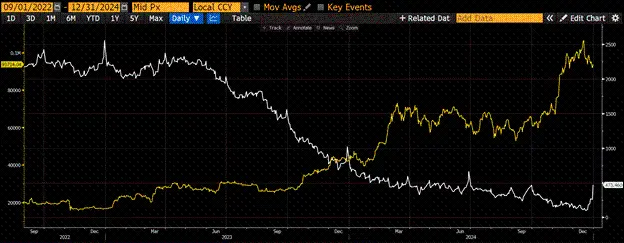
RRP Balance (White) vs. Bitcoin (Gold)
Like today, but for different reasons, Yellen couldn't count on the Fed to ease policy, as Powell was conducting a similar juggling act of austerity inspired by Paul Volcker. Yellen, or one of her cunning and smart staff, correctly deduced that by issuing more Treasury bonds, she could lure money market funds to redirect their interest-free funds from reverse repos (RRP) into the leveraged financial system, as these funds would be willing to hold them because the bonds offered slightly higher yields than RRP. This allowed her to inject $2.5 trillion in liquidity into the market from the third quarter of 2022 to early 2025. During this period, Bitcoin increased by nearly six times.
This was a quite bullish market environment, but people were afraid. They knew high tariffs and the "de-coupling" of China and the U.S. were bad for stock prices. They thought Bitcoin was just a high-beta version of the Nasdaq 100. They were bearish and didn't understand how an apparently harmless repurchase plan could lead to increased future USD liquidity. They sat and waited for Powell to ease policy. However, he couldn't directly ease policy or provide quantitative easing (QE) like his predecessors from 2008 to 2019. The times had changed, and now the Treasury was the main driver of money printing. If Powell really cared about inflation and the long-term strength of the dollar, he should have offset the impact of Yellen and current Treasury Secretary Bensons' actions. But he didn't do it then, and he won't now; he will sit passively and let the situation unfold.
Just like in the third quarter of 2022, when people thought Bitcoin might fall below $10,000, a series of adverse market factors intertwined around the cycle low of about $15,000. Today, some people think Bitcoin will fall below $60,000 from $74,500, and the bull run is over. Yellen and Bensons are not playing around. They will ensure the government can get funding at an affordable interest rate and suppress bond market volatility. Yellen injected a limited amount of RRP liquidity into the system by issuing more Treasury bonds instead of Treasury bills; Bensons will inject more liquidity by repurchasing old bonds with new ones, maximizing the ability of RV funds to absorb the increased bond supply. Neither of these is well-known or recognized by most investors. Therefore, they missed the opportunity and had to chase the price once the market breakthrough was confirmed.
Verification
To make the repurchase a net stimulus, the deficit must continue to rise. On May 1st, through the quarterly refinancing announcement (QRA) from the U.S. Treasury, we will know the future borrowing plans and compare them to previous estimates. If Bensons has to borrow more or expects to borrow more, it means that tax revenues are expected to decline; therefore, the deficit will expand with spending remaining unchanged.
Then, in mid-May, we will receive the official deficit or surplus data for April from the Treasury, including the actual tax revenue data for April 15th. We can compare the year-over-year changes in the beginning of fiscal year 2025 and observe whether the deficit is expanding. If the deficit increases, the bond issuance will increase, and Bensons must do everything possible to ensure that RV funds can increase their base trade positions.
Trading Strategy
Trump's tariff policy is like a skier cutting a steep and dangerous slope, triggering an avalanche. Now we know that the Trump administration can tolerate how much pain or volatility (MOVE index) before taking any policy that could negatively affect the cornerstone of the fiat financial system. This will trigger a policy response, whose impact will increase the supply of USD that can purchase Treasury bonds.
If the frequency and scale of repurchases are insufficient to calm the market, the Fed will eventually find a way to ease policy. They have already indicated they will do so. Most importantly, they recently reduced the speed of quantitative tightening (QT) in March, which is positive for future USD liquidity. However, the Fed can do more than QE. Here is a short list of procedural policies that are not QE but can increase the market's ability to absorb increased Treasury bond issuance, some of which may be announced at the Fed meeting on May 6-7:
Removing the SLR restrictions on Treasury bonds for banks. This will allow banks to use unlimited leverage to purchase Treasury bonds.
Conducting QT twist operations, reinvesting the funds raised from maturing MBS into newly issued Treasury bonds. The Fed's balance sheet size remains unchanged, but this will add $35 billion in marginal purchasing pressure to the Treasury market each month for the next few years until the total MBS matures.
The next time Trump hits the tariff button (he will certainly do so to ensure countries respect his authority), he will be able to demand more concessions, and Bitcoin will not crash along with certain stocks. Bitcoin knows that, given the insane debt levels required for the current and future operation of the financial system, deflationary policies cannot be sustained long-term.
Mt. Sharpe World's ski cut triggered a 2-level financial market avalanche, which could quickly escalate to a 5-level, the highest level. But the Trump team responded, changed direction, and opened up new roads for the empire. By using the powder made from the driest and purest USD bills provided by the Treasury repurchase, the slope's foundation was reinforced. Now it's time to switch from climbing the mountain with a backpack full of uncertainties to jumping down the powdery slope, excitedly screaming as Bitcoin soars high.
As you can see, I am very bullish. At Maelstrom, we have maximized our crypto exposure. Now, everything is about buying and selling different cryptocurrencies to accumulate Bitcoin. During the correction from $110,000 to $74,500, we bought a lot of Bitcoin. Bitcoin will continue to lead the trend because it is the direct beneficiary of the liquidity injections into the future, aimed at mitigating the impact of the U.S.-China "de-coupling." Now, the global community sees Trump as a madman who wields tariff weapons recklessly, and investors holding U.S. stocks and bonds are looking for a value non-conformist alternative. In the physical realm, it's gold. In the digital realm, it's Bitcoin.
Gold has never been seen as a high-beta version of U.S. tech stocks; therefore, it performed well as a historical longest-standing anti-establishment financial hedge when the overall market collapsed. Bitcoin will break free from its association with tech stocks and return to the "always goes up" embrace with gold.
So, what about shitcoins?
Once Bitcoin breaks through the historical high of $110,000, it may surge, further increasing its dominance. Perhaps it will miss $200,000. Then, funds will shift from Bitcoin to shitcoins. The alt season is coming!
Besides the shiny new shitcoins, the best-performing tokens will be those associated with projects that are profitable and can return profits to token holders. There are very few such projects. Maelstrom has actively accumulated positions in certain qualified tokens and has not yet completed the purchase of these gems.
They are gems, as they were hit hard like other shitcoins during the recent sell-off, but unlike 99% of garbage projects, these gems actually have paying customers. With so many tokens issued in CEX in "only goes down" mode, it's hard to convince the market to give the project another chance. Shitcoin dumpsters hope for higher annual percentage yields (APY) from actual profits, as these cash flows are sustainable.
To promote our product, I will write an entire article discussing some of these projects and why we believe their cash flow generation will continue and increase in the near future.
Until then, buy everything!
Disclaimer: Contains third-party opinions, does not constitute financial advice


AI Practical Guide
This column focuses on the real progress of Agents: technological evolution, application implementat

Crypto Weekly
Tracking on-chain movements of the smart money and institutions

Frontier Insights
Spotlight on Frontier, trending projects, and breaking events

Blowup Alert
As the 2026 crypto bear market deepens, exit scams and project blowups are becoming increasingly fre

Regulatory Watch
American Crypto Act – timely interpretations of policies worldwide

Popular Airdrop Tutorial
Selected potential airdrop opportunities to gain big with small investments

FusnChain
FusnChain