
ChainThink
Stay ahead, master crypto insights
Reprint | Is the U Card Dead? How Do PayFi Projects Survive?
Reprint | Is the U Card Dead? How Do PayFi Projects Survive?
2025-10-22 18:52
Original | Odaily Planet Daily (@OdailyChina)
Author | Wenser (@wenser 2010)
In 2025, stablecoins have become a highly anticipated cash flow source in the crypto industry, and the associated PayFi sector has attracted active participation from multiple parties: whether it's crypto-native projects, payment industry giants, stablecoin issuers, crypto exchanges, or stablecoin blockchains, all are actively positioning themselves to gain an edge in the development of the PayFi sector.
In this context, Odaily Planet Daily conducted interviews with multiple professionals in the PayFi industry during the Token2049 event in Singapore at the beginning of October. Through these exchanges, we found that the future of PayFi still holds many possibilities. The following content is compiled from the interviews, with some information adjusted for logical flow and length.
The Paradox of the PayFi Industry: Is U-Cards the Inevitable Path for Mass Adoption?
When it comes to PayFi, many people's first impression is still U-Cards. Previously, Infini had to reluctantly shut down its U-Cards business due to poor performance, which sparked intense market discussion (Recommended Reading《Interview with Infini Co-founder Junzhu: Why Did We Shut Down the U-Cards Business?》).
At the Token2049 event, when asked about their views on the U-Cards business model, multiple industry professionals gave different answers.
Roger, a marketing representative from DeCard, told Odaily Planet Daily that, based on local payment licenses in Singapore, DeCard has seen varying degrees of growth in card issuance and user numbers. The long-term compliance advantages accumulated over time allow DeCard to avoid starting from scratch in building its own application channels and user networks. Instead, DeCard can integrate with traditional payment giants like Visa and Mastercard, as well as traditional banking systems, to build corresponding payment networks. In his words, U-Cards remain one of the key components of DeCard's business.
However, some gave the opposite answer.
Pearce Chen from BenPay told Odaily Planet Daily, "In addition to the traditional U-Cards business relying on payment institutions such as Visa and Mastercard, we have taken a more forward-looking approach by using a 'QR code + POS machine or app scan' solution to meet payment needs. This allows direct use of stablecoins for payments, which are then converted into fiat currency through local clearing networks. This effectively removes upstream card issuers like Visa and Mastercard, and instead builds our own payment application channels and user networks. Since we are using stablecoins for payments, why should we rely on traditional payment institutions that we aim to disrupt?"
From this perspective, BenPay's approach is more Crypto Native. Unlike DeCard's 'integration strategy,' BenPay chose a more challenging path—building a PayFi network from scratch. Moreover, according to Pearce Chen, another focus of BenPay is the development of DeFi protocol tools, combining its Benfen payment blockchain and self-custody wallet to simplify complex DeFi protocols, enabling traditional users to enjoy DeFi returns in a 'foolproof' manner.
Interestingly, Ellipal also focuses heavily on entering the payment entry point through POS machines. According to 0xfate, Product Director of Ellipal, Ellipal's current POS machines already support users for offline lifestyle scenario consumption; simply swiping once, only a few seconds are needed to complete USDT/USDC stablecoin transfers.
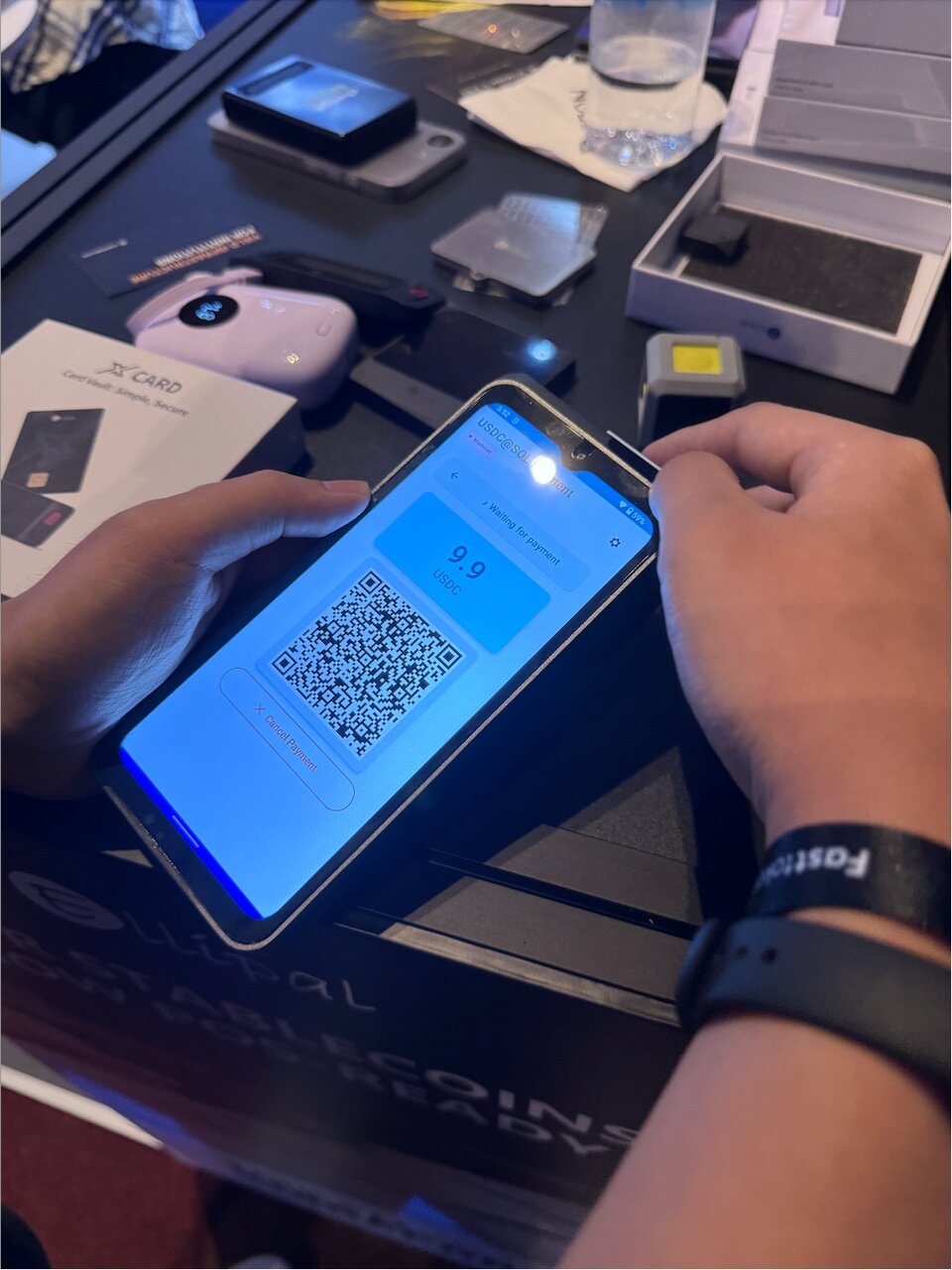
Ellipay POS Payment Demonstration
Faced with the layers of barriers set by traditional card issuers, crypto PayFi projects choose to change the hardware entry point to bypass restrictions, achieving slow penetration of PayFi applications in life scenarios and consumption scenarios. Especially in overseas markets where card-swiping consumption is a common practice, POS machine consumption remains a familiar mode of consumption for many people.
After all, overseas markets do not have a one-stop payment app like WeChat Pay or Alipay in China that allows transactions through QR codes.
Additionally, 0xfate mentioned, "PayFi is undoubtedly a valuable and profitable business. Although profit distribution does tend to concentrate upwards (such as stablecoin issuers), compared to other sectors, we see more opportunities downstream. This is because PayFi represents a super sector with extremely diverse user scenarios, different from all previous crypto sectors. Its user scenarios and demands are diversified. We cannot view it from the traditional payment perspective, because in the PayFi sector, the value distribution model will undergo fundamental changes: the value of the application layer is no longer limited to transaction fees but stems from the additional services created for high-degree-of-freedom users (such as integrated DeFi yields, social finance functions, programmable money applications, etc.), and these services will form the core growth drivers of future downstream profits."
It must be said that, given the current limited project models, the PayFi business model still has strong scalability and more possibilities.
Challenges and Opportunities in the PayFi Industry: Regulatory Arbitrage, User Education, and Infrastructure
Beyond existing businesses, Odaily Planet Daily also discussed the biggest challenges facing the PayFi industry with industry professionals.
Pearce Chen, VP of Business Development at BenPay, systematically shared his views. He believes that currently, the PayFi industry faces three main challenges:
First, the biggest challenge is regulatory compliance issues. Although different PayFi projects can set KYC/KYB thresholds at the payment transaction level, there are no clear regulations or management requirements in various countries regarding users' stablecoin assets generating interest. Essentially, the interest generation of PayFi projects constitutes regulatory arbitrage, and different regions' laws and national laws have different requirements for financial regulation of funds;
Second, the low adoption rate among C-end users. Currently, only the crypto community and some cross-border trade businesses use stablecoins for transactions; 95% of Chinese people don't even know about stablecoins, and even Bitcoin is just something they've heard of. From this perspective, the lack of user education and insufficient awareness is one of the main obstacles to the popularization of the PayFi industry, which often requires corresponding products to be grounded and have certain population penetration. It may even require some similar opportunities like WeChat red envelopes for popularization.
Finally, excessive reliance on the existing payment system and the imperfection of the underlying infrastructure are also major challenges for PayFi. At present, the operation of PayFi products still highly depends on the Swift settlement system, traditional banking system, and USD fund positions; any innovation at the industry level requires integration with various VA accounts and underlying systems. In addition, banks, as the gatekeepers of the PayFi industry, hold the "power of life and death"—they can freeze accounts at will, and PayFi project teams have no means to counter. Countless PayFi projects have worked hard, made various "ornamental innovations," essentially to prove "I am doing business, not money laundering," but still face structural pressure from regulatory authorities and the banking system.
When mentioning the "business model of PayFi projects," Pearce Chen also emphasized, the real competitive barriers in the PayFi industry often come from the perfection of large-scale infrastructure and underlying protocols— payment itself may not be profitable, and project teams must generate profits through asset accumulation and building a closed-loop financial ecosystem. Just like Alipay would not have succeeded without Yu'e Bao; it's not enough to simply connect to many bank infrastructures or major blockchain networks and think everything is fine, as such a business model would be very heavy. Compared to this, BenPay chooses to build its own blockchain network, allowing users to automatically map stablecoins from various blockchain networks to corresponding smart contracts, converting them into BUSD, and supporting both consumption and investment. This greatly simplifies the user operation process and usage threshold, which is crucial for subsequent product promotion and market popularization.
"The ultimate logic of the payment sector is that whoever can build a cheap and high-performance public chain, and provide a better user experience, will win the users' votes."
Currently, Ethereum and Solana respectively occupy certain priority positions with their security and low cost. However, in the near future, any high-performance public chain has the potential to drive the widespread adoption of PayFi—this doesn't necessarily require a high degree of decentralization, as long as it can reduce costs and improve efficiency to meet the needs of ToB and ToC users.
These views were also recognized by 0xfate, Product Director of Ellipal. Regarding the "challenges of the PayFi sector," he stated, "Similar to many other crypto sectors, the popularization of PayFi faces three core challenges: First, fund security is the cornerstone. The security of user assets is the premise of all business models, which directly depends on the iteration of underlying technology and the improvement of product design. Second, there exists a global structural contradiction in regulatory compliance. PayFi inherently has a global nature, but its ideal of unified service conflicts with the current regulatory framework. The solution lies in seeking global regulatory cooperation. Third, user awareness and penetration are the fundamental bottlenecks. After more than a decade of development, the user penetration rate of cryptocurrencies remains at 5%-10%, and among them, the number of users with the complex financial understanding required for PayFi is extremely small. Breaking through this bottleneck may depend on the emergence of a 'super app' that fundamentally lowers the usage threshold with an exceptional experience."
Finding a balance between asset security, global regulation, and user awareness is a major important issue that must be addressed by all PayFi projects and global popularization.
Short-Term and Long-Term Wars in the PayFi Industry: The Stage-by-Stage Trade-Off Between B-End and C-End Businesses
Additionally, for PayFi industry projects, choosing the business focus is an unavoidable trade-off.
Looking at the current industry situation, although C-end user demand is more active, due to factors such as the stage of market development, B-end business still belongs to the focus of most PayFi projects. After all, compared to institutional clients with transaction volumes ranging from tens of millions to hundreds of millions or even billions of dollars, C-end user demand is more fragmented, and in a way, it can be called "laborious and unrewarding."
However, based on the information obtained from conversations with multiple professionals, although PayFi business was initially considered by industry insiders to be more important for B-end users as a cash flow business, in the long run, C-end user demand will still be the mainstream of the market and the development focus. Generally speaking, the development process of PayFi projects may be divided into the following three stages:
Early Stage: Focus on B-End Business. In this phase, PayFi projects need to ensure that the business can generate cash flow and secure a place in the market competition. Currently, the business focus of truly profitable companies is mainly on ToB areas. For example, Huma Finance, a leading PayFi project in the Solana ecosystem; C-end business is more focused on traffic marketing and brand building.
Middle Stage: Emphasize Both B-End and C-End Businesses. When PayFi projects reach a certain stage, they need to ensure a smooth transition from "surviving" to "living well." This requires project teams to walk on two legs—B-end business creates continuous cash flow to support operations, while C-end business continuously expands the user market and increases user scale, ensuring future development.
Late Stage: Focus on C-End Business. In the long run, the ultimate goal of all PayFi projects is to become a unicorn company or even a monopolistic giant like WeChat, Alipay, or PayPal. The business focus that supports this goal is undoubtedly the C-end market, which has a large scale and more frequent payment and transaction needs.
From "surviving," to "living better," and finally to "lasting," becoming the winner in the industry, PayFi projects have a long way to go. The B-end institutional market and the C-end retail market are both indispensable.
The Future of PayFi Lies in Every Transfer Request
In the end, I would like to mention a few words about the current industry difficulties.
On one hand, the number of stablecoins in the cryptocurrency market is increasing, but for most people, the cost and scenarios of stablecoin transfers, payments, and trading have not seen significant improvements. On the other hand, there are still billions of people around the world who do not have their own bank account, or are facing the huge survival pressures of rapid depreciation of local currencies and hyperinflation.
In my personal opinion, the future of the PayFi industry should not remain confined within the digital fluctuations of crypto exchanges. Instead, it should go beyond the crypto market, reaching the homes of people around the world, and permeating into various daily life scenarios within the global economic system's capillaries. Only through these repeated transfer requests can the PayFi industry find its most loyal supporters, conquering the billions of ordinary people living on Earth with efficient and convenient user experiences.
At that time, PayFi will not be the dream of one person or one project, but an indispensable part of the lives of countless people.
Disclaimer: Contains third-party opinions, does not constitute financial advice


AI Practical Guide
This column focuses on the real progress of Agents: technological evolution, application implementat

Crypto Weekly
Tracking on-chain movements of the smart money and institutions

Frontier Insights
Spotlight on Frontier, trending projects, and breaking events

Blowup Alert
As the 2026 crypto bear market deepens, exit scams and project blowups are becoming increasingly fre

Regulatory Watch
American Crypto Act – timely interpretations of policies worldwide

Popular Airdrop Tutorial
Selected potential airdrop opportunities to gain big with small investments

FusnChain
FusnChain