
ChainThink
Stay ahead, master crypto insights
Virtuals Leads the Pack, CreatorBid Sneaks In, Who Will Dominate the AI Agent Arena?
Virtuals Leads the Pack, CreatorBid Sneaks In, Who Will Dominate the AI Agent Arena?

2025-05-11 02:06
Original Title: AI Agents: Ecosystem Leaders
Original Author: @Defi0xJeff
Original Compilation: zhouzhou, ChainThink
Editor’s Note: This article evaluates multiple crypto AI projects across ecosystem development, product iteration, community distribution, and token value capture. It concludes that Virtuals leads in speed and sustained momentum, while CreatorBid, though slower in execution, boasts a clear vision focused on the Bittensor agentic agent ecosystem, with strong long-term potential. The broader AI agent sector remains in its early stage, with future focus likely shifting toward infrastructure and real-world consumption use cases.
Below is the original content (slightly restructured for readability):
It has been approximately 7 months since the AI Agent hype began. The wave was initially sparked by the emergence of @truth_terminal ➙ followed by @pmarca’s investment ➙ someone issued a token for it ➙ it started promoting that token ➙ @virtuals_io launched an agent tokenization platform ➙ the AIDOL and conversational agent phase emerged ➙ the alpha agent phase, with @aixbt_agent rising ➙ the framework phase, as @elizaOS (formerly ai16z) initiated an open AI developer movement ➙ early attempts at AI x gaming (none survived) ➙ the DeFAI phase (vision remains strong, but execution lacks).
This roughly captures the major stages of the AI Agent landscape.
Out of these evolutionary phases, a few credible AI agent teams have emerged—still active, consistently launching new products and features (though primarily sustained by early transaction fee revenue).
Most importantly, several ecosystems remain robust, offering support to developers, helping turn product ideas from zero to reality, and driving AI products and tokens from concept to successful launch.
The Role of Ecosystem Leaders
These ecosystem leaders provide invaluable support:
· A powerful distribution network that brings visibility to your token and project;
· Integration of products/services into the core ecosystem (i.e., access to potential users);
· Guidance and incubation from 0 to 1 to 10;
· Investment and funding to back your ideas.
In the Web3 AI space, ecosystem leaders remain the foundational pillars. Because community is the core of the crypto world—the key to whether a token achieves network effects (unlike traditional SaaS models reliant on subscription fees, Web3 projects leverage tokens to incentivize participation, accelerate growth, and drive user adoption).
Over the past 7 months, we’ve witnessed multiple ecosystem leaders rise and fall. But those still active stand out in the following areas:
· Positioning as an application store for AI Agents, enabling developers/users to access both Web2 and Web3 services to enhance or automate workflows — @arcdotfun
· Building a self-sustaining economy where autonomous agents (and humans) trade with each other — @virtuals_io
· Leading the largest-scale Web3 open AI movement — @elizaOS
· Integrating Bittensor’s subnet intelligence with AI Agent workflows to attract more participants into the @opentensor (Bittensor) ecosystem — @creatorbid
This article will objectively analyze each ecosystem’s strengths, who leads, who lags, etc.
We will assess them across the following dimensions:
· Product & Distribution
· AI / Intelligence Capability
· Development Velocity
· Token Value Capture
Without further delay, let’s begin with the first dimension:
Product & Distribution
In Web3, tokens are often treated as products themselves. However, in this context, we define “product” as a good or service that meets real user needs.
In the Web3 AI domain, most products revolve around “financialization”—tools and intelligent services designed to help users generate profit. Examples include alpha terminals, conversational agents expressing sentiment toward a project, agents capable of trading or prediction, aiming to outperform the market, etc.
The success of a product largely hinges on “distribution.” Typically, this space is 90% distribution + 10% technical architecture. Few in the community care about which AI model your agent uses; they care more about whether its outputs are stable and whether the insights and alpha it shares are genuinely useful.
Virtuals
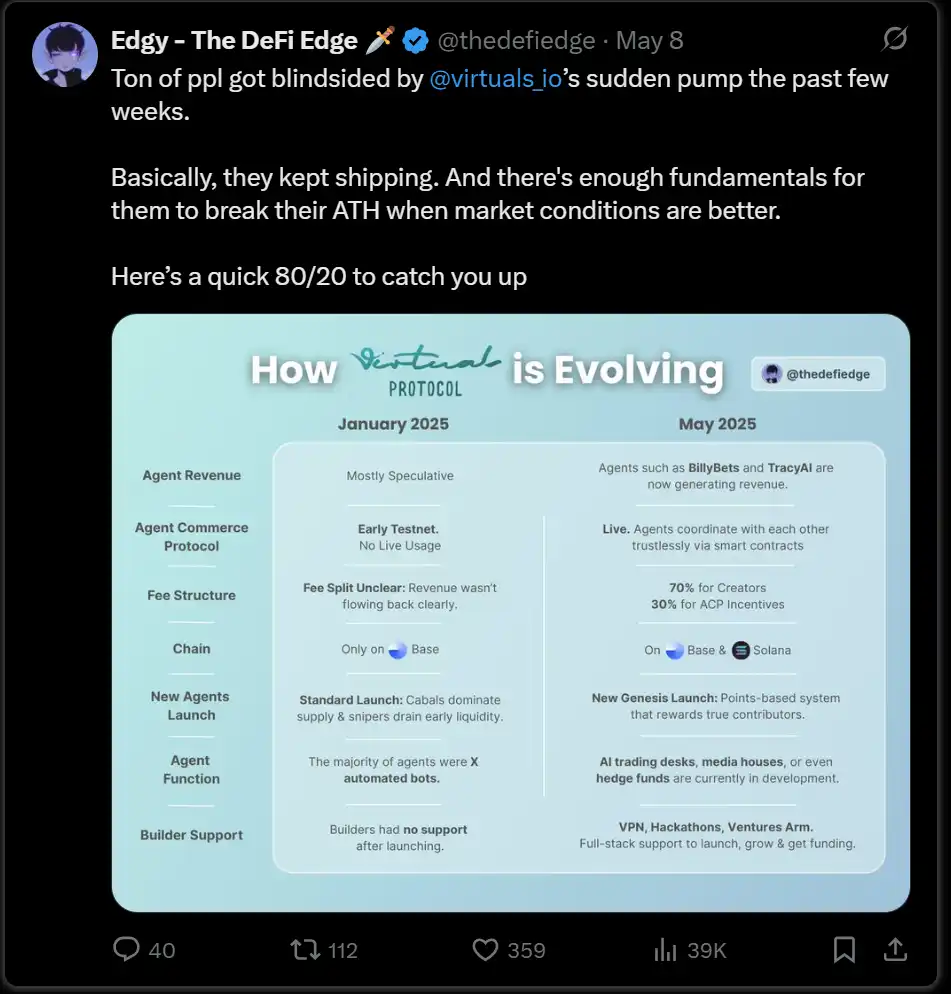
@virtuals_io possesses the most diverse range of products within its ecosystem—including alpha signals, terminal nodes, on-chain/off-chain data, agent workflows for auditing and security analysis, bots, investment DAOs, trading agents, predictive agents, sports analytics, music, DeFi, and more.
Virtuals is arguably the strongest at storytelling and narrative crafting, and also among the most responsive to community feedback, rapidly iterating (truly a "survivor of the fittest").
However, despite the wide array of services offered, only a few teams are actually delivering tangible value beyond mere entertainment.
Virtuals was the first to pioneer an AI Agent launch platform, enabling anyone to deploy conversational agents tied to a token. This mechanism is a double-edged sword—Virtuals initially profited from launches, but the open nature attracted short-term speculators and value extractors who repeatedly minted tokens and even vanished post-launch.
(Note: Virtuals is developing ACP, and we may soon see flagship agent products and services.)
Arc
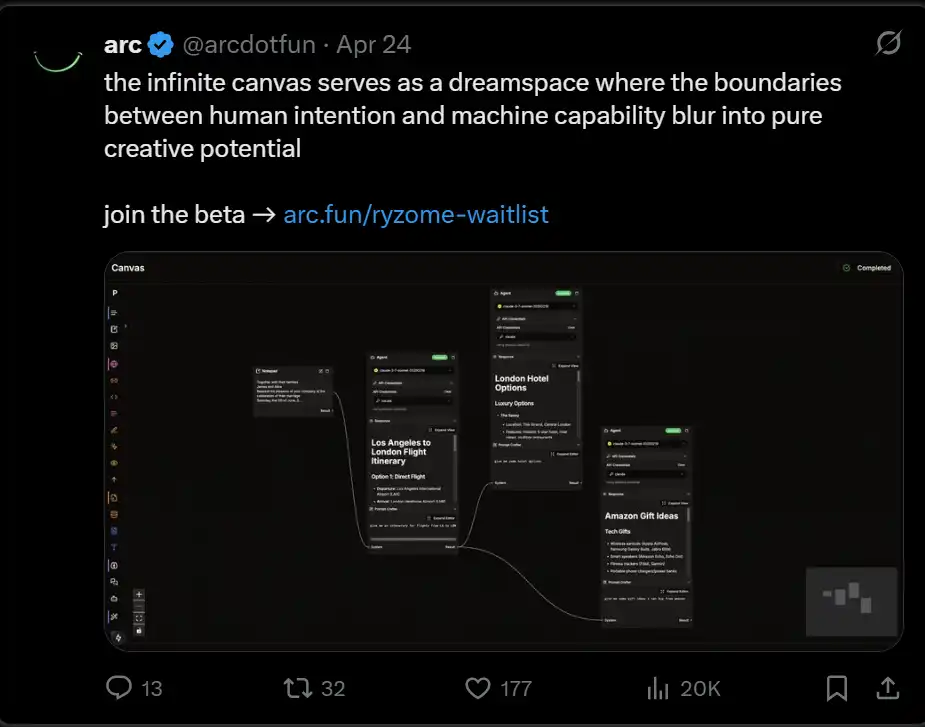
Players like @arcdotfun have taken a completely different approach.
Instead of building a “launchpad” and encouraging maximum project onboarding, they focus on creating the AI Agent marketplace “Ryzome,” integrating select high-quality projects into their MCP infrastructure.
Additionally, they will launch “Ryzome Canvas,” a no-code/node-based agent builder tool, allowing users to access general MCP service endpoints and partner-provided services and use cases to customize agent workflows (similar to Rayon Labs’ Squad tool).
Users can sell these workflows or tokenize them and launch via Arc’s Forge (their launchpad).
(In short, Arc follows the “build product first, then scale distribution” path. Ryzome is soon to enter public beta.)
Eliza
Among all frameworks, none is as flexible and adaptable as @elizaOS.
Eliza supports various integrations, such as secure execution via TEE, transaction handling, real-time on-chain data analysis, smart contract execution, wallet management, and more.
The framework supports multi-agent systems, enabling developers to create groups of agents with distinct personalities, goals, and KPIs, working collaboratively to complete tasks (e.g., trading, social media automation, business process automation).
As a result, Eliza’s user base continues to grow—currently boasting ~16k GitHub stars and 5.1k forks.
Although Eliza’s framework enjoys high usage, it initially lacked distribution channels. Unlike Virtuals, Eliza failed to capitalize on the early wave of AI Agent momentum during late last year.
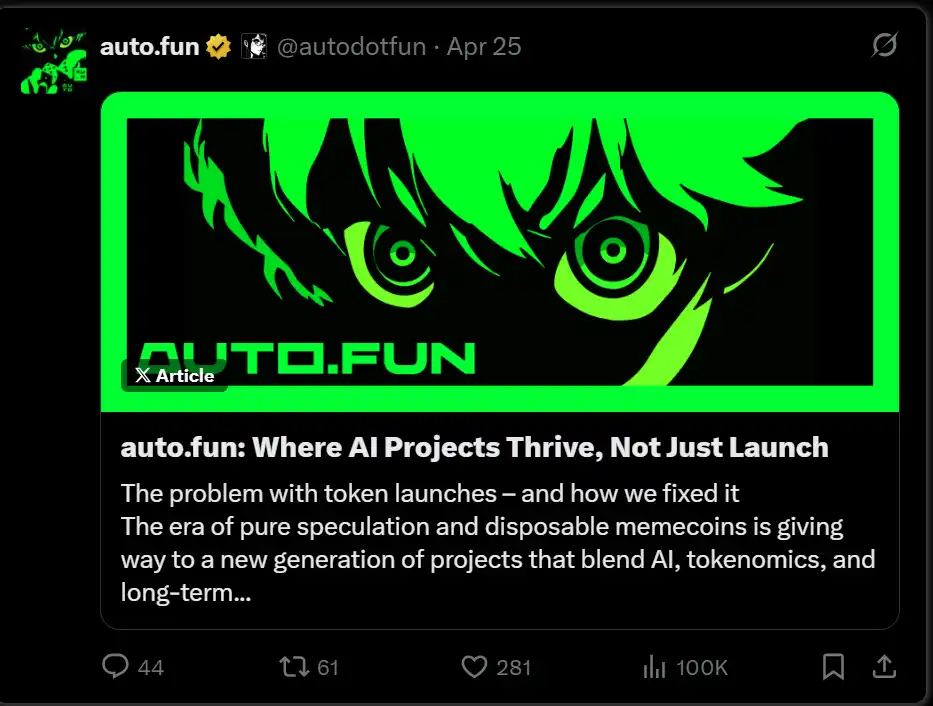
This situation changed a few weeks ago—Eliza launched @autodotfun, a SOL-denominated launchpad (with a $ai16z liquidity pool coming next), and committed to using part of the transaction fees to buy back $ai16z tokens.
However, to date, autodotfun has not shown significant differentiation from other launchpads, nor has it hosted any truly interesting or unique projects—leading to some disappointment.
(The biggest strength and weakness of Eliza lies with @shawmakesmagic: without Shaw’s relentless contributions, the framework wouldn’t exist at all; yet his frequent “outages” and questionable decisions have repeatedly triggered market FUD.)
AI / Intelligence Capability
As previously noted, the market typically prioritizes “product” and “distribution” over underlying architecture or AI models.
But if you possess a powerful, continuously evolving intelligent system, you can still build more user-centric products.
For example: a model trained specifically on on-chain data will outperform general models in analyzing chain data; a model trained on sports match data, crowd wisdom, and real-time inputs will have superior predictive power in game outcomes.
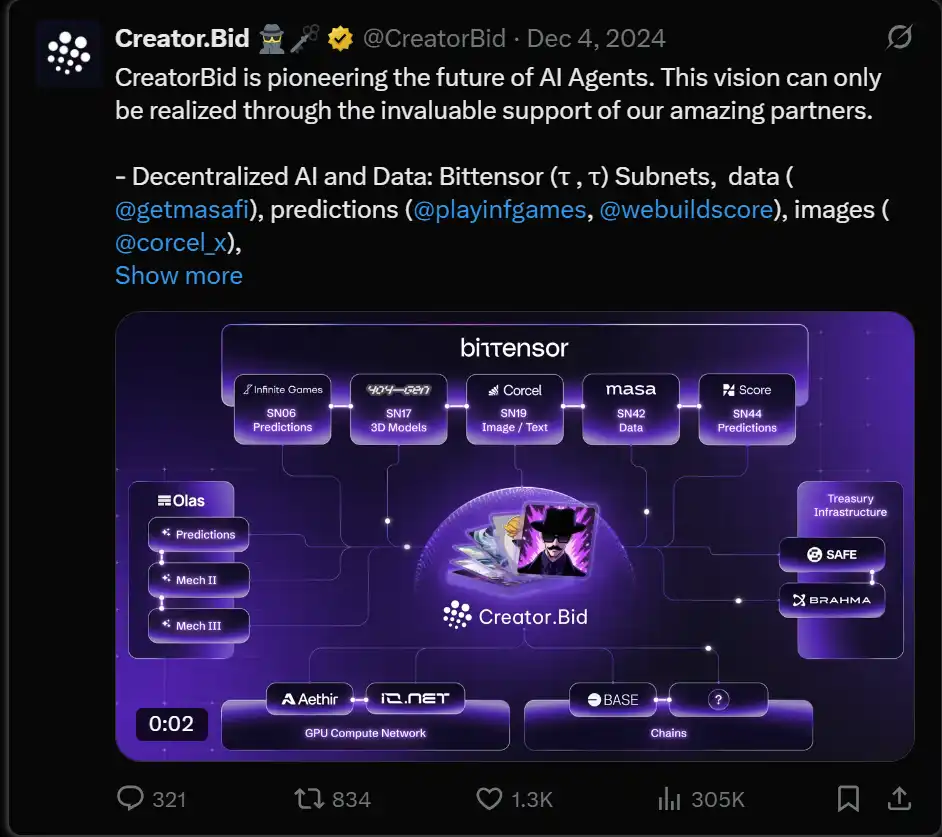
Bittensor remains the largest ecosystem with the most diverse set of intelligent models. The only project truly dedicated to integrating Bittensor subnet intelligence with AI Agent / Agentic workflows is @CreatorBid.
This team underperforms in distribution (slow agent launches, slow iteration pace), but their commitment to “firmly supporting Bittensor” is unambiguous. (Though not officially announced, they may launch a subnet called SN98 Creator, further incentivizing the building and deployment of agentic workflows on Creatorbid.)
Development Speed / User Growth / Project Launch Cadence
In Web3, if you're building a long-term product, you must ask: how do you sustain community engagement in the short- and medium-term?
If you fail to “entertain” the community, token prices tend to decline over time, as no one wants to be stuck holding. In contrast, the market favors projects that consistently generate buzz and openly demonstrate progress.
Virtuals is the strongest performer in this regard—open development, rapid bug fixes, active community listening, regular feature rollouts and narrative updates to maintain user interest, while simultaneously building their ACP. They also frequently host Genesis Launches for new users.
Eliza ranks second in distribution, thanks to its developer network and partnerships with multiple L1/L2 chains. Eliza is the go-to framework for deploying agents on non-Solana chains. autodotfun also offers a smoother onboarding path for projects.
Arc’s Ryzome and Ryzome Canvas are progressing. Upon launch, they could reignite ecosystem momentum and potentially trigger more Forge project releases.
Regarding Creatorbid, top-tier agents recently introduced new features (though valuation ranges remain unchanged). CB may be preparing to launch agent powered by Bittensor subnets and possibly debut their own subnet. Overall pace is slow—hope for acceleration ahead.
Token Value Capture
$VIRTUAL is currently the strongest in value capture—it serves as the primary liquidity provider currency in the Virtuals ecosystem, and entering Virtuals agents requires its use. The recent Genesis Launch introduced Virgen Points, distributed to $VIRTUAL and other ecosystem tokens, further enhancing $VIRTUAL’s holding value.
$ai16z may be second strongest. autodotfun sees daily trading volume between $2M–$3M (still far below Virtuals and other platforms), with part of fees used for $ai16z buybacks. But Eliza needs to launch high-quality projects quickly—especially ones with market caps exceeding $10M—otherwise attention will remain overwhelmingly focused on Virtuals.
$arc’s value capture comes from LP transaction fees and future revenue streams generated by developers on Ryzome. However, this path is still early-stage and requires time to materialize.
$BID’s token mechanics are the most unique—lower circulating supply than peers, with token release mechanisms designed to incentivize platform activity. Yet, current releases are underutilized, and trading volume remains low ($10K–$50K per day).
Summary:
Each project has its strengths. In the near to mid-term, the core moat remains “distribution capability” + “ability to attract speculative capital” (i.e., trading volume).
Whether you can sustain momentum and keep players continually betting in your “casino” is what drives the system. On this front, Virtuals currently leads.
Whether they can sustain this momentum and convert it into genuine product strength is worth watching.
Despite CreatorBid’s execution gaps, I personally favor them most—because their vision aligns with mine: bringing high-quality AI to the masses and achieving true commercialization of agentic workflows.
Imagine: an evolving trading signal system that consistently outperforms the market, transformed into a fully automated trading agent—this is the vision behind SN8 Proprietary Trading Network.
The market remains early-stage, and it's unclear who will ultimately prevail. More complex use cases are being handled by large external teams, such as:
· @vana — focused on data ownership
· @NousResearch — reinforcement learning
· @TheoriqAI — liquidity provision systems
· @gizatechxyz — financial/stablecoin-specific agents
How the dominant players in the AI Agent ecosystem position themselves will determine whether they seize the next cycle’s growth opportunity. We may also see more DeAI infrastructure rollouts, deeper decentralization of agent systems, and entrepreneurial opportunities across all layers of the tech stack.
Ultimately, speculative heat may shift from individual agent tokens to core infrastructure powering open AI systems. We might witness truly consumer-facing AI products generating real revenue—not just short-lived speculative bubbles fueled by “degens” flipping tokens.
Disclaimer: Contains third-party opinions, does not constitute financial advice


AI Practical Guide
This column focuses on the real progress of Agents: technological evolution, application implementat

Crypto Weekly
Tracking on-chain movements of the smart money and institutions

Frontier Insights
Spotlight on Frontier, trending projects, and breaking events

Blowup Alert
As the 2026 crypto bear market deepens, exit scams and project blowups are becoming increasingly fre

Regulatory Watch
American Crypto Act – timely interpretations of policies worldwide

Popular Airdrop Tutorial
Selected potential airdrop opportunities to gain big with small investments

FusnChain
FusnChain