
ChainThink
Stay ahead, master crypto insights
Interview with Matt, CEO of JuChain: Discussing the $100 Million Venture Fund, Market Cycles, and Project Survival
Interview with Matt, CEO of JuChain: Discussing the $100 Million Venture Fund, Market Cycles, and Project Survival

2025-12-24 19:27
Interviewee: Matt, Co-Founder and CEO of JuChain
Interview by ChainThink
In an era where public blockchain narratives are increasingly defined by "parameter wars" and hype cycles, JuChain has taken a more pragmatic approach: eschewing the myth of the "universal public chain," it instead integrates years of accumulated project teams, users, and capital resources from its exchange platform with a production-ready blockchain, wallet, and tooling ecosystem—backed by a $100 million venture fund to provide financial and operational support for project upgrades.
In this exclusive interview, Matt, co-founder and CEO of JuChain, offers a candid overview of JuChain’s positioning, fund tiering mechanism, collaboration workflow, and boundaries, while discussing how to advance ecosystem development amid uncertain market cycles.
Biography:
Matt (@Matt_Jucom) is Co-Founder and CEO of JuChain, with deep expertise in blockchain infrastructure and digital asset investment. He entered the crypto space in 2014, actively participating in mining and investing, founding mining pools and multiple tech firms. In 2021, he established Web3 Ventures LTD in Singapore, focusing on blockchain infrastructure and digital asset investment. He currently leads JuChain’s ecosystem development and recently announced the establishment of a $100 million venture fund open to project teams seeking collaboration and support.
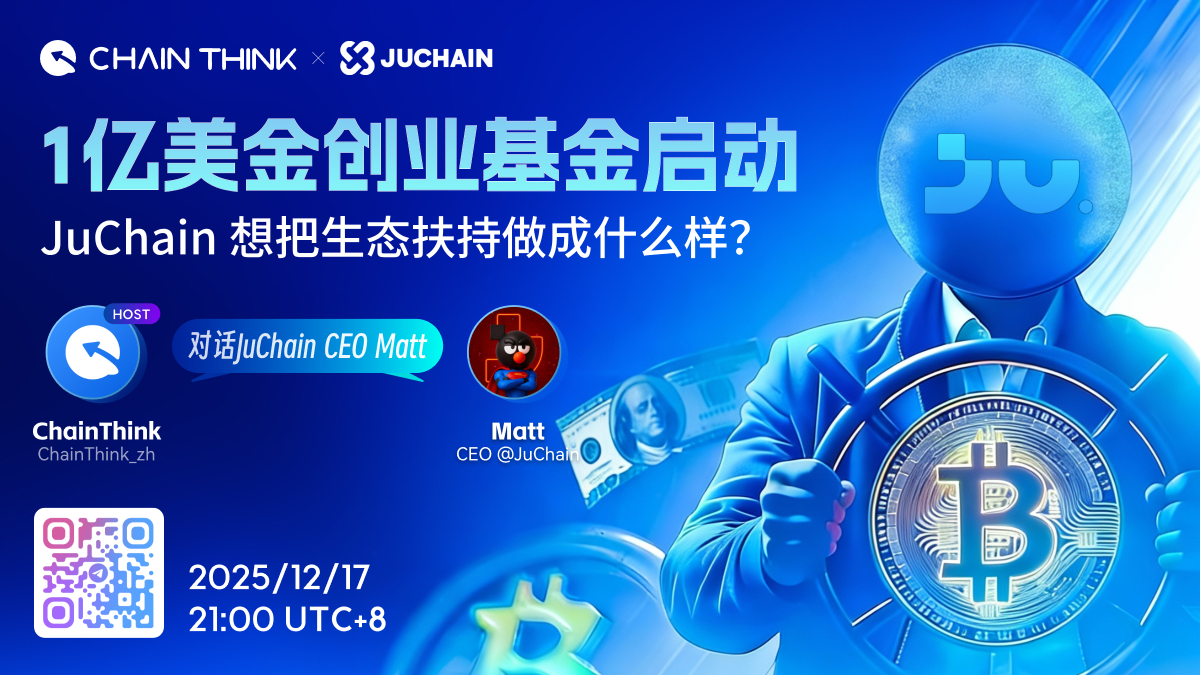
Below is the full transcript, slightly edited:
ChainThink: Please start by introducing yourself to our audience, and briefly tell those unfamiliar with JuChain about your background and what we’ll be discussing today.
Matt:
Hello everyone, I’m Matt, currently leading JuChain-related initiatives and also handling international business and incubation within the group.
To summarize today’s core message in one sentence: We’ve launched a $100 million venture fund and are actively seeking partnerships and support opportunities with project teams through open channels.
JuChain’s positioning isn’t about chasing the “universal public chain” narrative. Instead, we aim to close the loop across three key areas:
First, leveraging years of accumulated project teams, users, and capital resources from our exchange side;
Second, providing a production-ready blockchain and integrated wallet/tooling stack capable of supporting real-world project deployment;
Third, using this $100 million fund to deliver financial and operational support to projects seeking meaningful upgrades.
So today we’ll discuss the blockchain, the fund, and macro conditions—but the central message is this: The fund is real, we’re actively scouting for suitable projects and teams, and we welcome any team with a project and ambition to upgrade to reach out.
ChainThink: If you had to describe JuChain’s performance over the past year using three keywords, which would they be and why?
Matt:
I’d choose three words: Building Infrastructure, Defining Direction, Revealing Commitment.
Building Infrastructure:
Over the past year, our primary focus has been “building infrastructure”—stabilizing the mainnet, streamlining wallet and core workflows, and establishing foundational modules like smart contracts and risk controls. While these efforts may not seem flashy externally, without robust infrastructure, any discussion around ecosystem growth or project support remains theoretical.
Defining Direction:
We’ve invested significant time clarifying our strategic stance: JuChain will not compete with Ethereum or Solana on raw performance metrics or grand narratives. Instead, we’re focused on becoming a blockchain and infrastructure layer specifically tailored for project teams and industry assets.
In other words, we won’t try to be everything to everyone—we have clear service preferences: teams with real projects, active user bases, and a genuine desire to evolve are our priority partners.
Revealing Commitment:
This year, we took a direct step: publicly announcing the $100 million venture fund to signal clearly that we’re not just talking about welcoming projects—we’re prepared to back them with real capital and resources.
For JuChain, this year wasn’t about chasing short-term buzz. What matters most is solidifying infrastructure, clarifying our positioning, and transparently showcasing our commitments and mechanisms.
ChainThink: For you personally, transitioning from running an exchange to building a blockchain and ecosystem, what’s the biggest shift in mindset?
Matt:
The biggest shift is moving from a “fee-generation” logic to a “helping partners build sustainable value” mindset.
Running an exchange, the business model was straightforward: list tokens, run events, drive trading volume—more activity meant higher revenue.
But when building a blockchain, ecosystem, and fund, you’re engaging directly with project teams and founders who invest real resources and face real user demand and long-term operational pressure.
If you still center solely on platform profits, it’s nearly impossible to build lasting trust and collaboration.
So now I remind myself with three guiding principles:
First, a partner must first achieve positive returns within the ecosystem before we can meaningfully discuss ecosystem development;
Second, projects must survive across market cycles—only then does the blockchain’s value become evident;
Third, deploying the $100 million fund effectively means allocating capital to the right teams and projects—only then do whitepapers and roadmaps turn into tangible execution.
ChainThink: 2025 has been highly dynamic for the crypto industry—policy shifts, market trends, and narratives are all evolving. What do you consider the most important milestones for JuChain this year?
Matt:
I won’t use official jargon—I’ll share my personal perspective in three points.
First, Acknowledging Reality: We’re not here to build the “world’s number one blockchain.”
Many previous blockchain projects talked about “disrupting Ethereum” or “rebuilding the internet,” but internally we’re clear: JuChain is a vertical blockchain tailored for project teams and industry assets. Our true advantage isn’t in competing on technical benchmarks—it lies in the combination of three elements: exchange-side access points, established project network, and this $100 million fund as real capital commitment.
Second, Clarifying Our Target Audience.
We’ve defined our ideal clients very precisely: team leads, existing projects needing upgrades, and hybrid “project + business” teams—such as in education, mining hardware, asset management, and cultural tourism. We want to help these teams transition smoothly onto-chain and achieve structural, asset, and business model upgrades.
Third, The Fund Is Now Operational, Not Just a Name.
We’ve moved beyond branding—we’re now evaluating projects through a structured S/A/B/C tiering system, with formal forms, processes, and review mechanisms. It’s not about “who you know”—we’re genuinely seeking qualified teams and projects, and we’re ready to deploy capital and resources under transparent, merit-based criteria.
ChainThink: The public blockchain space is fiercely competitive—Ethereum emphasizes decentralization, Solana pushes high performance, Base benefits from Coinbase backing, and Sui has language advantages. What is JuChain’s core competitive edge?
Matt:
Let me be clear: JuChain won’t compete on technical parameter comparisons. Chains like Ethereum, Solana, and Base are industry-grade infrastructure—trying to outdo them on TPS, language features, or TVL is ultimately meaningless and unlikely to yield real differentiation.
Our goal is to become a blockchain that project teams and industry assets naturally want to join—and find easier to launch on.
Based on this vision, our competitive strength rests on three pillars.
First, real project and user entry points.
Backed by Ju.com’s long-standing user base and project ecosystem, we can immediately connect with authentic projects and real demand—something many pure-tech teams struggle to achieve from day one.
Second, real capital and resource commitment.
We’re not just saying “welcome to build”—we’re putting up $100 million in actual capital and openly stating: for teams with projects, teams, and upgrade ambitions, we’re ready to offer funding, resources, and collaborative support under a formal framework.
Third, willingness to invest in complex, long-term collaboration tasks.
By “complex work,” we mean helping projects restructure, refine tokenomics, resolve legacy issues, and meet basic risk and compliance standards. Many blockchains prefer clean, standardized projects—but we’re more willing to partner with teams committed to compliance, transparency, and long-term sustainability, tackling challenges together and filling systemic gaps.
Thus, JuChain’s path is clear: we don’t seek to be the “most powerful” chain in terms of parameters—we aim to be the chain that’s most willing to roll up its sleeves with project teams to make things happen and operationalize mechanisms.
ChainThink: Many are curious about this $100 million venture fund. Can you detail how it’s structured? How many projects do you plan to support? What’s the timeline?
Matt:
Let me get specific here.
First, Scale and Timeline.
The fund size is equivalent to $100 million, and we aim to deploy this capital into project support over the next 12–24 months—not keep it idle on paper.
Second, Project Volume Expectations.
S-tier flagship projects: 5–10 planned—could be “project + business” hybrids or projects backed by real industry assets;
A-tier key projects: 100 planned—projects with existing teams, user bases, and upgrade ambitions;
B/C-tier: We’ll offer more technical, tooling, and traffic support, with small-scale funding or phased top-ups based on project progress.
Third, A Core Principle.
This $100 million isn’t for PR—it’s to test a hypothesis: can project teams leverage the “blockchain + capital + tools” combo to launch more sustainable, transparent, and long-lived projects?
So let me say plainly: if you have a project, a team, and are considering a strategic upgrade, view yourself as a potential candidate for this fund. We welcome you to reach out and enter the evaluation pipeline.
ChainThink: There’s much debate around the “four-year cycle”—some claim it’s obsolete, others believe next year will still be bearish. How do you see the four-year cycle? How is JuChain responding to uncertainty?
Matt:
I often say internally: Cycles can be referenced, but not worshipped.
My view breaks down into three layers.
First, the four-year cycle still holds some reference value, but it’s being diluted by more variables.
Today’s industry is influenced by too many factors: Fed policy, macro liquidity, regulatory shifts, ETFs, RWA, geopolitics, etc. Halving still matters, but it’s no longer the sole rhythm setter.
Second, for project teams, the most important thing isn’t predicting market swings—it’s surviving across cycles.
Projects that endure typically share one trait: regardless of bull or bear markets, they consistently deliver real value to users—not just profiting from price volatility.
Third, for JuChain, our strategy is counter-cyclical construction and pro-cyclical scaling.
Currently, we focus on counter-cyclical actions: improving the chain, building tools, launching the fund, and identifying projects—with a conservative pace in selecting teams and collaboration models.
If market conditions improve, we accelerate capital and resource deployment; if it stays cold, we become more selective but never stop.
In short: we’re not betting on a specific year—we’re betting on teams ready for their next phase of evolution, who will eventually need a reliable path like JuChain to bring their vision to life.
ChainThink: Returning to the question everyone cares about: how does this $100 million fund ensure capital goes to the most aligned teams? Many teams want to know: what kind of projects actually qualify for funding? Is this a gimmick or real support?
Matt: First, the review process hinges on three core criteria.
First, authenticity: Is it a real project with a real team? Do they have genuine users, and are they truly active on the ground—or just temporary spinners crafting stories?
Second, willingness for transparency and long-term upgrading: Are they open to deconstructing their model, adopting more transparent and sustainable mechanisms, and accepting basic risk and compliance thresholds?
Third, alignment with JuChain: Are they willing to prioritize launching their next major project within our ecosystem, and to adopt our wallets, tools, and task systems for user growth?
Second, on the gimmick vs. real support question: My answer is straightforward.
Gimmicks mean nothing to us, but misallocating real capital hurts us deeply.
So we’re implementing a visible, clearly documented S/A/B/C tiering system—step by step, we’re disbursing funds while simultaneously building out the ecosystem support structure.
ChainThink: If I were a project team, after hearing this, I’d want to apply immediately. Is the process overly complex? How exactly is funding distributed? From contact to receiving the first disbursement, how many steps are involved?
Matt:
We’ve distilled the process into five simple steps that teams can remember: One action from you, and we handle the rest.
The one thing you need to do: submit a brief profile via the industry incubation interest form, official customer service, or business liaison—include: who you are, what your project is, user scale, current challenges, and the type of support you need.
Then we handle the next five steps:
Step 1: Initial Screening & Tiering — internally assess whether you’re S/A/B/C tier, with clear notification if eligible, or feedback if not;
Step 2: Deep Form & Detailed Discussion — complete a detailed high-priority project form and schedule a video call to thoroughly discuss project structure, debt status, revenue model, community health, and other critical aspects;
Step 3: Internal Review & Risk Assessment — evaluated jointly by business, risk, and technical teams, resulting in a decision: whether to support, how to support, and to what extent;
Step 4: Support Package Confirmation & Agreement Signing — confirm funding amount, technical support, traffic resources, and key milestones, with clear responsibilities for both parties documented;
Step 5: First Disbursement & Resource Deployment — once agreement is signed, initiate the first tranche of capital and accompanying resources, followed by staged releases tied to milestone achievements.
For project teams, the core takeaway is simple: Submit your materials to enter the review—everything else is handled by us.
ChainThink: Many teams worry: after collaborating with you, will we lose control of our project? What role does JuChain play in partnerships? How is project autonomy protected?
Matt:
I’m clear on this point and will embed it in the partnership framework. Our role is that of a co-founder and infrastructure provider—not a traditional client.
First, brand, users, and operational control remain with the project team: names, IP, communities, agent systems—key assets stay under your ownership. We don’t demand equity, nor do we require transferring all assets to our name.
Second, we earn long-term collaborative gains: after growing together in the JuChain ecosystem, we receive a portion of assets, revenues, or long-term profit-sharing—not upfront control.
Third, we uphold two red lines: compliance and risk. Any illegal or user-harming behavior is strictly prohibited during collaboration—this protects users and preserves the project’s long-term reputation.
Fourth, all support and public milestones are outcome-linked: funding, traffic, and technical support are tied to measurable goals—released upon achievement, adjusted if missed—ensuring traceability and auditability.
I want to tell project teams: We’re not here to take over your project or make decisions for you. We’re here to provide capital and tooling so your project can run stably and sustainably over the long term. The project remains yours—we’re simply offering behind-the-scenes infrastructure and support.
ChainThink: Let me speak for many teams: for those facing growth bottlenecks or small teams with limited scale, is this fund accessible? What would you most like to say to them?
Matt:
First, yes—access is open. As long as you have a team, users, and a genuine desire to stabilize and grow your project long-term, this fund welcomes you to engage.
We’re not only interested in the most polished projects. Often, it’s teams under pressure yet still committed to evolving—those deserve the most support.
Here are three messages for such teams.
First, don’t define yourself as a “last-round project.” If you’re willing to restructure and refine your model, this stage could be the launchpad for your next phase.
Second, you don’t have to carry all the burden alone. In the past, teams had to build systems, raise capital, and manage crises solo. Now, you can offload some complexity to us—system design, smart contracts, mechanism modeling, and resource allocation.
Third, taking the first step is simple: just start the conversation. Submit the industry incubation interest form or express intent via official channels—then we’ll manage the rest.
ChainThink: One final question: After one year, what outcome would you hope the external world uses to judge whether this fund was successful?
Matt:
After one year, I’ll mainly look at two things.
First, how many projects successfully completed upgrades and transitions, overcoming bottlenecks—not just vanished after receiving a check;
Second, how many project teams in the ecosystem would say openly: “Choosing JuChain was helpful,” even pivotal at a critical juncture.
If we can present a list of such projects after one year, I’ll consider the fund meaningful.
After three years, I hope people remember two things when they mention this fund: the capital was genuinely delivered to builders and teams, and it helped a group of people evolve from “running a project” to “building a lasting venture.” If we’re remembered that way, I’ll know it was worth explaining everything clearly today.
Disclaimer: Contains third-party opinions, does not constitute financial advice


Market Analysis
BTC/ETH, Major Cryptocurrencies, and Hot Altcoins Price Trends

Popular Airdrop Tutorial
Selected potential airdrop opportunities to gain big with small investments

Crypto-linked Stocks
Crypto-stock linkage, real-time market quotes and in-depth analysis

Frontier Insights
Spotlight on Frontier, trending projects, and breaking events

Alpha Research
Alpha New Token Research Report, Binance Alpha Operation Suggestions

Regulatory Watch
American Crypto Act – timely interpretations of policies worldwide

Crypto Weekly
Tracking on-chain movements of the smart money and institutions