
ChainThink
Stay ahead, master crypto insights
A Top-Tier Trader's 10,000-Character Guide to Surviving in Crypto: Don't Let "Get Rich Quick" Destroy You
A Top-Tier Trader's 10,000-Character Guide to Surviving in Crypto: Don't Let "Get Rich Quick" Destroy You
2026-01-27 23:01
Original Title: Your fast money brain will make you lose everything
Original Author: @0xPickleCati, Crypto Trader
ChainThink ChainThink Note: This article is a deep sharing from crypto trader Pickle Cat. In the Chinese-speaking world, she is more commonly known as "Cucumber Cat." She entered the crypto market at the age of 12 (yes, truly 12 years old), has experienced multiple full bull and bear cycles, consistently ranks among the top in long-term profitable performance on token-based futures, and has accumulated over $40 million in profits. Tags such as “Gen Z,” “prodigy,” and “female trader” have long accompanied her trading journey.
However, this article is not a boastful summary about returns, techniques, or “how to succeed quickly.” On the contrary, it is a systematic reflection on trading, survival, and cognition after enduring complete market cycles. The core message is singular: do not let your “get-rich-quick” mindset destroy you. Below is the original content:
Your "fast money" mindset is the real culprit preventing you from making big money
I bought my first Bitcoin in 2013.
As someone who has lived through the entire cycle into 2026, I’ve seen the countless ways this market has devastated people.
What I’ve observed over this long period is an undeniable iron law:
Within this ecosystem, “winning” is never defined by how much money you make. Everyone who has touched this space has made money at least once—no matter how novice they are, no matter how small their capital. They can briefly become a “genius.” But what does “winning” actually mean? It means you made the money—and still have it years later.
In other words, if you want to transform your life through crypto, you must first realize this isn’t a competition of “who makes the most” or “who multiplies fastest.” It’s a race to see who survives until the end.
But reality is harsh: most so-called “geniuses” become fuel. Only a small fraction survive to see the next cycle. Among those survivors, the number capable of achieving sustained compound growth is even rarer.
After 2010–2011, market sentiment once again returned to the dull phase I’m familiar with.
That day, I lost many friends I’d thought would stand by me for years in crypto. Though this “farewell” has happened countless times, each encounter still triggers me to instinctively open my fragmented reflections from these past years.
I think it's time to organize them. To understand the ultimate question: what, exactly, are the replicable traits that allow one to survive in crypto?
So I reached out to a few fellow veterans still active in crypto, leading to this article.
This piece is my exclusive insight—my blood-and-sweat masterpiece. It aims to explain:
· Why some people survive the cyclical “bloodbath,” while others fail completely?
· How to maintain hope even when crushed by bear markets?
· What actions you must take to become the person described above?
To fully grasp this truth, we must first return to fundamentals. Forget everything others have told you about this space.
“The only true wisdom is knowing that you know nothing.” — Socrates
This article briefly explains the history of crypto and its essence—elements most newcomers ignore. After all, learning this is far less thrilling than immediately placing trades (or losing money).
But from my personal experience, it’s precisely these overlooked aspects that grant immunity to bull and bear cycles. As philosopher George Santayana said: “Those who forget the past are doomed to repeat it.”
In this article, I’ll guide you to understand:
I. What truly drives crypto out of sideways consolidation? How to distinguish between “market revival” and “last gasp”? Includes 3 case studies and a ready-to-use basic “evaluation framework”
II. What actions increase your odds of catching the next major trend?
III. What replicable common traits do those who survive multiple bloodbaths and keep profiting possess?
If your wallet has ever been “decentralized” in crypto, this article is written for you.
I. The Real Drivers That Break Crypto Out of Sideways Ranges
Whenever people ask why crypto markets stall, the answers are almost always the same: no new narrative yet! Institutions haven’t fully entered! No technological revolution! Blame the pump-and-dump manipulators and KOLs! All because some platform/project/company messed up!
These factors are indeed important—but solving them is never the real reason for ending crypto winters.
If you’ve experienced enough cycles, you’ll recognize a clear pattern: crypto’s resurgence never comes because it becomes more like traditional systems. Instead, it happens because people remember—how suffocating the old system truly was.
Crypto stagnation isn’t due to lack of innovation or just liquidity issues.
At its core, it’s coordination failure—more precisely, when all three of the following break down simultaneously:
· Capital loses interest
· Emotion is exhausted
· Current consensus can no longer explain “why we should care about this ecosystem”
Under such conditions, weak prices aren’t because crypto is dead—they’re because no new element exists to rally new participants into alignment.
This is the root of most confusion.
People always assume the next cycle will be triggered by some “better, bigger, flashier” product, feature, or narrative. But these are merely outcomes, not causes. The real turning point only emerges after deeper consensus upgrades are completed.
If you don’t see this logic, you’ll keep being led by market noise, becoming the easiest target for those holding large positions and manipulating price action.
That’s why some people endlessly chase “the next hot thing,” trying to be the ultimate diamond hand, only to find themselves arriving too late—or worse—buying air coins within air coins.
If you want to develop genuine investment intuition—something that lets you spot early opportunities instead of getting emotionally wrecked after every project launches—first, learn to distinguish:
The Difference Between Consensus and Narrative
The truth is, every time crypto breaks out of winter, it’s always due to one thing: consensus evolution.
“Consensus,” in this context, refers to humanity finding a new way to use cryptocurrency as a medium to financially tokenize abstract elements (like faith, judgment, identity) and enable large-scale coordination around them.
Please note: consensus is not equivalent to narrative. And most people’s cognitive bias begins right here.
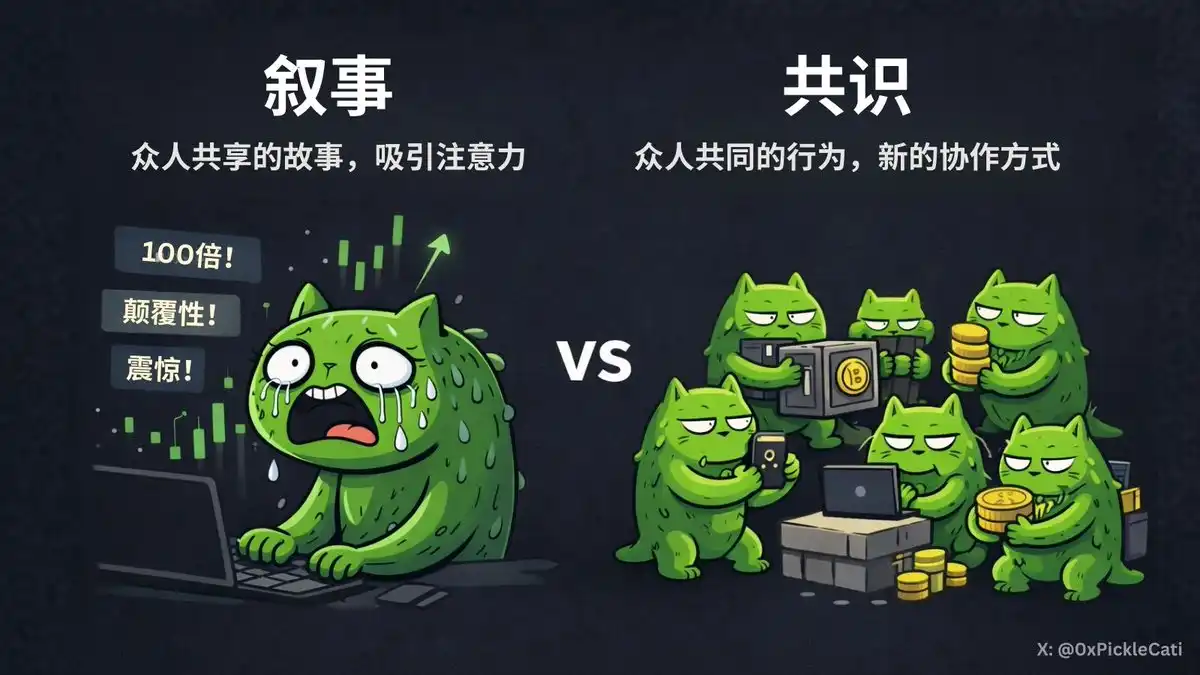
Narrative is a shared story.
Consensus is collective action.
Narratives attract attention; consensus retains people.
· Narrative without action → short-lived frenzy
· Action without narrative → silent evolution
· Both present → true major cycle begins
To truly grasp this, you need to think long-term and adopt a broader perspective.
When you quickly review crypto’s brief history, you’ll realize:
All narratives are fundamentally about aggregation—and that is consensus.
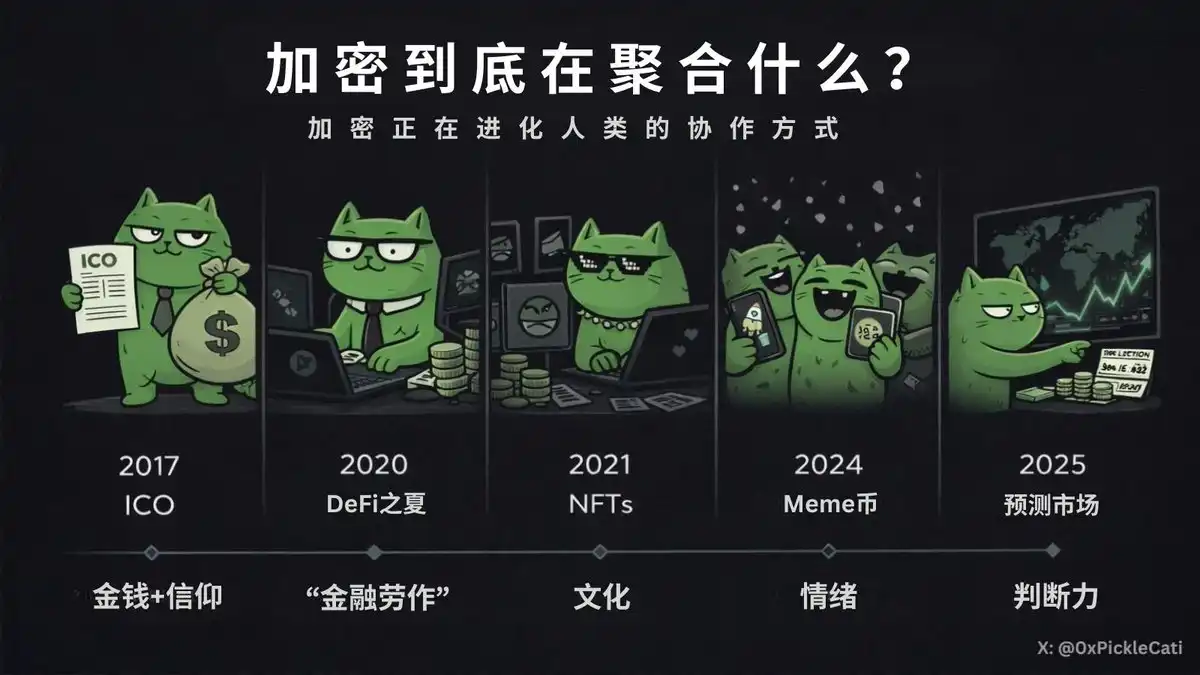
2017’s ICO boom was the ultimate “gathering” technique of that era. Fundamentally, it was a coordination mechanism—bringing together believers in the same story, pooling their funds and faith into one place.
It basically said: “I’ve got a PDF and a dream—bet on it?”
Later, IDOs brought this “gathering” to decentralized exchanges, turning fundraising into a permissionless, free-for-all ritual.
Then came DeFi Summer 2020, which aggregated “financial labor.” We became backend staff for a bank that never closes: lending, collateralizing, arbitraging, chasing 3000% APY night after night, praying it won’t rug when we wake up.
Then 2021’s NFTs, which aggregated not just capital but people who resonated with a shared culture, aesthetic, or ideology. Everyone asked: “Wait, why am I buying a JPEG?” “That’s not just a picture—it’s culture.”
We were all searching for our own “tribe.” Your little image was your passport, a digital badge of belonging—a ticket to high-level chats and elite parties.
By 2024’s Meme coin era, this trend is undeniable. People now care less about technology. What’s truly being aggregated is emotion, identity, and inside jokes within the community.
You’re not buying a whitepaper anymore. You’re buying the phrase: “You know what I mean—and you get why I’m laughing (or crying).” You’re buying a community that makes you feel less alone when the price drops 80%.
Now we’re entering prediction markets. These aggregate not emotion, but judgment—the shared belief in the future. And crucially, these beliefs flow across borders without restriction.
Taking the US presidential election as an example: a global focal event. But if you’re not American, you have no vote. In prediction markets, though you still can’t vote, you can bet on your own conviction. At that moment, the real shift becomes obvious.
Cryptocurrency is no longer just moving money—it’s redistributing power over “who gets to decide.”
With each cycle, a new dimension gets integrated into this grand system: money, faith, financial labor, culture, emotion, judgment, ____? What’s next?
You’ll notice that every crypto breakout is essentially about gathering people in a new way. Each phase brings not just more users, but a new reason to stay—this is the key.
The focus has never been on the token itself. The token is just the topic that draws people together to play. What’s truly flowing in this system are things capable of carrying increasingly massive native consensus.
Put bluntly: what flows in the pipeline isn’t really “money.” It’s us—learning how to achieve larger, more complex consensuses without bosses overseeing us.
To better understand this, consider this simple “Three-Fuel Model”:
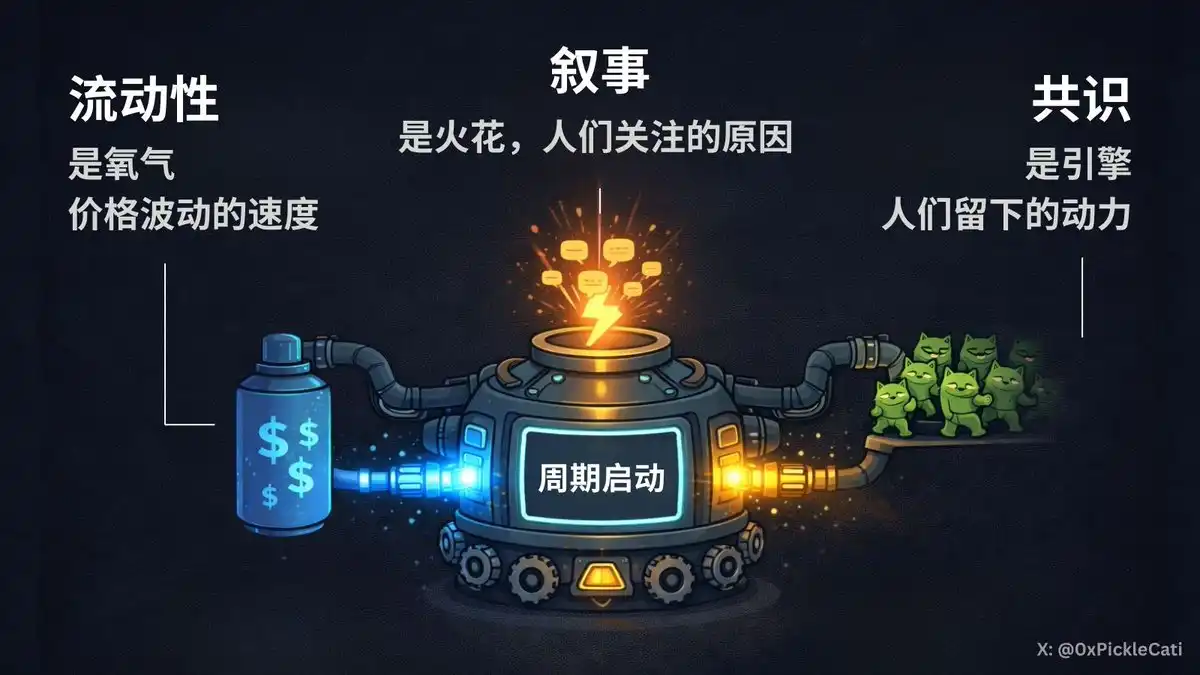
· Liquidity (macro risk appetite, dollar liquidity, leverage capacity) acts like oxygen injected into the market, determining how fast prices can move.
· Narrative (why people care, how it’s explained, shared language) attracts attention, determining how many eyes are focused here.
· Foundation of consensus (shared behavior, repeated actions, decentralized coordination mechanisms) affects sustainability, determining who stays when price stops delivering returns.
Liquidity may temporarily push prices higher. Narratives may briefly ignite attention. But only new consensus building can give people a win-win action beyond mere buying and selling.
This is why many so-called crypto mini-booms fail to become real bull runs: they have liquidity and compelling stories, but people’s actual consensus remains unchanged.
So how to tell “last gasp” from true “consensus upgrade”?
Don’t look at price first—look at behavior. True consensus upgrades often show similar signals over time, changing how we gather to “play” together.
It always starts with behavior, not price.
If you want to learn to identify this yourself, reading theory is useless. You must first revisit crypto history, extract lessons, and summarize patterns—only then can you spot the next consensus upgrade.
Below are four parts: three expanded case studies I’ve compiled, followed by a basic checklist to help identify whether the next consensus upgrade is underway, and how to judge whether narrative-driven behavior will truly persist.
Expanded Case 1: The Rise of ICOs in 2017 vs. Early Experimentation
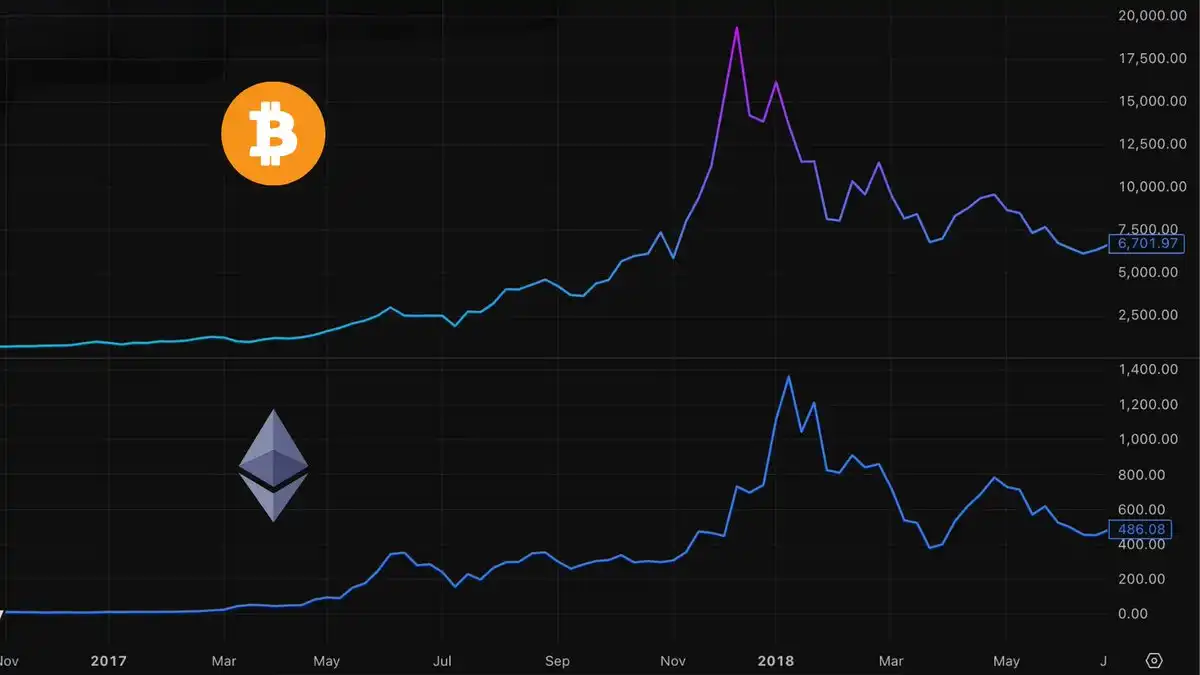
BTC & ETH Price during ICO Boom (Mid-2017 – Mid-2018)
This was the first time crypto learned how to globally coordinate people and capital at scale. Billions flowed onto-chain—not toward mature products, but toward ideas.
Before this, there had been early experiments: Mastercoin in 2013, Ethereum’s own crowdfunding in 2014. These were interesting, but niche. They hadn’t created a behavior pattern that could draw everyone into the same orbit, globally shared.
In crypto’s early days, the game was simple: mine, trade, hold, spend it (e.g., on darknet markets).
Of course, there were plenty of “quick-rich” Ponzi schemes back then—but we didn’t yet have a standardized way for strangers to collectively bet on a shared dream on-chain.
The DAO in 2016 was crypto’s true “aha” moment. It proved a group of strangers could pool funds solely via code. But honestly… the tools were primitive, tech fragile, and it was ultimately hacked to death. The behavior pattern emerged, but wasn’t sustainable.
Then came 2017—everything became “scalable.”
Ethereum and (now more mature) ERC-20 standards turned token issuance into a mass-production process. Suddenly, the foundational logic of entering crypto underwent a revolution:
Financing moved fully on-chain, becoming the norm. Whitepapers became investment vehicles. We traded “minimum viable product” for “minimum viable PDF.” Telegram directly became financial infrastructure.
This new “trendy” behavior brought millions in and fueled an epic bull run. But more importantly, it permanently reshaped crypto’s DNA.
Even after the bubble burst, we never reverted to the “old model.” Anyone, anywhere, could now crowdsource a protocol—this idea had taken root.
Yes, most ICOs in that era were outright scams or Ponzi schemes. Such dirty business existed before 2017 and still exists today in 2026. But the way people coordinate work and allocate capital has forever changed—that’s what we call “consensus upgrade.”
Expanded Case 2: DeFi Summer 2020 vs. False Bull
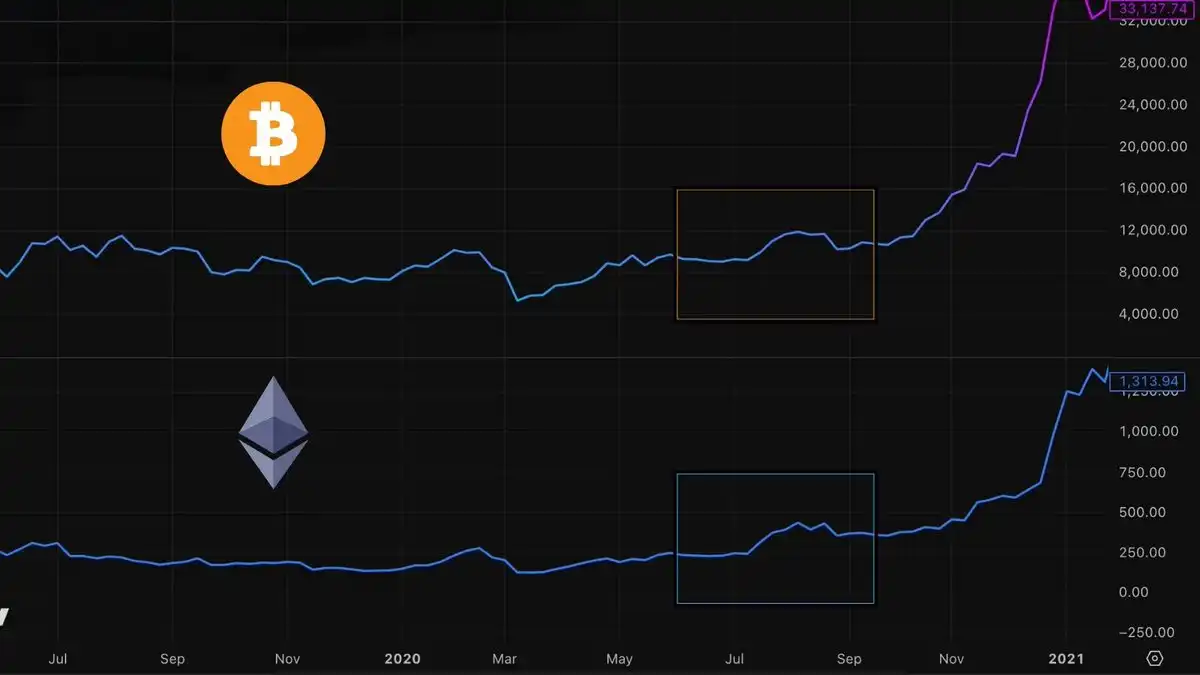
BTC & ETH Price during DeFi Summer (June–September 2020)
This era was also a true “consensus upgrade,” because even without explosive price growth, people began treating crypto assets as actual financial tools. This differed sharply from the ICO era—where price rise and user behavior fed each other in a symbiotic loop.
Before 2020, besides the ICO mania, crypto experience was mostly “buy, hold, trade, then pray.” (Yeah, unless you were a miner… or doing something shady.)
Now, people gradually developed on-chain muscle memory, permanently transforming the industry. We learned to:
· Lend: Deposit your crypto into protocols to earn “rent.”
· Collateralize loans: Gain purchasing power without selling your crypto—like using your house as collateral.
· Liquidity mining: Weekly shifting funds to the highest-yielding pools—funds constantly shuffling.
· Be a LP: Place your tokens on the table for others to trade, earning fees from transaction volume.
· Recursive collateralization: Collateralize, borrow, re-collateralize, re-borrow—stacking leverage and yield layer upon layer.
· Govern: Actually participate in voting on protocol rules, not just betting on token price.
During DeFi Summer, even as ETH and BTC traded sideways, the ecosystem felt “alive”—activity didn’t depend on straight-line price surges.
It broke the “pure casino” mindset because crypto finally felt like a productive financial system—not just a speculative toy.
Projects like Compound ($COMP), Uniswap ($UNI), Yearn Finance ($YFI), Aave ($AAVE), Curve ($CRV), Synthetix ($SNX), and MakerDAO ($MKR/$DAI) became “the internet’s banks.”
Even wild experiments like SushiSwap mattered. Its “vampire attack” directly siphoned liquidity from Uniswap, proving incentive mechanisms could truly orchestrate capital like an army.
Then… came false revival, false bull, “last gasp.”
Like food-named clone farms—Pasta, Spaghetti, Kimchi. They brought no new coordination behavior. Most vanished as quickly as they appeared.
By 2021, DeFi remained vibrant (dYdX, PancakeSwap growing fast), but the wild growth phase ended. Crowds had already shifted to the next shiny narrative (NFTs).
Looking back from today (2026), you’ll see 2020 was when “on-chain economy” truly began. Almost everything we do now—from airdrop points, chasing TVL, to Layer 2 incentives—follows the 2020 playbook. After DeFi Summer, if a new product doesn’t offer users a substantive reason to stay on-chain, it’s hard to generate lasting excitement.
Incentives can drive short-term activity, but if these rewards don’t establish a lasting community habit (a new paradigm), the project rapidly turns into a ghost town once subsidies stop.
Expanded Case 3: NFT Era Reverses Social Habits
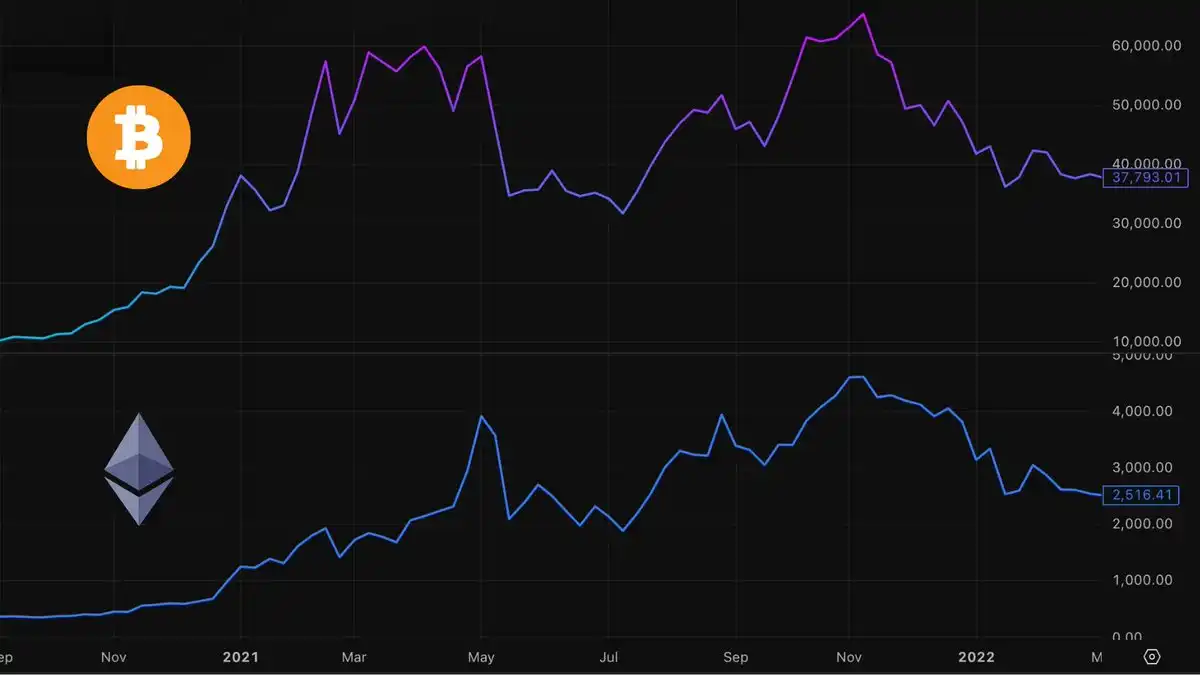
BTC & ETH Price during NFT Mania (Early 2021 – Mid-2022). 2021 was a “perfect storm”: global monetary easing, macro liquidity, institutional entry, NFT explosion, DeFi growth, and the chain wars—all resonating simultaneously to push the market to peak. This case study focuses on NFTs—the most influential catalyst in that cycle.
If DeFi Summer was the era of geeks obsessing over liquidity curves, 2021 was when crypto finally gained “personality.” We stopped optimizing purely for yield and started pursuing atmosphere, identity, and belonging.
For the first time, digital items weren’t just easily copy-pasteable “things.” They had verifiable provenance. You weren’t just “buying a picture”—you were buying a digital receipt saying “you are the original owner,” with the entire blockchain as your witness.
This completely rewrote social scripts. People stopped trying to out-compute each other and started showcasing identity.
Now avatars are passports. Owning a CryptoPunk or a BAYC became a digital “proof of belonging.” Your avatar is no longer your cat—it’s your ticket to the “global elite circle.”
Thresholds emerged. Your wallet became your membership card. Without the right assets, you can’t access private Discord channels, attend insider parties, or receive exclusive airdrops.
And IP ownership. BAYC granted commercial rights to holders, successfully breaking the “ownership revolution” into mainstream. Suddenly, strangers coordinated around their “apes,” developing derivatives, music, and streetwear.
Most importantly, it attracted vast numbers of “outsiders.” Artists, gamers, creators—those who didn’t care about APY or liquidation mechanics—suddenly found a reason to own a wallet.
Crypto was no longer just finance. It became the native cultural layer of the internet.
From the consensus habit perspective:
· Replaced liquidity pools: collectible series
· Replaced total locked value: floor price and social capital
· Replaced yield: sense of belonging
Naturally, “last gasp” followed…
First, a wave of “imitators.”
Once the “Bored Ape” model was validated, imitators flooded in. They had stories but no soul. Countless visually similar collections emerged—basically “Bored Ape, but the protagonist is a hamster”—promising fairy-tale roadmaps. Most turned to air—or priced air.
Then came the “wash trading” frenzy.
Platforms like LooksRare and X2Y2 tried to force DeFi mining logic onto NFTs, creating “trading mining.” Result? A gang of “scientists” bought and sold to themselves—left hand to right hand. Transaction volume looked impressive, pretending the market was back, but behind the scenes, robots were front-running, harvesting fees. Real players had already quit.
Finally, the “celebrity cash grab” surge.
Almost every A/B-list celebrity launched a collection, told by their agents it was a “new printing press.” With no real consensus or community behind them, these projects disappeared faster than TikTok trends.
So what’s the lesson?
Just like with ICOs and DeFi Summer, the NFT bubble burst. But the behavioral residue lasted permanently. It endured long enough to permanently change the industry.
Crypto is no longer just a digital bank—it’s the native cultural layer of the internet. We no longer ask “Why own a JPEG?” We start understanding what these behaviors truly represent.
For example:
· Brands are shifting toward “digital passports” and “community-as-a-service” (CaaS)
· In this AI-saturated era, provenance has become the standard for digital authenticity
· Community-first launch models are now the default playbook for every new consumer startup
Collaborative habits remain, and we’ve learned to belong to digital culture—never to return to the era of being just a “user.”
How to sharpen your “investment vision”? What can you do?
By now, you’ve read one-third of this article. I’ve provided three detailed cases showing how to distinguish false consensus upgrades (“last gasp”) from real ones.
Frankly, I could write hundreds of pages more on Meme coins and prediction markets—but teaching someone to fish beats giving them a fish. So I leave the analysis part to you for self-reflection.
Also, failed narratives and failed “consensus upgrades” are worth studying—such as Metaverse 1.0 (2021–2022), SocialFi 1.0 (2023–2024). Though they left only “one-wave” wreckage and didn’t immediately reshape behavior, that doesn’t mean they’re finished. True “consensus upgrades” rarely happen overnight. Just as Mastercoin in 2013 pioneered ICOs but lay dormant for years until exploding in 2017, early failures serve as stepping stones for cognition.
Don’t dismiss something just because it’s “cooled down.” The next “consensus upgrade” might be something entirely new—or a resurrection of a previously failed “old thing” in a “new form.” When that happens, this awareness becomes your golden opportunity.
The best way to sharpen “investment vision” is to personally invest effort in research, analysis, and verification.
Ask yourself repeatedly: Do you truly understand what the crowd is doing? If you can’t observe behavioral shifts, you can’t detect the tide change.
Before concluding Part I, I’ve prepared a basic checklist to help identify if the next consensus upgrade is coming. I call it the “Sucker Self-Protection 5 Questions”:
1. Are “outsiders” entering?
A group of participants whose primary goal isn’t profit appears. You see people who aren’t here just to flip coins. They’re creators, builders, or seekers of identity. If the room only has traders, the room is fundamentally empty.
(If you’re a trader reading this—yeah, I’m one too. We both know, to keep this game going, PVP alone isn’t enough.)
2. Can it pass the “incentive decay” test?
Observe what happens when rewards dry up or prices plateau. If people stay, a habit has formed. If they vanish once the “free lunch” ends, you’re dealing with a pile of labeled air.
3. Are they choosing “daily habits” over “holding”?
Newbies only watch k-charts. Experts observe what people do daily. If they’ve built daily routines around this system, it’s a permanent upgrade.
4. Is there a “behavior > experience” phenomenon?
Real transformation happens when tools are still raw, fragmented, and inefficient. If people endure bad UX to participate, the behavior is “valid.” By the time apps become smooth and polished, you’re too late.
5. (Most important!) Is there “love-driven effort”?
This is critical. When people defend a system because it’s part of their identity—not just because they’d lose money—the shift is complete.
So if you only fixate on price, your endless fantasy of “buying at X price” may be exactly why you keep “missing the trend,” “not holding,” “always panicking,” “can’t sleep with positions.” Big green candles appear because behavioral patterns changed months earlier.
Price is the result of this shift; price is merely a lagging indicator that finally admits the world has moved on.
II. Practice more, wealth won’t 1000x, but first make your cognition 10x
I know what you’re thinking now.
“Okay, I get the underlying logic—behavioral shifts, coordination upgrades, etc.—theoretically I know what to look for. But when the next consensus upgrade truly hits, chaos and opportunity coexist… So what actually will go 1000x? More importantly, how can I spot these things early to buy in heavily?”
Honestly, this is the real world—not a tomato-flavored novel. Just asking this question is priceless.
If someone confidently looks you in the eye and gives you some “5-step wealth secret” from nowhere, they’re either trying to get you to carry their coffin, or sell you their “secret masterclass” for thousands in IQ tax.
Why? Because every new cycle is a brand-new coordination game.
You can’t take the DeFi Summer 2020 playbook and expect it to help you pick which Meme coins will explode in 2024/2025. Even if you’re a top-tier Meme hunter today, your methods won’t guarantee success in 2026’s prediction market.
“Path dependency” has ruined so many.
(Though nothing’s absolute—if you’re Trump, well… you’re right. After all, you’re both capable of drawing K-lines. Congrats on being unmatched in two fields.)
No one can predict the future. But at minimum, we can build solid foundations and a bottom-up framework so when real opportunities come, you can understand them 10x faster than others.
Having your own framework doesn’t guarantee you’ll make more than last cycle—but it gives you a massive first-mover advantage over those who just come to gamble.
The framework consists of three parts: crypto cycle fundamentals + crypto knowledge structure + value anchoring system.
Part I is done. Now Part II: “What should I learn, and how?”
One thousand people, one thousand Hamlets—no “absolute right answer.”
So below are two personal recommendations.
Recommendation 1: Become a Chain-Camper

Here’s a must-have skillset list—everything is 100% learnable online for free. No paid courses or “masters” needed. Your only cost: determination and time.
First, improve your ability to detect “organized sniper events,” otherwise you’ll always be the sucker. Learn to proficiently check wallet history, holding distribution, bundled transactions, fund origins and flows—and sniff out suspicious on-chain red flags.
Second, understand market mechanisms, assess potential supply shocks, and avoid brutal liquidations. Know where to check and comprehend: order book depth, bid-ask spread, exchange net inflow/outflow, token unlock schedules, Mcap/TVL ratio, open interest, funding rate, macro capital flows.
Third, if you don’t want to be devoured in the “dark forest,” at minimum understand how MEV works—otherwise you won’t know when you’re “sandwiched” (my painful lesson).
If you want to dig deeper and outrun everyone else, you must also learn to identify fake trades/wash trading/pump-and-dump, arbitrage farming, “low circulation/high FDV” traps. If you’re farming airdrops, understand anti-witch mechanisms.
Another key point: automate information flow tasks—data anomaly alerts, news filtering, narrative screening, noise reduction. With vibe coding now available, the barrier to entry is low—anyone can learn.
In 2026, almost everyone I know—including those with no CS background—has built custom tools to filter junk and find opportunities. If you’re still relying entirely on manual info hunting, that’s likely why you’re always one step behind.
If you don’t invest your resolve, time, and effort to build this foundation, you’re choosing “hard mode.” Small consequence: always lagging behind or missing chances. Big consequence: fraud, drained wallets, exploitation—until you finally break down and start learning (or simply quit).
I know, because I walked this path too—hit every single trap: scammed by strangers and “friends,” fell for Ponzi schemes, bizarre insider dumps, backdoor contracts, hot wallet theft, OTC scams, even social engineering attacks. Oh, and don’t count my three liquidations.
Besides these “technical” aspects, I’ve also compiled practical anti-fraud tips for the “social detective” level.
Start simple: Has the official project account changed names over 10 times? Were previous aliases linked to defunct scam projects? Numerous tools exist to check account name change history—use them. Before investing, verify if the team exists—founders and core members have X, LinkedIn, GitHub accounts?
If they claim past work at renowned companies or graduation from elite schools, verify—fabricated Stanford, Berkeley diplomas, and fake Meta, Google, Morgan Stanley resumes are far more common than imagined.
For claims like “backed by a VC,” “incubated by…” or “partnered with…”, same rule. Some “renowned investors” never actually funded. Some partners were only indirect consultants, yet allowed the project to use their logo. This happens far more than you think—I’ve been victimized myself.
In today’s AI-saturated landscape, fake engagement is rampant and only getting harder to detect. Can you spot abnormal follower-to-engagement ratios? Can you identify bots or AI-generated chit-chat on Discord, Telegram, and X?
If you couldn’t do any of the above before, you now know where to start training.
Recommendation 2: Dive into the World and Cultivate Good Karma

Simply put, you need to meet more people. Like the finance and tech worlds, your network is your greatest asset.
I could write a “50 things to check when researching a project,” but that would be pure noise. Why? Because the real “core intelligence” or alpha—when it still holds first-mover advantage—is never publicly shared.
By the time a project is loudly hyped by famous voices in your feed, you might still make money—but that’s not the “life-changing 1000x gain” you came to crypto seeking. The optimal entry window is already welded shut.
This is why, in every cycle, most eager newcomers end up as liquidity and exit the space. Their information is filtered through layers of private circles—delayed, and delayed again.
So if you don’t yet have one (or more) reliable “insider lines,” position management is your only safety net. Always allocate most of your crypto assets to long-term holdings.
Long-term holdings require less sensitivity to information asymmetry and no crushing time pressure like short-term trading. They give you breathing room to study public data, no need to be the first to spot patterns—because if a project survives even 1.5 cycles, regardless of your entry timing, you’ll likely catch several waves of profit.
Meanwhile, your long-term goal is to stop being a bystander and become a participant. To do that, you need chips—besides family, the world operates on mutual benefit. Those you admire won’t exchange first-hand insights with someone who offers no equal value.
You need to become “someone valuable” or possess “something valuable” to trade—whether expertise, field research, capital, or networks. No one knows everything. Precisely because of this, you can seize the opportunity.
The best approach: sincerely and passionately dive into one ecosystem. First, get a job in a project within your area of interest—developer, operations, business development—anything. “Entry is easier with good connections.” Work is the fastest way to build reputation and meet target audiences.
Of course, just having an entry-level web3 job won’t instantly give you everything—but it’s a great start.
“But what if I lack experience and can’t find a reputable crypto job?”
Good news: in 2026, crypto still isn’t a “career desert” like traditional finance or tech giants. You don’t need elite degrees and stacks of elite internships, plus seven rounds of interviews to land a role.
In this industry, your on-chain track record is your resume. If you’ve invested serious time experimenting, “going all-in,” and actually doing things, you likely already have more relevant experience than most career-switchers from “corporate world.”
Don’t want to work? You still have two options (both requiring massive effort): If you’re exceptionally smart and lucky enough to perform brilliantly on-chain and aren’t ready to retire, link your wallet address to your Twitter/X account—you don’t even need to actively network. “Kindred spirits” will come to you. Building a personal brand on X is grueling and deeply personal—this isn’t a universal advice.
No free lunch. No reliable shortcut. 100% effort doesn’t guarantee 100% success—but 100% laziness guarantees 100% failure (unless your name is Barron Trump).
III. How to Persist Until Victory
Based on personal experience, those who survive trough cycles share two traits:
1. They hold firm beliefs independent of price
2. They’ve established multi-dimensional value anchoring systems
First, we must clarify: conviction is not blind obsession or blind faith based on “some big figure” saying something.
It’s not “I’ll never sell, no matter what.”
True conviction is structural—and structural inherently includes flexibility. You can have strong conviction while still taking partial profits or adjusting position ratios.
The key difference lies in whether you can always, consistently return to the table.
You don’t leave when the music stops. Your original reason for being here was never the red-green k-charts. You stayed because of that fundamental “why.”
Those who survive cycles never ask: “Gurus, is it up or down today?” They ask: “Even if prices remain misaligned with my view for years, does the underlying logic still hold?”
This mental shift leads to vastly different outcomes.
The “fast money” mindset doesn’t just drain your wallet—it erodes your belief and destroys your belief system. Rebuilding faith is far harder than rebuilding capital.
So what’s their “multi-dimensional value system”? How can you build your own?
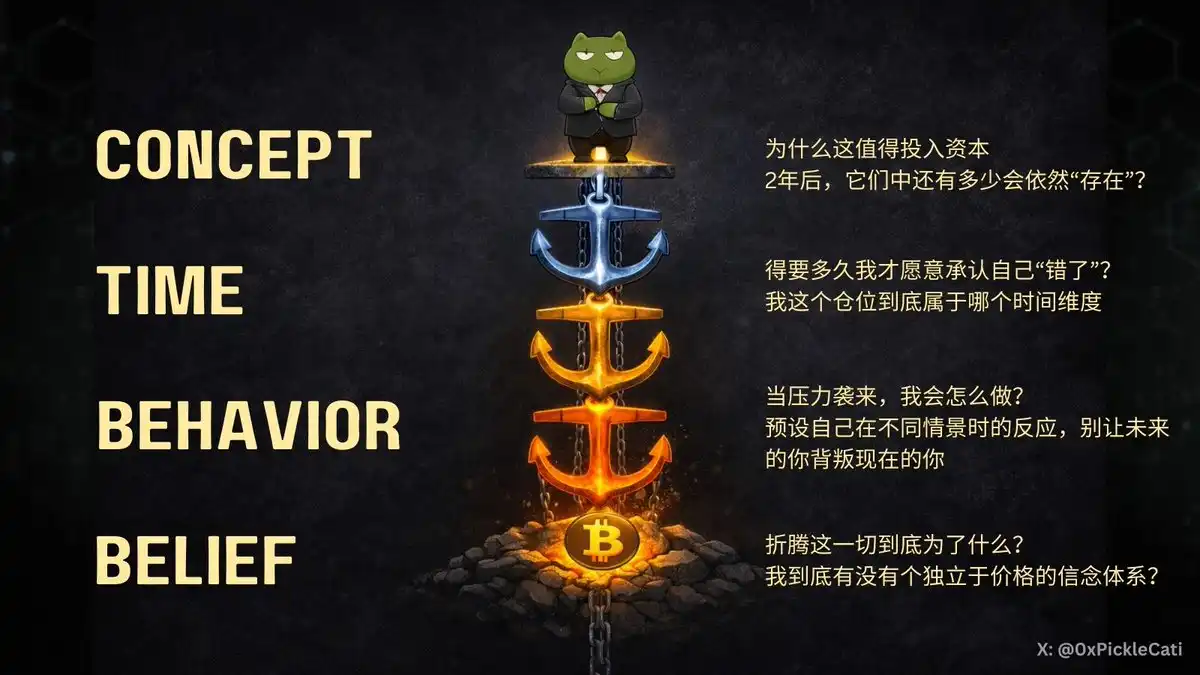
Layer 1: Conceptual Anchoring (Concept)
Stop dancing to k-charts. Focus on core principles. Ask yourself: What makes this worth holding—even if the price crashes through the screen?
Recall your last 10 token trades. Fast-forward two years. Ask: How many of them will still “exist”? How many will still be “important”?
If you can’t explain why a project deserves long-term capital without mentioning “community” or “moonshot,” you don’t have conviction. You have a position.
Layer 2: Temporal Dimension (Time)
Most people’s behavior is chaotic. Their decisions are easily manipulated by group emotions—like this example:
· Today, they follow a secret Telegram channel and buy 4 different Meme coins rumored to go to the moon
· Tomorrow, they bet on certain projects on Polymarket because a “big figure” tweeted a “wealth secret”
· Suddenly, they disappear for a while
· Then one day, they privately message you, asking about a soon-to-list token
· Somehow, they suddenly buy a privacy-themed token, not even knowing what that sector does
· A few days later, they shout “bull run is back!” “BTC is fully charged, go all in!”—blindly going long on Bitcoin just because a headline says “will hit $200k next month”
Hey, that’s not strategy. That’s handing your money to others—losing the Holy Grail might even have better odds.
Of course, I’ve seen some people profit this way—but I’ve never seen anyone keep that money two months later. The only thing they leave behind is a glorious past and psychological trauma of +99999%.
The real problem? Easily distracted by noise, and opening multiple fronts beyond their capability and cognitive limits.
Short-term speculation, mid-term positioning, and long-term investing each require completely different behavioral patterns. Those who survive cycles clearly know which time dimension each position belongs to—and never let emotions cross dimensions.
They don’t abandon long-term conviction due to short-term price noise, nor use long-term narratives to justify impulsive short-term trades.
If you’re transitioning from intraday trading to swing trading, here are common “self-destructive” mistakes:
1. You tell yourself you’re now a “long-term investor,” but 80% of your time is chasing one-time news headlines.
2. You panic over a minor 3% retracement within your risk tolerance.
3. Worst of all, you still use a “grab quick money” mindset to allocate positions and assess risks—leading to you selling off the trend again and again.
Anchoring by time dimension forces you to answer an extremely uncomfortable question before clicking “buy”—to prevent this vicious cycle: “How long must I wait before admitting I’m wrong?”
Layer 3: Behavioral Level (Behavior)
You can’t claim “faith” only when things are going well. When your account is bleeding red, and your mind screams “do something,” that’s the real test.
You need a self-questioning framework to predict yourself—not the market.
Before every trade, go through this checklist to ensure future-you won’t sabotage present-you:
· When price drops x%, do I have a plan? Have I clearly decided whether to hold, reduce, or exit?
· Am I a “bottom-of-the-pants” type? During drawdowns, am I objectively reassessing my investment logic, or subconsciously gathering info to justify panic selling?
· Am I frequently changing my target levels? When price rises x%, do I become greedy and keep pushing my take-profit targets because “it feels right”?
· Can I explain “holding” without using the word “hype”? Besides emotion and hype, can I clearly articulate the reason behind my holding?
· Is this “conviction” or “sunk cost”? When a position stalls beyond expectations, am I holding because the logic still stands, or because I refuse to admit I was wrong?
· How long is my “admit-error” delay? When I violate a trading rule, do I notice immediately and act, or only react after the account is destroyed?
· Am I prone to “revenge trading”? After a loss, do I feel a surge of adrenaline and rush into another trade just to “recover what I lost”?
The purpose of these questions isn’t to predict k-chart movements—but to sketch out whether future-you will betray present-you under immense psychological pressure.
“Behavioral anchors” are essentially stress pre-processing. Set actions in calm moments to prevent reckless moves in despair.
After all, if you haven’t planned how to “play” trading, trading will eventually start “playing” you.
Layer 4: Belief Dimension (Belief)
Have you noticed the fastest people to vanish are often the loudest in bull markets:
“This is the last chance to buy XX!” “After this, you’ll never see Bitcoin under $100k!” “Listen to me—eat, fry, fly! Not buying XX means you’re fighting against the future!”
As prices reverse, these people vanish one by one. Their “faith” seems never to have existed.
This “overnight riches” mindset not only destroys portfolios through frequent trading, but also corrodes belief systems. A shattered belief system is far harder to rebuild than a bankrupt bank account.
“Fast money always invites pitiful excess behavior. It’s human nature, like African animals feeding on carrion.” — Charlie Munger
Tragically, most people exhaust their capital precisely at the peak of the party. When the real opportunity (true bear market) finally arrives, they’ve run out of bullets.
What a cruel joke: the very mindset that brought people into crypto—the desire for overnight riches—is the exact force killing their ability to accumulate wealth.
Most people don’t even realize what they’ve lost until years later, when Bitcoin doubles again, and they slap their thighs: “Why couldn’t I just hold through that pain? If I’d known, I’d have held.”
This is why belief is the most critical layer: it’s a creed forged over years.
How to test if your belief is strong enough?
Try this: If someone fiercely challenges your stance right now, can you calmly defend it? Can you face sharp questions without avoiding them?
Your belief should be intensely subjective and unique.
For some, it’s Cypherpunk spirit: a total rejection of control and centralized authority. For them, crypto isn’t just an investment—it’s a beacon of exit from a broken system.
For others, it’s a new iteration in monetary history: they see the cyclical pattern of fiat devaluation and financial predation, realizing crypto is the only hedge against traditional systems that collapse in similar ways every century.
For some, it’s sovereignty, neutrality, or survival rights.
You must find your own “why”—not rent someone else’s ideology. I can’t tell you what your belief should be, but I can share mine.
Last year, when I had only 2000 followers and no one cared what I said, I wrote a post answering a simple question: Why, after all these crashes and zeros, do I still buy Bitcoin? I called it: “The Fourth Covenant Between God and Humanity.”
Human history’s first three covenants all had a fatal flaw: they were never meant for everyone.
The first was the Old Testament—bound by bloodline, ownership decided before birth. If you weren’t in the chosen lineage, you never qualified.
The second was the New Testament—preaching love and salvation for all. But history reveals the truth masked by words: if you were a poor Asian farmer in the 17th century, you never got to step foot in a cathedral. The empire blocked you—only race, power, and hierarchy determined who deserved salvation.
The third was the Declaration of Independence—the birth of the modern world, promising freedom, equality, and opportunity—but only if you were born in the right land, held the right passport, and lived in the right system.
Of course, “migration freedom” exists in some sense—but for most, the cost is too high, the probability too remote. These rules seem never written for ordinary people.
Most never even reach the starting line. They spend their lives proving they “deserve” to belong—through money, education, obedience, or luck—layer upon layer begging the system to accept them.
Now, the fourth covenant appears: Bitcoin

This is the first system in human history that asks nothing about who you are.
It doesn’t care about your race. It doesn’t care about your nationality. It doesn’t care what language you speak or where you were born.
No priest, no state, no borders, no permission required—just you and a private key.
You don’t need to be chosen. You don’t need connections. You don’t need approval. You don’t need to prove yourself to Bitcoin. You either understand it, or you don’t.
This system doesn’t promise comfort, safety, or guaranteed success. It only offers something humanity has never truly possessed before: equal rules and equal access for everyone at the same time.
For me, this isn’t an investment thesis, not a trade, not a gamble. This belief is the only reason I can sit quietly through market storms, endure years of silence, doubt, mockery, and despair—and still hold on.
If you’ve patiently read this far...
Congratulations—you’ve obtained the blueprint of a survivor.
You’ve learned how to identify “consensus upgrades,” how to use the “investigator toolkit” to increase early-entry odds, and what elements are needed to build belief and maintain discipline.
But I must be honest: Dao follows nature. If you can’t control the user of the tool, no matter how advanced the tool, it’s always brute force.
Everything I’ve shared stems from countless mistakes, lessons, and scarred experiences over 13 years in the market. My scattered notes were born from late-night conversations with fellow survivors from the battlefield.
Looking at my messy notes, I realize I have enough material to write a book—each chapter could explore crypto from a different angle.
Yet these lessons can’t be mastered overnight, just as the “fast money mindset” can’t truly make you rich.
I’ve watched every cycle’s “geniuses” fall... Losing money wasn’t due to stupidity or bad moves. It was because they all had a brain designed only for fast money, with a proud but fragile pride. Meanwhile, those still profiting in 2026, and those who preserved gains and exited safely, share one cognition: The token itself has never been the point.
The point is the sovereign system we’re building—and the personal discipline required to belong to it.
Crypto is the cruelest, most honest teacher on Earth: it exposes your inner demons and finds your weakest traits—greed, impatience, or laziness—and charges you a massive tuition fee. My bill, I believe, I’ve already paid in full, haha. My only hope is this article saves you from paying as much as I did.
If you’ve truly read every word (not letting AI summarize for you), I genuinely believe you have the potential to become one of us survivors who conquered multiple cycles. You’re the kind who can truly master the skill set I outlined in Part II.
I sincerely hope you’ll become one of my new “old friends,” to grow alongside me through the next cycle, the one after, and countless cycles ahead—witnessing Bitcoin’s complete disruption of the world.
And to my long-time readers: thank you. Your kindness and support inspired me to reflect on my past and share these experiences.
Crypto may often frustrate, but it’s still worth loving—and worth building for.
So I’ll go ahead—see you at the next “consensus upgrade.”
Disclaimer: Contains third-party opinions, does not constitute financial advice


AI Practical Guide
This column focuses on the real progress of Agents: technological evolution, application implementat

Crypto Weekly
Tracking on-chain movements of the smart money and institutions

Frontier Insights
Spotlight on Frontier, trending projects, and breaking events

Blowup Alert
As the 2026 crypto bear market deepens, exit scams and project blowups are becoming increasingly fre

Regulatory Watch
American Crypto Act – timely interpretations of policies worldwide

FusnChain
FusnChain