
ChainThink
Stay ahead, master crypto insights
Binance and CZ Suffer Another Attack, Cathie Wood Delivers Sharp Remarks
Binance and CZ Suffer Another Attack, Cathie Wood Delivers Sharp Remarks
2026-01-29 10:07
Nearly three months after the 1011 incident, its repercussions continue to unfold, inflicting an unprecedented reputational crisis on Binance and its founder, Changpeng Zhao.
Over these past few days, on the crypto-focused timeline of social platform X, nearly all content has been saturated with intense criticism and attacks directed at Zhao. Many KOLs have labeled him a "fraud," widely perceived as experiencing a "persona collapse" and suffering from "traffic backlash."
The incident originated from Cathie Wood’s remarks in a recent episode, where she attributed Bitcoin’s recent price decline to the $28 billion deleveraging event triggered by a Binance software malfunction on October 10. She analyzed that current market selling pressure has largely subsided, and with institutional investors turning their attention to the pivotal shift of the four-year cycle, Bitcoin is expected to consolidate between $80,000 and $90,000 before reversing downward trends and resuming upward momentum.
Prior to the 1011 event, Bitcoin and other cryptocurrencies experienced a sharp drop, resulting in over $500 billion in global crypto market capitalization evaporating. Leverage liquidation amounts exceeded $19 billion—marking the largest leveraged liquidation event in crypto history. Both ordinary users and prominent market makers and VCs suffered massive losses. One prevailing view holds that the event was closely tied to abnormal Binance liquidation mechanisms. Subsequently, Binance even revised the K-line data for certain assets exhibiting anomalous behavior.
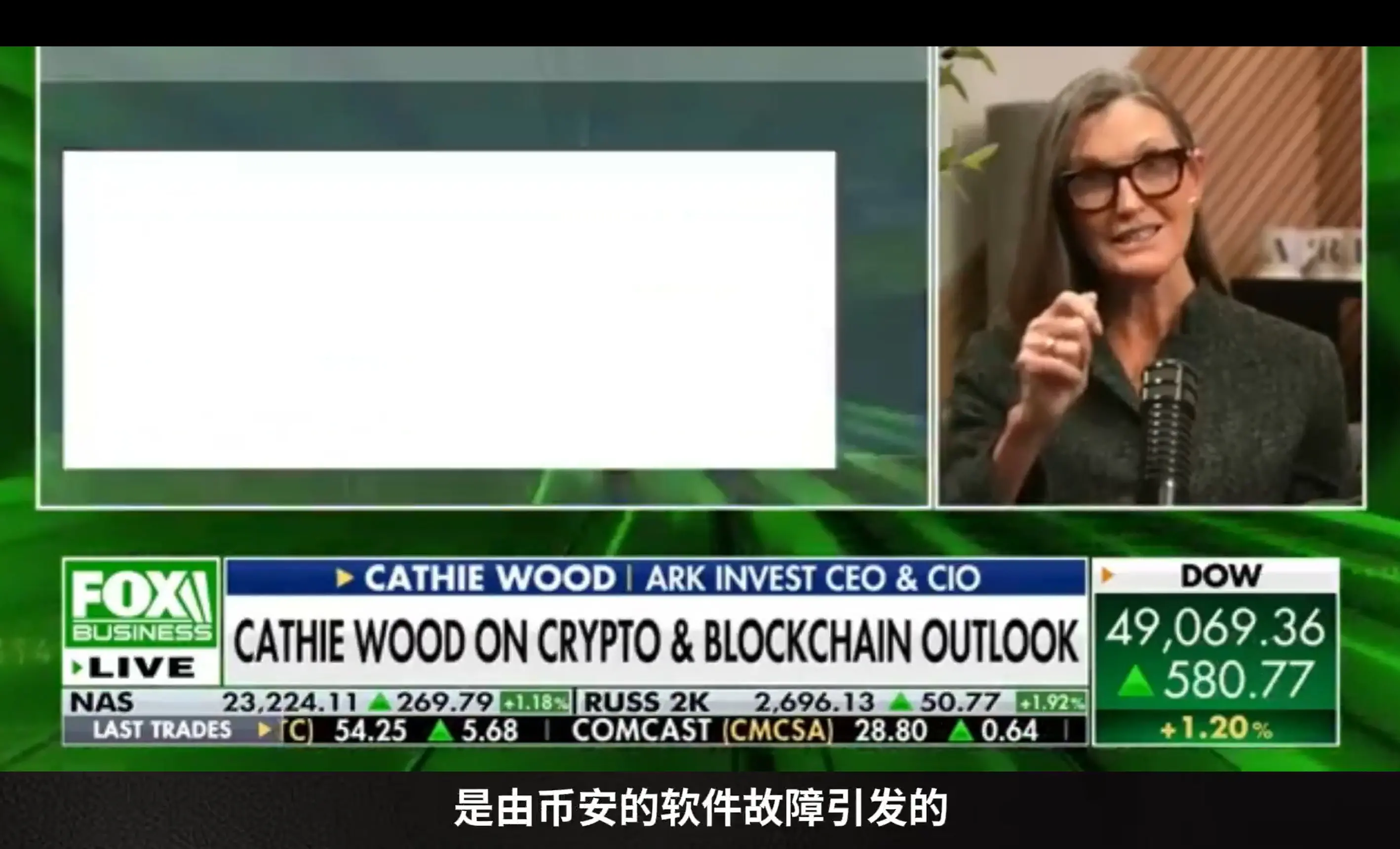
Given Cathie Wood’s deep influence across both traditional finance and crypto, as well as her status as an early investor in Coinbase and Bitcoin, her comments have reignited public awareness of the devastating aftermath of the 1011 event. In today’s persistently sluggish crypto market, this has once again stoked investor anxiety.
Among early voices, Leonidas, co-founder of Zap/Ord.io, stands out as one of the most influential. He passionately declared on Twitter that Zhao is not only the biggest crypto fraudster in history but also the greatest con artist in human civilization. The world has never witnessed such large-scale fraud, manipulation, and corruption as Binance currently represents. Send this man to jail!
Crypto trader Anglio also tweeted that CZ is solely responsible for the October 10 liquidation disaster. Because he wanted to crush HYPE, he ended up destroying his own ecosystem. CZ is a complete criminal. The comment section is filled with similar sentiments like “You defraud others, ruin lives, destroy markets, yet still pretend to be good.”
These statements center on the 1011 liquidation event, holding Binance primarily accountable—and criticizing the lack of any official investigation report or admission of fault. Meanwhile, numerous new tokens listed on Binance last year have plunged sharply, causing severe losses for investors. Consequently, Zhao, as Binance’s largest shareholder, has become the focal point of outrage.
Perhaps due to Binance’s long-standing cultivation of relationships with KOLs and the algorithmic echo chamber effect on X, these early criticisms initially failed to spread widely within the Chinese-speaking X community. However, starting from the 28th, the accumulated negative energy from the English-speaking discourse inevitably spilled into the Chinese X circle, prompting many prominent influencers to launch sharp critiques against Binance.
Renowned crypto trader Chuanmu posted on X: “When will you finally apologize and compensate all users across exchanges for the October 11 incident? This couple at Binance keeps diverting attention and remains silent about that day, evading responsibility. They harvested billions in assets from users and market makers in just one day, turning the entire industry into a conveyor belt for Dubai-style scams!”
OKX founder Xu Mingxing also posted on the 28th, stating that the incident caused real and lasting damage to the industry. Leading companies should focus on strengthening core infrastructure, building trust with global users and regulators, and safeguarding long-term corporate interests.
However, Changpeng Zhao and He Yi have consistently rejected all external criticism. Zhao first linked many negative tweets to organized attacks, pointing out that unfamiliar accounts suddenly began posting highly similar content within a short timeframe—exhibiting clear patterns of replication and amplification, suggesting systematic manipulation rather than organic discussion.
Subsequently, Zhao addressed concerns about low-quality token listings, asserting that in any industry, most companies or projects fail. Only a few successful ones grow exponentially. No one can predict a project’s future. Exchanges should give opportunities to earnest projects. Not every listing on an exchange needs to be bought.
He Yi further tied these criticisms to broader historical shifts and conflicting interests. “When driving global change, widespread discussion, questioning, and dissent are inevitable. This is not unique to any single industry but a recurring pattern throughout history during structural transformations,” she said. “Discussions around crypto and Binance stem from complex sources—ranging from emotional swings driven by market cycles to differences in commercial competition, business models, and ideological positions.”
Some KOLs have echoed He Yi and Zhao’s perspectives. For instance, Crypto Orange argued this may represent a phase in the East-West crypto rivalry. Cathie Wood has long served as a voice for Western capital—her rhetoric tends to be bolder, more direct, and exaggerated. During Bitcoin’s bull run, she publicly proclaimed prices reaching millions, fueling the trend. Now, her attack on Binance might similarly serve as a signal gun for top-tier Western capital.
Yet, in today’s public sentiment landscape, completely disavowing responsibility and attributing all issues to bot campaigns or commercial competition has become increasingly alienating. Such responses do not quell controversy—they only amplify investor anger. Discussions on X continue to spread further.
In a persistently weak market, investors tend to seek outlets for their negative emotions. For years, Zhao and other major beneficiaries of the industry have failed to adequately assume responsibility. Instead, they’ve repeatedly urged users to “HODL” on Twitter while facing controversies over listing vetting and ecosystem development. Under such conditions, the trigger event rapidly turned them into the target of public fury. However, demonizing Zhao alone as “the biggest scammer in the industry” overlooks market cycles, user accountability, and the scale effects of platforms—making it arguably unfair.
Ultimately, in this still wild-west stage of development, within a high-volatility, strongly cyclical speculative arena, no one is a pure “savior,” nor is anyone an eternal “demon.”
Disclaimer: Contains third-party opinions, does not constitute financial advice


AI Practical Guide
This column focuses on the real progress of Agents: technological evolution, application implementat

Crypto Weekly
Tracking on-chain movements of the smart money and institutions

Frontier Insights
Spotlight on Frontier, trending projects, and breaking events

Blowup Alert
As the 2026 crypto bear market deepens, exit scams and project blowups are becoming increasingly fre

Regulatory Watch
American Crypto Act – timely interpretations of policies worldwide

Popular Airdrop Tutorial
Selected potential airdrop opportunities to gain big with small investments

FusnChain
FusnChain