
ChainThink
Stay ahead, master crypto insights
Was the 1011 Crash Binance's Fault? OKX Founder Engages in Heated Debate with Dragonfly Partner
Was the 1011 Crash Binance's Fault? OKX Founder Engages in Heated Debate with Dragonfly Partner
2026-02-03 12:13
Amid the recent sharp volatility in the crypto market on October 11, OKX Founder and CEO Star publicly stated that the event was linked to Binance’s promotional activities around USDe and the resulting structural leverage; meanwhile, Dragonfly Partner Haseeb directly refuted this narrative, arguing it fails to hold up on both timeline and cross-exchange impact grounds. CZ and Ethena Founder Guy Young also joined the discussion. Below are the key points from each party.
Star’s Tweet on January 31
No complexity. No surprise.
The October 10 event was caused by irresponsible marketing campaigns from certain firms.
On October 10, tens of billions were liquidated. As CEO of OKX, we clearly observed a fundamental shift in the microstructure of the crypto market following that day.
Many industry participants believe the damage inflicted surpassed even that of the FTX collapse. Since then, extensive discussions have emerged regarding what triggered it and how to prevent recurrence. The root cause is not difficult to identify.
What Actually Happened
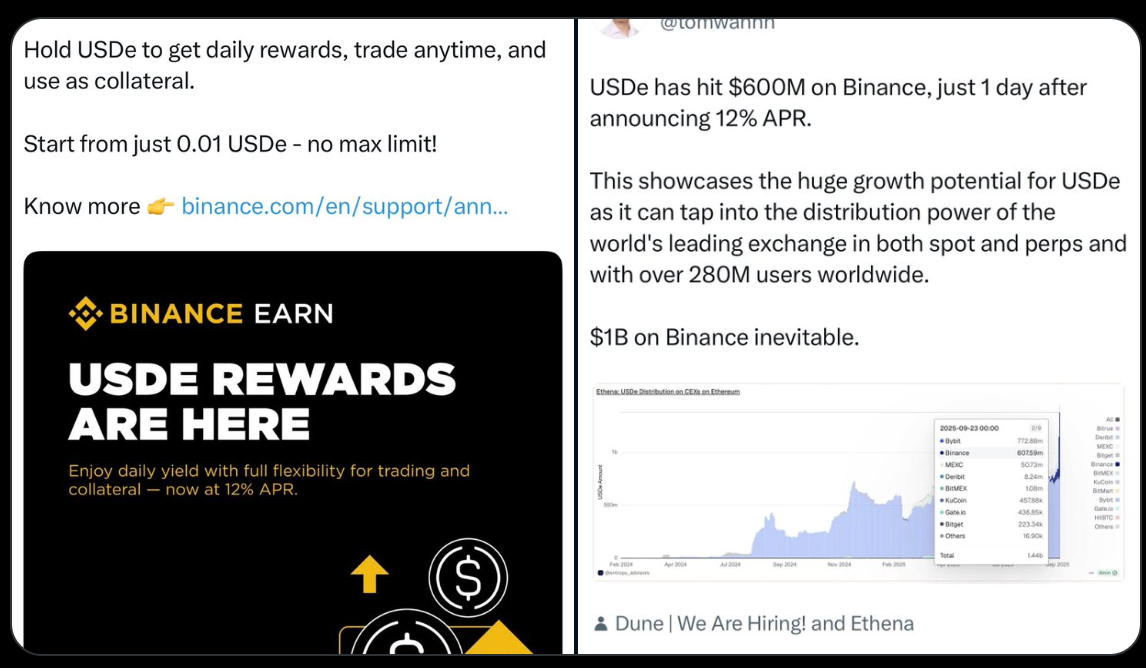
1. Binance launched a temporary acquisition campaign offering 12% APY for USDe, while allowing USDe to be used as collateral with the same treatment as USDT and USDC—without effective restrictions.
2. USDe is a tokenized hedge fund product.
Ethena raised capital through so-called “stablecoins,” deploying funds into index arbitrage and algorithmic trading strategies, then tokenizing the resulting fund. This token could then be deposited on exchanges to earn yield.
3. USDe fundamentally differs from products like BlackRock’s BUIDL or Franklin Templeton’s BENJI, which are low-risk, tokenized money market funds.
In contrast, USDe embeds hedge fund-level risk. This distinction is structural, not superficial.
4. Binance users were incentivized to convert USDT and USDC into USDe for high yields, but underlying risks were inadequately emphasized. From a user perspective, trading with USDe appeared identical to using traditional stablecoins—despite vastly higher actual risk exposure.
5. Risk escalated further as users engaged in the following actions:
• Converting USDT/USDC into USDe,
• Using USDe as collateral to borrow USDT,
• Re-converting borrowed USDT back into USDe,
• And repeating this cycle continuously.
This leveraged loop generated apparent APYs of 24%, 36%, even exceeding 70%. Since these yields were offered by major platforms, they were widely perceived as “low-risk.” Systemic risk rapidly accumulated across the global crypto market.
6. At that point, even a minor market shock proved sufficient to trigger collapse.
When volatility hit, USDe quickly depegged, followed by cascading liquidations. Deficiencies in risk management around assets such as WETH and BNSOL further amplified the crash. Some tokens briefly approached zero trading volume.
The damage inflicted on global users and companies—including OKX clients—was severe, and recovery will take time.
Why This Matters
I’m addressing the root cause, not blaming or attacking Binance. Openly discussing systemic risk can be uncomfortable, but if the industry is to mature responsibly, it’s necessary.
I anticipate a wave of misinformation and orchestrated FUD targeting OKX in the near term. Nevertheless, honestly discussing systemic risk remains the right course—and we will continue doing so.
As the world’s largest exchange, Binance wields disproportionate influence—and accordingly bears the responsibility of an industry leader. Long-term trust in crypto cannot be built on short-term yield games, excessive leverage, or marketing tactics that obscure risk.
The industry needs leaders who prioritize market stability, transparency, and responsible innovation—not a winner-takes-all mindset that views criticism as hostility.
Crypto is still in its early stages.
What we normalize today will determine whether the industry earns lasting trust—or repeats past mistakes.
Dragonfly Partner Haseeb’s Counter-Tweet
To be blunt, Star’s claim is frankly absurd.
Star attempts to argue that the root cause of October 10 was Binance launching Ethena’s yield campaign, leading traders on Binance to over-leverage USDe via circular operations, which eventually reversed due to a minor price fluctuation, triggering a cascading collapse.
The flaw in this narrative lies in:
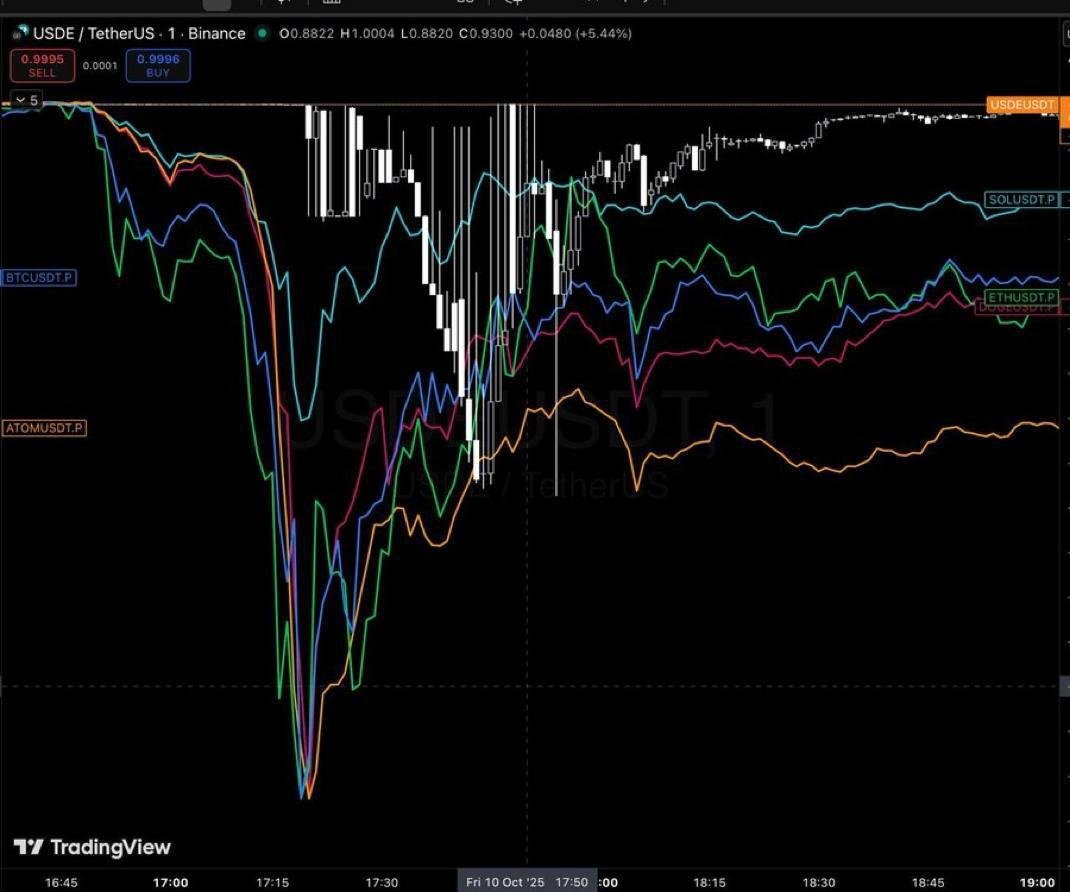
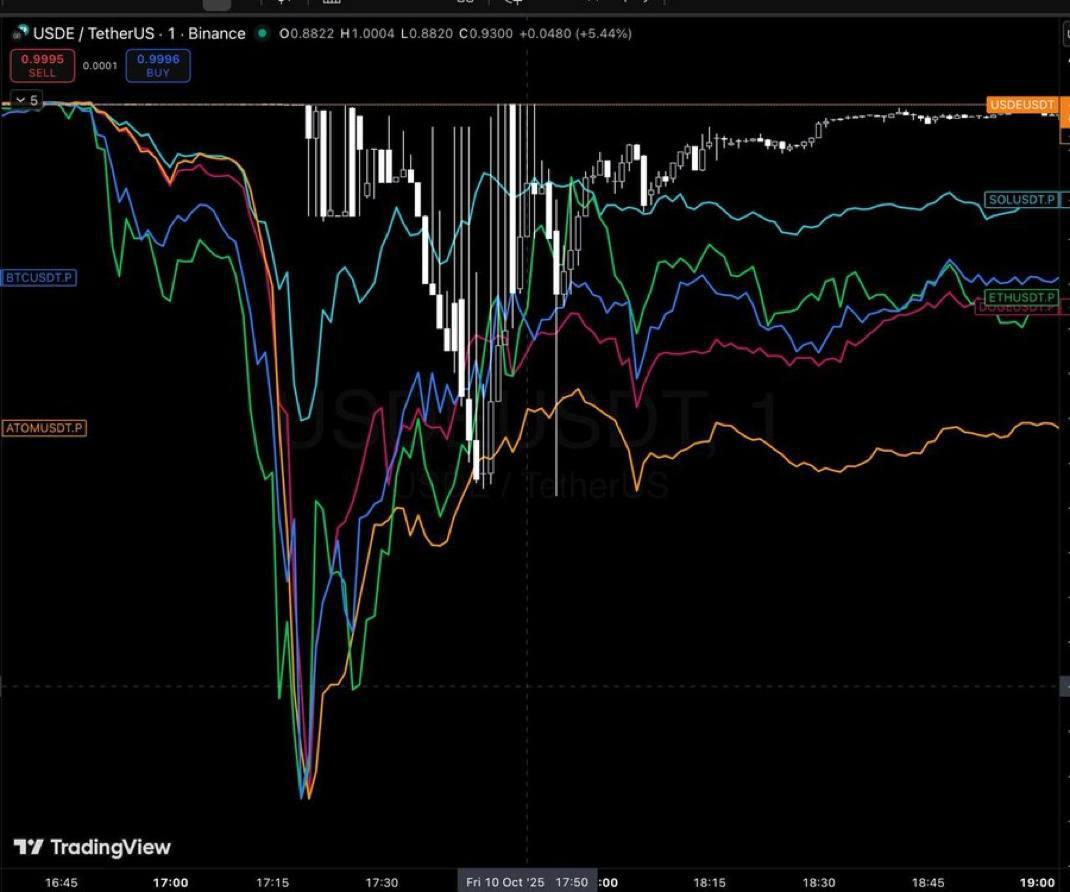
1) The timeline doesn’t align. BTC bottomed 30 minutes earlier than USDe’s price on Binance was affected. Thus, USDe clearly couldn’t have “caused” the liquidation cascade. This is a clear reversal of causality.
2) Price deviation for USDe occurred only on Binance; no such deviation happened on other exchanges. Yet the liquidation spiral unfolded everywhere. Therefore, if USDe’s “depegging” didn’t propagate globally, it cannot explain why every exchange experienced massive liquidations. This contrasts sharply with Terra, which depegged universally and caused uniform destruction across all venues.
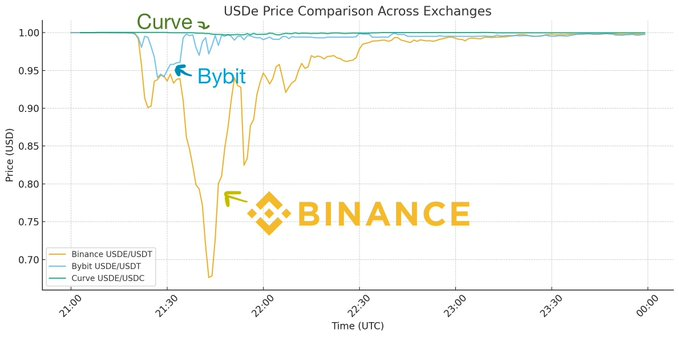
So perhaps you could patch Star’s argument by saying, “Fine, maybe Ethena didn’t cause October 10, but it amplified it.” Even as an amplifier, USDe fails scrutiny because it didn’t cross-exchange propagate. We know what a credible crash explanation should look like—Terra, 3AC, FTX all had global balance sheet effects felt everywhere. USDe did not. It more closely resembled an isolated incident within Binance’s order book.
3) This raises a question: Why has Star only “exposed” these details now, months later? He provides no new evidence previously unknown or unanalyzed. All order book data has been public for over four months—yet he suddenly speaks up now? This reads less like genuine insight and more like provocation toward CZ, using a simple story to imply CZ’s involvement or negligence in causing October 10.
To be honest: There is no plausible “simple story” that explains October 10. Neither do I. If such a simple story existed, the market would already have converged on a consensus—just as it did for 3AC or FTX collapses.
In my view, the most plausible narrative for October 10 is:
· Trump issued tariff threats on Friday night, spooking the market;
· This triggered massive sell-offs, as crypto remained the only tradable asset at the time;
· Surge in activity caused Binance’s API to crash, creating significant price dislocations and preventing market makers from balancing inventory across exchanges. This led to numerous non-executable liquidations, but the liquidation engine kept firing regardless—amplified by ADL triggers everywhere, breaking hedging and risk control systems;
· Market makers were wiped out and unable to recover—they need APIs to rebalance inventory. Without them, there was no “last buyer” to absorb many altcoin positions. Retailers couldn’t flood in to scoop up assets during a chaotic Friday night;
· Crypto liquidation mechanisms are not self-stabilizing (like circuit breakers in traditional finance); instead, they’re designed purely to minimize bankruptcy risk;
· Altcoin prices exhibit extreme path dependence, and we entered a very poor trajectory.
This is my story. It’s unsatisfying—but so is the “Binance + Ethena did it” narrative. A better root-cause explanation might be “APIs failed at the worst possible moment”—but that sounds less conspiratorial.
When simple stories don’t hold, unfortunately, one must accept a complex narrative. And I believe this complex narrative best reflects the real situation on October 10. Fortunately, crypto history is a recurring cycle of “bad things happen, then markets recover.”
Long-term, I’m not concerned that October 10 permanently damaged the market. It’s just path-dependent pricing—retail and market makers were heavily impacted on October 10 and will need time to recover.
Haseeb’s Tweet Comment
Alright, this issue is bigger than I expected, so let me clarify a few points upfront:
Dragonfly was an early investor in Ethena. Binance and OKX also invested early and partnered with Ethena. OKX also invested in Dragonfly, and one of Dragonfly’s partners (not Dragonfly itself) invested in OKX—so we have business ties with nearly every party involved here. This isn’t a case of “X got paid, so X supports Y.”
This debate isn’t about whether Binance is good or OKX is bad. The core issue is: What actually caused October 10?
Getting this right is crucial—it directly determines what changes we must make in the industry to prevent recurrence. So if the answer is “don’t do APY projects with Ethena,” that would be great—if it were truly that simple. But it almost certainly isn’t, which is exactly what Star implies here.
Other Comments
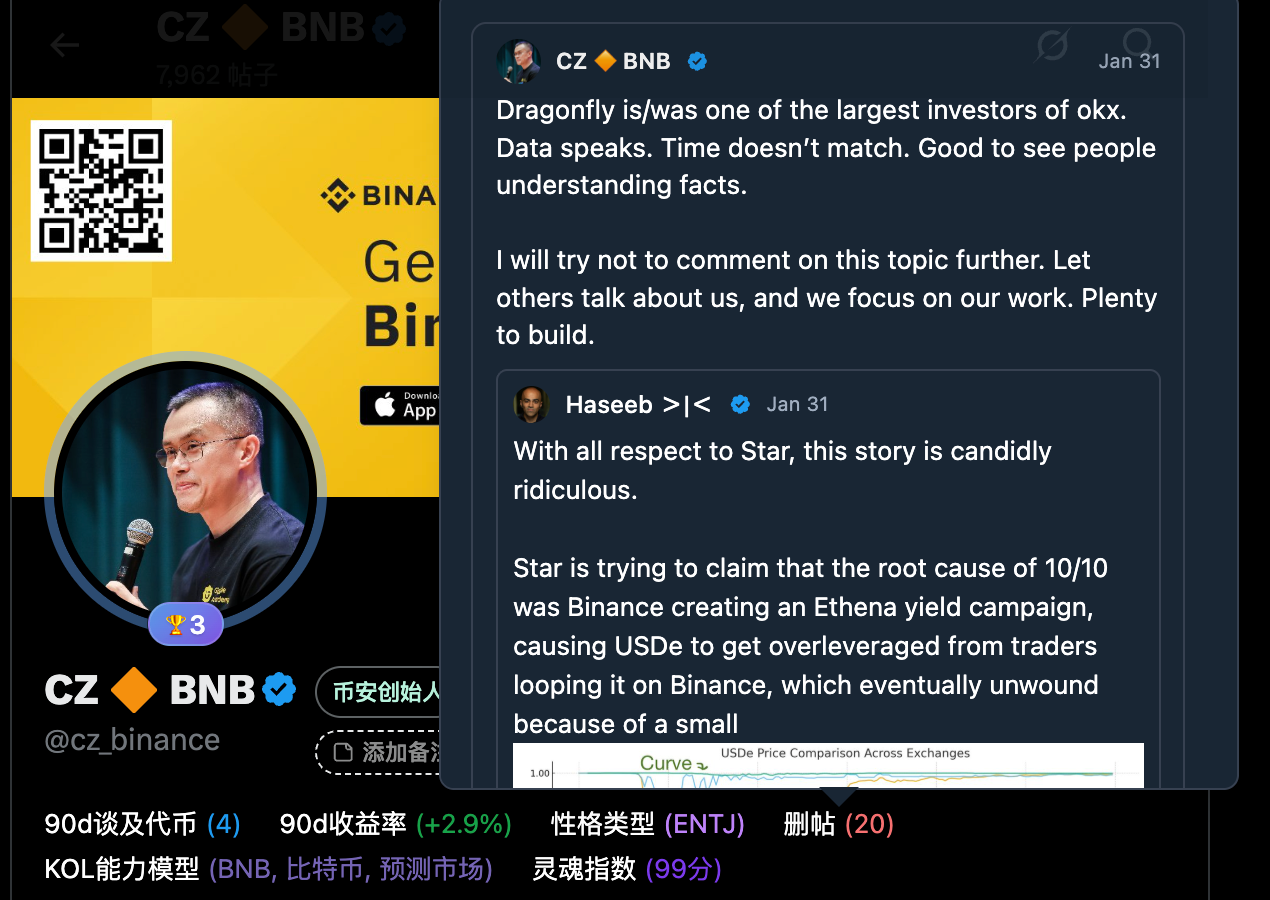
CZ first retweeted Haseeb’s tweet and said: “Dragonfly was/is one of OKX’s largest investors. Data speaks for itself. Timeline doesn’t add up. Glad to see someone finally grasping the facts. I’ll try to avoid further commentary on this topic. Let others talk about us—we’ll focus on building. There’s still much to build.”
However, this tweet has since been deleted by CZ.
Star responded to CZ’s comment as follows:
Nevertheless, clarifying the facts remains important. Here’s the record:
1. BTC began declining approximately 30 minutes before USDe depegged.
This actually supports the prior view: initial volatility stemmed from a market shock.
Without the USDe leveraged loop, the market might have stabilized then. The cascading liquidations were not inevitable—they were structurally amplified, as previously explained.
2. Dragonfly has never invested in OKX—neither small nor large.
In fact, OKX invested in Dragonfly before @hosseeb joined the firm.
Additionally, a former fund managed by one of Dragonfly’s partners (not Dragonfly itself) invested in OKX. These are independent, verifiable facts.
3. I won’t spend any more time on this topic.
The facts are clear. I have no intention of engaging in prolonged debate.
Ethena Founder Guy Young retweeted Haseeb’s post and said:
We all crave simple explanations and scapegoats—but regrettably, this one is factually incorrect.
The data below makes it clear: USDe’s price divergence on Binance’s order book occurred a full 30 minutes after BTC touched bottom from this crash.
Either you’re wrong, or this is the first “root cause”—occurring after the event.
You have a large audience that trusts your words. Spend five minutes reviewing the data before speaking. Do better.
Repost | Wu Shuo Blockchain
Disclaimer: Contains third-party opinions, does not constitute financial advice


AI Practical Guide
This column focuses on the real progress of Agents: technological evolution, application implementat

Crypto Weekly
Tracking on-chain movements of the smart money and institutions

Frontier Insights
Spotlight on Frontier, trending projects, and breaking events

Blowup Alert
As the 2026 crypto bear market deepens, exit scams and project blowups are becoming increasingly fre

Regulatory Watch
American Crypto Act – timely interpretations of policies worldwide

Popular Airdrop Tutorial
Selected potential airdrop opportunities to gain big with small investments

FusnChain
FusnChain