First Memory ETF Launches in History, a Bearish Sell Signal?
First Memory ETF Launches in History, a Bearish Sell Signal?
When everyone believes a certain trade is "impossible to lose," that's precisely when the danger is greatest.
When a trade becomes so crowded it requires a dedicated ETF just to accommodate retail investors, smart money is often already selling.
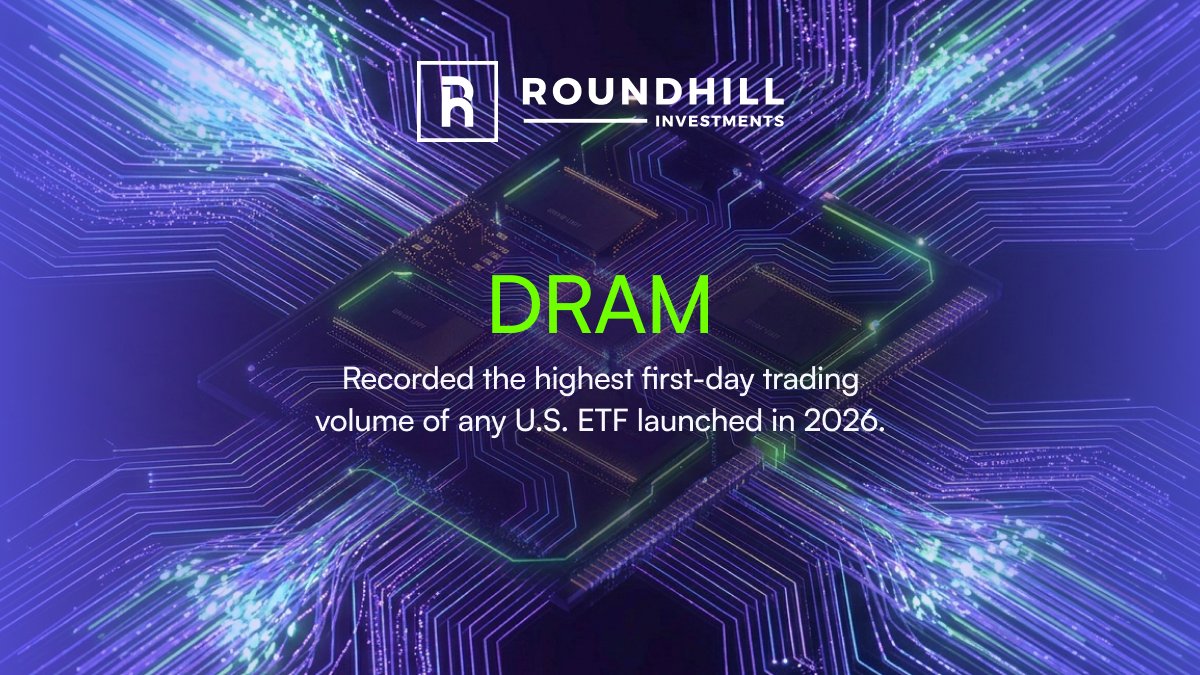
On April 2, Roundhill Investments officially launched the world’s first pure-play memory semiconductor ETF, ticker $DRAM, directly adopting the name of memory modules. The closing price on its debut day was $27.76, followed by a 5% post-market gain to $29.15.
It looked like a frenzy. But hours later, BTIG released a cold, hard research report: the listing of the DRAM ETF is, in fact, a contrarian sell signal for memory stocks.
Don’t rush to dismiss this as sensationalism—this Wall Street iron law has been repeatedly validated.
The ETF’s "Portfolio Composition": Three Giants Consume Three-Quarters
First, let’s examine what exactly $DRAM holds.
This ETF currently holds only nine stocks, extremely concentrated. Micron Technology, Samsung Electronics, and SK Hynix each hold approximately 25% weight on average, collectively accounting for nearly three-quarters of the fund’s total position. The remainder is distributed among storage companies such as Kioxia, SanDisk, Western Digital, and Seagate.
The expense ratio is 0.65%, not cheap. There are currently no options available. To comply with RIC (Regulated Investment Company) diversification requirements, the fund had to resort to Total Return Swaps (TRS) to "pad" its holdings—essentially, the portfolio is too concentrated, forcing reliance on derivatives to pass regulatory scrutiny.
Roundhill CEO Dave Mazza put it bluntly: "Memory is becoming central to the AI ecosystem." That’s accurate. HBM (High Bandwidth Memory) is indeed one of the most critical bottlenecks in today’s AI infrastructure. SK Hynix holds over 60% market share in HBM, Micron’s HBM production is already sold out through end-2026, and Samsung is aggressively catching up.
The product logic isn’t flawed—but timing is.
Roundhill’s "Death Kiss": A History of Precise Contrarian Indicators
BTIG pulled up Roundhill’s own product history, and the results were grim.
The most iconic case is the Roundhill MEME ETF. This fund, tracking retail-favorite stocks, debuted in December 2021—right at the absolute peak of the meme stock bubble. Subsequently, the UBS MEME Index plummeted by roughly 80%, and the fund was forced into liquidation in November 2023. Even more telling? It relaunched in October 2025, just after meme stocks had rebounded 100% from their lows. The result? The index dropped another ~40% shortly after relaunch.
Two launches. Two perfect tops. If you used Roundhill’s product release dates as shorting signals, your returns would likely surpass those from buying the ETF itself.
This isn’t just an issue with Roundhill. BTIG identified a broader pattern: the launch of thematic ETFs often marks the “consensus peak” of a particular trade.
In October 2021, ProShares launched the first U.S.-listed Bitcoin futures ETF ($BITO), with opening trading volume exceeding $1 billion. The entire market celebrated. One month later, Bitcoin peaked at $69,000 before crashing 77%.
In November 2017, ProShares introduced EMTY, a short ETF targeting physical retail. The result? The physical retail index rebounded 50% over the next nine months.
In January 2008, VanEck launched the Coal ETF (KOL), followed by a 12-year bear market during which coal stocks plunged 99%. KOL was liquidated at its lowest point in December 2020—and since then, coal stocks have surged 660%.
ETF listing = top. ETF liquidation = bottom. This pattern repeats time and again. The underlying logic is simple: when a theme becomes hot enough that ETF issuers believe "retail will buy," the rally is likely nearing its end. ETF issuers are always trend chasers—they sell packaged Beta, not Alpha.
Who’s Swimming Naked After 350% Gains?
Warning signals on the data front are now unmistakable.
The Goldman Sachs TMT Memory Exposure Index has surged 350% over the past year, peaking at a staggering 400% gain in February before the DRAM ETF even launched. Micron’s stock once deviated from its 200-day moving average by over 150%—a level exceeding even the dot-com bubble era, an unprecedented extreme in Micron’s history. BTIG notes that if Micron merely reverts to its 200-day MA, it implies a ~30% decline from current levels.
The euphoria across the memory sector is well-documented. EWY (iShares Korea ETF) has risen ~140% over the past year—but upon breakdown, 84 percentage points of that return came from just two stocks: Samsung and SK Hynix. This "Korea ETF" has effectively become a proxy for a memory ETF: Samsung accounts for ~27%, SK Hynix ~20%, together nearly half.
This is precisely the demand $DRAM aims to capture. Over the past year, EWY has attracted $8.3 billion in inflows—many investors bought Korean ETFs solely to bet on memory. Roundhill accurately identified this gap.
But “precisely capturing demand” and “precisely stepping on the top” are often indistinguishable until after the fact.
The Other Side of the Super Cycle
Fairly speaking, the bullish case remains compelling.
Bank of America defines 2026 as a “super cycle reminiscent of the 1990s,” forecasting global DRAM revenue growth of 51% and NAND growth of 45%. Goldman Sachs estimates the HBM market will reach $54.6 billion by 2026—a 58% year-over-year increase. WSTS forecasts global semiconductor market growth exceeding 25% in 2026, approaching $97.5 billion.
Micron’s fiscal 2025 data center revenue surged 137% to $2.07 billion, with all HBM capacity sold out through 2026. Capital expenditure plans are set at $2 billion (up 45% YoY). SK Hynix maintains over 50% market share in HBM3E and is the preferred supplier for custom chips from NVIDIA and Google.
These are real industrial trends, unrelated to speculation. AI’s demand for memory is structural—each new GPU generation doubles HBM requirements. The H100 needs 80GB; by the time we reach the GB300 NVL72 architecture, demand hits 17.3TB.
So the core contradiction is clear: the memory industry is undoubtedly a good business—but is the current price still justified?
A parallel: when BITO launched in October 2021, Bitcoin’s long-term outlook was sound. After spot ETF approval in 2024, BTC did indeed hit new highs. But if you bought on BITO’s launch day, you’d first endure a 77% drawdown—then wait three years to break even.
The fundamentals may be right, but the trade can still be wrong. Timing is everything.
Viewpoint: No Death Knell, but the Alarm Is Definitely Sounding
Our assessment: the launch of the DRAM ETF doesn’t necessarily mean a peak or crash in the memory sector—but it absolutely shouldn’t be taken as a “safe to go all-in” signal. Instead, it functions as an extremely precise sentiment thermometer. When an industry becomes so hot it demands a dedicated ETF to feed retail appetite, at minimum it indicates three things:
First, the Easy Money phase is over. Over the past year, Micron’s 350% surge was largely driven by valuation expansion, not earnings catch-up. Going forward, memory stocks must prove their current prices via actual performance growth—with minimal room for error.
Second, the “thematic ETF trap” deserves high vigilance. Roundhill’s track record is the ultimate lesson. When an investment theme gets packaged into a low-barrier retail product, it often signals institutional investors are trimming positions while retail investors are piling in. Not conspiracy theory—just the natural ecology of capital markets. The incentive structure of product issuers ensures they chase popularity, never anticipate turning points.
Third, the real risk lies in pricing—not fundamentals. Micron’s 150% deviation from its 200-day MA exceeds even the dot-com bubble levels. Even if AI-driven memory demand doubles, a 30% technical correction remains entirely within reasonable bounds.
History doesn’t repeat itself exactly—but it rhymes. After BITO launched, Bitcoin crashed 77%. The MEME ETF hit two peaks perfectly. Can $DRAM break this curse?
The one thing we can be certain of: when everyone believes a single trade is “impossible to lose,” that’s when the danger is greatest.
Disclaimer: Contains third-party opinions, does not constitute financial advice
Coinbase Perpetual Contract Trading for Non-U.S. Regions Will Be Suspended for Approximately 1 Hour Starting at 17:00 on October 1
4 days ago
SpaceXAI to Tidy Up Subscription Chaos, Grok and Cursor to Unify Plans Within Weeks
20 days ago
JPMorgan: Oracle's Backlog Orders Up by $26 Billion, Funding Trail Raises Questions
20 days agoThe Nasdaq-100 Index futures decline widens to 1.5%
20 days agoJefferies: Expecting Fed rate hike this week, Wunsch's comments to be pivotal
20 days agoData: Bitcoin's current holding volume has decreased by 13.5% compared to September 3rd, suggesting the market may have already begun deleveraging ahead of time
20 days ago
The UK's Financial Conduct Authority is exploring regulatory exemptions for tokenized gold
20 days ago


AI big events
Key AI Events, Outlook on Industry Trends

Meme
ETH,BNB,SOL Hot Memes

Blowup Alert
As the 2026 crypto bear market deepens, exit scams and project blowups are becoming increasingly fre

RWA
Stock, Commodity & Bond Tokenization

Market Analysis
BTC/ETH, Major Cryptocurrencies, and Hot Altcoins Price Trends

prediection markets
Follow new prediction market trends, insight real event expectations.

AI Practical Guide
This column focuses on the real progress of Agents: technological evolution, application implementat

Crypto Weekly
Tracking on-chain movements of the smart money and institutions

Frontier Insights
Spotlight on Frontier, trending projects, and breaking events

Regulatory Watch
American Crypto Act – timely interpretations of policies worldwide