Before the Tech IPO Surge, Polymarket Aims to Make a Comeback
Before the Tech IPO Surge, Polymarket Aims to Make a Comeback


This wave of tech IPO mania has everyone eager to "get on board," including Polymarket.
With SpaceX's Nasdaq listing just 23 days away, this IPO stands to break every record in the history of public offerings.
OpenAI’s last valuation reached $500 billion, Anthropic reportedly valued at $400 billion, and SpaceX at $1.75 trillion. Among the global 1,600 unicorn companies, cumulative valuations total $5 trillion. Historically, returns from this space have been accessible only to institutions and accredited investors. To directly purchase shares in these firms, one must meet a six-figure minimum investment, endure a one-year lock-up period, pass accredited investor verification, and leverage established networks—barriers that keep retail investors out.
Moreover, private companies are under no obligation to disclose valuations. Valuation figures from funding rounds lag behind real-time market conditions, secondary market pricing is fragmented, and employee stock transaction prices remain highly sensitive internal information. This very opacity presents the ideal entry point for prediction markets.
On May 19, before this pivotal moment, Polymarket launched a exclusive partnership with Nasdaq, introducing a suite of prediction contracts tied to pre-IPO company valuations. Users can now bet on whether OpenAI will exceed $1 trillion by year-end, whether Anthropic will hit $1.1 trillion by December 31, or whether SpaceX will reach $1.5 trillion before June 30. Nasdaq serves as the official data source, responsible for final contract settlement.
Polymarket previously offered markets for OpenAI’s first-day closing market cap; Bloomberg reported cumulative trading volume of $1.6 million since September last year. Kalshi already features denser IPO contracts: the probability of Cerebras Systems going public before 2027 is priced at 95%, Kraken at 83%, Databricks at 70%, Discord at 70%. Contracts for OpenAI and Anthropic are also available.
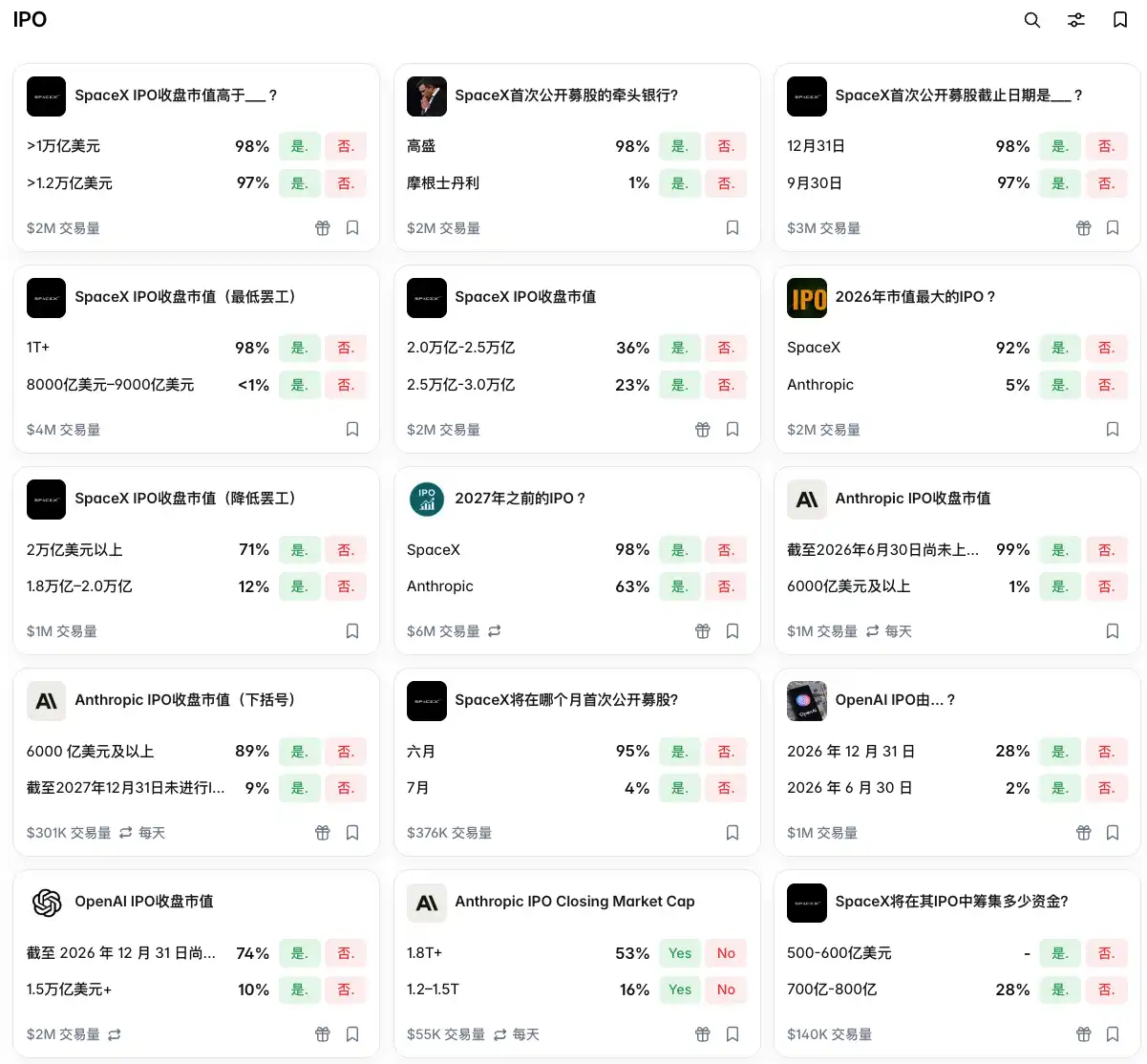
Both competing platforms are placing significant strategic focus on this pre-IPO surge.
Over the past eight months, Polymarket has been overtaken by Kalshi across nearly all measurable metrics.
In April, Kalshi recorded $14.8 billion in monthly trading volume, a 13% month-over-month increase. Polymarket’s combined global and U.S. app volume totaled $10.2 billion, a decline of 8.9% month-over-month. Active traders dropped from 733,000 in March to 643,000 in April—a 12% decrease. In terms of valuation, Kalshi’s latest round reached $22 billion, while Polymarket is reportedly negotiating a $15 billion valuation.
A Bank of America report from April noted that Kalshi captured approximately 89% of the U.S.-based prediction market share.
Kalshi has enjoyed a smoother trajectory than Polymarket over the years. In 2020, it became the first and remains the only event-based derivatives platform to receive a Designated Contract Market (DCM) license from the CFTC. This allows Kalshi to accept USD, issue 1099 tax forms, integrate SDKs with Robinhood, and license its probability data to media outlets like CNN and CNBC. In February this year, Kalshi was named to TIME’s TIME100 list of most influential companies, and its app briefly approached ChatGPT in App Store rankings.
Meanwhile, Polymarket was fined $1.4 million by the CFTC in 2022 and subsequently exited the U.S. market. The CFTC and Department of Justice concluded their latest investigation into Polymarket in July 2025, after which it secured compliance through the acquisition of QCEX, gaining a regulated exchange license.
However, this new collaboration with Nasdaq may signal the beginning of Polymarket’s comeback.
The specific partner is Nasdaq Private Market (NPM), a company incubated by Nasdaq, dedicated exclusively to serving non-public companies. NPM’s core operations revolve around two key functions:
First, organizing secondary market liquidity programs for employee equity. Companies like OpenAI, SpaceX, and Anthropic hold vast amounts of options and restricted stock in employees’ hands. Since these firms aren’t publicly traded, employees can’t sell shares on public exchanges. NPM facilitates tender offers, enabling employees to sell their shares to approved external investors. NPM discloses that it has facilitated nearly $80 billion in such transactions across over 1,000 liquidity programs, serving more than 200,000 employee shareholders.
Second, building a private company valuation database. NPM gains daily visibility into the prices at which OpenAI, Anthropic, and SpaceX employee shares trade on the secondary market. These data were historically sold exclusively to institutional clients at premium annual fees.
The pivotal step in this partnership is NPM’s decision to grant Polymarket access to these valuation datasets for the first time.
NPM Data Vice President Rodolfo Sanchez stated in the press release: “The data flows in both directions.” NPM provides Polymarket with data for contract settlement, while Polymarket’s price curves serve as actionable “institutional signals” for NPM’s clients. When institutions purchase NPM data, they gain access to a real-time probability curve derived from hundreds of thousands of retail participants pricing contracts live.
This is not Polymarket’s first venture into data monetization.
In October 2025, ICE announced an investment of up to $2 billion, with a pre-money valuation of $8 billion. The focus wasn’t on valuation but on deal terms: ICE secured global exclusive distribution rights to Polymarket’s data. Through NYSE’s parent company’s sales channels, Polymarket’s probability data began being sold to global institutional clients.
In January 2026, Polymarket entered a exclusive partnership with Dow Jones. Its predictive data was integrated into The Wall Street Journal, Barron’s, MarketWatch, and Investor’s Business Daily. The News Corp financial media network began embedding Polymarket’s probability signals as standardized modules akin to the DJIA or VIX index within editorial layouts.
In February 2026, ICE officially launched the Polymarket Signals and Sentiment product. Thousands of real-time contract quotes from Polymarket were structured into a data feed, distributed via ICE Consolidated Feed to institutional clients—delivered alongside NYSE stock data, bond prices, and corporate announcements through the same pipeline. ICE CEO Ben Jackson cited this product alongside Reddit and Dow Jones during the Q1 earnings call, labeling it one of the three pillars of ICE’s alternative data services.
Now, this latest collaboration represents Polymarket’s bid to seize control of the authoritative valuation determination for the hottest segment of the private market this year.
We suspect Kalshi won’t remain idle. Its next move is likely to involve negotiations with a private market data provider, replicating this structure. However, mainstream private data vendors like Forge and PitchBook are smaller in scale and cover fewer companies than NPM. With NPM already exclusively partnered with Polymarket, Kalshi’s entry into this arena will come at a higher cost.
Original: BlockBeats
Disclaimer: Contains third-party opinions, does not constitute financial advice
Bessent: Advancing the Cryptocurrency Regulatory Framework Through Actions by the SEC and CFTC
2 hours ago
Polymarket US Launches 5-Minute Cryptocurrency Price Movement Prediction Market
2 hours agoCFTC Sues Utah State, Aiming to Block Its Restrictions on Prediction Markets
4 hours agoCancore Closes $7.2 Million Seed Round with Participation from Paper Ventures
6 hours agoNVIDIA and Oracle Expand Collaboration, Scaling NVIDIA Vera Rubin Architecture Deployment to Multi-Gigawatt Levels
7 hours agoCoinbase to List Stable (STABLE)
8 hours agopredict.fun: API documentation site hosted by third-party service provider was attacked, resulting in partial loss of user funds
9 hours ago