Are Prediction Markets a Money Machine? A Deep Dive into Their Profit Models
Are Prediction Markets a Money Machine? A Deep Dive into Their Profit Models


When discussing prediction markets in the past, people cared more about their accuracy, trading volume, and potential to become new information markets. But when prediction markets are viewed as a business, the core question shifts: what is the revenue model of prediction markets?
In the commercial world, high trading volume does not equate to platform profitability. A market can generate massive buzz and frequent user activity, yet if most trades do not fall within the fee collection scope—or if engagement is sustained solely through subsidies and points—then trading volume becomes merely attractive data, not healthy revenue.
For prediction markets, the true test of commercial capability isn't "how many contracts have been launched" or "how viral a particular event is," but whether the platform can seamlessly connect three key elements:
The impulse for genuine trading;
Sufficient depth in order book liquidity;
Converting active taker demand into Fees (transaction fees).
This is why the business model of prediction markets is far from a simple “tax on contract openings.” On the surface, they appear as yes/no betting games, but the real foundation of platform revenue lies in underlying transaction structures, liquidity mechanisms, fee asymmetries, and user behavior dynamics.
Especially after Polymarket began systematically introducing Taker Fees, the narrative around prediction markets has shifted from “information tool” to “revenue validation” phase.
This article dissects the fundamental mechanics of prediction markets from a commercial perspective:
How do prediction market platforms make money?
Why does the Maker/Taker game theory determine a platform’s survival?
What are the essential differences in fee designs across leading platforms such as @Polymarket, Kalshi, @opinionlabsxyz, and @predictdotfun?
Why is the highest-trading segment often not the most profitable?
💡 Core Insight: Prediction markets don’t sell answers—they sell disagreement.
The closer the price is to 50/50, the greater the market divergence, stronger the trading impulse, and higher the likelihood that the platform converts active trades into fee revenue. The closer the price approaches 0 or 100, the more certain the outcome becomes; while informational value remains, the corresponding fee weight drops significantly.
Thus, the true commercial moat of prediction markets isn’t turning “events” into contracts—but turning “disagreement” into trading activity, and then reliably converting that activity into revenue.
One: How Do Prediction Markets Make Money? Not by Launching Contracts, But by Converting Disagreement into Fees
To analyze the cash flow of prediction markets, we must first clarify the four core drivers of revenue. These interlock to form a closed loop from traffic to monetization.
1️⃣ Transaction Fees – Direct Revenue Source
Most prediction markets charge active traders—the Takers—because Takers consume liquidity, while Makers provide it.
This means not all trades generate revenue for the platform. Only those where users are willing to execute immediately, paying for speed and certainty, truly contribute to fees.
2️⃣ Liquidity – Foundation for Sustained Trading
The hardest challenge for prediction markets isn’t launching contracts—it’s ensuring sufficient depth.
If no orders are posted on a contract, users cannot buy or sell, rendering even a trending topic unable to form an effective price.
Therefore, many platforms reduce Maker costs or offer incentives to Makers.
This isn’t a direct revenue source, but it determines whether fees can persist long-term.
No liquidity → no sustained trading → no stable fee income.
3️⃣ Information Value – Mindshare Capture
A distinguishing feature of prediction markets versus ordinary trading platforms is that they don’t just serve as tools—they also produce information.
Once a contract accumulates sufficient volume and liquidity, its price becomes a probabilistic signal. Media outlets cite it, KOLs interpret it, traders monitor it, and ordinary users use it to gauge market sentiment.
This doesn’t directly convert to fees, but it drives visibility, user mindshare, and external amplification. Over time, this information value reinforces trading demand.
4️⃣ User Operations and Discount Systems – Turning Activity into Revenue
Beyond base transaction fees, platforms use discounts, referrals, events, points, and rebates to increase trading frequency. While these measures don’t directly generate revenue, they impact long-term monetization capacity. For example, Opinion offers user discounts, trade discounts, and referral discounts; Predict.fun employs a simpler base fee and discount mechanism; Polymarket focuses on differentiated fee tiers across sectors and Maker rebates. Discounts and incentives aren’t mere subsidies—they involve sacrificing part of profit to retain users, then gradually converting activity into revenue.
Two: Horizontal Comparison of Fee Structures Across Leading Prediction Market Platforms
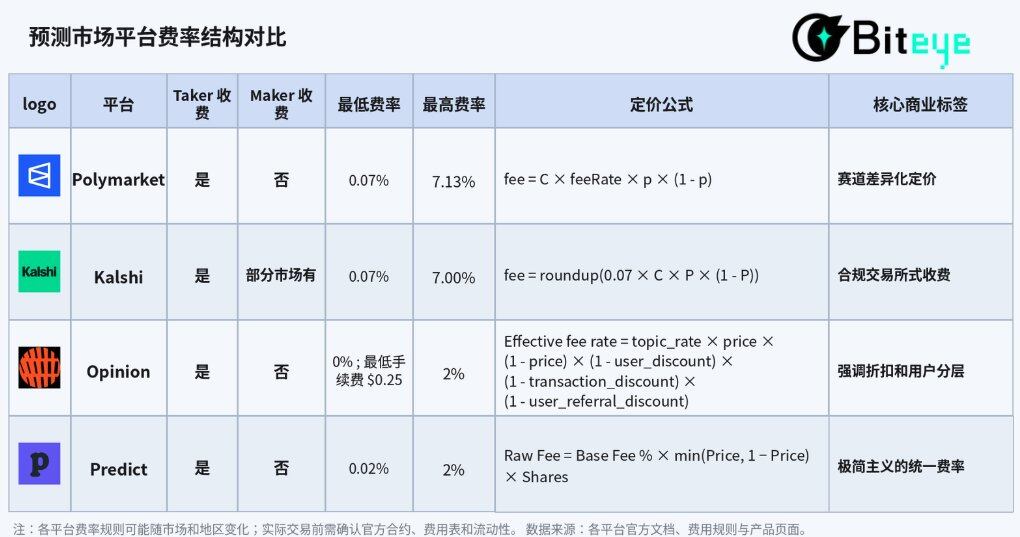
Looking at several major prediction markets, industry strategy is highly convergent: encourage limit orders to provide liquidity and convert active execution into revenue. Yet tactically, platforms diverge due to differing positioning.
1️⃣ Polymarket: Granular Pricing by Sector
Polymarket’s Taker fee logic combines “sector differentiation” with “disagreement-based pricing” to an extreme degree. Its official core formula is:
fee = C × feeRate × p × (1 - p)
where C is the number of shares traded, p is the contract price, and feeRate is determined by the market sector.
This mechanism hinges on two core variables:
Sector-specific pricing: Based on verified fee rates, Crypto has a feeRate of 0.07, Sports 0.03, Politics/Finance/Tech 0.04, Culture/Weather 0.05, and some Geopolitics markets 0. Thus, Polymarket does not apply uniform fees—instead, it uses differentiated rates based on transaction frequency, sensitivity, and user willingness to pay across sectors.
Disagreement-based pricing: Perfectly aligned with the mathematical curve of p × (1 - p). The closer the price is to 50/50 (maximum market divergence), the higher the fee; the closer to 0 or 100 (more certain outcomes), the lower the fee.
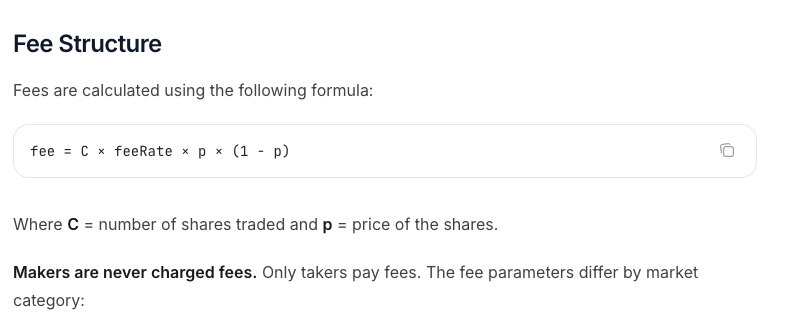
https://docs.polymarket.com/trading/fees
2️⃣ Kalshi: Closer to a Compliant Exchange Model
Kalshi’s fee design operates under a compliance framework similar to traditional financial derivatives exchanges. Its standard Taker fee formula also ties to price disagreement:
fee = round up(0.07 × C × P × (1 - P))
where C is the number of contracts, P is the contract price, and fees are rounded up to the nearest cent. This structure closely resembles Polymarket’s C × feeRate × p × (1-p).
Kalshi’s fee structure shares similarities with Polymarket: fees depend on contract price, peaking near 50¢ and declining toward 1¢ or 99¢. Kalshi’s fee schedule shows that for 100 contracts, the Taker fee ranges roughly between $0.07 and $1.75.
But a key difference is that Kalshi charges Maker fees on some markets—and only when orders ultimately execute. Cancelled orders incur no fee. This indicates Kalshi’s fee structure is more like a compliant exchange: not simply free Maker access forever, but complex bilateral fee rules tailored per market.
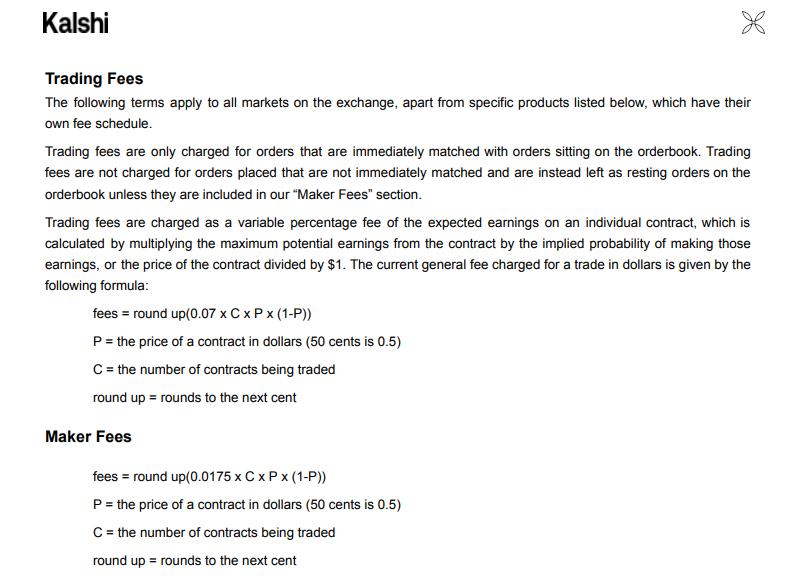
https://kalshi.com/docs/kalshi-fee-schedule.pdf
3️⃣ Opinion: Emphasis on Discounts and User Segmentation
Opinion introduces an extremely complex “multi-dimensional discount system,” with its effective fee rate formula:
Effective fee rate = topic_rate × price × (1 − price) × (1 − user_discount) × (1 − transaction_discount) × (1 − user_referral_discount)
Thus, Opinion’s fees depend not only on market price and topic_rate, but also on user discounts, transaction discounts, and referral discounts.
Opinion also sets a $5 minimum order size and a $0.25 minimum fee to prevent micro-trades from generating negligible fees.
This signals that Opinion’s fee design leans heavily into user operations:
topic_rate differentiates between markets
user_discount enables user segmentation
Compared to Polymarket’s “sector-differentiated pricing,” Opinion treats fees as an operational lever: using discount systems to guide trading, retention, and acquisition, while offering free Makers to lower order entry barriers and maintain liquidity.
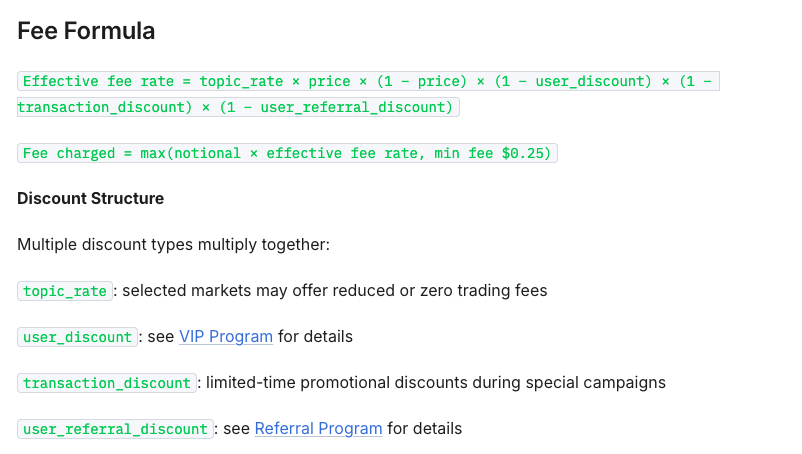
https://docs.opinion.trade/trade-on-opinion.trade/fees
4️⃣ Predict.fun: Minimalist Uniform Fee Structure
Predict.fun’s fee structure is relatively simpler, designed to reduce user cognitive load.
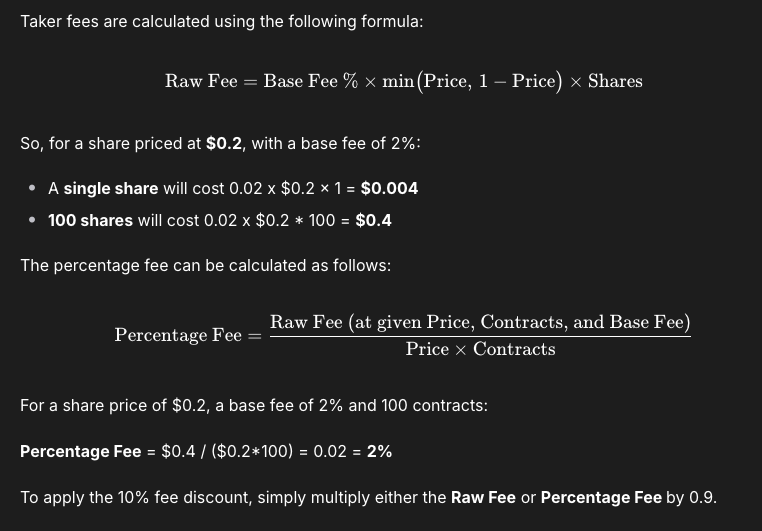
According to its current public specifications, the fee calculation formula is:
Raw Fee = Base Fee % × min(Price, 1 − Price) × Shares
Base Fee is currently 2%. Actual rate remains largely fixed at 2% below 50%; above 50%, the effective rate decreases as price approaches 1.
Additionally, Predict.fun supports fee discounts, further reducing fees post-discount.
This design is more intuitive: users don’t need to determine which side of the contract they’re on—just focus on the execution price to understand fee variation.
https://docs.predict.fun/the-basics/predict-fees-and-limits#limits
It’s evident that all prediction market platforms share a common goal: converting active trading behavior into revenue.
This confirms that monetization in prediction markets isn’t a single path. They ultimately answer one question: are users willing to pay for trading?
Three: Deep Dive into Polymarket – Trading Volume ≠ Real Revenue
While platforms experiment with diverse models, validating actual monetization efficiency, Polymarket remains the most suitable benchmark.
Two main reasons:
Its fee path is clearest: starting with Crypto, expanding to Sports, and now charging across nearly all categories
Its data is more comprehensive: official feeRates and 7D/30D Fees allow deeper revenue structure analysis
Thus, we’ll use Polymarket as a case study to answer a more specific question: is the highest-volume sector also the most profitable?
3.1 From Free to Paid: Polymarket’s Commercialization Timeline
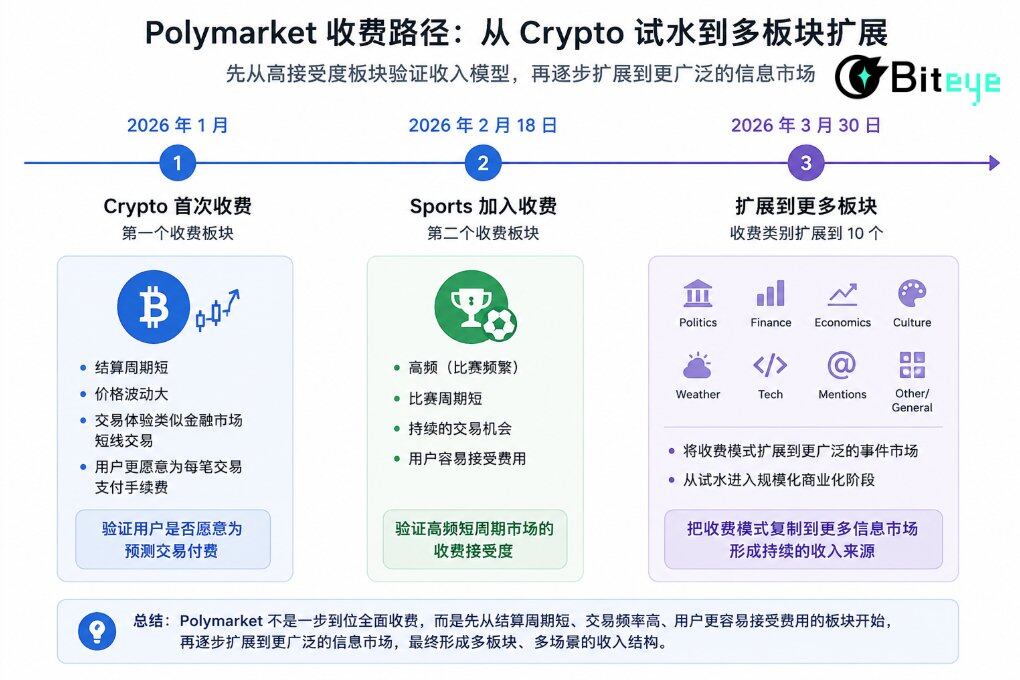
January 2026: Crypto became the first paid segment
Polymarket re-entered the U.S. market, initially introducing Taker Fees in the Crypto segment. Cryptocurrency contracts feature short settlement cycles, high volatility, and trading behaviors akin to short-term secondary markets. Users prioritize speed of realization over friction cost sensitivity—making it an ideal testing ground for fees.
February 18, 2026: Sports became the second paid segment
Shortly after, on February 18, 2026, the Sports segment became the second paid category. Sports contracts naturally exhibit high-frequency, short-cycle traits, providing consistent trading scenarios—making Sports a logical extension of the fee model.
Thus, Polymarket’s initial fee rollout on Crypto and Sports was a strategic move to validate the revenue model using segments with higher user acceptance.
March 30, 2026: Expansion to More Segments
On March 30, 2026, Polymarket extended Taker Fees to Politics, Finance, Economics, Culture, Weather, Tech, Mentions, Other/General, and other categories—expanding charged segments to 10.
After full monetization, Polymarket didn’t apply uniform fees across all segments. Instead, it adopted a finer-grained fee structure—a pivotal moment in its commercialization. Polymarket began extending its fee model across broader markets.
The results were spectacular. According to latest data, Polymarket demonstrated immense revenue capture ability: 7D Fees reached $9.27M, 30D Fees hit $36.3M. Its 7-day revenue ranks among the top six in the entire crypto ecosystem, officially entering the tier of revenue-generating projects.
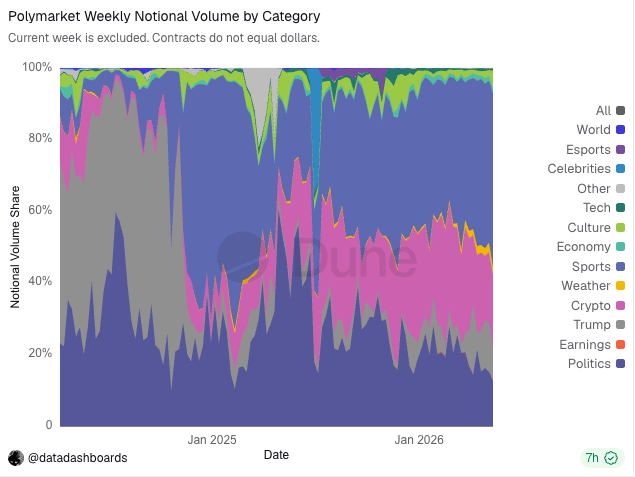
3.2 Core Segment Breakdown and Price Distribution Analysis
To estimate Polymarket’s actual revenue per segment, we analyzed transaction data from 2021 to February 2026, calculating fees for five major segments.
Market share of market orders varies significantly across segments:
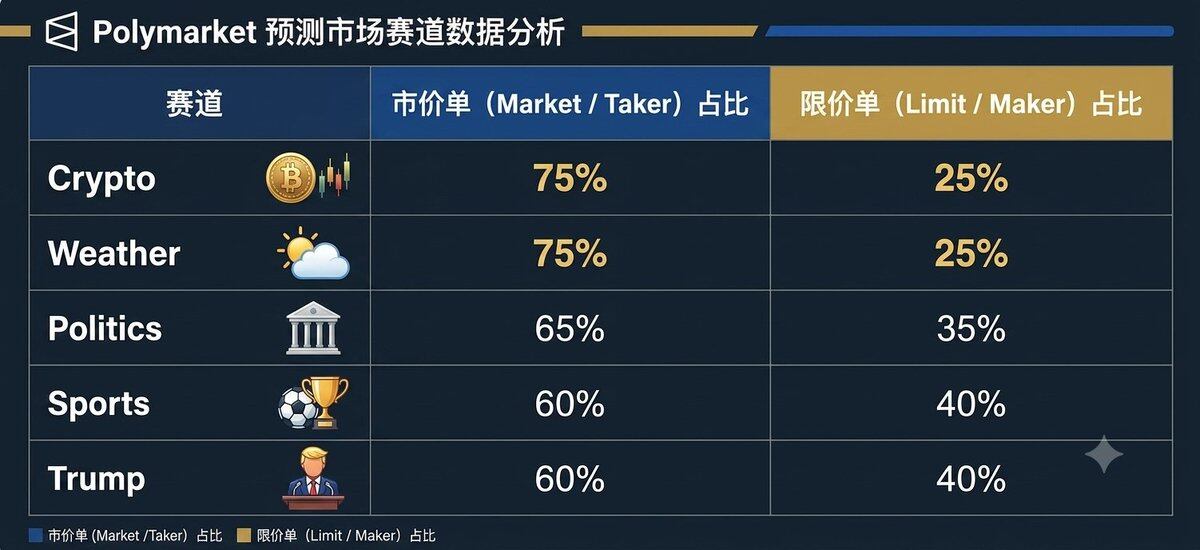
Crypto leads with 75% market order share—highly consistent with the volatile nature of crypto assets. Users prefer immediate market orders to lock in gains or losses. Similarly, Weather segments, driven by real-time meteorological events, emphasize rapid response.
Fee levels heavily depend on the price range of executed trades.
Reason: not all trades within fee-eligible contracts generate equal fees. Polymarket’s fees correlate with p × (1 - p). The closer the price is to 50/50 (greater market disagreement), the higher the fee weight. The closer to 0% or 100% (more certain outcomes), the lower the fee weight.
Data from the five main segments shows most trades cluster between 30–50, especially in the 40–50 range:
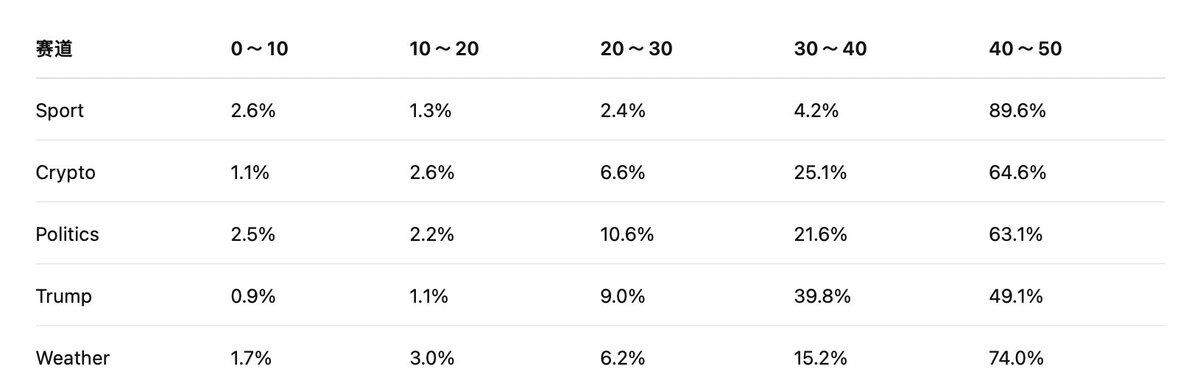
This data indicates that Polymarket’s primary trading activity occurs not in settled, predictable ranges, but in zones where significant market disagreement persists.
3.3 Revenue Estimation: Who Is the Profit Cow?
We estimated fee revenue across five segments using each segment’s market turnover, corresponding feeRate, and p × (1-p) weights across price bands. Accounting for post-fee adoption, some fee-sensitive users may shift from Taker to Limit orders—especially those engaging in end-of-session trades, low-odds arbitrage, or frequent short-term trading who now calculate ROI more carefully.
Thus, we applied a more conservative assumption: assuming a 20% decline in market order volume post-fee implementation.
The adjusted formula becomes:
Adjusted estimated fee ≈ Market turnover × 80% × feeRate × (1 - p)
Based on 7D total volume and segment-wise volume shares, we estimated 7D market order turnover for the five main segments.
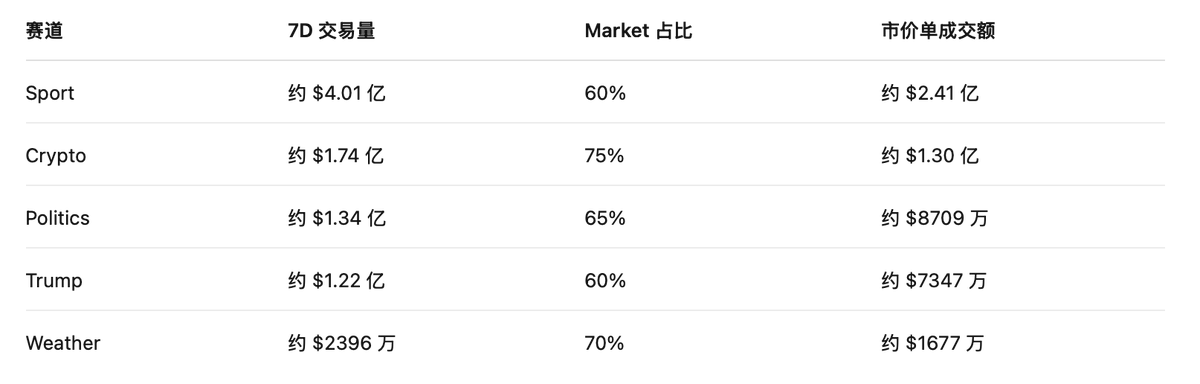
We already calculated market order turnover per segment. Next, combining each segment’s feeRate and price-weighted p × (1-p), we estimated fees. To ensure robustness, we used midpoints of price intervals as approximations:
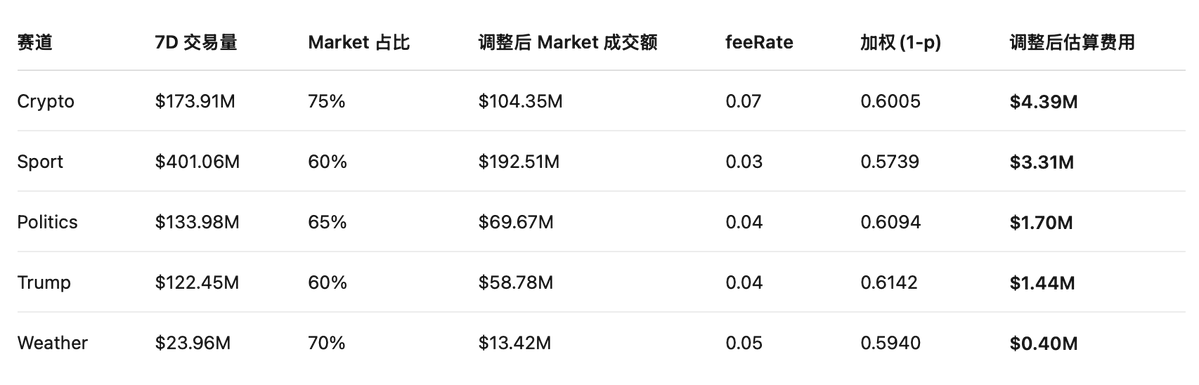
(Note: Due to data lag, historical order type distribution, and dynamic segment changes, this model aims to reflect relative contribution ratios. Total sum may differ slightly from actual system-calculated Fees.)
What do the data reveal?
1️⃣ Crypto is currently the top profit contributor, with 7D estimated fees of ~$4.39M—the “profit cow.”
This is counterintuitive: Sport leads in trading volume, with 7D volume at ~$401M vs. Crypto’s ~$174M. Yet Crypto ranks first in fees, due to two factors:
Higher market order ratio: Market orders account for ~75%, significantly higher than Sport’s 60%. Since Polymarket primarily charges Takers, Crypto sees more trades falling into the fee pool.
Highest feeRate: At 0.07, compared to Sport’s 0.03. Even with identical market order turnover, Crypto generates substantially higher fees per unit of trade.
2️⃣ Sport is the second-largest fee source, with 7D estimated fees of ~$3.31M—the “volume base.”
Sport’s strength lies in sheer volume: its 7D volume (~$401M) ranks first among the five segments. However, its weakness is clear: lowest feeRate at 0.03.
3️⃣ Politics and Trump, combined, yield ~$3.14M in 7D estimated fees—very close to Sport—representing a pulse-driven traffic funnel.
Politics-related contracts are highly event-driven. Unlike Sports with daily consistent matches or Crypto with continuous price swings, politics lacks steady rhythm. But during elections, polls, policy shifts, or candidate statements, sudden surges in trading occur. Thus, though trading pace isn’t stable, political contracts deliver substantial fee contributions during peak periods.
4️⃣ Weather’s 7D estimated fees are ~$40K—the lowest among the five segments.
Thus, Polymarket’s revenue structure can be summarized simply: Crypto drives platform revenue, Sport drives volume, Politics/Trump drives event-driven spikes for user acquisition.
Four: Four Final Judgments on Prediction Market Segments from Polymarket’s Lens
Polymarket’s successful closed-loop model offers transformative insights for the entire prediction market space:
1️⃣ Comprehensive Shift in Evaluation Metrics
Previously, prediction markets were judged by trading volume and trending topics. In the commercial era, success metrics will fully shift to: actual Fees, Taker share, order book depth, and bid-ask spread (Spread). Pure, circular “wash trading” volumes will be unsustainable under fee mechanisms.
2️⃣ Different Event Types, Different Revenue Roles
Future prediction market platforms won’t rely on a single contract type to dominate. Instead, they will evolve toward fine-grained specialization.
Crypto-like markets resemble financial trading: rapid price changes, short feedback loops, and high sensitivity to execution speed—making them ideal for high revenue efficiency.
Sports function like steady cash flow: frequent events, clear outcomes, and continuous trading scenarios—perfect for daily volume contribution.
Politics/Trump-type markets lean toward event bursts: not consistently active, but capable of explosive volume during election cycles, polling shifts, or policy announcements.
Weather-type markets prove that even with limited scale, standardized events with clear outcomes can establish their own trading ecosystems.
3️⃣ Fee Mechanisms Reverse-Engineer Contract Quality
In the free phase, platforms could launch countless contracts. After fees, users and market makers begin optimizing rigorously—fee structures themselves act as filters for market quality.
A good prediction market must satisfy multiple conditions:
Clear outcome for settlement
Frequent information updates driving price changes
Sufficient market disagreement to stimulate trading intent
Adequate liquidity enabling active execution
Resistance to manipulation
4️⃣ The Moat Lies in “Sustainable Pricing Power”
Launching a YES/NO contract is easy. The hard part is sustaining order flow: continuous posting, active taking, price updating, and risk-taking willingness. Only when a contract maintains deep liquidity and high trading frequency does its price gain reference value—enabling platform revenue generation.
Thus, the true moat of prediction markets isn’t “who finds hot topics fastest”—but rather: transforming hot topics into tradable markets👉ensuring long-term liquidity👉making prices signals that the external world willingly references.
Five: Final Thoughts
Projects with grand narratives abound, but few turn those narratives into tangible, real-world revenue.
Polymarket was once the most glamorous name in the space. Now, having transitioned from “traffic story” to “systematic revenue engine,” it proves one thing to the entire industry:
The ultimate value of prediction markets extends beyond “how accurate they are at forecasting the future.” It lies in their ability to transform real-world uncertainty into a standardized, high-frequency, self-sustaining marketplace capable of generating consistent profits.
In the past, prediction markets proved they could capture massive attention. Now, they are proving they are an unbeatable business model.
1 Calculation method: extract market order vs. limit order ratios per segment, estimate p × (1 - p) impact across price bands, then combine with respective fee rates to approximate each segment’s fee contribution.
Original authors: Changan, Amelia, Biteye Content Team
Disclaimer: Contains third-party opinions, does not constitute financial advice
Bessent: Advancing the Cryptocurrency Regulatory Framework Through Actions by the SEC and CFTC
2 hours ago
Polymarket US Launches 5-Minute Cryptocurrency Price Movement Prediction Market
2 hours agoCFTC Sues Utah State, Aiming to Block Its Restrictions on Prediction Markets
4 hours agoCancore Closes $7.2 Million Seed Round with Participation from Paper Ventures
6 hours agoNVIDIA and Oracle Expand Collaboration, Scaling NVIDIA Vera Rubin Architecture Deployment to Multi-Gigawatt Levels
7 hours agoCoinbase to List Stable (STABLE)
8 hours agopredict.fun: API documentation site hosted by third-party service provider was attacked, resulting in partial loss of user funds
9 hours ago