Polymarket's 6th Anniversary: Bathrooms, Exile, and Home
Polymarket's 6th Anniversary: Bathrooms, Exile, and Home


On June 17, Polymarket celebrated its sixth anniversary since launch.
In the world of crypto, six years is a long time—long enough for a narrative to go from bubble to ruin, and for a product to evolve from an obscure experiment into mainstream infrastructure. Six years ago, Polymarket was just a prediction market hastily built by a young founder in his bathroom during New York’s pandemic lockdown. Today, it has entered the balance sheets of Google, The Wall Street Journal, sports leagues, the CFTC regulatory framework, and Intercontinental Exchange (ICE), the parent company of the New York Stock Exchange, becoming the most closely watched "information market" globally.
If viewed solely through today’s lens, Polymarket appears as a textbook success story: explosive trading volume, soaring valuation, its founder joining the ranks of the youngest self-made billionaires, and prediction markets transitioning from a crypto niche into mainstream media and live sports broadcasts. But when we rewind the timeline, the story is far from smooth. It’s not a linear growth arc but rather a continuous saga of being ousted, then repeatedly attempting to return through the front door.
The earliest premise behind Polymarket was simple: When the world is full of uncertainty, can prices reach truth faster than media, experts, or opinion polls? Over these six years, Polymarket turned real-world events like COVID-19, the U.S. election, the Titan submersible incident, Biden’s potential withdrawal, Trump Whale, FBI raids, CFTC approval, and ICE investment into markets—only to be repeatedly punished by the rules of the real world.
Thus, the significance of Polymarket’s sixth anniversary lies in this moment: witnessing a crypto product born in a bathroom rise to the crossroads of finance, media, sports, and regulation. This article by BlockBeats aims to tell exactly that six-year journey: how Polymarket survived, how it was expelled from the U.S., and how it eventually bought back its ticket home.
The Gambler in the Bathroom
October 2013: A single email arrived in the inbox of the U.S. Securities and Exchange Commission.
The sender was Shayne Coplan, 14 years old, still attending high school in Manhattan. According to his later public version, this email came from a teenager who had read *Flash Boys* and was captivated by electronic trading networks. The message was brief, yet carried a unique blend typical of youth: half innocence, half confidence.
He introduced himself as a sophomore at a Manhattan high school working on a stock exchange based on ECN technology. His immediate goal was to confirm whether this idea was “fully legal” and compliant with SEC regulations.

On December 2, 2024, Coplan shared this old email on X, captioning it with one line: “What people call an 'overnight success' takes a decade.” Looking back decades later, this email feels like an almost too-perfect foreshadowing. At the time, Coplan could not have known he would ultimately build not a traditional stock exchange, but a global prediction market where people bet on the future using price signals. He couldn’t have imagined that this market would later be driven out of the U.S. due to regulatory issues—and years later attempt to re-enter through the front door.
Polymarket’s Prehistory
Coplan grew up in Manhattan, raised by his mother, with a father who was a film professor at NYU. He attended public schools in Hell’s Kitchen, not elite prep institutions for Wall Street heirs. His persona never quite fit the mold of someone trained in traditional finance systems. Instead, he seemed forged from internet culture, cryptocurrency, entrepreneurial biographies, and the streets of New York.

During those years, he began exploring cryptocurrency. According to media reports, his entry point was oddly coincidental: while downloading pirated music, he stumbled upon crypto, began studying it, and even tried building his own mining rig. For many peers, the internet was about games, music, and social platforms; for Coplan, it felt more like a direct staircase leading underground. Following this path, he discovered a new financial world without teachers, entry barriers, or age limits.
In 2014, Ethereum’s presale launched. Coplan bought ETH at around $0.30 per token. This early investment later became seed capital for his startup journey.
At the same time, he cold-emailed Genius, a lyrics website, pitching himself. After sending numerous unreturned emails, he showed up at their office door. NYMag later described Coplan as having messy curls and near-encyclopedic knowledge of billionaire tech founders. Genius eventually offered him an internship.
This experience is crucial to understanding Polymarket’s origin: it reveals that Coplan’s early research wasn’t about finance, but about “how a digital idea becomes reality.” While annotating pages for Zuckerberg, Travis Kalanick, and others at Genius, he was essentially sketching a blueprint for his own future. Repeatedly reading these stories and dissecting them was, in essence, learning a path: how an outsider idea can enter the mainstream.
Later, he enrolled at NYU to study computer science but dropped out after one semester to fully commit to crypto entrepreneurship. From 2018 to 2019, he acquired the domain union.market and launched a product called Union Market, focused on yield-generating digital assets. That project never materialized.
But failure didn’t push him away from the central question: markets. During that period, he encountered economist Robin Hanson’s paper on futarchy. The core idea was radical: if markets aggregate information, can prediction markets help society make decisions? In other words, can prices reflect not only asset value but also the probability of future events?
Coplan wrote to Hanson expressing his intent to build such a market. Hanson dismissed it. The reason was straightforward: prediction markets weren’t new—decades of attempts had failed far more often than they succeeded. The concept sounded correct in theory, but always struggled to enter everyday life.
By late 2019, Coplan had become disillusioned with crypto entirely. At 21, two and a half years out of college, with no significant achievement and money nearly gone, he stood at rock bottom. Looking back now, Polymarket’s origin is often framed as a “genius founder spotting an opportunity” story. But in real time, it felt more like a person at the lowest point, searching desperately for an exit within an old idea.
Everything changed in 2020.
COVID Breaks the Rules
In March 2020, New York became the epicenter of the U.S. pandemic.
Times Square was empty, Broadway closed, restaurants flipped chairs upside down, and subway cars held only scattered masked riders. Ambulance sirens became the city’s background score. Every morning, people woke not to check the weather, but to scan new case counts, hospitalizations, deaths, governor press conferences, and new lockdown rules.
For most New Yorkers, lockdown meant fear, stagnation, and endless waiting. Some lost jobs, others fled the city, and many were trapped in small apartments refreshing news feeds endlessly.
Everyone asked the same questions: When will we reopen? Will cases keep rising? When will the vaccine arrive? Will the presidential election be reshaped by the crisis? Yet traditional information channels offered unstable answers. Experts, media, government, and social platforms all sounded certain—but each certainty was quickly overturned by new realities.
This was precisely the environment where prediction markets thrived—not because people suddenly liked gambling, but because life presented too many unavoidable, unpredictable problems. The pandemic transformed “the future” from an abstract concept into something everyone faced daily. Everyone was predicting, but most predictions lacked price signals.
Coplan saw the opportunity.
He developed the product in his apartment bathroom in Lower Manhattan. Later, he repeatedly referred to it as the “makeshift bathroom office.”
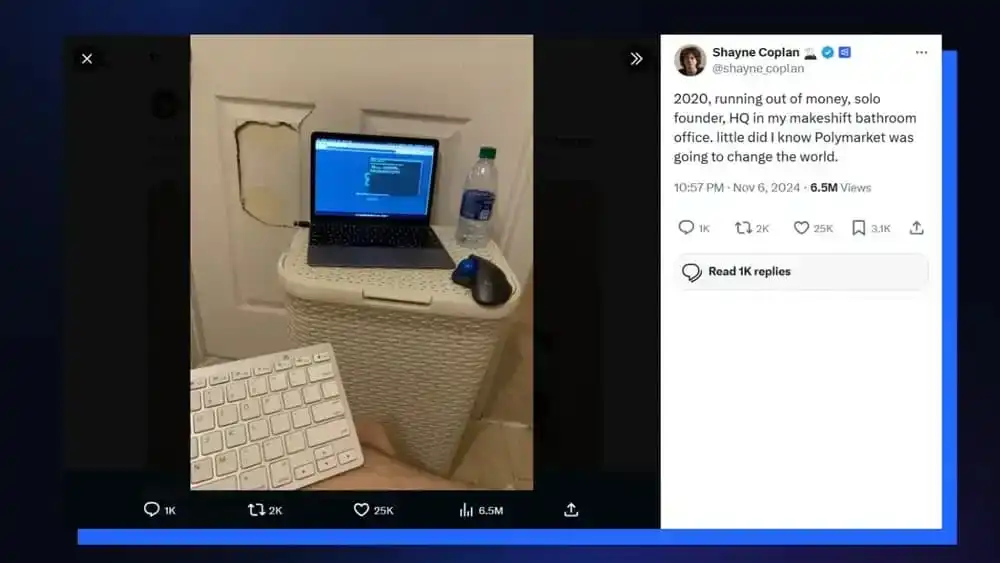
A resource-starved young man, building a market to price chaos during the world’s most chaotic period. The pandemic turned everyone into forecasters, and Coplan wanted to compress scattered judgments—from chat groups, news comment sections, expert interviews, and traders’ desks—into a single tradable price.
He had no co-founder, money was nearly gone, he needed to inventory his apartment items, and calculate what he could sell to pay rent. The product name kept changing: Union.market, Union Marketplace, before finally settling on Polymarket. At first, this name felt arbitrary—just a new gateway sprouting from the remnants of an old project.

June 2020 marked Polymarket’s official launch. Technically, it used Polygon and USDC for settlement—offering lower fees, faster speed, and a user experience closer to a standard web app compared to earlier Ethereum-based prediction markets like Augur.
The early markets were straightforward: ETH price, U.S. COVID-19 case trends, the 2020 election. Though seemingly disparate, they pointed to one central question: When the world is surrounded by uncertainty, are people willing to express their views on the future with real money?
Four months later, the answer began to emerge.
In October 2020, the U.S. presidential election entered its final sprint. The pandemic continued, mail-in ballots became a battleground, racial justice protests still echoed in streets and televised debates, and economic recession loomed over household budgets and market expectations. Trump sought to prove he could lead America out of crisis; Biden framed the election as a chance to “return to normalcy.”
That autumn, every corner of American society was pulled apart by politics. TV stations continuously aired polling data, hosts endlessly analyzed red-blue maps; social media overflowed with conspiracy theories, factional mobilization, and arguments over mail-in voting; Wall Street attempted to forecast tax, regulatory, and fiscal policy shifts; ordinary people searched for stability between pandemic fears and electoral anxiety. Everyone asked: Does Trump still have a chance? Is Biden’s lead solid? If counting is delayed, will the market crash first?
When Polymarket launched, it was still a niche crypto tool. But the election gave it its first real public test. In October, Polymarket completed a $4 million seed round led by Polychain Capital, with participation from Naval Ravikant, Nick Tomaino of 1confirmation, and others.
For a product born in a bathroom, this funding wasn’t just capital—it was a signal: at least a group of crypto investors believed prediction markets might once again become useful.
In November, the Biden-Trump showdown reached its climax. Polymarket’s prices consistently pointed toward a Biden victory in the weeks before the vote. The “Will Trump win?” market recorded over $8 million in trading volume. Today, that figure seems modest—nowhere near the tens of billions seen during the 2024 election cycle. But at the time, it proved one thing: people were willing to trade political judgment on a blockchain-based market.
This $8 million wasn’t the end of a commercial success, but the beginning of a product’s core proposition. It demonstrated that Polymarket was more than a temporary toy during the pandemic or a crypto community’s internal experiment. It provided the first visible sample answering whether market prices could serve as real-time signals for public events.
Of course, Polymarket in 2020 was still tiny. It remained more of a crypto insider tool than a reference source for mainstream political media. Coplan personally managed social accounts, directly messaging investors to ask for likes and shares. Vitalik Buterin tested Polymarket and praised its UX for non-crypto users on Twitter. This feedback was vital, because one of the biggest failures of past prediction markets was beautiful theory paired with unusable products.
Regulatory Crackdown
In 2021, Polymarket evolved from a solo project into a team of over ten people. User base grew from thousands to tens of thousands MAU. A more complete team began operating around it: product managers, market analysts, community builders, and handlers of recurring settlement disputes. It was no longer just a page Coplan had assembled in his bathroom—it had become a genuine venue producing prices, controversy, and news content.
The internal culture was distinctly “rebel/maverick,” carrying the typical aura of a crypto startup: build fast, launch, then deal with rules and boundaries later.
This was the 2021 crypto bull market—where almost everyone believed speed mattered more than order. DeFi, NFTs, DAOs, chain games—new narratives emerged daily, each challenging old rules. Polymarket operated under this atmosphere.
Coplan also continued accumulating social capital within crypto culture. Under the pseudonym ethsquiat, he amassed a large NFT collection and early supported crypto artists like FEWOCiOUS. This wasn’t part of Polymarket’s core mission, but it helps explain Coplan. For this generation of founders, identity, capital, taste, and product are intertwined—sometimes a wallet address says more than a business card.
But Polymarket differed from most crypto products. NFTs could be labeled art, DeFi could be framed as financial experiments, DAOs as organizational innovation. Once prediction markets began handling real-world events, they immediately hit financial regulation and jurisdictional boundaries. Polymarket could claim to be an “information market,” but regulators saw something else: users betting money on event outcomes—looking suspiciously like unregistered event-based contracts.
Thus, CFTC scrutiny became concrete. The question shifted from “Is your product interesting?” to “Do you have the right to offer these contracts?” The more markets Polymarket launched, the sharper the issue became. ETH price, COVID cases, presidential elections, policy events—these markets looked like information to users, but like binary options in regulatory documents.
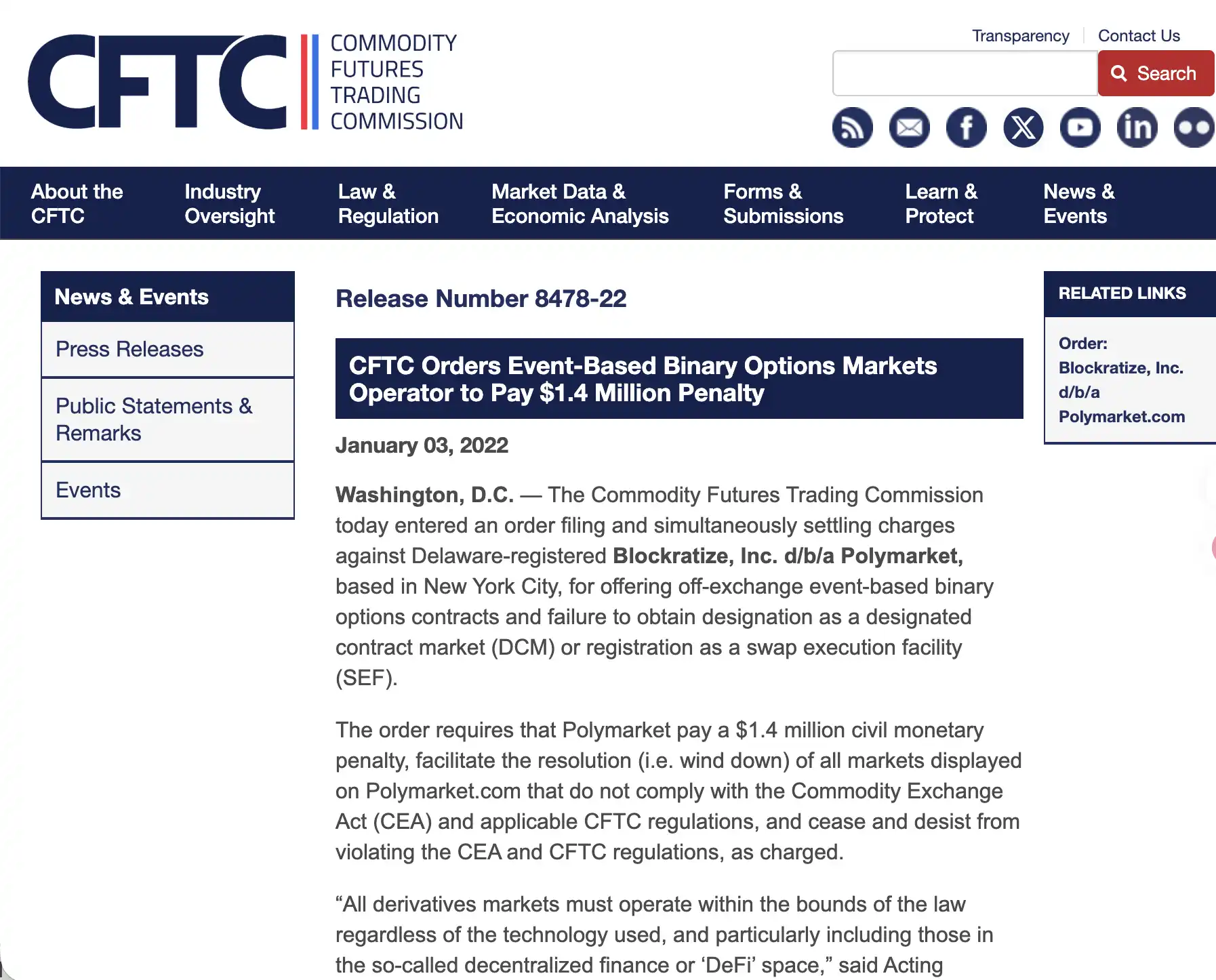
On January 3, 2022, the CFTC issued a cease-and-desist order against Polymarket, alleging it operated unregistered event-based binary options markets—unregistered off-exchange binary options contracts not listed on designated exchanges. Penalties included a $1.4 million civil fine, requirements to wind down non-compliant markets, and a ban on further violations. The CFTC noted Polymarket received reduced penalties due to “substantial cooperation.” By then, Polymarket had offered over 900 event markets.
After the penalty, Polymarket began geoblocking U.S. users.
A platform still headquartered in New York, run by U.S.-based founders, serving global political and financial events, was forced to redirect core trading outside the United States—even though many of the events discussed occurred within the U.S.
Exile and Explosion
After the CFTC penalty, Polymarket entered a strange state. It didn’t die, but it was no longer whole. It kept running, served overseas users, continued launching markets—but lost its most critical, symbolic domestic market.
For a New York-based company, this was awkward. It wasn’t a total failure—because the product lived on. But it wasn’t truly successful either—because U.S. users were blocked. It resembled exile: the company stayed in the U.S., but the product had to pretend the U.S. didn’t exist.
In May 2022, former CFTC Chair J. Christopher Giancarlo joined Polymarket’s advisory board as chair. Known in the crypto space as “CryptoDad,” this appointment sent a clear signal: post-regulatory slap, Polymarket began reinforcing its compliance narrative.
But compliance narratives couldn’t instantly change the situation. An advisory board isn’t a license, and a former regulator’s name wouldn’t automatically open the U.S. market. From 2022 to 2023, Polymarket entered a low phase. Fully offshore operations, shrinking scale. By year-end 2023, cumulative trading volume totaled approximately $73 million. While plausible at the time, this number paled in comparison to the explosion during the 2024 election cycle—almost like another era.
Low periods are hard to document and easily overlooked—they lack iconic photos, viral tweets, or dramatic regulatory raids. But for startups, these moments often decide fate: no applause, slow growth, fading external narratives, yet the team must still fix bugs, manage markets, explain settlements, and maintain liquidity daily.
Coplan didn’t give up. The team kept iterating the product—improving mobile experience, making the interface lighter, streamlining order placement, reducing friction for non-crypto users. The vision of prediction markets could be grand, but users leave for small reasons: slow loading, unclear settlements, poorly written market descriptions, poor mobile usability. From 2022 to 2023, Polymarket survived in these subtle details.
It also waited for the next major public event to draw people back into prediction markets. Not every wait carries heroism. Sometimes, perseverance means maintaining a marginal product through the next news cycle—even when no one believes you’ll succeed.
The Titan Submersible Incident
The next news cycle arrived ungracefully.
In June 2023, OceanGate’s Titan submersible went missing during a dive to the Titanic wreckage. Global media covered rescue efforts continuously. Search vessels patrolled the surface, experts explained oxygen levels on live news, and social media filled with fear, morbid curiosity, anger, and dark humor. Each hour passed, and the event grew into an inescapable public tragedy.

Polymarket swiftly launched a related market: “Will the submersible be found before June 23?” Betting exceeded $2 million. Polymarket’s official account even replied to a viral tweet from musician Rico Nasty: “Still a 15% chance they find them by Friday.”
This comment thrust Polymarket into the spotlight—but not in a flattering way. Critics accused it of gambling on human tragedy, turning death and rescue into odds. Supporters argued the market didn’t create the tragedy—it merely made visible judgments already being discussed publicly. Both sides had merit.
Then, the U.S. Coast Guard announced finding debris, concluding the submersible suffered a catastrophic implosion. Disputes erupted over how “found” should be defined, prompting UMA oracle intervention for arbitration. This exposed a deeper flaw in prediction markets: real-world events aren’t clean like contract terms. A word, a timestamp, a press conference—each could determine how millions of dollars were settled.
The Titan incident didn’t earn Polymarket acclaim—but it did earn attention. Google search volume peaked at historical highs. It proved a grim truth: any news can be monetized. Politics, disasters, war, technology, entertainment—any event with public interest and uncertainty can become a price.
From this moment, Polymarket ceased being just a political forecasting tool. It became more like a shadow market of the news world. News provides headlines; markets provide probabilities. Media creates attention; prices absorb it. The more chaotic, controversial, and unresolved an event, the better suited it is for Polymarket trading.
This path eventually led to the 2024 U.S. election.
Another Election Cycle
In 2024, American politics returned to high tension. Trump aimed to reclaim the White House, Biden sought re-election, and inflation, immigration, war, cultural conflict, and anxiety about democratic institutions intertwined. News screens filled daily with red-blue maps, swing states, court cases, rallies, and polling curves.
This was prime timing for Polymarket.
In May 2024, Polymarket disclosed two rounds of financing totaling $70 million. Series A raised $25 million, led by General Catalyst, with Joe Gebbia, co-founder of Airbnb, participating. Series B raised $45 million, led by Founders Fund, with Vitalik Buterin investing personally, alongside 1confirmation, ParaFi, Dragonfly, Kevin Hartz, and others. Combined with the 2020 seed round, Polymarket’s total funding surpassed $70 million.
Founders Fund partner Joey Krug later offered a telling explanation: “Internally at Founders Fund we developed a habit of checking Polymarket at times of breaking news.” This was more valuable than a typical investor endorsement. It indicated Polymarket had evolved from a trading product into a reflexive tool for some amid breaking news.
In summer 2024, Nate Silver, founder of FiveThirtyEight, joined Polymarket as an advisor. This move further cemented Polymarket’s “information tool” positioning. It wasn’t just crypto insiders claiming to beat the media—the most renowned polling analysis brand in the U.S. was now part of its narrative.
The real turning point came after June 27.
Following the presidential debate, Biden’s performance triggered massive shock across Democratic circles and media systems. Clips replayed endlessly on TV, short videos spread rapidly on social platforms, anonymous party leaks surfaced, donors panicked, the White House scrambled to contain fallout, and the campaign repeatedly insisted everything was normal. All information clashed within days.
Mainstream political discourse still clung to the narrative that “he’ll continue.” Many sensed trouble in the room, but no one dared declare it a conclusion. Polymarket’s prices, however, had no such decorum. The market didn’t wait for press conferences or public statements from party leaders—it simply let traders continuously adjust their bets with capital. While media and political systems struggled to find language, Polymarket had already begun reflecting another possibility: Biden might withdraw.
This was Polymarket’s shift from passive exile to active counterattack. It was no longer just following news—it was providing a market signal before consensus formed in the news system. For Coplan, this mattered more than pure trading volume growth. It proved the story Polymarket wanted to tell: prediction markets aren’t casinos, but faster mechanisms for aggregating information.
From July to October 2024, Polymarket became a standard reference in mainstream political news. It accurately predicted Biden’s withdrawal and Trump’s selection of JD Vance as running mate. Increasing numbers of journalists, investors, and political observers began treating Polymarket as a real-time public sentiment dashboard.
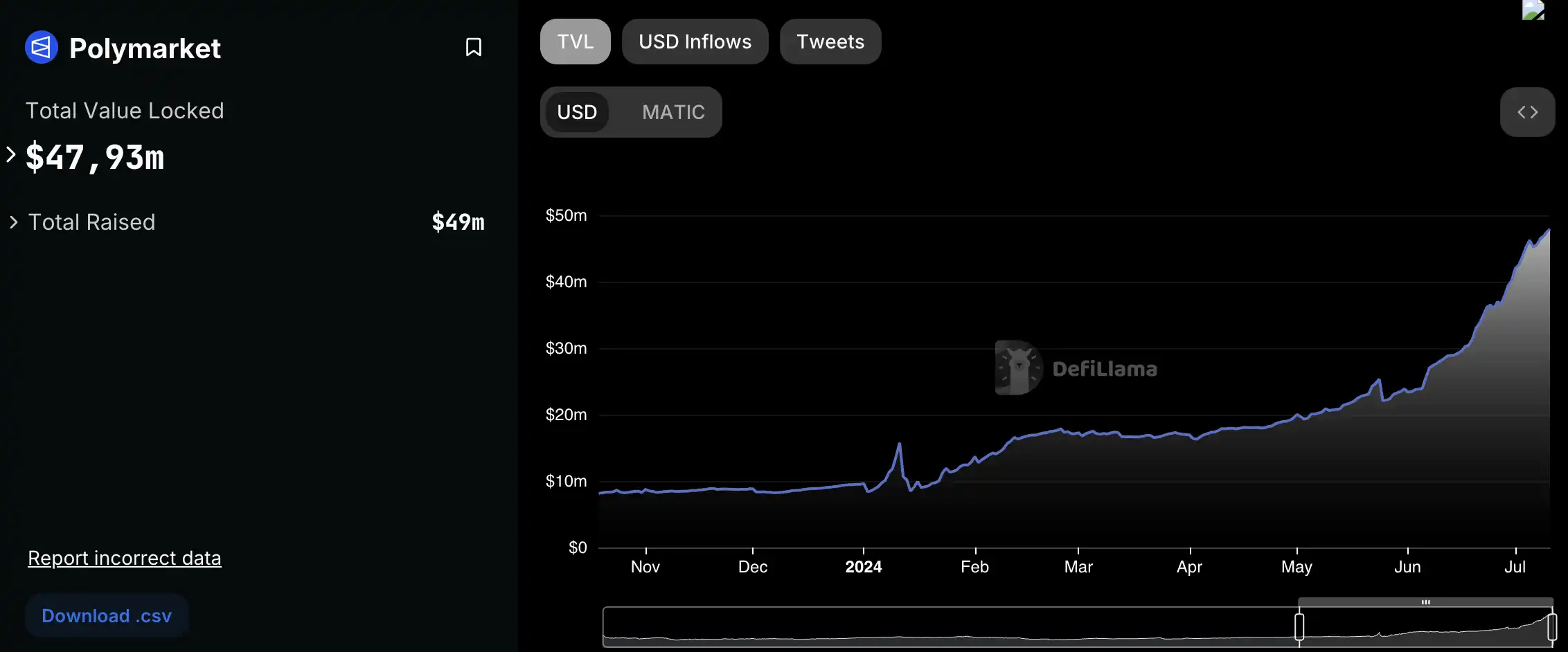
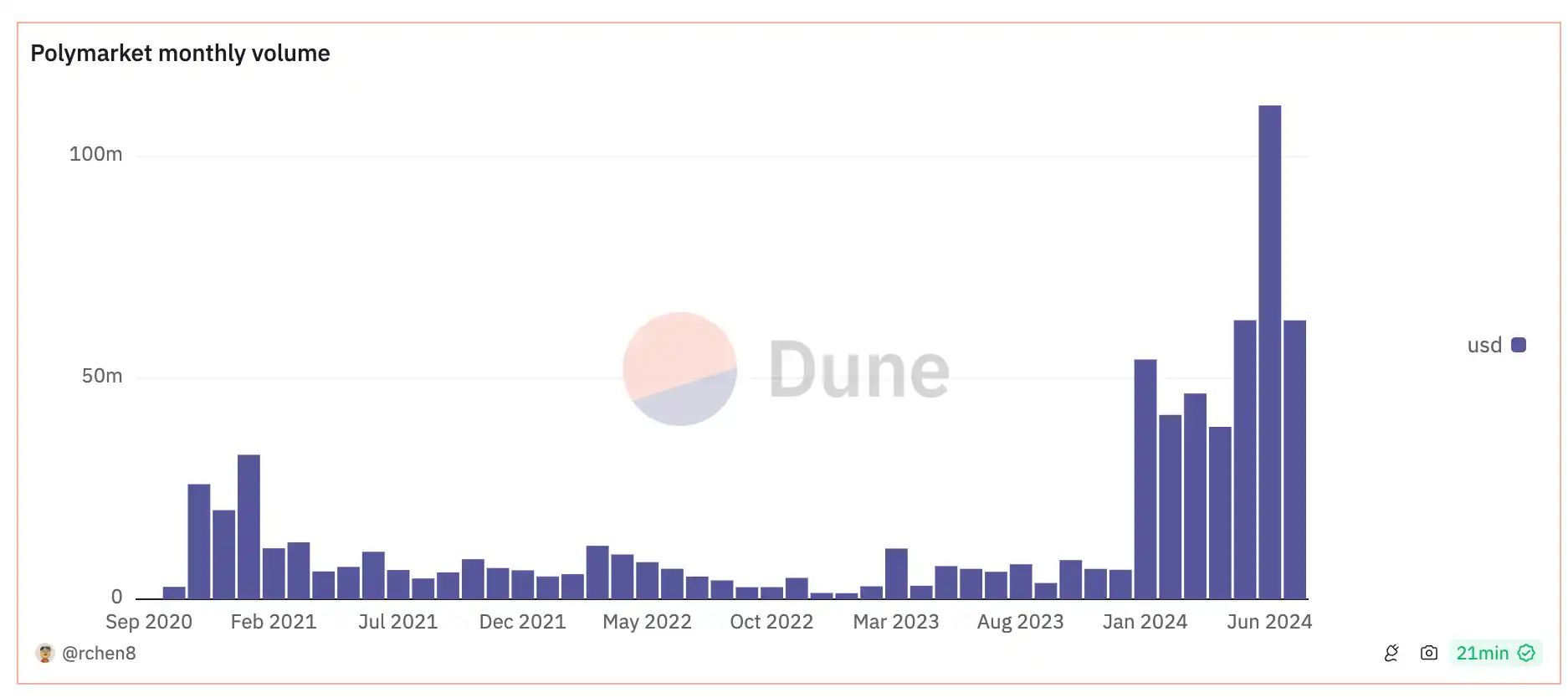
Meanwhile, the Trump Whale controversy erupted. A French former bank trader, nicknamed Théo in media reports, placed over $45 million in bets on Trump’s victory across accounts like Fredi9999, Theo4, PrincessCaro, and Michie. The Wall Street Journal first reported the large-scale activity, sparking manipulation suspicions. After investigation, Polymarket stated no evidence of manipulation was found.
The core issue wasn’t just how much one person bet, but that Polymarket finally faced the inevitable problem after success: if a prediction market begins influencing public narratives, is it merely reflecting information—or also creating it?
On November 7, Coplan appeared on CNBC Squawk Box for his first-ever television interview. Shortly after, he received a call from Mar-a-Lago leadership. In a Fortune interview, he said: “I've learned that anything is possible. Turning dreams into reality has never felt more tangible, and luckily I'm a dreamer. The world is shaped and changed by optimists.”
This sounded like a victor’s manifesto. But Polymarket’s story has never been a simple triumph. Each time it proves its usefulness, it pushes itself into greater danger.
Eight days later, danger knocked.
FBI Raids the Apartment
On November 13, 2024, at 6 a.m., New York hadn’t fully awakened. Just days earlier, Coplan had been explaining prediction markets on camera. He was jolted awake by a loud bang. In a CBS 60 Minutes interview, he recalled FBI agents using a battering ram. The door was smashed open, devices seized.
No arrest, no indictment, no public explanation of the investigation’s cause.
From the $3.6 billion in trading volume on election night, to a phone call from Mar-a-Lago, to the FBI’s hammering door—just eight days apart. A 26-year-old founder had just reached the center of global political narrative, only to stand barefoot in his home watching federal agents take his equipment. For Coplan, this wasn’t ordinary legal risk—it was deeper uncertainty: he didn’t know what the investigation targeted, whether he was the target or collateral, or whether the mainstream recognition his company had just gained would instantly become new evidence of guilt.
Hours later, he logged into a new phone on X and posted: “new phone, who dis?”
This post became widely quoted because it perfectly captured Coplan and Polymarket’s stance: no explanation, no weakness. A casual internet slang response to a federal raid. It sounded like a joke—but also like resistance.
He then posted a more serious update: “It's discouraging that the current administration would seek a last-ditch effort to go after companies they deem to be associated with political opponents. Polymarket has provided value to tens of millions of people this election cycle, while causing harm to nobody.”
Polymarket’s spokesperson framed the event more directly: “This is obvious political retribution by the outgoing administration.” Elon Musk commented on X: “This seems messed up.”
Yet critics saw different issues. Polymarket had promised in 2022 to block U.S. users after CFTC penalties. Yet it processed billions in trades during the 2024 election and deeply influenced U.S. political discourse. Even if the platform claimed U.S. users couldn’t trade, regulators had reason to question: were these geoblocks truly effective? Were U.S. users still accessing via other means? Was Polymarket violating its 2022 settlement agreement?
The FBI raid brought all contradictions to the surface simultaneously. Polymarket could claim it was an information market, that it harmed no one, that it merely accelerated truth. But to regulators, it could still be an unapproved event contract market trying to enter the U.S. The more successful it became, the less it could hide behind the “niche crypto product” label.
Three weeks later, Coplan took the stage at the New York Times DealBook Summit. The venue: Jazz at Lincoln Center, midtown Manhattan—far from his bathroom office, close to Wall Street and media centers. Below sat hedge fund managers, Silicon Valley executives, and political commentators. Lights, cameras, name tags, security, media seats—all belonging to the mainstream world.
For a founder recently raided by the FBI, whose phone was seized and whose investigation remained unresolved, this wasn’t an obvious choice. A safer path would have been silence, staying low, letting lawyers handle everything. Coplan chose the opposite. He stepped into the spotlight and continued discussing the future of prediction markets.
Meanwhile, walls grew higher. Late 2024, French regulators began investigating whether Polymarket violated local rules; the platform subsequently implemented geoblock for France. Early 2025, Singapore, Poland, Belgium, and others added Polymarket to lists of illegal gambling or unauthorized platforms.
Individually, these bans may not have significantly impacted trading volume. But layered atop the FBI raid and DOJ/CFTC investigations, they sent a clear signal: gray areas were narrowing. No regulatory framework had a dedicated slot for “prediction markets.”
From late 2024 to early 2025, Coplan and his team’s choices became clear. Continuing to circumvent regulations made no sense. The real path wasn’t avoiding oversight—but entering it. Not waiting outside the U.S. gate for permission, but buying a ticket to enter.
Homecoming
Connection with the Trump Family
Mid-July 2025, the sword hanging over Polymarket finally fell.
The U.S. Department of Justice (DOJ) and CFTC concluded their investigation of Polymarket without filing any charges, lifting three years of legal shadows. Many speculated the reason lay in Polymarket’s newfound ties with the Trump family.
Polymarket now had real expansion potential.
In July 2025, Polymarket acquired QCEX for $112 million. The purchase wasn’t just a name—it included a full entry point into the U.S. regulatory ecosystem: QCX LLC, a CFTC-registered derivatives exchange, and its clearinghouse QC Clearing LLC. QCX would later operate as “Polymarket US.”
This step was pivotal: instead of applying for a license from scratch—too slow, too uncertain, too prone to getting stuck in regulatory quicksand—Polymarket chose a direct route: acquiring an entity already holding a license.
On August 26, Donald Trump Jr. joined Polymarket’s advisory board. Concurrently, 1789 Capital, linked to Trump, invested in Polymarket. This looked like a straightforward political quid pro quo—but also mirrored the real-world echoes of the 2024 election.
Polymarket’s accurate prediction of Trump’s victory caught the Trump camp’s attention. By 2025, regulatory climate, political winds, and discussions about legalizing prediction markets began converging. To supporters, this was a long-misunderstood innovation finally gaining a chance to re-enter the U.S. To critics, it was a gray platform leveraging political cycles to get closer to power.
Polymarket has always thrived in ambiguity. It’s both an information market and a gambling platform; both financial infrastructure and a political mood machine; it can be framed as a victory for market freedom or a triumph of regulatory arbitrage. Trump Jr.’s addition simply pushed this ambiguity into clearer view.
In September, the CFTC issued a no-action letter to QCX, effectively allowing Polymarket to operate event contracts in the U.S. through intermediary channels. Coplan praised the CFTC’s “impressive work” and “record timing” on X.
Placed beside the 2013 email he’d written to the SEC, this sentence created a poetic symmetry. A 14-year-old boy once asking regulators if his exchange idea was legal. Twelve years later, standing behind a platform handling billions in trades, finally securing a pathway into the U.S. regulatory system.
The Check from the NYSE Parent Company
What truly signaled Polymarket’s identity shift was the transaction on October 7, 2025.
Intercontinental Exchange (ICE) announced a strategic cash investment of up to $2 billion in Polymarket. ICE is the parent company of the New York Stock Exchange and one of the world’s most important exchange groups. Polymarket’s valuation reached $8 billion, post-money about $9 billion. ICE would also become Polymarket’s global data distributor, with joint initiatives advancing tokenization.

That month, Coplan was included in the Bloomberg Billionaires Index. Forbes estimated his net worth at around $1 billion, based on roughly 11% equity stake. At 27, he transitioned from a 26-year-old dropout raided by the FBI to one of the youngest self-made billionaires—within less than a year.
Later, CBS 60 Minutes asked him if he ever thought Polymarket could be worth so much. His reply was quintessentially Coplan: “I mean, I didn't start it to not get here, you know?”
Not humility, not surprise—but rather: I was always headed here.
As capital and regulatory narratives advanced, Polymarket began integrating into sports, media, and financial data systems. October to November 2025, partnership announcements poured in. The NHL became the first professional sports league to collaborate with a prediction market platform. UFC designated Polymarket as its exclusive official prediction market partner; Dana White and Coplan appeared together on CNBC. Yahoo Finance named Polymarket its exclusive provider of crypto prediction market data. Google Search and Google Finance began incorporating Polymarket’s predictive data.
These partnerships may seem scattered, but they collectively signal one thing: Polymarket is no longer just a destination—it’s becoming someone else’s data layer. Users may not open the Polymarket app daily, but they might see its odds in Google searches, its probabilities on Yahoo Finance, or its market signals embedded in sports broadcast pages. Prediction markets, once requiring active user engagement, are now becoming embeddable data content in other contexts.
On November 13, one year after the FBI raid, Coplan posted on X: “Cheers to free markets, the American dream, and $3000/hr lawyers.”
Exactly one year prior, he had been woken from bed, his phone taken, and federal agents standing in his apartment. One year later, he was a billionaire, his company had just secured a $2 billion strategic investment from ICE, and the path back to the U.S. was about to be officially opened.
“Free markets”—Polymarket’s ideal for the world; “American dream”—its story for itself; “$3000/hr lawyers”—the cost of ideal and story in American reality.
On November 25, the CFTC issued a revised Order of Designation, formally approving Polymarket to operate as a regulated Designated Contract Market via QCX. U.S. users can now trade through FCMs and traditional brokerage channels. Polymarket now operates under the same regulatory framework as CME and ICE.
In January 2022, the CFTC penalized Polymarket, stating it couldn’t provide event contracts in that manner. In November 2025, the CFTC approved Polymarket to return to the U.S. through a different legal entity and regulatory path—operating as a regulated market. The door wasn’t broken down; it was rekeyed. Coplan didn’t bypass the rules—he bought access within them, then had regulators open the door.
In December, Polymarket US launched in limited scope, ending nearly three years of U.S. market absence since the 2022 penalty. This “homecoming” wasn’t romantic. No button could erase three years of gray area, nor could one approval erase all controversies. But it achieved a clear act: a platform expelled from the U.S. had returned along the regulatory path.
On December 1, Anderson Cooper’s 60 Minutes featured a lengthy interview with Coplan. Sitting in the most traditional American TV news format, Coplan explained to the broadest audience what Polymarket truly was.
He said: “Polymarket is the most accurate thing we have as mankind right now.”
He also said: “People rely on Polymarket because we provide clarity where there is confusion and accountability where there is ambiguity.”
Providing clarity in chaos, accountability in ambiguity. For a product long labeled a gambling platform, this was an ambitious redefinition.
On December 11, Coplan was named to CoinDesk’s “Most Influential 2025.” At this point, Polymarket’s comeback was complete: investigations ended, licensing pathways secured, CFTC clearance granted, ICE investment secured, mainstream media endorsement, and the U.S. market reopened.
If the story ended here, it would resemble a standard victory. But Polymarket’s new normal isn’t peace—it’s a larger battlefield.
Polymarket’s Sixth Year
January 7, 2026: The Dow Jones/WSJ data distribution agreement went live, bringing Polymarket’s predictive data into the Wall Street Journal’s content ecosystem. This move wasn’t as headline-grabbing as the ICE investment, but its significance was profound: market prices began entering the production pipeline of the news industry.
Previously, news reported events, markets traded them. Now, market prices themselves became part of the news. Journalists covering an election, rate cut, or sports event could cite Polymarket’s probabilities alongside polls, odds, and futures prices. Polymarket evolved from a subject of reporting into a tool for reporting the world.
Days later, this tooling entered a more mass-market context.
On January 11, the 83rd Golden Globes broadcast featured Polymarket odds for the first time. Red carpet, gowns, stars, trophies, and prediction market odds appeared in the same frame. Polymarket correctly predicted 26 of 28 awards.
Coplan posted on X: “The single most mainstream prediction market integration to date. A surreal moment and a highlight for all our team members' moms.”
This wasn’t a message for regulators or investors—it was a young team realizing their creation had made it onto a TV show their parents might watch. But criticism followed swiftly. Critics called it “gambling meets dystopia.” When everything can be predicted, traded, and shown live, is the world clearer—or colder?
On January 27, Polymarket became the exclusive prediction market partner for all MLS events. Sports became the new frontier. Compared to politics, sports results are more frequent, clearer, and easier to consume; compared to traditional gambling, prediction markets could position themselves as closer to trading and information.
In February, Polymarket piloted taker fees on sports markets, initially covering NCAA and Serie A. Prior crypto market fees already generated weekly revenue of ~$1.08 million. Charging fees marked a new phase: no longer just proving volume and information value, but systematically demonstrating a viable business model.
That same month, Ari Borod, former CBO of Fanatics, joined as President of Sports Business Development. Fanatics had previously sued to prevent his departure, later settling out of court. This minor incident underscored the stakes: Polymarket’s entry into sports wasn’t just a crypto company expanding its product line—it was competing with traditional sports businesses, gambling firms, and media rights holders for talent and position.
On February 4, Blockratize, Inc. filed trademark applications for “POLY” and “$POLY.” CMO Matthew Modabber had earlier clearly stated: “There will be a token, there will be an airdrop.”
This brought Polymarket’s narrative back to its crypto roots. While it entered CFTC frameworks, partnered with ICE, and supplied data to WSJ and Google, the market still expected it to launch a token, conduct an airdrop, and redistribute platform value to crypto users. This is Polymarket’s other tension: the more it moves toward Wall Street, the harder it is to sever ties with the crypto community. Because the earliest believers, users, and liquidity providers were precisely those willing to bet on the world on-chain.
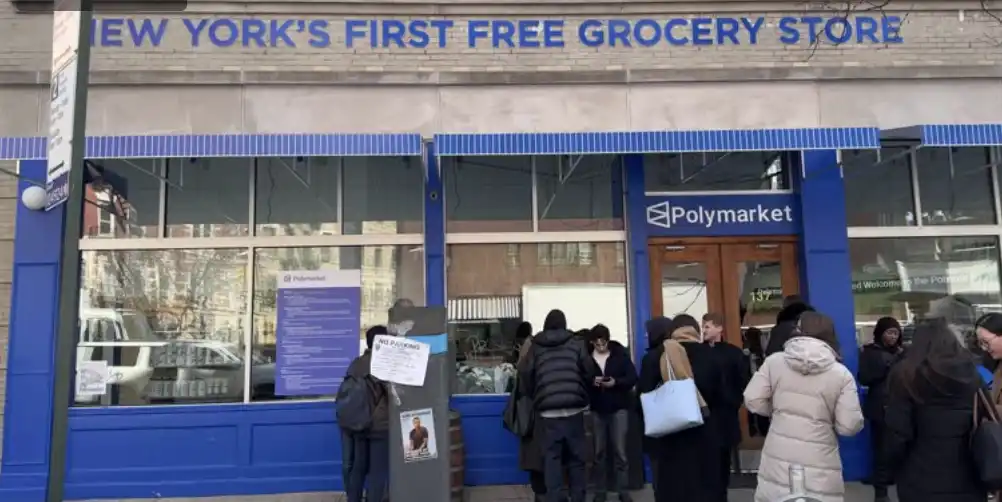
In March, ICE added a $600 million investment, raising Polymarket’s valuation to ~$15 billion. That month, Polymarket signed a multi-year exclusive agreement with MLB, reportedly valued up to $300 million.
On March 18, Polymarket acquired Brahma, a DeFi infrastructure company founded in 2021 with over $1 billion in transaction volume. Within 30 days of acquisition, Brahma shut down its standalone product, with all teams and technologies integrated. The focus: lowering on-chain usage friction—wallet creation, deposits, token swaps—those pain points that deter average users from blockchain products.
Coplan said: “Building reliable infrastructure across blockchain networks and traditional financial rails is hard—there are no shortcuts.”
This statement fits Polymarket in 2026 perfectly. It’s no longer just a website or a prediction market frontend. It now straddles two infrastructures: one blockchain network, the other traditional financial rails. One demands openness, speed, and global liquidity; the other requires licenses, clearing, intermediaries, and compliance. The real challenge isn’t getting users to click yes or no—it’s making these two systems temporarily coexist within one product.
On March 30, Polymarket introduced a tiered fee structure across all categories, using an inverted parabolic model: Crypto peak at 1.80%, Financial & Political at 1.00%, Sports at 0.75%, Maker fees free with 25% rebate. Market projections estimate annual revenue exceeding $200 million.

June 2026 marked Polymarket’s sixth anniversary.
Six years ago, it was a small product grown in a New York bathroom during lockdown. Six years later, it entered Google, WSJ, sports leagues, ICE, CFTC regulatory frameworks, and mainstream TV broadcasts. Cumulative trading volume, valuation, partners, regulatory status—every metric suggests it has moved from the edge to the center.
But the sixth anniversary isn’t a fairy-tale ending.
The CFTC proposed formal authorization for sports event contracts, while restricting sensitive markets like injuries and high school sports. Bipartisan senators introduced the “Prediction Markets Are Gambling Act,” aiming to ban CFTC-authorized platforms from offering sports contracts. Wired reported that U.S. users still heavily accessed Polymarket via offshore international sites. Valuation reportedly approached $20 billion. $POLY token and airdrop remain anticipated, with market odds of completing TGE between 62% and 70% in 2026.
Coplan has returned home. But he returns not to the America of 2020.
The 2020 America was still searching for answers in pandemic and election; Polymarket was a new, small tool. The 2026 America knows this tool can shape narratives, attract capital, challenge polls, trigger regulation, join sports leagues, and enter mainstream media. The door is open—but the living room is now filled with regulators, investors, journalists, league executives, traders, lawyers, and critics.
Thus, “homecoming” isn’t the end of the story—it’s a change of identity. On this sixth anniversary, Polymarket finally stands where it always wanted to be: the world now takes information markets seriously.
But that also means the world is ready to judge it seriously.
Original article: BlockBeats
Disclaimer: Contains third-party opinions, does not constitute financial advice
Bessent: Advancing the Cryptocurrency Regulatory Framework Through Actions by the SEC and CFTC
2 hours ago
Polymarket US Launches 5-Minute Cryptocurrency Price Movement Prediction Market
2 hours agoCFTC Sues Utah State, Aiming to Block Its Restrictions on Prediction Markets
4 hours agoCancore Closes $7.2 Million Seed Round with Participation from Paper Ventures
6 hours agoNVIDIA and Oracle Expand Collaboration, Scaling NVIDIA Vera Rubin Architecture Deployment to Multi-Gigawatt Levels
7 hours agoCoinbase to List Stable (STABLE)
8 hours agopredict.fun: API documentation site hosted by third-party service provider was attacked, resulting in partial loss of user funds
9 hours ago