The Wall Street Journal Exposes Polymarket's "Deceptive Marketing": Fabricated Profit Videos, Targeted Feeds for U.S. Users
The Wall Street Journal Exposes Polymarket's "Deceptive Marketing": Fabricated Profit Videos, Targeted Feeds for U.S. Users


According to an investigative report published by The Wall Street Journal on June 21, Polymarket systematically hired dozens of social media creators to film fake trading videos on counterfeit platforms that closely mimic its official website, creating a false impression of "easy profits." The Journal reviewed 1,105 videos posted by 10 creators between December 2025 and mid-May 2026, finding that approximately 70% featured betting scenes—yet none of the roughly $1.9 million in displayed transactions were real.

Fake Website, Fake Trades, Fake Wins: The Fraudulent Supply Chain Behind 1,105 Videos
The Wall Street Journal’s investigation uncovered a complete system of marketing fraud.
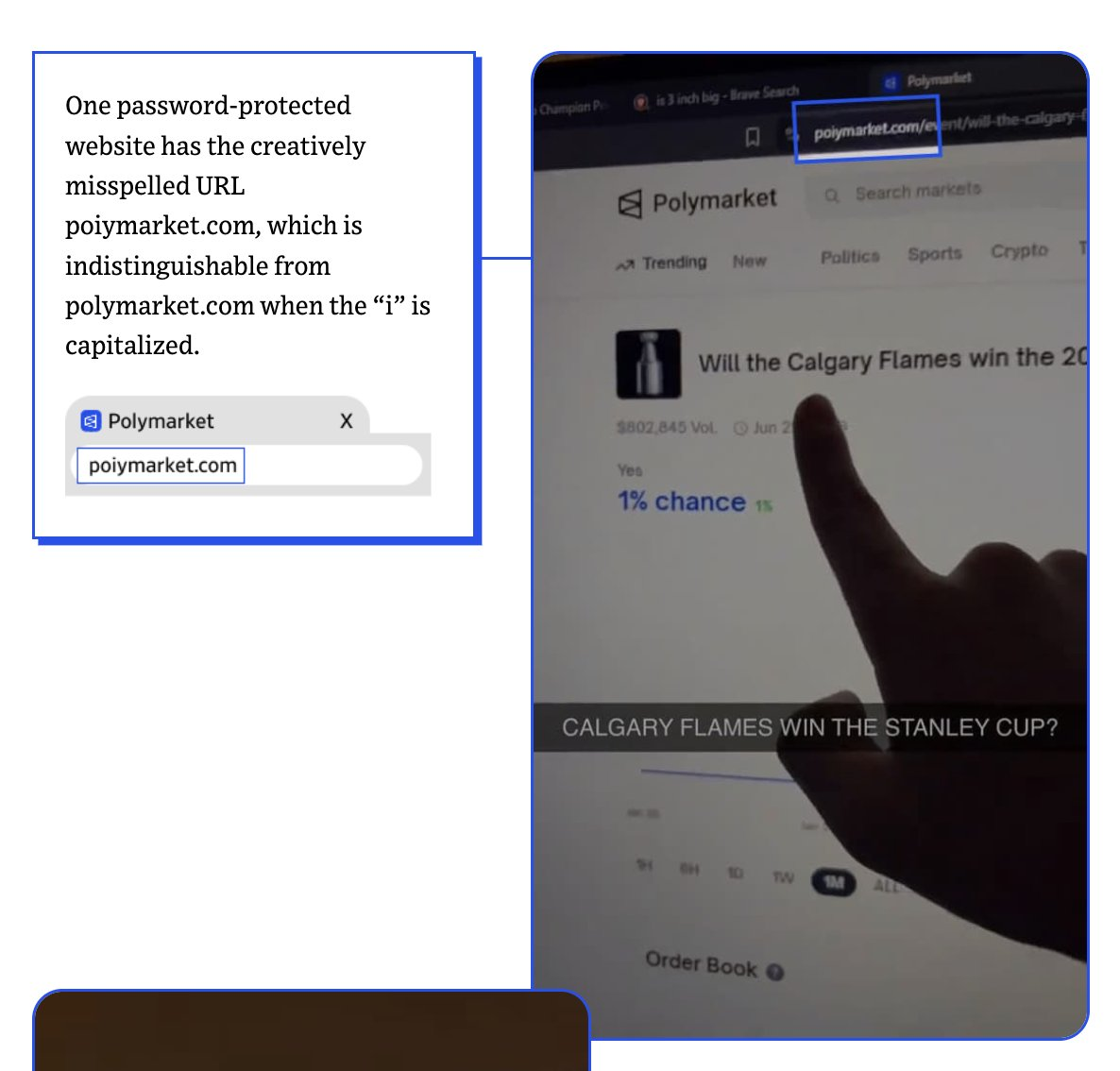
Polymarket and its marketing contractor Virality built replica sites nearly identical to the official platform, enabling creators to simulate trades and record videos. According to reports, one such spoof domain was “poiymarket.com” (replacing lowercase L with uppercase I), visually indistinguishable from the authentic URL.
Among the 1,105 videos reviewed, about 70% displayed betting scenes—but all transactions occurred on the fake site, never executed on Polymarket’s actual blockchain-based platform. Around 10% of the videos employed more deceptive tactics: creators used expired news footage or fabricated headline screenshots to falsely imply they had won bets.
A notable example is a video posted in January by college student George Makihara, claiming he bet $1,000 on “Trump saying the word ‘McDonald’s’ publicly this month” and won $100,000. However, the footage of Trump uttering the phrase was two months old. After verifying actual on-chain data from Polymarket, the Journal found that over 50 accounts placed bets on the same event that month—and all suffered losses.
It is estimated that the total fake profits shown across 118 videos approached $900,000. If these bets had been placed on the real platform, the actual losses would have exceeded $166,000.
Targeting U.S. Users: Polymarket Has Been Excluded from American Services Since 2022
The most sensitive aspect of this marketing scheme lies in audience targeting. Since reaching a settlement with the U.S. Commodity Futures Trading Commission (CFTC) in 2022, Polymarket has been prohibited from offering services to users in the United States. While users may bypass restrictions via VPNs, the platform itself is barred from marketing directly to American audiences.
However, internal guidance documents obtained by The Wall Street Journal reveal that Virality explicitly instructed its network of “clippers” (low-paid social media users responsible for reposting and amplifying content) to only receive compensation if at least 60% of viewers originated from the U.S. In one internal group chat, a Polymarket marketing contractor wrote that clipper accounts containing “Polymarket” or “poly” in their names would not be paid.
According to analytics firm Tubular, these videos accumulated over 140 million views across TikTok, YouTube, and Instagram. Creators earned monthly stipends of approximately $2,000 to $3,000, and prior to journalist inquiries, most had not disclosed their paid partnerships with Polymarket.
Multimillion-Dollar Deal with Adin Ross: Paid Promotions Discussing Insider Trading
Polymarket’s promotional spending extends far beyond student creators. According to The Wall Street Journal, the platform signed a multimillion-dollar marketing contract with 25-year-old influencer Adin Ross, who spends an average of 30 minutes per week browsing Polymarket during his live streams, discussing potential trading opportunities.
Polymarket and Virality included dozens of Ross’s videos in their paid promotion program. The Journal discovered that at least five of these videos discussed strategies for exploiting insider information to profit on the platform—for example, leveraging advance knowledge of Drake’s new album release date for arbitrage.
More broadly, The Wall Street Journal identified at least 19 videos promoted by Polymarket that discussed insider trading opportunities—directly contradicting previous public statements by Polymarket CEO Shayne Coplan, who dismissed insider trading allegations as “absurd and baseless.” Ross himself is now facing class-action lawsuits, including a federal RICO case, over alleged deceptive promotions on the gambling platform Stake.us.
Two Marketing Scandals in One Month: Escalating Regulatory Pressure
The Wall Street Journal’s investigation is not isolated. On June 5, Politico reported that Polymarket’s Chief Marketing Officer Matthew Modabber transferred over $2.5 million via personal PayPal accounts to more than 800 creators and influencers between January 2025 and February 2026, with at least $350,000 going directly to content creators promoting Polymarket. Approximately 24 identifiable influencers posted over 490 Polymarket-related posts on X after receiving payments—none disclosing their paid relationships.
Meanwhile, regulatory and legal pressures on Polymarket continue to mount. In May, the U.S. Department of Justice charged a Google software engineer with profiting approximately $1.2 million on Polymarket using confidential company information—the first-ever federal criminal prosecution for insider trading on a prediction market. In April, the DOJ also accused a U.S. Army sergeant of using classified intelligence to earn over $400,000 on contracts linked to Polymarket. On June 21, chain-tracking firm Lookonchain reported that three Polymarket wallets collectively made $24.25 million in profits from World Cup predictions and funneled funds through a single Binance deposit address—strong evidence of potential insider trading.
Polymarket stated in a statement that it “is committed to maintaining accurate, fair, and transparent markets” and will conduct a comprehensive audit of actively promoted content. Yet for a platform whose core value proposition rests on blockchain transparency, its growth strategy relies fundamentally on unverifiable off-chain fake videos—an inherent contradiction that severely undermines its foundational trust model.
Jason Trost, CEO of competitor Smarkets, commented: “The essence of an exchange lies in having a genuine order book accessible to anyone for audit. Regulated exchanges retain settlement records and are accountable to the CFTC—precisely because of this.”
By: Claude, DeepChaos TechFlow
Disclaimer: Contains third-party opinions, does not constitute financial advice
Bessent: Advancing the Cryptocurrency Regulatory Framework Through Actions by the SEC and CFTC
2 hours ago
Polymarket US Launches 5-Minute Cryptocurrency Price Movement Prediction Market
2 hours agoCFTC Sues Utah State, Aiming to Block Its Restrictions on Prediction Markets
4 hours agoCancore Closes $7.2 Million Seed Round with Participation from Paper Ventures
6 hours agoNVIDIA and Oracle Expand Collaboration, Scaling NVIDIA Vera Rubin Architecture Deployment to Multi-Gigawatt Levels
7 hours agoCoinbase to List Stable (STABLE)
8 hours agopredict.fun: API documentation site hosted by third-party service provider was attacked, resulting in partial loss of user funds
9 hours ago