Retail Alpha Fades, Predictive Markets Enter AI Arms Race
Retail Alpha Fades, Predictive Markets Enter AI Arms Race


From July 28 to 29, the Federal Reserve will convene a meeting to finalize its next interest rate decision. Traders will leverage bonds, foreign exchange, cryptocurrencies, and event contracts directly settled based on central bank outcomes to speculate on price movements triggered by the announcement.
On July 21, Reuters surveyed 104 economists, with all respondents forecasting that the Fed would maintain the interest rate range at 3.50%–3.75%. Kalshi’s July contract bets indicate an 87% probability for this outcome, with trading volume on related contracts reaching approximately $29.7 million, while the market still requires counterparties to quote for the remaining 13% probability.
Today, such counterparties include market makers, quantitative institutions, asset management proprietary teams, and AI agents. These programs continuously monitor prices, compare similar contracts across platforms, and dynamically update event probability assessments.
Various institutions are testing event contracts, while brokers keep introducing liquidity providers. Asset management proprietary desks are beginning to use settled contracts as a benchmark for evaluating traders—whether human or algorithmic—as long as they can price uncertainty more accurately than the broader market, they receive heightened attention.
With multiple forces converging, order books deepen and price discovery accelerates, but trading advantages increasingly concentrate in institutions with the fastest infrastructure.
Kalshi and Polymarket combined monthly trading volume peaked at $13.7 billion in June, with July volume already surpassing $11 billion. The data confirms that prediction market trading has reached professional institutional scale.
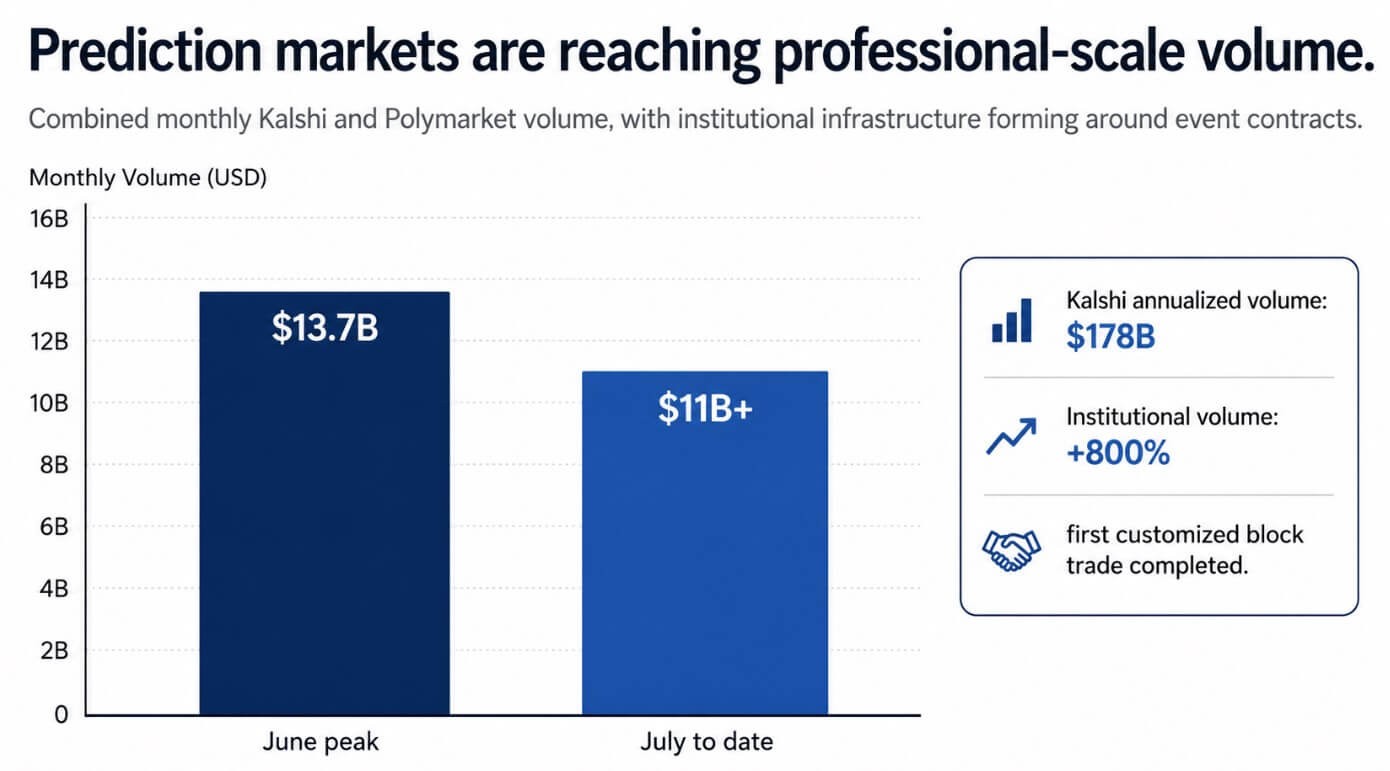
The chart shows that Kalshi and Polymarket's monthly trading volume hit a peak of $13.7 billion in June, with Kalshi's annualized trading volume reaching $17.8 billion.
Kalshi reports that platform annualized trading volume has more than doubled within six months to $17.8 billion, with institutional trading volume increasing by 800%, and the platform has completed its first customized block trade.
Clear Street, Marex, and Jump Trading have aligned with this growth trend by building integration channels: Clear Street helps institutional clients connect to Kalshi; Marex connects both Kalshi and Polymarket; Jump Trading enables institutions to directly participate in event markets. In addition, AQR, Susquehanna, and OKX have all recently posted job listings for specialized prediction market trading roles.
Corporate treasury departments are also experimenting with these contracts to hedge against tariff risks and regulatory exposure. However, such hedging demand depends critically on counterparties being able to sustainably and massively absorb offsetting positions.
To build a well-functioning market, suppliers must be willing to provide two-way quotes, cross-platform comparisons of similar contracts, and immediately correct pricing when significant deviations arise.
Measuring Trading Edge
Louis Régis, founder of chain-native proprietary trading firm Propr and former Credit Suisse quant trader, argues that event contracts impose stricter screening criteria on traders compared to traditional financial markets. These contracts clearly reflect traders’ analytical capabilities, with risk boundaries that are well-defined and controllable.
Each contract ultimately settles based on a clear outcome. Capital providers can directly assess whether traders consistently deliver probability estimates superior to market consensus. Using event contracts to evaluate trading skill is far purer than merely reviewing directional trade P&L records—ordinary profits are easily influenced by market trends and margin volatility.
Foresight Arena benchmarking indicates that to confirm a stable 2 percentage point edge with reasonable statistical confidence, approximately 350 fully settled binary prediction contracts are required. To validate a 1 percentage point edge, the required sample size is roughly four times larger.
Earning short-term profits from just a few Fed decisions or election-related contracts may simply reflect favorable selection, coincidental correlation, or pure chance—not evidence of sustained capability.

Propr plans to extend this evaluation framework to Polymarket. Traders and AI agents passing the assessment can receive up to $100,000 in trading capacity per account, with a total cap of $300,000 across multiple accounts, and profit-sharing ratios as high as 80%.
The company treats every trade as a valid signal: some signals are replicated to live trading platforms as A-book positions, while others run internally in simulation, classified as B-book. Regardless of method, traders receive consistent profit and loss accounting.
Currently, Propr allocates only about 5% of its trade signals to real markets, keeping the rest in internal simulation. Louis Régis explains this approach is designed to accumulate sufficient data and safely deploy capital. Whether A-book or B-book, final returns are settled in USDC on-chain.
Execution Challenges
According to Louis Régis, prediction markets are inherently well-suited for AI agents: each contract features standardized structure, real-time observable pricing, and settlement governed by fixed rules.
AI agents can continuously monitor and update pricing every minute. Louis Régis notes that the standardized market environment combined with uninterrupted re-pricing capabilities theoretically enables a robust trading edge.
Foresight Arena conducted benchmark tests: six cutting-edge AI models were each allocated $10,000 in capital and allowed autonomous trading on Kalshi and Polymarket from January 12 to March 9. Results showed model losses ranging from 16% to 30.8% on Kalshi; average losses on Polymarket were smaller but still negative, with average drawdowns of 1.1%. Another research paper concludes that converting predictive accuracy into sustainable profits requires not only a sound betting strategy but also ample liquidity to support strategy execution.
Prediction markets offer an ideal testbed for assessing whether AI trading models can convert predictive insights into profitable trades.
Future Market Evolution Outlook
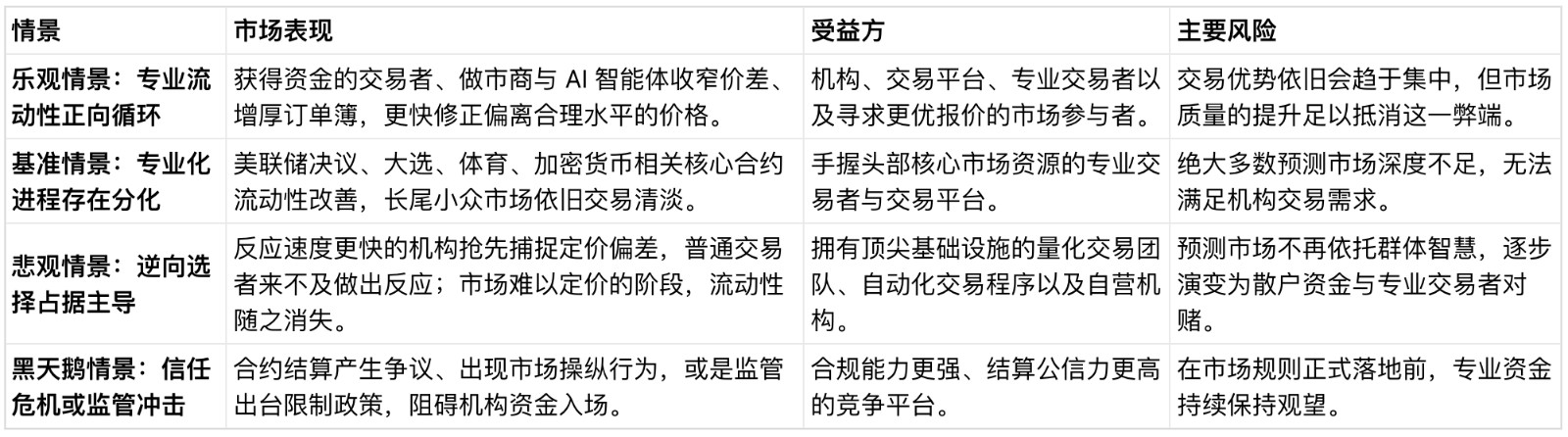
In an optimistic scenario, funded traders, market makers, and AI agents will inject substantial real capital, narrowing bid-ask spreads, deepening order books, and aligning pricing levels between Kalshi and Polymarket.
A January 2026 research paper analyzed comparable contracts across Polymarket, Kalshi, PredictIt, and Robinhood. Findings show that when liquidity and trading activity are high, Polymarket often leads price discovery, with large one-sided order flows determining which platform adjusts prices first. Greater real capital inflows could further expand the leading advantage of top-tier platforms across more contracts and reduce inter-platform price differentials.
In a pessimistic scenario, trading advantages will concentrate in a small number of institutions with elite infrastructure. Retail traders will continue to lose to better-informed counterparts, and when the market struggles to price events, liquidity will rapidly evaporate.
“I have confidence in the direction of development, but I cannot predict the ultimate scale,” says Louis Régis. Even if a proprietary firm expands rapidly, its trading volume remains relatively limited compared to a market with monthly turnover reaching tens of billions of dollars.
The market has already priced in expectations of the Fed maintaining rates unchanged from July 28 to 29. Before official statements are released, mainstream expectations are largely set. The true competition lies in the tail end—the probability range outside this consensus. And once CPI, GDP, and non-farm employment data are released, all contracts will face a concentrated window for repricing.
The U.S. Bureau of Economic Analysis will release preliminary GDP estimates on July 30, with the July jobs report coming out on August 7. Each data release triggers the same contest: who can first anticipate data surprises or fastest correct outdated pricing will capture the order flow.
Consistently accurate pricing of such data-driven market moves is the key criterion for traders or models to gain real capital support from proprietary firms.
By: Gino Matos, Translated by: Saoirse, Foresight News
Disclaimer: Contains third-party opinions, does not constitute financial advice
Bessent: Advancing the Cryptocurrency Regulatory Framework Through Actions by the SEC and CFTC
2 hours ago
Polymarket US Launches 5-Minute Cryptocurrency Price Movement Prediction Market
2 hours agoCFTC Sues Utah State, Aiming to Block Its Restrictions on Prediction Markets
4 hours agoCancore Closes $7.2 Million Seed Round with Participation from Paper Ventures
6 hours agoNVIDIA and Oracle Expand Collaboration, Scaling NVIDIA Vera Rubin Architecture Deployment to Multi-Gigawatt Levels
7 hours agoCoinbase to List Stable (STABLE)
8 hours agopredict.fun: API documentation site hosted by third-party service provider was attacked, resulting in partial loss of user funds
9 hours ago